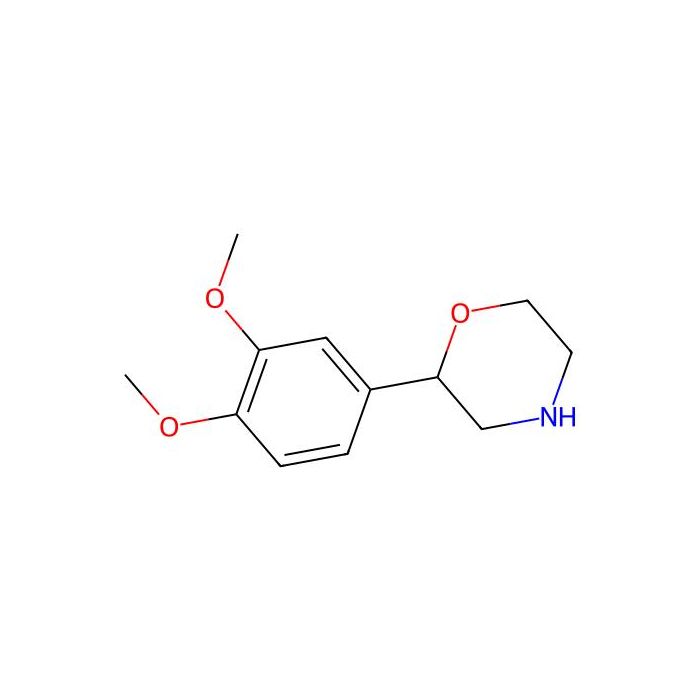
This compound belongs to the class of organic compounds known as phenylmorpholines. These are aromatic compounds containing a morpholine ring and a benzene ring linked to each other through a CC or a CN bond.
External Descriptors
Not available
1. Djoumbou Feunang Y, Eisner R, Knox C, Chepelev L, Hastings J, Owen G, Fahy E, Steinbeck C, Subramanian S, Bolton E, Greiner R, and Wishart DS. ClassyFire: Automated Chemical Classification With A Comprehensive, Computable Taxonomy. Journal of Cheminformatics, 2016, 8:61.
Certificati (CoA, COO, BSE/TSE e tabella di analisi)
C of A & Other Certificates(BSE/TSE, COO):
Analytical Chart:
Proprietà chimiche e fisiche
Peso molecolare
223.270 g/mol
XLogP3
0.900
Hydrogen Bond Donor Count
1
Hydrogen Bond Acceptor Count
4
Rotatable Bond Count
3
Exact Mass
223.121 Da
Monoisotopic Mass
223.121 Da
Topological Polar Surface Area
39.700 Ų
Heavy Atom Count
16
Formal Charge
0
Complexity
212.000
Isotope Atom Count
0
Defined Atom Stereocenter Count
0
Undefined Atom Stereocenter Count
1
Defined Bond Stereocenter Count
0
Undefined Bond Stereocenter Count
0
The total count of all stereochemical bonds
0
Covalently-Bonded Unit Count
1
Calcolatori di soluzioni
Molarity Calculator
Determine the necessary mass, volume, or concentration for preparing a solution.
Dilution Calculator
Determine the dilution needed to prepare a stock solution.
Reconstitution Calculator
Recensioni
Recensioni dei clienti
Application Protocols
Not applicable. No validated biological assay protocols (e.g., WB, IHC, IF, FC) are associated with this small-molecule reagent. For synthetic applications, see the Reaction Conditions and Synthetic Utility sections.
Biological Roles
Item-specific biological data: Not specified for this item; for research use only.
General context (biochemistry/chemical biology)
The morpholine ring is a common motif in chemical biology probes and small-molecule libraries, contributing a balanced combination of basicity and polarity for target engagement and cellular permeability.
3,4-Dimethoxyphenyl (veratrole-like) fragments appear in natural products and synthetic ligands; after O-demethylation to catechols, such scaffolds can chelate metals or participate in redox chemistry.
As a standalone small molecule, 2-aryl morpholines can act as ligands in screening campaigns or as intermediates en route to more complex bioactive analogs via N-acylation/alkylation or aromatic functionalization.
Protonation of the secondary amine (physiological pH-dependent) enables salt formation and improved aqueous handling for in vitro assays.
No claims are made regarding therapeutic activity, efficacy, or clinical utility. This product is for research use only.
Buffer Applications
This compound is not a dedicated buffering agent. While the morpholine nitrogen is weakly basic (conjugate acid pKa for morpholine derivatives typically ~8.3–8.7, literature), 2-(3,4-dimethoxyphenyl)morpholine is not used as a standard buffer. For buffering in the pH 6–8.5 range, consider Good’s buffers (e.g., MOPS, MES) or phosphate/HEPES systems. Use this product primarily as a synthetic/building-block reagent rather than as a buffer component.
Green Alternatives
Greener processing considerations (general)
Solvent choice has the largest environmental footprint. Prefer bio-derived or safer solvents when compatible with reactivity and purity requirements.
Example comparisons (literature guidance; choose case-by-case)
DCM/chloroform → ethyl acetate, methyl tert-butyl ether (MTBE), or cyclopentyl methyl ether (CPME) for extractions and chromatography, when separation performance remains acceptable.
THF → 2-methyltetrahydrofuran (2-MeTHF) from renewable sources for many amine acylations/alkylations.
DMF/NMP → acetonitrile, propylene carbonate, or dimethyl carbonate where feasible to reduce reproductive toxicity concerns.
Processing tips
Form the hydrochloride or mesylate salt to crystallize from greener alcohol/ester solvents, reducing reliance on chlorinated solvents.
Employ micellar catalysis (aqueous surfactant systems) for certain N-acylations or SNAr steps to cut organic solvent use.
Consider continuous flow for exothermic O-demethylations to improve heat transfer and reduce solvent volumes.
Trade-offs: Greener solvents may alter solubility, rates, or selectivity. Validate on small scale and monitor impurity profiles before scale-up.
Pharmaceutical Uses
Item-specific pharmacopeial status/excipient role: Not specified for this item; refer to CoA/Spec Sheet.
General formulation/process context (no therapeutic claims)
Aryl morpholines serve as intermediates in API discovery and process development. The secondary amine allows salt selection studies (e.g., HCl, mesylate, citrate) to tune crystallinity and handling of advanced intermediates.
The 3,4-dimethoxy motif can be transformed to catechols or further derivatized to tune solubility and stability, facilitating SAR campaigns.
As an excipient: not typical. This scaffold is primarily a research/intermediate building block rather than a formulated excipient.
Any use in manufacturing or clinical contexts requires independent qualification and compliance with applicable regulations; this product is supplied strictly for research use only.
Physical Properties
Item-specific specifications: Not specified for this item; refer to CoA/Spec Sheet.
Literature/typical values for closely related compounds (reference only; not product specifications)
Molecular weight: ~223.27 g/mol (for C12H17NO3)
Expected physical state: organic solid or high-boiling liquid depending on purity/form; many arylmorpholines are low-melting solids.
Lipophilicity: dimethoxy substitution increases polarity relative to unsubstituted diphenyls; estimated clogP in the 1–2.5 range (literature estimation for arylmorpholine anisoles).
Solubility profile (qualitative, literature): good solubility in polar organic solvents (DMSO, DMF, MeOH, EtOH, CH3CN, CHCl3); limited solubility in water as free base but readily soluble in dilute acids as the ammonium salt.
UV characteristics: anisole chromophore typically shows absorption in near-UV (ca. 200–290 nm) due to π→π* transitions; exact cutoff Not specified for this item; refer to CoA/Spec Sheet.
Boiling/melting point, density, refractive index: Not specified for this item; refer to CoA/Spec Sheet.
Notes: All numerical values above are literature expectations for the chemical class and must not be used as product specifications. Consult the CoA/SDS for lot-specific data.
Quality and Grades
Item-specific grade/purity: Not specified for this item; refer to CoA/Spec Sheet.
Interpreting common grades (general guidance)
Research grade: suitable for discovery chemistry, method development, and general synthesis.
95–98% purity (if specified on CoA): typical for small-molecule building blocks; confirm by NMR/GC/LC.
HPLC grade (solvents) or LC/MS grade (analytes): refers to low non-volatile residue and low UV background; not directly applicable unless specified.
Stabilizers/inhibitors: None indicated for this item. If present in a specific lot, stabilizer identity and implications will be listed on the CoA/SDS.
QC considerations for arylmorpholines (general):
Identity confirmation: 1H/13C NMR (anisole OCH3 singlets; morpholine –O–CH2– and –N–CH2– multiplets), HRMS, and IR (C–O stretch ~1240–1270 cm−1; C–N stretches).
Purity assessment: HPLC/GC for organic impurities; residual solvents per ICH where applicable.
Water/peroxide/metal content: Not specified for this item; refer to CoA/Spec Sheet.
Reaction and Applications
Typical research uses (general, for arylmorpholine anisoles)
Building block in medicinal and materials chemistry where the morpholine motif modulates basicity, solubility, and H-bonding.
Precursor to catechol-containing analogs via selective O-demethylation, enabling further diversification (e.g., O-acylation, O-alkylation, metal chelation motifs).
Can be quaternized or acylated at the morpholine nitrogen to tune physicochemical properties or introduce handles for coupling.
Representative transformations (literature)
O-demethylation (BBr3, AlCl3/thiols, or HBr) to 3,4-dihydroxyphenyl derivatives.
N-acylation (acid chloride/anhydride, base) to amides; N-alkylation (alkyl halide, base) to tertiary amines.
Electrophilic aromatic substitution on the anisole ring (e.g., bromination/nitration) is directed/activated by methoxy groups; positions ortho/para to methoxy are most reactive.
Oxidation to N-oxide (mCPBA) as a synthetic intermediate; subsequent Cope elimination strategies possible in suitable systems.
Practical tips
Control acid strength and temperature during O-demethylation to avoid N-dealkylation or ring opening.
Use non-nucleophilic bases (DIPEA, Hunig’s base) for acylations to minimize side reactions.
For chromatographic purification, add 0.1–1% TEA to eluents to reduce amine tailing.
Note: No manufacturer-specific application notes were provided for this item; content above is general guidance.
Reaction Conditions
General literature guidance (not item-specific specifications; adjust to your substrate and scale):
O-Demethylation of 3,4-dimethoxy aryl units
Reagents: BBr3 (1–3 equiv per OMe) in DCM, −78 to 0 °C addition, then 0–25 °C for 2–16 h; quench cautiously with MeOH/H2O. Alternative: AlCl3/thiol or concentrated HBr at reflux.
Notes: Shield the morpholine nitrogen (e.g., as an amide or salt) to minimize N-dealkylation; avoid prolonged high temperatures.
N-Acylation
Conditions: acid chloride (1.1–1.5 equiv), base (DIPEA or TEA, 2–3 equiv), DCM or MeCN, 0–25 °C, 1–6 h. Carbodiimide couplings (EDC/HOBt or HATU) effective in DMF/MeCN.
Notes: Monitor by TLC/HPLC; add catalytic DMAP for sluggish acylations.
N-Alkylation
Conditions: alkyl bromide/iodide (1.2–2.0 equiv), K2CO3 or Cs2CO3, MeCN/acetone/DMF, 25–60 °C, 2–18 h. For reductive amination, use NaBH(OAc)3 in DCE/MeOH with aldehydes.
Electrophilic aromatic substitution (on anisole ring)
Bromination: NBS or Br2 (cat. FeBr3), DCM/AcOH, 0–25 °C. Nitration: HNO3/Ac2O at low temperature for controlled mono-nitration.
Oxidation to N-oxide
mCPBA (1.1–1.5 equiv) in DCM, 0–25 °C, 1–4 h; monitor to avoid over-oxidation.
Expected yields vary widely (40–90%) depending on substitution and protection; optimize stoichiometry, temperature, and order of addition. Employ inert atmosphere and anhydrous solvents where moisture-sensitive reagents are used.
Safety and Handling
Item-specific hazard data (GHS, pictograms, H-statements): Not specified for this item; refer to SDS.
General safety considerations for arylmorpholines (literature/good practice)
Likely hazards: may cause skin/eye irritation and respiratory irritation; amines can be harmful if swallowed. Avoid dust/aerosol formation.
Personal protective equipment (PPE): lab coat, safety glasses or face shield, and suitable chemical-resistant gloves (e.g., nitrile). Work in a fume hood to control vapors and dust.
First aid (general):
Inhalation: move to fresh air; seek medical attention if symptoms persist.
Skin contact: wash with soap and water; remove contaminated clothing.
Eye contact: rinse cautiously with water for several minutes; remove contact lenses if present and easy to do; seek medical advice if irritation continues.
Ingestion: rinse mouth; do not induce vomiting; seek medical attention.
Incompatibilities: strong oxidizers; strong acids/bases may lead to salt formation or degradation. Avoid reactive acylating/alkylating agents unless controlled synthetically.
Handling tips: keep container tightly closed; avoid prolonged exposure to air and light that may promote oxidative discoloration of anisole moieties. If preparing solutions, use anhydrous solvents when moisture-sensitive reactions are intended.
Waste: dispose according to local regulations for organic amines/ethers; collect halogen-free organic waste separately.
Always consult the product SDS for authoritative, item-specific safety information.
Solvent Selection
Polarity and miscibility (general for this compound class)
The molecule is moderately polar (secondary amine + two methoxy groups) and typically dissolves well in polar aprotic and protic organic solvents: DMSO, DMF, MeOH, EtOH, acetonitrile, acetone, ethyl acetate, dichloromethane, and chloroform. Limited solubility in nonpolar hydrocarbons; forms soluble salts in aqueous acidic media.
Choosing solvents by application
NMR: CDCl3 or DMSO-d6 commonly provide well-resolved spectra; acidic impurities may broaden the NH signal.
Preparative work: Ethyl acetate/hexanes or DCM/MeOH gradients often separate arylmorpholine impurities; add a drop of triethylamine to suppress tailing on silica when the amine interacts.
Reaction media: For acylation/alkylation at nitrogen, use anhydrous DCM, THF, MeCN, or DMF; for O-demethylation of anisoles, DCM or toluene under Lewis acid conditions.
Comparison to alternatives (general)
Versus highly polar bases (e.g., piperazine derivatives), arylmorpholines are less basic and more lipophilic, aiding solubility in moderately polar organics while still enabling salt formation for aqueous handling.
Notes: Solubility and behavior can vary by lot and counterion; item-specific solubility is Not specified for this item; refer to CoA/Spec Sheet.
Storage and Reconstitution
Item-specific storage: Room temperature (per Product Data). Shipments: Not specified for this item; refer to CoA/Spec Sheet.
General storage guidance for small organic amines/anisoles
Keep tightly closed in the original container. Store in a dry, well-ventilated place away from strong oxidizers and strong acids/bases.
Protect from excessive heat and direct sunlight to minimize oxidative discoloration.
If long-term storage is planned, consider desiccation and inert gas blanket after opening.
Solution preparation (general)
Prepare stock solutions in dry DMSO, DMF, MeOH, or acetonitrile as appropriate for your application. Typical lab stocks: 10–100 mM in DMSO for screening; filter (0.22 µm) if needed.
For aqueous work, form a soluble salt by adding a stoichiometric acid (e.g., HCl) and dissolve in water or buffer; verify pH and stability before use.
Stability: Item-specific stability and shelf-life are Not specified for this item; refer to CoA/Spec Sheet.
Research use note: For research use only; not for human or veterinary use.
Structure and Identity
Item-specific (from Product Data)
CAS: 100370-59-0
InChIKey: 50649 (as provided)
Storage conditions: Room temperature
Literature/Computed identifiers and features (non-specification; for reference)
Preferred name: 2-(3,4-Dimethoxyphenyl)morpholine
Molecular formula (literature): C12H17NO3
Molecular weight (literature): ~223.27 g/mol
Canonical SMILES (literature): not specified for this item; refer to CoA/Spec Sheet.
Structural features: An anisole-type aromatic ring bearing ortho-dimethoxy substitution (3,4-dimethoxy) attached to the C2 position of a morpholine ring. The morpholine retains a secondary amine (–NH–) within a six-membered heterocycle containing one oxygen.
Stereochemistry: Substitution at C2 of morpholine renders that ring carbon a stereogenic center; typical commercial material is racemic unless otherwise stated (no stereochemical specification provided for this item).
2D description in words: A benzene ring with methoxy groups at the 3- and 4-positions, bonded via the 1-position to the carbon adjacent to nitrogen in a morpholine ring (–O–CH2–CH2–NH–CH(Ar)–CH2–).
Synthetic Utility
Functional groups and reactivity
Secondary amine within morpholine: amenable to N-acylation (amide formation), N-alkylation (tertiary amine/salt formation), and oxidation to N-oxide.
Aromatic ring with 3,4-dimethoxy substitution: activated toward electrophilic aromatic substitution; methoxy groups are handles for O-demethylation to catechols.
Ether linkages (anisoles): can be cleaved (BBr3, BCl3, HBr) to reveal phenols for downstream diversification (etherification, esterification, sulfonation).
Retrosynthetic value
Disconnection to 3,4-dimethoxybenzaldehyde/halide precursors and a 2-substituted morpholine synthon (e.g., via nucleophilic substitution or addition to iminium intermediates).
Enables late-stage functionalization: N-protection/deprotection strategies allow orthogonal chemistry on the aromatic ring without interfering with the amine.
Representative downstream transformations
Formation of amide-linked conjugates (coupling to acids/activated esters).
Quaternary ammonium salts for phase-transfer or property modulation.
Suzuki/Heck-type diversification after prior halogenation/nitration of the anisole ring.
Notes: Choose protecting groups compatible with Lewis acids if planning O-demethylation (e.g., Boc may not survive strong Lewis acids; consider sulfonamides or perform sequence accordingly).
Target Specificity
Not applicable. This product is a small-molecule chemical reagent/building block and is not an antibody, enzyme, or biological targeting reagent. No antigen/epitope or species reactivity information applies.
We use cookies to ensure the website functions properly and, where permitted, to improve your experience. You can manage your preferences at any time in Settings. Learn more in our Cookie Policy.
Shall we send you a message when we have discounts available?
Remind me later
Thank you! Please check your email inbox to confirm.
Products are supplied to verified businesses, institutions, and qualified professionals for research and development use only. Not for use in humans, animals, diagnosis, or therapy.