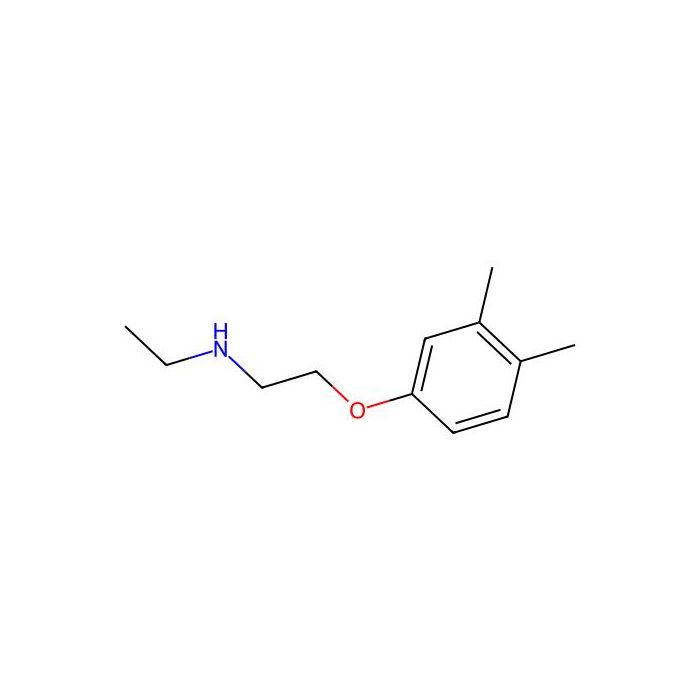
This compound belongs to the class of organic compounds known as phenol ethers. These are aromatic compounds containing an ether group substituted with a benzene ring.
External Descriptors
Not available
1. Djoumbou Feunang Y, Eisner R, Knox C, Chepelev L, Hastings J, Owen G, Fahy E, Steinbeck C, Subramanian S, Bolton E, Greiner R, and Wishart DS. ClassyFire: Automated Chemical Classification With A Comprehensive, Computable Taxonomy. Journal of Cheminformatics, 2016, 8:61.
Certificati (CoA, COO, BSE/TSE e tabella di analisi)
C of A & Other Certificates(BSE/TSE, COO):
Analytical Chart:
Proprietà chimiche e fisiche
Peso molecolare
193.280 g/mol
XLogP3
2.600
Hydrogen Bond Donor Count
1
Hydrogen Bond Acceptor Count
2
Rotatable Bond Count
5
Exact Mass
193.147 Da
Monoisotopic Mass
193.147 Da
Topological Polar Surface Area
21.300 Ų
Heavy Atom Count
14
Formal Charge
0
Complexity
149.000
Isotope Atom Count
0
Defined Atom Stereocenter Count
0
Undefined Atom Stereocenter Count
0
Defined Bond Stereocenter Count
0
Undefined Bond Stereocenter Count
0
The total count of all stereochemical bonds
0
Covalently-Bonded Unit Count
1
Calcolatori di soluzioni
Molarity Calculator
Determine the necessary mass, volume, or concentration for preparing a solution.
Dilution Calculator
Determine the dilution needed to prepare a stock solution.
Reconstitution Calculator
Recensioni
Recensioni dei clienti
Application Protocols
No application protocols are specified for this item. As a small-molecule building block, usage protocols depend on the intended synthetic or analytical procedure.
General guidance (literature)
Preparation of amide derivatives: dissolve the amine in anhydrous DCM, add base (e.g., DIPEA), cool to 0 °C, and add acyl chloride dropwise. Stir at 0–25 °C until completion (TLC/LC–MS), then quench with aqueous NaHCO3, extract, dry, and purify.
Formation of HCl salt for handling: dissolve the free base in Et2O, add 2 M HCl in Et2O dropwise until precipitation ceases, cool, filter, wash with cold ether, and dry under vacuum.
Please consult primary literature or your internal SOPs for step-by-step methods tailored to your application.
Biological Roles
Item-specific biological/biochemical roles: Not specified for this item; no assigned biological function. For research use only.
General context (literature; not a medical claim)
Aryl-oxy-alkylamines are common motifs in chemical biology probes and small-molecule libraries due to their tunable basicity and lipophilicity, enabling interactions with diverse protein binding sites.
The secondary amine can be protonated near physiological pH, influencing membrane permeability and enabling salt formation for aqueous work. Ether-linked aryl heads often engage in π–π and cation–π interactions while the amine provides H-bonding capability.
3,4-Dimethyl substitution increases hydrophobic surface area and can modulate microsomal stability and binding by reducing metabolic oxidation at benzylic positions compared to unsubstituted analogs (general SAR observation).
Use in life science research
Serves as a versatile intermediate to assemble amide, urea, or sulfonamide derivatives used in target identification campaigns, probe development, and structure–activity relationship studies.
Note: This product is provided strictly for non-clinical, laboratory research use. No biological activity is implied or claimed for this specific item without supporting assay data.
Buffer Applications
This compound is not a conventional buffering reagent and is not typically used to prepare standardized laboratory buffers.
General notes (literature)
Secondary amines can exhibit conjugate acid pKa values around 9–10.5; however, bespoke small-molecule amines are rarely used as buffers due to limited water solubility of the free base and lack of standardized buffering capacity data.
If needed for specialized applications, buffering behavior would be achieved via its protonated salt in the alkaline range; such use should be experimentally validated (titration curve, ionic strength) and is not recommended as a routine approach.
Recommendation
For reliable buffering in biological or analytical contexts, use established systems (e.g., TRIS, HEPES, phosphate, borate) with well-characterized pKa and compatibility profiles.
Green Alternatives
While the product itself is a building block (not replaceable as a solvent), several greener choices can be made for its synthesis, handling, and purification.
Greener solvent choices (literature guidance)
Replace DCM/CHCl3 with EtOAc, 2-MeTHF, CPME, or toluene where reaction compatibility permits (e.g., acylations, sulfonylations).
Favor alcohols (EtOH, i-PrOH) or water/EtOH mixtures for crystallizations of amine salts instead of acetone or chlorinated media.
For SN2 N-alkylations, use MeCN or green carbonate bases (K2CO3) in 2-MeTHF/MeCN instead of DMF.
Reagent/method substitutions
Reductive amination: employ catalytic hydrogenation (H2/Pd or H2/Raney Ni in EtOH) or NaBH(OAc)3 in AcOH/EtOAc instead of NaBH3CN in MeOH to lower cyanide risk.
Couplings to carboxylic acids: use green coupling agents (e.g., CDI in EtOAc or ethyl acetate-based T3P) in place of carbodiimides in DMF/DCM.
Workup: leverage pH-switch extraction to minimize solvent volume; consider in-line salt-switch crystallizations to avoid chromatography.
Trade-offs
2-MeTHF/CPME improve EHS profile and facilitate phase separations but can alter reaction rates/solubilities; minor temperature/base adjustments may be needed.
Avoiding DMF/NMP reduces reproductive toxicity concerns but may require longer reaction times or higher temperatures to achieve full conversion.
Pharmaceutical Uses
No pharmacopeial excipient role or formulation status is specified for this item.
General, non-clinical context (literature)
Aryl-alkyl secondary amines like 2-(3,4-dimethylphenoxy)-N-ethylethanamine are frequently employed as intermediates in medicinal chemistry campaigns. They can be elaborated into amide, sulfonamide, urea, or quaternary ammonium derivatives for screening.
Salt selection studies: forming mineral-acid salts (HCl, HBr, mesylate) can improve crystallinity and help define solid-state properties (hygroscopicity, melting point), which is valuable in preformulation research.
Physicochemical tuning: 3,4-dimethyl substitution raises lipophilicity; derivatization at nitrogen allows fine control of pKa/logD to meet target property ranges.
Compliance note
This product is supplied for research use only. It is not intended for human or veterinary use, nor for use in diagnostic procedures or as a drug substance/excipient.
Physical Properties
Item-specific specifications
Appearance: Not specified for this item; refer to CoA/Spec Sheet.
Grade/Purity: Not specified for this item; refer to CoA/Spec Sheet.
Molecular weight (spec): Not specified for this item; refer to CoA/Spec Sheet.
Literature/general expectations for this scaffold (not item specifications)
State at ambient conditions: commonly a colorless to pale yellow oil for free-base aryl-alkyl secondary amines; corresponding mineral-acid salts often crystalline solids.
Basicity: secondary amine with conjugate acid pKa typically ~9–10.5 (literature, secondary aliphatic/arylethylamines).
Solubility: free base is generally miscible with many polar organic solvents (alcohols, ketones, ethers, chlorinated solvents) and has limited water solubility; protonated salts are readily water-soluble.
Volatility: low to moderate; boiling points for related phenoxyethyl secondary amines are commonly above 200 °C at 1 atm (literature trend).
LogP: aryl-dimethyl substitution increases lipophilicity; analogous aryl-alkylamines often exhibit cLogP in the 2–3.5 range (literature trend).
Practical handling notes (general)
Viscosity and hygroscopicity: secondary amines can absorb CO2/H2O; minimize headspace and keep container tightly closed.
Spectroscopic characterization: secondary amine N–H stretch (IR ~3300–3400 cm⁻¹), aromatic stretches (IR ~1600 cm⁻¹), ether C–O (IR ~1200–1250 cm⁻¹); in 1H NMR, expect benzylic/alkoxy methylenes ~3.9–4.2 ppm (O–CH2), ~2.6–3.1 ppm (CH2–N), N–ethyl ~1.0–1.2 ppm (t) and ~2.5–3.0 ppm (q), and aromatic methyl singlets ~2.2–2.3 ppm. Values are typical literature ranges.
Quality and Grades
Item-specific information
Grade/Purity: Not specified for this item; refer to CoA/Spec Sheet.
Stabilizers/Inhibitors: Not specified for this item; refer to CoA/Spec Sheet.
Guidance on quality considerations for this compound class (general)
Amine content and identity: verify by 1H/13C NMR, HRMS/ESI, and IR. Secondary amine can be confirmed by N–H signal and derivative formation (e.g., acylation test).
Residual solvents and volatiles: assess by GC; low levels of chlorinated or polar aprotic solvents are desirable for sensitive applications.
Acid/base titration: assay of amine functionality by nonaqueous titration can complement chromatographic purity.
Salt form vs free base: specify clearly; salts (e.g., HCl) can improve handling, crystallinity, and assay accuracy. Free bases may show variable assay due to CO2/H2O uptake.
UV profile (for HPLC monitoring): aryl core affords strong absorbance near 210 and 254 nm; HPLC-grade solvents and low baseline noise help for quantitative analysis.
Metals and inorganic residues: typically low for small-molecule organics; if catalytic steps (Pd, Ni, Cu) are used in synthesis, confirm residual metals if application demands.
Documentation
For reportable specifications (purity %, water, residual solvents, stabilizers), and chromatographic methods, please refer to the item-specific CoA/Specification Sheet.
Reaction and Applications
Chemotype utility
Nucleophilic secondary amine: robust handle for derivatization to amides, sulfonamides, ureas/carbamates, isothioureas, and tertiary amines or quaternary ammonium salts.
Aryl ether with 3,4-dimethyl substitution: the anisidine-like activation pattern directs electrophilic substitution ortho/para to the oxygen; sterics from the 3,4-Me groups bias site selectivity.
Representative reaction families (literature)
Acylation and sulfonylation: with acid chlorides/anhydrides or sulfonyl chlorides (base: TEA, DIPEA; solvents: DCM, THF). Produces amide/sulfonamide libraries.
Carbamate/urea formation: reaction with chloroformates to carbamates; with isocyanates to ureas.
Reductive amination/N-alkylation: convert to tertiary amines using aldehydes/ketones plus NaBH3CN or catalytic hydrogenation; or direct SN2 alkylation with alkyl halides/carbonates.
Quaternization: alkyl iodides/triflates yield stable ammonium salts for phase-transfer or materials applications.
Salt formation: mineral acids (HCl, HBr, H2SO4) provide crystalline salts useful for isolation and formulation studies.
Application domains (non-clinical)
Lead optimization/intermediate: aryl-oxy-alkylamine motif appears across agrochemical and materials research; this substituted variant serves as a lipophilic, basic fragment for SAR exploration.
Linker chemistry: ether–ethylene–amine spacer offers conformational flexibility for attaching aryl heads to polar tails via amide/sulfonamide couplings.
Practical tips
Keep as free base dry and under inert headspace to minimize CO2 uptake. For multistep sequences, isolating as the HCl salt can simplify handling and assay.
During chromatographic purification, precondition silica with 1–2% TEA to prevent tailing of basic products.
Reaction Conditions
General conditions for common transformations of secondary aryl-alkylamines (literature; illustrative, not item specifications)
Acylation to amides
Reagents: acid chloride (1.0–1.2 eq) or EDCI/HOBt or T3P with carboxylic acid.
Reductant: NaBH3CN (MeOH, pH 5–6) or NaBH(OAc)3 (DCE/AcOH) or H2/Pd (EtOH).
Temperature/time: rt to 50 °C, 2–16 h.
SN2 N-alkylation / quaternization
Electrophiles: alkyl halides or carbonates (1.1–1.5 eq; for quats 2–3 eq).
Base/solvent: K2CO3/MeCN or Cs2CO3/acetone; heat 40–80 °C.
Time: 4–24 h.
Salt formation (e.g., HCl salt)
Reagent: HCl in dioxane or Et2O, or gaseous HCl.
Solvent: Et2O/MTBE to precipitate salt; wash with ether.
Temperature: 0–25 °C.
Notes
Pre-dry solvents and reagents; amines can retain moisture/CO2.
For chromatography of basic products, include 0.1–1% TEA in eluent to reduce tailing.
Monitor reactions by LC–MS at 210/254 nm; the aryl ether provides strong UV response.
Safety and Handling
Item-specific hazard information
GHS Classification: Not specified for this item; refer to SDS.
Signal Word: Not specified for this item; refer to SDS.
Hazard Statements (H-Statements): Not specified for this item; refer to SDS.
Pictograms: Not specified for this item; refer to SDS.
General safety guidance for secondary amines and aryl ethers (literature/good practice)
Likely hazards: can cause skin/eye irritation; vapors may be irritating. Secondary amines are bases and may be corrosive to mucous membranes.
PPE: lab coat, safety glasses or face shield, and appropriate chemically resistant gloves (e.g., nitrile). Use in a chemical fume hood to control vapors.
Incompatibilities: strong oxidizers; acylating/alkylating agents (vigorous reactions); nitrosating agents (risk of N-nitrosamine formation; strictly avoid nitrite in acidic media). Forms salts with strong acids.
First aid (overview): move to fresh air if inhaled; rinse skin with soap/water upon contact; flush eyes with water for ≥15 min; seek medical attention if symptoms persist. If ingested, rinse mouth; do not induce vomiting; obtain medical attention.
Spills: absorb with inert material (vermiculite), collect in compatible container. Neutralize residues cautiously if appropriate; avoid release to drains.
Fire response: use dry chemical, CO2, or alcohol-resistant foam. Combustion may release NOx/COx. Containers may build pressure when heated.
Always consult the product-specific SDS for authoritative hazard and response information.
Solvent Selection
This product is a small-molecule building block, not a chromatography-grade solvent. Solvent selection guidance below focuses on dissolution, manipulation, and reaction use.
General solubility and polarity considerations (literature)
Polarity: moderately lipophilic aryl ether with a basic center; neutral free base behaves as a polar, H-bond-accepting donor; its conjugate acid is cationic and water-soluble.
Likely miscibility: soluble in alcohols (MeOH, EtOH, i-PrOH), ethers (THF, MTBE), esters (EtOAc), ketones (MEK, acetone), chlorinated solvents (DCM, chloroform), and aromatic solvents (toluene). Limited solubility in water as free base; water miscible upon protonation (e.g., HCl salt).
Practical choices by task
Synthetic transformations: use polar aprotic solvents (MeCN, DMF, DMSO) for N-alkylation or coupling; non-protic media (DCM, THF, toluene) for acylation/sulfonylation with a base scavenger (TEA, DIPEA).
Workup/extraction: adjust pH to partition. Extract free base into organic; extract protonated amine into aqueous acid and back-extract after basification.
Purification: salts often crystallize from alcohol/ether mixtures; free base can be purified by flash chromatography (silica deactivated with 1–2% TEA) using hexanes/EtOAc or DCM/MeOH gradients.
Comparison notes
Versus more hydrophilic amines, this aryl-alkylamine may require more polar eluents for chromatography but offers better organic solubility.
If odor or volatility are concerns, select higher-boiling solvents (EtOAc, 2-MeTHF) and work in a fume hood.
Storage and Reconstitution
Item-specific storage and shipping
Storage Conditions: Room temperature (from Product Data).
Shipped In: Not specified for this item; refer to CoA/Spec Sheet.
General handling recommendations (small-molecule secondary amine)
Container: store in tightly closed, chemically compatible glass with PTFE-lined cap; minimize headspace to limit CO2/H2O uptake.
Atmosphere: store under dry air or inert gas where feasible; include desiccant in secondary packaging.
Light: protect from excessive light; use amber bottles for prolonged storage.
Stability: secondary amines are generally stable at ambient temperature; avoid prolonged exposure to strong acids/bases and oxidizers.
Reconstitution/Preparation for use
If supplied as free base oil/solid: dissolve in dry organic solvent appropriate to the application (e.g., DCM, THF, MeCN, EtOAc, alcohols). For aqueous work, prepare a protonated salt by adding a stoichiometric mineral acid, then dilute with water or buffer.
If supplied as an acid salt: adjust pH with base (e.g., NaHCO3 or triethylamine) and extract into organic solvent to obtain the free base if needed.
Note: For definitive shelf-life, impurity limits, and any stabilizers, please consult the product’s CoA/Specification Sheet and SDS. Research use only.
Structure and Identity
Brief description: 2-(3,4-Dimethylphenoxy)-N-ethylethanamine is a phenoxyethyl secondary amine bearing a 3,4-dimethyl-substituted phenyl ether and an N-ethyl substituent. The scaffold is typical of aryl-oxy-alkylamines used as synthetic intermediates.
Item-specific (from Product Data)
CAS: 915921-62-9
PubChem CID: 28065602
InChIKey: 418550 (as provided)
SMILES: Not specified for this item; refer to CoA/Spec Sheet.
Molecular formula: Not specified for this item; refer to CoA/Spec Sheet.
Molecular weight: Not specified for this item; refer to CoA/Spec Sheet.
Computed/literature identifiers and features (for reference; not item specifications)
Approximate molecular formula (computed from name): C12H19NO (literature)
Key functional groups: secondary amine (–NH–), aryl ether (Ar–O–), two ring methyl substituents (3,4-dimethyl)
Structural features: a benzene ring para/meta-disubstituted with methyl groups, connected via an ether oxygen to a –CH2–CH2–N(H)–CH2CH3 chain. No defined stereocenters; expected as a single constitutional isomer.
General structural notes
The phenoxy oxygen is strongly activating/ortho–para directing on the ring; the 3,4-dimethyl pattern increases lipophilicity and steric bulk around the aryl face.
The secondary amine provides a basic site that can be protonated to form crystalline salts (e.g., HCl), often advantageous for purification/handling.
Aryl ether (Ar–O–CH2–): stable under many conditions; the benzylic O–CH2– linkage tolerates bases and mild nucleophiles; cleaves only under forcing conditions (e.g., strong Lewis acids).
3,4-Dimethyl aryl core: modestly activating; directs electrophilic substitution ortho/para to oxygen, with steric bias from methyls.
Retrosynthesis and derivatization (literature strategies)
Disconnection to 3,4-dimethylphenol + 2-haloethylamine derivative (protected) via Williamson ether synthesis; subsequent deprotection and N-ethylation (alkyl halide or reductive amination).
Alternatively, start from phenoxyethylamine followed by selective N-ethylation to deliver the secondary amine (control to avoid tertiary amine formation with stoichiometry/base choice).
Use cases in synthesis
Scaffold for amide/urea library generation against acid/chloroformate panels.
Handle for tethering aryl heads to polar fragments via short spacers.
Precursor to cationic surfactant-like quaternary ammonium salts for phase-transfer or materials exploration.
Practical considerations
To minimize over-alkylation, employ weakly basic conditions (K2CO3) and anhydrous polar aprotic solvents with controlled equivalents of alkylating agents.
For difficult acylations, activate acids with CDI or T3P to avoid HCl generation and side reactions.
Target Specificity
Not applicable. This product is a small-molecule chemical reagent and is not an antibody, enzyme, or biological macromolecule with defined target specificity. No target or epitope information is provided for this item.
We use cookies to ensure the website functions properly and, where permitted, to improve your experience. You can manage your preferences at any time in Settings. Learn more in our Cookie Policy.
Shall we send you a message when we have discounts available?
Remind me later
Thank you! Please check your email inbox to confirm.
Products are supplied to verified businesses, institutions, and qualified professionals for research and development use only. Not for use in humans, animals, diagnosis, or therapy.