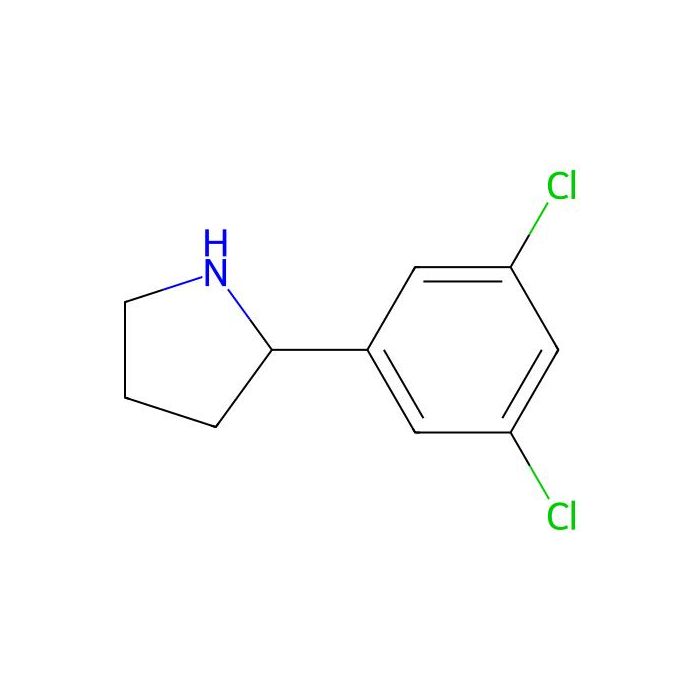
This compound belongs to the class of organic compounds known as phenylpyrrolidines. These are polycyclic aromatic compounds containing a benzene ring linked to a pyrrolidine ring through a CC or CN bond. Pyrrolidine is a five-membered saturated aliphatic heterocycle with one nitrogen atom and four carbon atoms.
External Descriptors
Not available
1. Djoumbou Feunang Y, Eisner R, Knox C, Chepelev L, Hastings J, Owen G, Fahy E, Steinbeck C, Subramanian S, Bolton E, Greiner R, and Wishart DS. ClassyFire: Automated Chemical Classification With A Comprehensive, Computable Taxonomy. Journal of Cheminformatics, 2016, 8:61.
Certificati (CoA, COO, BSE/TSE e tabella di analisi)
C of A & Other Certificates(BSE/TSE, COO):
Analytical Chart:
Proprietà chimiche e fisiche
Peso molecolare
216.100 g/mol
XLogP3
3.100
Hydrogen Bond Donor Count
1
Hydrogen Bond Acceptor Count
1
Rotatable Bond Count
1
Exact Mass
215.027 Da
Monoisotopic Mass
215.027 Da
Topological Polar Surface Area
12.000 Ų
Heavy Atom Count
13
Formal Charge
0
Complexity
164.000
Isotope Atom Count
0
Defined Atom Stereocenter Count
0
Undefined Atom Stereocenter Count
1
Defined Bond Stereocenter Count
0
Undefined Bond Stereocenter Count
0
The total count of all stereochemical bonds
0
Covalently-Bonded Unit Count
1
Calcolatori di soluzioni
Molarity Calculator
Determine the necessary mass, volume, or concentration for preparing a solution.
Dilution Calculator
Determine the dilution needed to prepare a stock solution.
Reconstitution Calculator
Recensioni
Recensioni dei clienti
Application Protocols
Not applicable as an assay reagent in the sense of antibody/protein kits. There are no WB/IHC/IF/FC protocols specific to this small molecule.
Practical laboratory usage notes (general):
For stock solutions, prepare in dry DMSO, DMF, or acetonitrile at convenient concentrations (e.g., 10–100 mM) and store aliquots tightly sealed to minimize moisture/CO2 uptake; verify stability for your use-case.
For chromatography, use base-doped eluents (0.1–1% Et3N) or ion-exchange purification to minimize tailing. Verify identity/purity by NMR and LC–MS before downstream steps.
Biological Roles
Item-specific biological roles: Not established for this catalog item; for research use only.
General context (literature/chemical biology):
2-Aryl pyrrolidines are common motifs in small-molecule libraries and can engage in cation–π and hydrogen-bonding interactions due to the protonatable amine. However, this is a general chemical observation and does not imply any biological activity for this specific compound.
As a secondary amine, it can be converted to water-soluble salts for biochemical assays, but no endogenous role or metabolic function is associated with this synthetic scaffold.
Metabolism considerations (generic): secondary amines may undergo N-dealkylation, N-oxidation, and aromatic ring halide retention under oxidative metabolism in vitro; these notes are provided solely to inform design of chemical probes and do not constitute pharmacological claims.
No claims of therapeutic effect or diagnostic utility are made. Any use in biological systems should be preceded by appropriate controls, dose–response characterization, and adherence to institutional safety and ethical guidelines.
Buffer Applications
Not typically applicable. This compound is a hydrophobic secondary amine building block and is not used as a defined buffering agent. While the conjugate acid of a secondary amine has a pKa(H) typically around 10–11 (literature), shaping pH in that region is better achieved with established buffer systems (e.g., carbonate/bicarbonate, borate) that offer well-characterized ionic strength and capacity.
If an aqueous solution is needed for handling:
Prepare a defined salt (e.g., hydrochloride) in a volatile acid and dilute into the working medium; confirm pH independently.
For extraction or workup steps, adjust pH to >11 to partition the free base into organic solvents, or to <3 to keep it in the aqueous phase as the ammonium salt.
Green Alternatives
This product is a solid/liquid amine building block rather than a reagent or solvent with direct green replacements. Greenness considerations focus on transformations it undergoes:
Greener choices for common reactions (literature guidance):
Amide couplings: Prefer carbodiimide-free systems (e.g., CDI in greener solvents) or coupling in EtOAc/2-MeTHF instead of DMF/DCM when feasible. Enzymatic amidation may be an option for certain substrates.
Carbamate/urea formation: Use non-phosgene routes (triphosgene alternatives such as carbonyldiimidazole, or CO2-based methods) and run in 2-MeTHF or Cyrene where solubility allows.
Alkylations: Employ alcohols as alkyl sources under borrowing-hydrogen catalysis instead of alkyl halides; solvent choices like 2-MeTHF or water/ethanol mixtures can reduce environmental impact.
Sulfonylations: Minimize excess sulfonyl chloride; choose bases with lower environmental burden (e.g., K2CO3) and solvents like EtOAc or Me-THF.
Small comparison (solvent selection example):
DCM vs 2-MeTHF: 2-MeTHF offers lower toxicity, partial bio-based origin, and higher boiling point aiding recovery; DCM provides rapid extractions and excellent chromatographic behavior but has higher EHS concerns.
General best practices:
Atom economy and protecting-group minimization; telescoped sequences reduce solvent/energy use.
Apply in-process controls to avoid repeated purifications that drive solvent consumption.
Pharmaceutical Uses
Item-specific pharmacopeial/excipient status: Not specified for this item; refer to CoA/Spec Sheet.
General context (non-clinical, no therapeutic claims):
Role: This scaffolding amine is primarily a synthetic intermediate/building block in medicinal chemistry programs. It can be transformed into amides, ureas, sulfonamides, or tertiary amines for structure–activity relationship (SAR) studies.
Salt forms: For formulation research, tertiary derivatives or protonated salts may be explored to modulate solubility and solid-state properties. Any such use remains at the research stage unless supported by regulatory filings.
Regulatory: No implied USP/EP monograph or GMP status. For any application beyond laboratory research, appropriate qualification and regulatory assessment would be required.
All mentions here concern formulation/manufacturing research contexts only; no medical use is claimed or recommended.
Physical Properties
Item-specific specifications: Not specified for this item; refer to CoA/Spec Sheet.
Literature/computed (general guidance for similar structures; not product specifications):
Aggregation/phase: many 2-aryl pyrrolidines are colorless to pale oils or low-melting solids.
Basicity: secondary alicyclic amines typically have pKa(H) ~10.5–11.5 (literature), implying that the conjugate acid forms readily with mineral or sulfonic acids and is water-soluble as salts.
Solubility profile: free base expected to be miscible with many organic solvents (e.g., dichloromethane, ethyl acetate, acetonitrile, THF) and sparingly soluble in water; protonated salts are water-soluble.
Volatility: moderate; benzylic substitution and dichloro aryl ring increase MW and reduce volatility relative to pyrrolidine.
LogP: aryl dichloro substitution generally increases lipophilicity vs. unsubstituted aryl analogs; exact value not provided here.
Spectroscopic notes: secondary amine N–H stretch (IR ~3300–3400 cm−1), aromatic C–Cl stretches (~600–800 cm−1); 1H NMR shows benzylic CH at ~3–4 ppm, pyrrolidine ring protons ~1.6–3.5 ppm, aromatic protons ~6.8–7.4 ppm (solvent-dependent, literature patterns).
Do not use these literature values as specifications; consult the CoA/SDS for definitive property data.
Quality and Grades
Item-specific grade/purity: Not specified for this item; refer to CoA/Spec Sheet.
Guidance for interpreting quality on this compound class (general information):
Research grade vs. higher-purity: For discovery chemistry and SAR work, typical purity targets are ≥95% by HPLC/GC/qNMR. For structure–activity screening or as a building block in multistep syntheses, higher purity (≥98%) minimizes carryover of amine-related impurities that can complicate downstream steps.
Residual solvents and amine titer: Secondary amines can retain protic solvents; Karl Fischer moisture and residual solvent profiles are often reported. If relevant to your work, request these from the CoA.
Stabilizers/inhibitors: None are typically added to secondary amines; if salt forms are supplied, counterion and equivalence should be disclosed on documentation.
Identity confirmation: 1H/13C NMR, HRMS (M+H+ ~217.1 for C10H12Cl2N), and HPLC purity are common. For chiral applications, enantiomeric ratio (er) or optical rotation may be provided if an enantioenriched material is offered.
For this catalog item, consult the specific batch CoA/Spec Sheet for: assay/purity, analytical methods (HPLC/GC), residual solvents, water, and impurity profile. Do not infer or assume specifications beyond the provided documents.
Reaction and Applications
This compound is a 2-aryl-substituted pyrrolidine secondary amine, widely used as a building block in synthetic and medicinal chemistry. Typical applications (literature/practice):
Amide/urea/carbamate formation: Reacts with acyl chlorides, activated esters, or carbamoyl chlorides to furnish amides and ureas. For peptide-like couplings, reagents such as HATU/EDC/Oxyma in DMF/DCM are common; base (DIPEA) scavenges HCl.
Sulfonamide synthesis: Reaction with sulfonyl chlorides (e.g., TsCl, MsCl) in the presence of base (Et3N, NaHCO3) affords sulfonamides, valuable for SAR exploration.
Alkylation: As a secondary amine, N-alkylation with alkyl halides or reductive alkylation with aldehydes/ketones produces tertiary amines; control conditions to avoid over-alkylation.
Quaternization: Tertiary amine products can be quaternized with methylating agents (e.g., MeI) to generate ammonium salts.
Oxidation: Oxidation at nitrogen to the N-oxide (with mCPBA) or at carbon to lactams under specific conditions (e.g., C–H oxidation) can diversify scaffolds.
Ligand/organocatalyst precursor: 2-aryl pyrrolidines appear in chiral ligand/catalyst families; enantioenriched variants can be prepared/resolved when stereochemistry is critical.
Practical tips:
Manage basicity: include base scavengers or acid additives to moderate selectivity in acylations.
Purification: amines tail on silica; use base-modified eluents or SCX cartridges.
Analytical: monitor reactions by LC–MS in ESI+; typical [M+H]+ expected at m/z ~217 for the free base (literature calculation).
Reaction Conditions
General conditions for typical transformations of 2-(3,5-dichlorophenyl)pyrrolidine (literature guidance; adapt via small-scale scouting):
Amide formation: HATU (1.0–1.2 eq), carboxylic acid (1.0 eq), DIPEA (2–3 eq) in DMF or DCM, 0–25 °C, 1–4 h. Workup by aqueous quench, extraction, and purification with base-modified silica. Typical yields for unhindered acids: 70–95%.
Sulfonamide formation: ArSO2Cl (1.05–1.2 eq), Et3N (2 eq) in DCM or MeCN at 0 °C → rt, 1–3 h; or K2CO3 in MeCN/H2O biphasic. Yields commonly 70–90%.
Reductive alkylation to tertiary amines: carbonyl (1.1 eq), AcOH (cat.), NaBH3CN (1.2–1.5 eq) in MeOH/THF, 0 °C → rt, 2–16 h; maintain pH 5–6 to suppress over-alkylation. Typical yields 60–85%.
N-Protection (Boc): Boc2O (1.1–1.5 eq), base (Na2CO3 or DIPEA) in THF/MeOH or dioxane/water, 0–25 °C, 1–3 h. High yields (>85%).
Aryl C–Cl cross-coupling (on protected derivative): Pd-catalyzed Suzuki with boronic acids (Pd(dppf)Cl2 2–5 mol%, K3PO4, toluene/EtOH/H2O, 80–100 °C). Protect amine (e.g., Boc) to avoid catalyst poisoning.
For analytical control, LC–MS (ESI+) monitoring at m/z ~217 for [M+H]+ of the free base is convenient.
These are generic conditions; optimize for your substrates and scales. Always observe appropriate safety controls.
Safety and Handling
Item-specific hazard data: Not specified for this item; refer to SDS.
Signal word: Not specified for this item; refer to CoA/Spec Sheet.
H-statements/GHS classification/pictograms: Not specified for this item; refer to CoA/Spec Sheet.
General safety guidance for secondary amine, aryl-substituted (literature/practice):
Hazards: May cause skin/eye irritation and respiratory irritation. Amines can be harmful if swallowed and may be corrosive to eyes in concentrated form. Avoid inhalation of vapors and contact with skin/eyes.
PPE: lab coat, nitrile gloves, safety goggles; use in a chemical fume hood.
Incompatibilities: strong oxidizers; reacts with acylating/sulfonylating agents; forms salts with strong acids; may absorb CO2/HCl from air over long exposures (keep well sealed).
First aid (overview; defer to SDS): move exposed person to fresh air; flush eyes/skin with water for ≥15 min; remove contaminated clothing; seek medical attention if symptoms persist.
Fire: organic base; use CO2, dry chemical, or foam. Combustion may produce HCl and nitrogen oxides.
Spill: absorb with inert material, avoid release to environment, ventilate area, and dispose per institutional/municipal regulations.
Always consult the product-specific SDS for authoritative hazard, exposure limits, and response measures.
Solvent Selection
Applicability: This product is a small-molecule secondary amine building block, not used as a solvent. The guidance below addresses dissolving/processing it in reactions and analyses.
General solvent considerations (literature/practice):
Polarity: As a moderately lipophilic arylated secondary amine, it dissolves well in medium-polarity organic solvents (DCM, EtOAc, MeCN, THF, toluene) and alcohols. Water solubility is low as the free base but high as mineral-acid salts.
Acid–base handling: To prepare aqueous solutions, form a salt in situ (e.g., by adding HCl in dioxane or H2SO4) and then dilute with water or buffer. For free-base workups, basify and extract with immiscible organics (e.g., MTBE, DCM).
Chromatography: For silica gel, add 0.1–1% Et3N to eluents to suppress tailing, or pre-form a salt and purify via SCX (strong cation exchange) resin.
Drying: If water-sensitive transformations are planned (e.g., acyl chlorides, carbamoylations), dry the amine and solvents (3 Å molecular sieves or distillation) and handle under inert atmosphere.
Comparison notes:
Protic solvents (MeOH, EtOH) can promote salt formation and sometimes side reactions (transesterification/acyl transfer). Aprotic polar solvents (DMF, DMAc, DMSO) maximize solubility for SN2/amide couplings but complicate workup.
Storage and Reconstitution
Item-specific storage/shipping:
Storage conditions: Room temperature (per Product Data). Protect from moisture and strong acids/bases.
Shipped in: Not specified for this item; refer to CoA/Spec Sheet.
General handling guidance for secondary amines:
Container: store in airtight, chemically compatible vials (amber glass recommended) to limit light exposure and CO2/HCl uptake. If extended storage is anticipated, consider inert gas backfill (N2 or Ar).
Stability: secondary amines are generally stable at ambient conditions when kept dry and sealed. Avoid prolonged exposure to air in open containers.
Reconstitution/stock solutions: dissolve in anhydrous organic solvents (e.g., DMSO, DMF, MeCN, THF, DCM). For aqueous work, form a defined salt in situ (e.g., hydrochloride) before dilution. Filter (0.2 µm PTFE) if particulates are present.
Freeze–thaw: not typically necessary for the neat material. For solutions, aliquot to avoid repeated freeze–thaw; store DMSO/DMF solutions at −20 °C if stability permits.
Always consult the product’s CoA/SDS for definitive storage and stability information. Research use only.
Structure and Identity
Item-specific (from Product Data):
SKU: D1067814
Product name: 2-(3,5-Dichlorophenyl)pyrrolidine
CAS: 887344-13-0
PubChem CID: 3677656
InChIKey: 315724 (as provided)
SMILES: Not specified for this item; refer to CoA/Spec Sheet.
Literature/computed (for context; not item-specific specifications):
Expected molecular formula (from name): C10H11Cl2N
Core structural features: a 5-membered saturated heterocycle (pyrrolidine, secondary amine) bearing a benzylic C–C bond to a 3,5-dichlorophenyl ring. The benzylic carbon (C-2 of pyrrolidine) is stereogenic in the substituted ring; material is typically racemic unless otherwise specified.
2D description: a pyrrolidine ring (–CH2–CH–CH2–CH2–NH–) whose C-2 carbon is bonded to the ipso carbon of a benzene ring substituted by chlorine atoms at the meta positions (3 and 5).
Synthetic Utility
Key functional elements and reactivity (literature/practice):
Secondary amine nucleophile/base: readily undergoes acylation (amides/carbamates), sulfonylation (sulfonamides), and reductive alkylation to furnish tertiary amines. The aryl dichloro ring is inert under many conditions, enabling chemoselective N-functionalization.
Benzylic stereocenter at C2: allows access to chiral derivatives; enantioenriched analogs can be generated by asymmetric alpha-arylation or by resolution of salts with chiral acids (e.g., tartrate, mandelate). Retention/inversion issues are minimal at nitrogen; stereocontrol focuses on C–C bond-forming steps.
Downstream diversification: electrophilic aromatic substitution is deactivated by 3,5-dichloro substituents, but cross-coupling at remaining aryl C–Cl positions (under Pd/Ni catalysis) may be leveraged to elaborate the ring if conditions tolerate the amine (often protected as amide/carbamate before coupling).
Protection strategies: convert to Boc/CBz carbamates to moderate basicity for metal-catalyzed reactions and chromatographic handling.
Retrosynthetic hints:
Disconnection to 2-aryl pyrrolidine core via Pd-catalyzed alpha-arylation of N-protected pyrrolidines with 3,5-dichloroaryl halides/triflates (literature precedent).
Alternative routes: radical-mediated Minisci-type C–H arylation on prefunctionalized precursors or hydroarylation of pyrroline derivatives, followed by deprotection.
Target Specificity
Not applicable. This product is a small-molecule chemical building block, not a biological macromolecule or affinity reagent. No antigen/epitope/clone/isotype information applies.
We use cookies to ensure the website functions properly and, where permitted, to improve your experience. You can manage your preferences at any time in Settings. Learn more in our Cookie Policy.
Shall we send you a message when we have discounts available?
Remind me later
Thank you! Please check your email inbox to confirm.
Products are supplied to verified businesses, institutions, and qualified professionals for research and development use only. Not for use in humans, animals, diagnosis, or therapy.