This compound belongs to the class of organic compounds known as fluorobenzenes. These are compounds containing one or more fluorine atoms attached to a benzene ring.
External Descriptors
Not available
1. Djoumbou Feunang Y, Eisner R, Knox C, Chepelev L, Hastings J, Owen G, Fahy E, Steinbeck C, Subramanian S, Bolton E, Greiner R, and Wishart DS. ClassyFire: Automated Chemical Classification With A Comprehensive, Computable Taxonomy. Journal of Cheminformatics, 2016, 8:61.
Determine the necessary mass, volume, or concentration for preparing a solution.
Dilution Calculator
Determine the dilution needed to prepare a stock solution.
Reconstitution Calculator
Recensioni
Recensioni dei clienti
Application Protocols
Not applicable. No immunoassay or bioassay protocols (e.g., WB, IHC, IF, FC) are associated with this small-molecule reagent. For synthetic or analytical workflows, refer to the Reaction Conditions and Synthetic Utility sections for practical guidance.
Biological Roles
This product is intended for research use only. No medical or clinical claims are made. The notes below provide general biochemical context for aryl α‑hydroxy acids.
Structural class: Aromatic α-hydroxy acids (Aryl-HAs) resemble mandelic acid frameworks, which occur in microbial metabolism and have been explored as enzyme substrates/inhibitors in vitro.
Enzymatic relevance (literature/general):
α-Hydroxy acid dehydrogenases and oxidases can interconvert α-hydroxy and α-keto acids; fluorinated aryl substituents often modulate binding and turnover due to altered electronics/hydrophobicity.
Carboxylate transporters (e.g., MCT family) recognize small carboxylates; fluorinated aryl groups typically decrease transporter affinity versus aliphatic analogs (trend; system-dependent).
Chemical biology uses:
As a probe or analogue in SAR studies to assess the impact of meta-fluoro substitution on enzyme recognition or protein–ligand interactions.
Potential as a building block in prodrug or ligand frameworks for in vitro assays, where the α‑hydroxy handle enables derivatization to esters/carbonates.
Acid pKa near 3–4 implies partial ionization at physiological pH; meta‑F increases acidity slightly and may enhance metabolic stability of the aryl moiety.
Note: No specific biological role is assigned to this item by the manufacturer; consult primary literature for system-specific data.
Buffer Applications
This compound is not a conventional buffering reagent. While it is a carboxylic acid, it is not typically employed as a defined buffer system in biochemistry.
Practical guidance:
For pH control near 3–4, dedicated buffers (e.g., citrate, formate, acetate) with well-characterized pKa values and ionic strength behaviors are preferred.
The compound can be dissolved and adjusted to pH > pKa to increase solubility for certain assays, but this should be viewed as solubilization rather than buffering.
Recommendation: Use standard buffer systems (acetate pH 3.6–5.6, citrate pH 3–6.2, phosphate pH 5.8–8) for reproducible biochemical work, and reserve this compound for its role as a substrate, ligand, or synthetic intermediate.
Green Alternatives
While the compound itself is a solid substrate rather than a solvent, greener choices can be made for its handling, reactions, and purifications.
Prefer greener solvents when feasible:
Replace DMF/NMP with acetonitrile, 2-MeTHF, CPME, or ethyl acetate for esterifications/couplings when compatible.
Use ethanol or isopropanol instead of methanol for recrystallizations and stock solutions, considering solubility.
Opt for water-rich biphasic systems (water/EtOAc) exploiting acid/base partitioning to minimize chlorinated solvent use.
Greener reagents and conditions:
Employ catalytic esterifications with solid acid catalysts or enzymatic acylations (lipases) in green solvents.
Use carbodiimide couplings with ethanol as solvent and OxymaPure to reduce hazardous byproducts compared to HOBt.
Explore electrochemical or photocatalytic oxidation of the benzylic alcohol in lieu of stoichiometric oxidants.
Energy and waste reduction:
Conduct reactions at ambient temperature/pressure where possible; leverage microwave or flow chemistry for intensification with reduced solvent volumes.
Comparison snapshot (general):
DCM vs EtOAc: EtOAc is less toxic and biodegradable; often suitable for extractions and some couplings.
THF vs 2-MeTHF: 2-MeTHF has a better environmental profile and reduced peroxide propensity; check solubility and reaction rates before substitution.
Pharmaceutical Uses
For research use only. Not for human or animal use.
Formulation role (general, literature): Aryl α‑hydroxy acids can serve as intermediates in the synthesis of active pharmaceutical ingredient (API) candidates, pro-moieties (e.g., carbonate/ester promoieties), or reference standards in analytical development.
Excipient status: Not a common pharmacopeial excipient. No compendial status is indicated here. Verify any intended GMP-related use with appropriate quality documentation.
Process chemistry relevance:
Used as a chiral or racemic building block in lead optimization where the α‑hydroxy–carboxylate motif is transformed to amides, esters, or α‑keto acids.
Fluorination at the 3‑position can adjust lipophilicity and metabolic stability in target scaffolds, making this a useful fragment for med-chem libraries.
Analytical use:
Potential reference or system suitability compound for chromatographic methods evaluating fluorinated aryl carboxylates or α‑hydroxy acid derivatives.
Item-specific pharmacopeial grade, residual solvent limits, and elemental impurity controls: Not specified for this item; refer to CoA/Spec Sheet if pharmaceutical development use is contemplated.
Physical Properties
Only item-specific specifications listed on the Product Data may be treated as product specs. All values below are literature/computed and provided for general reference; verify against the CoA/SDS for your lot.
Physical state/appearance: Not specified for this item; refer to CoA/Spec Sheet. (Aryl α‑hydroxy acids are typically crystalline solids.)
Melting point: Not specified for this item; refer to CoA/Spec Sheet. (Arylmandelic acids often melt/decompose in the ~120–175 °C range; literature values depend on isomer and purity.)
Boiling point: Not applicable for practical purposes (carboxylic acids of this type generally decompose before boiling at 1 atm; literature often reports “decomp.”).
Density: Not specified for this item; refer to CoA/Spec Sheet.
Refractive index: Not applicable (solid); Not specified for this item; refer to CoA/Spec Sheet.
pKa (carboxyl): Literature for mandelic-acid derivatives typically ~3.1–3.6; electron-withdrawing F meta to the benzylic center slightly increases acidity relative to mandelic acid (pKa ~3.41).
pKa (alcohol): Typically >12 (literature; weakly acidic benzylic secondary alcohol).
LogP: Literature for arylglycolic acids with one F substituent is often in the low 1–2 range (ionization-state dependent).
Solubility (qualitative, literature):
Water: moderate when deprotonated; limited as the neutral acid; enhanced by pH > pKa.
Organic: soluble in polar protic (MeOH, EtOH) and polar aprotic solvents (DMSO, DMF); sparingly soluble in nonpolar solvents.
UV: Aromatic ring gives typical π–π* absorption around 200–280 nm (literature), with substituent-dependent fine structure.
Quality and Grades
Grade/Purity: Not specified for this item; refer to CoA/Spec Sheet for assay, related substances, and residual solvents.
What grade typically implies (general):
Research grade: Suitable for most synthetic and analytical laboratory applications; impurity profile tailored for chemical use, not for clinical/diagnostic applications.
High-purity/≥98% materials (when specified) are often appropriate for asymmetric synthesis, chiral resolution studies, or as analytical standards after verification.
Stabilizers/additives: Not specified for this item; refer to CoA/Spec Sheet. Aryl α‑hydroxy acids are generally stable without added stabilizers when stored cool and dry.
UV/GC/HPLC suitability: If HPLC or LC–MS applications are intended, verify low UV background and residual solvent content on the CoA.
Lot-specific documentation: For rigorous work (e.g., quantitative kinetics, material qualification), request and review the CoA for:
Assay (%), water content (KF), inorganic residues (ash), heavy metals, and residual solvents (GC)
Enantiomeric composition, if enantiospecific applications are planned (racemate vs enantiopure).
Reaction and Applications
2-(3-Fluorophenyl)-2-hydroxyacetic acid is a versatile arylglycolic acid building block. Its juxtaposed –CO2H and –CHOH groups enable diverse transformations.
Representative applications (literature/general):
Esterification to protected arylglycolates (Fischer, Steglich/DMAP, Mitsunobu for inversion at Cα when using appropriate nucleophiles).
Amide/peptide coupling with amines (EDC/HOBt, HATU, DIC/DMAP) to give arylglycolamides; control racemization at Cα under mild conditions.
Oxidation of the secondary alcohol to the corresponding 3-fluorobenzoylformic acid (using TEMPO/BAIB, Swern, or Dess–Martin), or to 3-fluoro-mandelic acid derivatives.
Reduction/deoxygenation sequences to access 3-fluoro-phenylacetic acid or 3-fluorostyrene derivatives (e.g., via Barton decarboxylation or Hunsdiecker-type variants after activation).
Formation of cyclic carbonates or lactones after appropriate protection/activation.
Asymmetric synthesis context:
The α-hydroxyl stereocenter allows resolution or enantioselective preparation; derivatives are used as chiral auxiliaries or resolved via diastereomeric salt formation with chiral amines.
Protecting group strategies:
Alcohol can be protected as TBDMS, TBS, or benzyl ethers; acid as methyl/benzyl esters. Orthogonal strategies enable stepwise elaboration of the benzylic center.
Metal-catalyzed functionalization:
The aryl fluoride confers distinct electronic effects; cross-coupling at the ring typically requires prior halogen exchange (e.g., to Br/I) or C–H activation tactics; the F often serves as a directing/diagnostic substituent.
Analytical uses:
Useful as a reference standard or intermediate in metabolite analog libraries where F-substitution modulates lipophilicity and stability.
Reaction Conditions
General, literature-based guidance for this compound class; optimize for your specific substrate and scale.
Esterification (Fischer/Steglich):
Solvent: MeOH, EtOH, or toluene/DCM with catalytic acid (H2SO4, p‑TsOH) or DCC/DMAP.
Temperature/time: 20–70 °C, 2–16 h (monitor by TLC/HPLC).
Notes: Remove water (Dean–Stark) or use molecular sieves to drive equilibrium. Protect/invert the α‑OH as needed (Mitsunobu for inversion).
Amide coupling:
Reagents: EDCI (1.1–1.5 equiv) + HOBt/Oxyma, or HATU (1.05–1.2 equiv) with DIPEA (2–3 equiv).
Solvent: DMF, DCM, or MeCN; 0–25 °C, 1–6 h.
Notes: Minimize base strength and temperature to limit racemization; pre-form activated esters at 0 °C if stereochemistry is critical.
Oxidation to α‑keto acid:
Dess–Martin (1.3 equiv) in DCM, 0–25 °C, 0.5–3 h; or TEMPO/NaOCl (pH 8.6, buffer) in biphasic CH2Cl2/H2O at 0–10 °C.
Avoid overoxidation/decarboxylation by controlling pH and oxidant stoichiometry.
Methyl/benzyl ester formation via SOCl2/MeOH or BnOH with catalytic acid.
Workup/purification:
Use acid–base extractions: partition into aq. NaHCO3 as carboxylate; re-acidify to precipitate.
Silica gel chromatography with acid suppressors (0.1–1% AcOH) may improve band shape for acidic compounds.
Safety and Handling
Always consult the product SDS for authoritative safety and first-aid guidance. The following points are general to aryl α-hydroxy carboxylic acids and not product-specific unless stated.
GHS classification, signal word, pictograms, H-statements: Not specified for this item; refer to SDS.
Likely hazards (general): May cause skin/eye/respiratory irritation; acidic; dust may be irritating. Avoid inhalation of particulates and contact with skin/eyes.
PPE: Lab coat, safety glasses or chemical splash goggles, nitrile gloves. Use a dust mask/respirator if handling large quantities of powder or if aerosolization is possible (per institutional SOPs).
Engineering controls: Handle in a fume hood to minimize exposure to dust/vapors and to prevent inhalation of any acidic aerosols during neutralization steps.
Incompatibilities: Strong bases (rapid neutralization, heat evolution), strong oxidizers, acylating/dehydrating agents (can form esters/anhydrides). Avoid reactive metals in the presence of acids.
First aid (general):
Inhalation: Move to fresh air; seek medical attention if symptoms persist.
Skin contact: Wash with soap and water; remove contaminated clothing.
Eye contact: Rinse cautiously with water for several minutes; remove contact lenses if present; seek medical attention if irritation persists.
Ingestion: Rinse mouth; do not induce vomiting; seek medical advice.
Spill response: Avoid dust generation; collect solid with non-sparking tools and place in suitable container. Neutralize residues with sodium bicarbonate solution if appropriate.
Storage conditions: Store at 2–8 °C (from Product Data). Keep container tightly closed, protected from moisture. Ship on wet ice (from Product Data).
Solvent Selection
This compound is a moderately polar aromatic α‑hydroxy acid. Solvent choice is dominated by its ionization state and target operation (reaction vs. purification vs. analysis).
Polarity/miscibility (general):
Neutral form: Prefers polar protic (MeOH, EtOH) and strong polar aprotic (DMSO, DMF, NMP). Poor in nonpolar solvents.
Deprotonated (carboxylate) form: Highly water soluble (as its Na/K salt); useful for aqueous workups and extractions.
Recommended solvents by task:
Reaction media for coupling/esterification: Anhydrous DCM, THF, MeCN, toluene, or DMF with appropriate dehydrating agents/coupling reagents.
Salt formation/neutralization: Water/MeOH or water/EtOH mixtures; adjust pH with NaOH/KOH or HCl/H2SO4 as needed.
Stock solutions for bioassays/analytics: DMSO or MeOH at 10–100 mM; filter before use.
Comparisons:
DMSO vs DMF: DMSO offers higher solubility and is more benign toxicologically; DMF may facilitate faster acylation but requires stricter handling.
MeOH/EtOH vs i-PrOH: MeOH and EtOH dissolve more at room temperature; i-PrOH may require warming.
Crystallization/purification:
Acid-base partitioning is effective: extract as carboxylate into aqueous base, re-acidify to precipitate the free acid.
Recrystallization from EtOAc/hexanes or EtOH/water mixtures can be effective; optimize with small-scale trials.
Storage and Reconstitution
Storage (from Product Data): Store at 2–8 °C. Ship on wet ice.
Container: Keep tightly closed in original container with desiccant if available. Protect from moisture and prolonged exposure to air to avoid gradual hydration or esterification in alcoholic media.
Stability: Aryl α‑hydroxy acids are generally stable under recommended storage. Avoid strong light/heat and prolonged basic conditions (which may cause salt formation/epimerization at elevated temperatures).
Reconstitution/solubility (general guidance):
Prepare stock solutions in DMSO, MeOH, or EtOH (10–100 mM). For aqueous use, dissolve in minimal organic solvent first or adjust aqueous media to pH > pKa (e.g., pH 7–9) to form the carboxylate salt.
Filter 0.22 µm for sterile applications. Record exact solvent and concentration on the vial.
Freeze–thaw: For solutions, aliquot and store at ≤−20 °C to minimize freeze–thaw cycles. Inspect for precipitation/crystallization upon thawing; redissolve with gentle warming or sonication.
Shelf life: Not specified for this item; refer to CoA/Spec Sheet. Periodically verify purity by HPLC/GC/NMR for long-term stored material.
Research Use Note: For research use only (from Product Data).
Structure and Identity
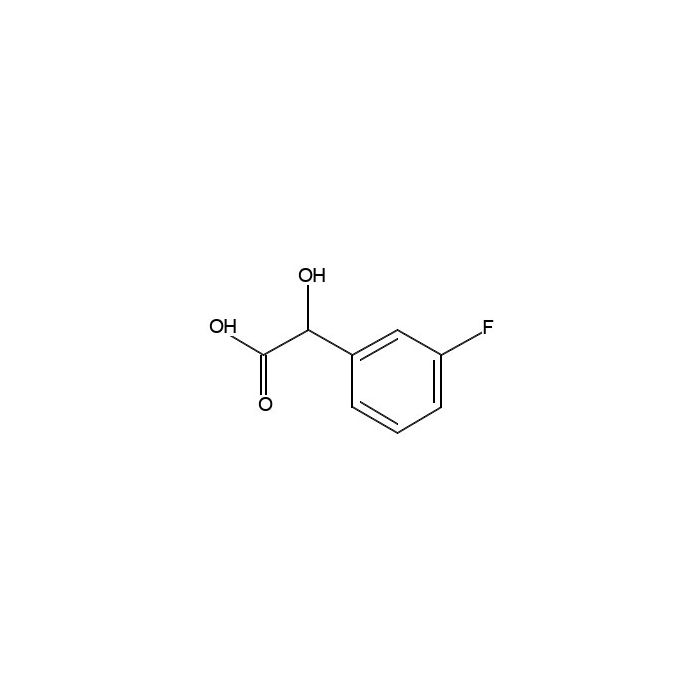
Brief description: 2-(3-Fluorophenyl)-2-hydroxyacetic acid is an arylglycolic acid (fluorinated mandelic acid) bearing a carboxylic acid and an alpha-hydroxyl group adjacent to a 3-fluorophenyl ring. Typically obtained and used as the racemate.
InChIKey: 126435 (as provided; refer to CoA/SDS for authoritative identifier)
Structure description (general/literature)
Core scaffold: arylglycolic acid (mandelic acid framework) with a meta-fluoro substituent on the phenyl ring.
Functional groups: one carboxylic acid (–CO2H), one alpha-secondary alcohol (–CHOH), and an aryl fluoride (–F on benzene).
Stereochemistry: the alpha carbon is stereogenic; commercial material is commonly racemic unless otherwise specified (Not specified for this item; refer to CoA/Spec Sheet).
2D description: a benzene ring bearing F at the 3-position relative to the benzylic carbon; the benzylic carbon bears both –OH and –CO2H substituents.
Computed/literature identifiers (for reference; not item specifications)
Note: When exact stereochemistry is required, use chiral SMILES/InChI for (R) or (S) isomers.
Synthetic Utility
Key reactivity arises from the juxtaposed carboxylic acid and benzylic secondary alcohol, plus the electronically distinctive 3‑fluoro substituent.
Transformations at the carboxyl:
Esterification: Fischer (acid-catalyzed), Steglich (DCC/DMAP), or acid chloride formation (SOCl2, oxalyl chloride) followed by alcohol trapping.
Amide formation: EDCI/HOBt, HATU, or CDI protocols with primary/secondary amines; control temperature and time to minimize racemization.
Decarboxylation after activation (e.g., NHPI esters with photoredox, Barton, or Hunsdiecker variants) to access benzylic radicals for further functionalization.
Transformations at the alcohol/benzylic center:
Protection as silyl or benzyl ether; Mitsunobu inversion for stereochemical editing.
Oxidation to α‑keto acid (benzoylformic acid analogue) using Dess–Martin periodinane or TEMPO/bleach systems.
Substitution to generate benzylic ethers, thioethers, or azides via activation (e.g., mesylate/tosylate formation).
Aryl ring considerations:
The meta‑F is robust; cross-coupling generally requires prefunctionalization (e.g., halogen–lithium exchange is not advised near the acid; protect/esterify first). Directed ortho-metalation relative to F is possible on protected derivatives under cryogenic conditions.
Retrosynthetic value:
Disconnection to 3‑fluorobenzaldehyde via cyanohydrin/oxidation or to 3‑fluorophenylacetonitrile/oxazoline routes is common in literature for arylglycolic acids.
Target Specificity
Not applicable. This product is a small-molecule chemical reagent, not a biological targeting agent or antibody. No antigen, epitope, species reactivity, clone, or isotype information applies.
We use cookies to ensure the website functions properly and, where permitted, to improve your experience. You can manage your preferences at any time in Settings. Learn more in our Cookie Policy.
Shall we send you a message when we have discounts available?
Remind me later
Thank you! Please check your email inbox to confirm.
Products are supplied to verified businesses, institutions, and qualified professionals for research and development use only. Not for use in humans, animals, diagnosis, or therapy.

 C2610405