This compound belongs to the class of organic compounds known as nitrobenzenes. These are compounds containing a nitrobenzene moiety, which consists of a benzene ring with a carbon bearing a nitro group.
External Descriptors
Not available
1. Djoumbou Feunang Y, Eisner R, Knox C, Chepelev L, Hastings J, Owen G, Fahy E, Steinbeck C, Subramanian S, Bolton E, Greiner R, and Wishart DS. ClassyFire: Automated Chemical Classification With A Comprehensive, Computable Taxonomy. Journal of Cheminformatics, 2016, 8:61.
Determine the necessary mass, volume, or concentration for preparing a solution.
Dilution Calculator
Determine the dilution needed to prepare a stock solution.
Reconstitution Calculator
Recensioni
Recensioni dei clienti
Application Protocols
Not applicable as a bioassay reagent. This item is a synthetic organic intermediate and does not have protocols such as WB, IHC, IF, or FC. For practical laboratory use, refer instead to the Reaction Conditions and Solvent Selection sections for guidance on setting up chemical reactions.
Biological Roles
Item-specific biological data: Not specified for this item; refer to CoA/Spec Sheet. This product is designated for research use only.
General information (literature; not item-specific):
2,4-Dibromonitrobenzene is a small, hydrophobic nitroaromatic and is not known to have intrinsic biological roles in metabolism or signaling. Nitrobenzene derivatives can undergo bioreductive transformation in microbial or hypoxic environments to yield hydroxylamines/anilines, but such processes are context-dependent and not a property of this specific commercial material.
Due to its hydrophobic, electron-poor aromatic core, the compound can serve as a synthetic intermediate toward more biologically relevant scaffolds (e.g., substituted anilines after reduction of –NO2 or cross-coupling elaboration), but it is not itself a biochemical reagent like a buffer, cofactor, or metabolite.
Environmental fate considerations (general): halogenated nitroarenes are typically persistent, with potential for bioaccumulation due to high logP values. Biodegradation may be slow and proceed via reductive pathways.
Practical note for lab biologists:
If used as a tool compound precursor, solubilize in DMSO or DMF to prepare concentrated stocks; avoid introducing this substrate directly to aqueous biological systems without appropriate formulation and toxicity assessment. No claims are made regarding suitability for cellular or in vivo use.
Buffer Applications
Not typically applicable. 2,4-Dibromonitrobenzene is a neutral, hydrophobic organic building block and does not function as a buffering agent. For lab applications with this compound, focus on organic reaction media and see the Solvent Selection, Reaction & Applications, and Reaction Conditions sections.
Green Alternatives
While the substrate itself is a halogenated nitroaromatic (intrinsically non-green), process greening can meaningfully reduce impact.
Greener solvent choices (literature/general):
Replace DMF/DMSO/NMP where possible with:
2-MeTHF or CPME for Pd-catalyzed couplings (better EHS profiles; ease of workup).
Toluene or anisole as less problematic aromatics vs chlorinated solvents.
Aqueous micellar media (e.g., surfactant-enabled Suzuki) to lower organic solvent volumes.
For SNAr, propylene carbonate can substitute for DMF/DMSO in some nucleophilic substitutions; verify solubility/kinetics.
Catalysis and energy:
Use highly active Pd catalysts with tailored ligands (BrettPhos/XPhos/SPhos) to run at lower loadings and temperatures.
Nickel catalysis (Ni(cod)2, air-stable precatalysts) can be effective for aryl bromides, reducing reliance on Pd.
Microwave or flow chemistry can shorten cycle times and enhance heat/mass transfer, reducing energy and solvent.
Waste minimization:
Sequence planning that performs cross-coupling before nitro reduction can avoid protecting group steps and minimize redox waste.
Employ recyclable heterogeneous catalysts (Pd/C under flow) and aqueous base to simplify catalyst recovery.
Trade-offs:
2-MeTHF/CPME have peroxide risks over time—implement peroxide testing and inhibitor management.
Micellar systems may require specialized surfactants and careful product extraction.
Nonpolar greener solvents may lower substrate solubility; reaction rates can drop without ligand/base optimization.
Pure organic → Micellar water (lower VOC; extraction step required)
Pharmaceutical Uses
Item-specific pharmacopeial status/excipient role: Not specified for this item; refer to CoA/Spec Sheet. For research use only.
General (literature; not item-specific):
Role in drug development: 2,4-Dibromonitrobenzene can serve as a versatile intermediate for constructing substituted anilines, biaryls, or heteroaryl motifs through cross-coupling and subsequent nitro reduction. These downstream structures can appear in API candidates, but the starting material itself is not an approved excipient or API.
Process chemistry context: The dihalide enables rapid SAR exploration by selective mono/di-coupling at the para and ortho positions. Retaining the nitro group during early-stage coupling allows chemoselective reduction at a later stage to unveil an aniline for salt formation or further derivatization.
Impurity control: If used in GMP-adjacent settings as an intermediate, monitor for residual brominated isomers, debrominated nitrobenzene, and metal residues from Pd/Ni catalysts. Typical controls include GC/HPLC purity, ICP-MS for metals, and verification of isomeric identity by NMR.
No therapeutic or clinical claims are made for this product; it is offered strictly for laboratory research and process development.
Physical Properties
Item-specific values: Not specified for this item; refer to CoA/Spec Sheet.
Literature/general properties for 2,4-dibromonitrobenzene (for reference only; not item specifications):
Molecular formula: C6H3Br2NO2 (literature)
Molecular weight: ~281.90 g/mol (calculated)
Physical state/appearance: typically a crystalline solid (literature, halonitrobenzenes are commonly low-melting solids)
Solubility profile: expected to be sparingly soluble in water; soluble in common organic solvents such as dichloromethane, chloroform, toluene, THF, DMF, and DMSO (literature/generic behavior of halonitroarenes)
Volatility: low (as an aromatic dihalide solid; literature/general)
Acid/base behavior: neutral aromatic compound; nitro group is strongly electron-withdrawing but not ionizable under neutral conditions (general)
LogP: expected moderately high due to two bromine atoms and aromatic ring (qualitative, literature expectation)
Notes for practitioners (general):
Refractive index and density are seldom reported for this solid; measure experimentally for formulation work.
Melting/boiling points vary in literature depending on polymorph and purity; verify on your batch CoA prior to thermal processing.
For precise solubility and partition data in specific solvent systems, determine empirically or consult primary literature.
Quality and Grades
Item-specific grade/purity: Not specified for this item; refer to CoA/Spec Sheet.
Stabilizers/additives: Not specified for this item; refer to CoA/Spec Sheet.
Guidance on interpreting grade (general, for research/lab use materials):
Research-grade halogenated building blocks are typically specified by HPLC/GC area % purity and by limits on related halogenated impurities or isomeric content. When present, metals (Pd, Cu) are monitored if the material is produced via cross-coupling.
If a product is labeled “>98%” or similar on the CoA, this refers to chromatographic purity under the stated method. Water content (KF), residual solvents, and isomeric purity may be listed separately. In the absence of such values in the Product Data, treat them as unspecified for this item.
UV-Vis or HPLC-grade designations do not normally apply to solid synthetic intermediates like 2,4-dibromonitrobenzene; focus instead on isomeric purity and residual halogenated solvents.
What matters for this compound type (general):
Isomeric composition: Ensure the 2,4-isomer predominates vs. other dibromonitrobenzene isomers.
Trace metals: If downstream cross-couplings or catalytic hydrogenations are planned, low ppm of metals may be desirable.
Particle size: Impacts dissolution and reaction homogeneity; may be worth specifying for scale-up.
Reaction and Applications
2,4-Dibromonitrobenzene is a versatile aryl dihalide activated by a strong –NO2 group, enabling both nucleophilic aromatic substitution (SNAr) and transition-metal-catalyzed cross-couplings.
Key application families (literature/general):
SNAr at aryl–Br activated by –NO2 (ortho/para):
Aminations: displacement with amines to access ortho- or para-arylamines.
Etherifications/Thioetherifications: reaction with alkoxides/aryloxides or thiolates.
Conditions: strong nucleophile (RO−, RS−, NR2−), polar aprotic solvent (DMSO/DMF), 60–140 °C. The nitro group accelerates substitution at positions ortho/para to –NO2; steric hindrance can bias site selectivity.
Palladium-catalyzed couplings on aryl–Br:
Suzuki–Miyaura (aryl/alkenyl/alkyl boron reagents) to build biaryl/alkenyl–aryl frameworks.
Buchwald–Hartwig amination to form anilines/anilides while retaining or later modifying –NO2.
Sonogashira/Heck couplings to install alkynyl or alkenyl substituents.
Site-selectivity can be tuned by ligand/catalyst choice; para–Br often reacts faster than ortho–Br due to sterics.
Nitro group transformations:
Reduction to aniline (Pd/C–H2, Fe/AcOH, SnCl2, or Zn/NH4Cl) after or before coupling, unlocking divergent routes to 2,4-dibromoanilines or mono-bromo anilines.
N–O bond chemistry (e.g., partial reductions) for access to hydroxylamines (less common on scale).
Applications:
Scaffold for medicinal chemistry SAR arrays (installation of diverse substituents at 2/4-positions, later reduction of –NO2).
Materials/ligand synthesis where electron-poor aryl units improve photophysical or coordination properties.
Practical notes:
Keep bases dry; trace water can hamper SNAr or affect selectivity.
For sequential couplings, exploit differential reactivity (para > ortho) and/or protecting –NO2 until late-stage.
Reaction Conditions
General literature guidance (illustrative; not item-specific specifications):
SNAr substitutions (RO−, RS−, R2N−):
Solvents: DMSO, DMF, NMP, or diglyme.
Bases/nucleophiles: NaOMe/MeONa in MeOH (for aryl ethers), K2CO3/cesium carbonate with phenoxides, NaSR for thioethers, secondary amines as both nucleophile and solvent in some cases.
Temperature: 60–140 °C depending on nucleophile strength and solvent; hours-scale reactions.
Notes: Positions ortho/para to –NO2 are most activated; sterics may slow substitution at the 2-position.
Suzuki–Miyaura coupling (Ar–B(OH)2, Ar–Bpin):
Catalyst: Pd(dppf)Cl2·DCM or Pd2(dba)3 with SPhos/XPhos.
Base: K3PO4, K2CO3, or Cs2CO3.
Solvent: 1,4-dioxane/H2O, THF/H2O, or toluene/H2O; 60–100 °C.
Typical outcome: para–Br often couples faster; control selectivity via ligand and temperature. Literature yields for aryl bromides commonly 70–95% under optimized conditions.
Buchwald–Hartwig amination (RNH2, R2NH):
Catalyst/ligand: Pd2(dba)3 or Pd(OAc)2 with BrettPhos, XPhos, or RuPhos.
Base: NaOtBu, KOtBu, or Cs2CO3.
Solvent: toluene, dioxane, or CPME; 60–110 °C.
Nitro reduction:
Catalytic hydrogenation: H2 (1–5 bar) with Pd/C or Raney Ni in EtOH/iPrOH at RT–50 °C.
Chemoselective metal reductions: Fe/AcOH or SnCl2 in EtOH for cases where aryl–Br retention is required.
Sonogashira/Heck:
Sonogashira: Pd(PPh3)2Cl2/CuI, Et3N or iPr2NH, THF/DMF, RT–60 °C (terminal alkynes).
Heck: Pd(OAc)2/PPh3, triethylamine, DMF or NMP, 80–120 °C (vinylation).
Always optimize on small scale; monitor by GC/HPLC. Dry reagents and exclude air/moisture for sensitive catalysis.
Safety and Handling
Item-specific hazard statements and GHS: Not specified for this item; refer to the product SDS for authoritative information.
General safety guidance for halogenated nitroaromatics (literature/best practice; not item-specific):
Likely hazards: May cause skin/eye irritation and respiratory irritation upon dust generation; harmful if swallowed; environmentally hazardous to aquatic life. Nitroaromatics can pose toxicity concerns—handle with care and avoid exposure.
PPE: Use lab coat, safety goggles, and appropriate chemical-resistant gloves (e.g., nitrile). Avoid inhalation of dust; handle in a fume hood.
Handling: Minimize dust formation. Avoid contact with strong bases and strong nucleophiles unless performing a controlled reaction. Keep away from strong reducing agents (which may convert –NO2) and from strong oxidizers.
Storage: Follow Product Data: store at room temperature. Keep container tightly closed in a dry, well-ventilated place. Protect from excessive heat and direct sunlight. Segregate from foodstuffs and incompatible reagents.
First aid (overview):
Inhalation: Move to fresh air; seek medical attention if symptoms persist.
Skin/eye contact: Rinse with plenty of water for at least 15 minutes; remove contaminated clothing; obtain medical advice if irritation continues.
Ingestion: Rinse mouth; do not induce vomiting; seek medical attention.
Spill/Disposal: Avoid release to the environment. Collect solids by sweeping with minimal dust; place in compatible container for disposal. Dispose of contents/container according to local regulations. Always defer to the SDS for detailed procedures.
Solvent Selection
Applicability: As a nonpolar-to-moderately polar halogenated aromatic solid, 2,4-dibromonitrobenzene dissolves best in chlorinated and aprotic polar organic solvents.
Limited/Poor: Alcohols (MeOH, EtOH) may be moderate; water is typically negligible.
Polarity class: Low-to-moderate polarity aromatic halide; aromatic π-system with two bromides increases polarizability (beneficial for solubility in chlorinated/aromatic media).
Dielectric context: Reactions benefiting from polar aprotic environments (SNAr, some Pd-catalyzed couplings) often use DMF, DMSO, NMP, or dioxane/MeCN mixtures; greener options include 2-MeTHF or CPME where feasible.
When to choose which solvent (general):
SNAr with alkoxides/aryloxides: DMSO, DMF, or diglyme to solubilize salts; temperature control 60–120 °C.
Suzuki–Miyaura coupling: 1,4-dioxane/H2O, THF/H2O, or toluene/H2O with a phase-transfer base; micellar water systems are possible with appropriate surfactants.
Buchwald–Hartwig amination: Toluene, dioxane, or CPME with bulky ligands; polar media (tBuOH, MeCN) sometimes used to tune rates/selectivity.
Reductions (–NO2 to –NH2): Ethanol, isopropanol, or EtOAc under catalytic hydrogenation; avoid basic media if you need to preserve aryl–Br for later cross-coupling.
Practical tip: Verify saturation concentration at the intended temperature; pre-warm and add co-solvent (e.g., toluene+DMF) to achieve homogeneous conditions before catalyst/base addition.
Storage and Reconstitution
Item-specific storage (from Product Data): Store at room temperature. Shipped under normal conditions.
Reconstitution: Not applicable (solid building block used as received). If preparing stock solutions, dissolve in a suitable anhydrous organic solvent (e.g., DMSO, DMF, THF, toluene, or DCM) to the desired concentration; filter if necessary through a PTFE membrane to remove particulates.
General best practices (not item-specific specifications):
Keep container tightly closed in a dry place; use desiccant if ambient humidity is high, as hygroscopic impurities or clumping can occur in some solids over time.
Protect from prolonged light and heat. Avoid repeated heating/cooling cycles that may induce degradation.
For solution stocks: store in amber vials at room temperature or 2–8 °C depending on solvent stability; bring to ambient temperature before opening to minimize moisture ingress. Label with solvent, concentration, and preparation date.
Avoid contact with strong oxidants/reductants during storage. Segregate from bases and nucleophiles to prevent unintended reactions.
Shelf-life: Not specified for this item; refer to CoA/Spec Sheet. Inspect periodically by NMR/GC/HPLC for long-term projects or before scale-up.
Structure and Identity
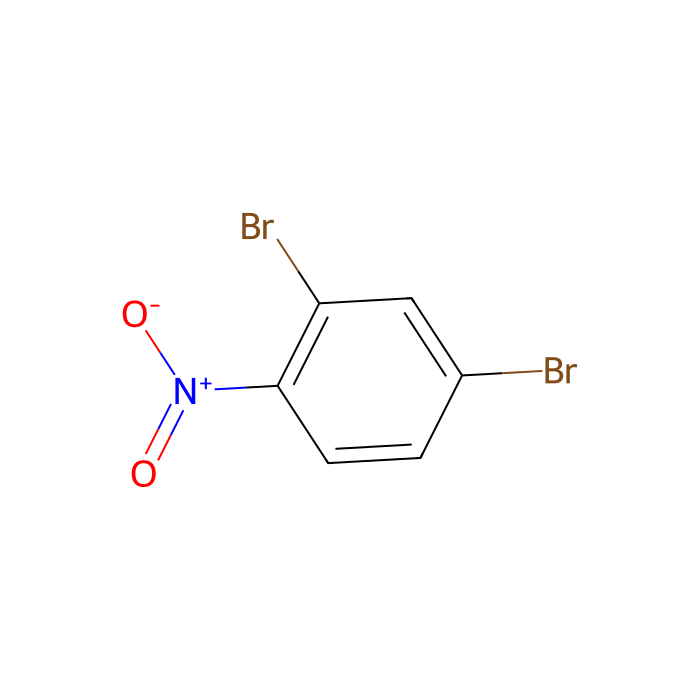
Brief overview: 2,4-Dibromonitrobenzene is a halogenated nitroaromatic building block featuring two aryl bromides and a nitro group on a benzene ring, enabling both cross-coupling and nucleophilic aromatic substitution strategies.
Item-specific (from Product Data):
SKU: D136641
Product Name: 2,4-Dibromonitrobenzene
CAS: 51686-78-3
PubChem CID: 12315646
InChIKey: 75544 (as provided; truncated/not standard; consult CoA/SDS for the definitive identifier)
SMILES: Not specified for this item; refer to CoA/Spec Sheet.
Literature/computed identifiers and features (for reference; not item-specific):
Approximate molecular weight: ~281.90 g/mol (calculated from C6H3Br2NO2; literature)
Representative SMILES (literature): O=N+c1ccc(Br)cc1Br (one of several equivalent depictions)
Structural features: benzene core bearing a nitro group (–NO2) and two bromine substituents at the 2- and 4-positions relative to the nitro. The nitro group is strongly electron withdrawing and meta-directing; aryl bromides are deactivating yet ortho/para-directing and serve as good leaving groups in cross-coupling and, when activated by –NO2, in SNAr.
2D structure description (general): A planar aromatic ring with –NO2 at position 1, Br at the ortho (2) position, and Br at the para (4) position relative to the nitro group; no stereocenters, no tautomers of consequence under standard conditions.
Synthetic Utility
Functional handles and strategic value (literature/general):
Two aryl–Br bonds: compatible with Pd/Ni-catalyzed cross-couplings (Suzuki, Buchwald–Hartwig, Sonogashira, Heck). Para–Br is often more reactive than ortho–Br, enabling sequential, regioselective elaboration.
Strongly activating –NO2 for SNAr: facilitates displacement of aryl–Br by hard nucleophiles at positions ortho/para to –NO2; can complement or replace metal-catalyzed routes.
Nitro group as a masked aniline: Late-stage reduction (e.g., H2/Pd-C, Fe/AcOH, SnCl2) reveals an –NH2 for acylation, sulfonylation, or diazotization.
Typical synthetic maneuvers:
Differential coupling: First couple at 4-Br with milder conditions/ligands, then address 2-Br with more forcing conditions or switch to SNAr.
Chemoselective SNAr: Install one nucleophile at the activated site while keeping the other bromide for cross-coupling.
One-pot telescoping: Cross-coupling → nitro reduction → acylation within the same vessel by solvent/base switches, minimizing isolations.
Retrosynthetic advantage:
Serves as a convergent node to elaborate both ortho and para positions independently, then convert –NO2 to –NH2 to access densely substituted anilines.
Practical considerations:
Control basicity to avoid unintended hydrodehalogenation during nitro reduction when catalysts are present.
Use ligand-controlled catalysis (e.g., bulky biaryl phosphines) to favor oxidative addition at the desired C–Br bond first.
Monitor reactions by GC/MS to distinguish mono- vs di-functionalized products; isomer signals are well-separated due to distinct substitution patterns.
Target Specificity
Not applicable. This product is a small-molecule chemical building block and is not an antibody, enzyme, or biological targeting reagent. No antigen/epitope, species reactivity, clone, or isotype information applies.
Domande frequenti
What is the purity of this product?
This product is supplied at ≥98% purity (chemical assay). Lot-specific values are stated on the Certificate of Analysis.
How should this product be stored?
Store at room temperature.
What are the CAS number, molecular formula and molecular weight?
The CAS Number is 51686-78-3, the molecular formula is C6H3Br2NO2, and the molecular weight is 280.9 g/mol. InChIKey DXRVYZGVVFZCFP-UHFFFAOYSA-N.
What documentation is provided?
Available product documentation, including Certificates of Analysis (COA), Safety Data Sheets (SDS), and specification sheets, is shown in the product document area. Document availability and access follow the current site policy.
Utilizziamo i cookie per garantire il corretto funzionamento del sito web e, ove consentito, per migliorare la tua esperienza. Puoi gestire le tue preferenze in qualsiasi momento nelle Impostazioni. Per saperne di più, consulta la nostra Cookie Policy.
Desidera che le inviamo un messaggio quando avremo sconti disponibili?
Ricordamelo più tardi
Grazie! Controlli la sua casella di posta per confermare.
Products are supplied to verified businesses, institutions, and qualified professionals for research and development use only. Not for use in humans, animals, diagnosis, or therapy.

 D23061188