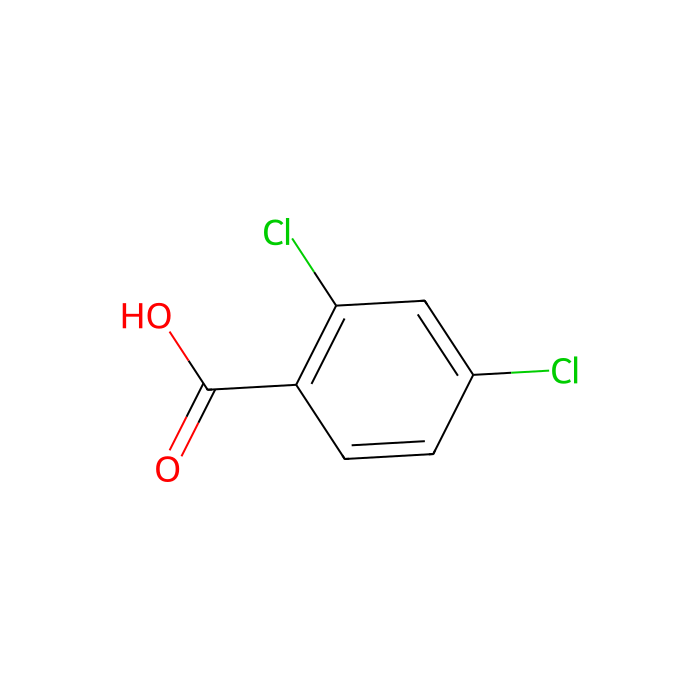
2,4-Dichlorbenzoic acid - ≥95%(GC) , CAS No.50-84-0

CAS: 50-84-0 Cat. No.: D104404 Formula: C7H4Cl2O2 Peso molecolare: 191.01 Beilstein Registry Number: 1868192 Numero EC: 200-067-8
Disponibile su ordine
QUALITÀ & PUREZZA ≥95%(GC)
Synonyms
2,4-Dichlorobenzoic Acid; Furosemide Imp. E (EP); 2,4-Dichlorobenzyl Alcohol Impurity E; Furosemide Impurity E|Benzoic acid, 2,4-dichloro-|2,4-DICHLOROBENZOIC ACID|2,4-Dichloro-benzoic acid|2,4 dichlorobenzoic acid|FUROSEMIDE IMPURITY E [EP IMPURITY]|DICHLOROBENZOIC ACID, 2,4-|2,4-Dichlorobenzoicacid
Storage
Room temperature
Shipped In
Normal
★
Dimensione
Germania (EU)
USA*
Prezzo
Qtà
25g
D104404-25g
—
Disponibile ≥10
8,59€
100g
D104404-100g
3 Disponibile
5 Disponibile

10,33€

15,53€
Salva 5,21 € (33.52%)
500g
D104404-500g
1 Disponibile
1 Disponibile

35,49€

54,58€
Salva 19,09 € (34.98%)
Enter a quantity for the sizes you want to add.

Panoramica

2,4-Dichlorobenzoic acid was used in solid-phase extraction and gas chromatographic determination of polar acidic herbicides in surface water.2,4-Dichlorobenzoic acid was used as reagent during the synthesis of pyrimido[2′,1′:2,3]thiazolo[4,5-b]quinoxaline derivatives. 2,4-Dichlorobenzoic acid was used as starting reagent during the synthesis of 1-(substituted)-1,4-dihydro-6-nitro-4-oxo-7-(sub-secondary amino)-quinoline-3-carboxylic acids.

Specifiche

Sinonimi
2,4-Dichlorobenzoic Acid; Furosemide Imp. E (EP); 2,4-Dichlorobenzyl Alcohol Impurity E; Furosemide Impurity E | Benzoic acid, 2,4-dichloro- | 2,4-DICHLOROBENZOIC ACID | 2,4-Dichloro-benzoic acid | 2,4 dichlorobenzoic acid | FUROSEMIDE IMPURITY E [EP IMPURITY] | DICHLOROBENZOIC ACID, 2,4- | 2,4-Dichlorobenzoicacid
Specifiche e purezza
≥95%(GC)
Condizioni di conservazione di stoccaggio
Room temperature
Spedito in
Normal
Purezza
≥95%(GC)
Nomi e identificatori
Pubchem Sid
Pubchem Sid Url
https://pubchem.ncbi.nlm.nih.gov/substance/504750938
SMILES
C1=CC(=C(C=C1Cl)Cl)C(=O)O
IUPAC Name
2,4-dichlorobenzoic acid
InChIKey
ATCRIUVQKHMXSH-UHFFFAOYSA-N
InChI
1S/C7H4Cl2O2/c8-4-1-2-5(7(10)11)6(9)3-4/h1-3H,(H,10,11)
Isomeri SMILES
C1=CC(=C(C=C1Cl)Cl)C(=O)O
WGK Germania
3
RTECS
DG6650000
Peso molecolare
191.01
Beilstein
1868192
Reaxys
1868192
Reaxys-RN_link_address
https://www.reaxys.com/reaxys/secured/hopinto.do?context=S&query=IDE.XRN=1868192&ln=

Dati avanzati

Taxonomic Classification

Taxonomy Tree

KingdomOrganic compounds
SuperclassBenzenoids
ClasseBenzene and substituted derivatives
SubclassBenzoic acids and derivatives
Intermediate Tree Nodes Benzoic acids
Direct ParentDichlorobenzoic acids
Alternative Parents Halobenzoic acids  4-halobenzoic acids  2-halobenzoic acids  Dichlorobenzenes  Benzoyl derivatives  1-carboxy-2-haloaromatic compounds  Aryl chlorides  Vinylogous halides  Monocarboxylic acids and derivatives  Organooxygen compounds  Organochlorides  Organic oxides  Hydrocarbon derivatives  
Molecular FrameworkAromatic homomonocyclic compounds
Substituents 2,4-dichlorobenzoic acid - Halobenzoic acid - 4-halobenzoic acid - 2-halobenzoic acid - Halobenzoic acid or derivatives - 4-halobenzoic acid or derivatives - 2-halobenzoic acid or derivatives - Benzoyl - 1,3-dichlorobenzene - 1-carboxy-2-haloaromatic compound - Chlorobenzene - Halobenzene - Aryl chloride - Aryl halide - Vinylogous halide - Monocarboxylic acid or derivatives - Carboxylic acid - Carboxylic acid derivative - Organochloride - Organohalogen compound - Hydrocarbon derivative - Organic oxide - Organic oxygen compound - Organooxygen compound - Aromatic homomonocyclic compound
DescrizioneThis compound belongs to the class of organic compounds known as dichlorobenzoic acids. These are benzoic acids having two chlorine atoms attached to the carboxylated benzene ring.
External Descriptors dichlorobenzene - chlorobenzoic acid
Struttura 3D
Modello di struttura chimica interattiva


Obiettivi associati (umani)
TSHR Tclin Thyroid stimulating hormone receptor (29986 Activities)
Activity TypeRelationActivity valueUnitsAction TypeJournalPubMed IddoiAssay Aladdin ID
CASP1 Tchem Caspase-1 (6235 Activities)
Activity TypeRelationActivity valueUnitsAction TypeJournalPubMed IddoiAssay Aladdin ID
Obiettivi associati (non umani)
Ppard Peroxisome proliferator-activated receptor delta (358 Activities)
Activity TypeRelationActivity valueUnitsAction TypeJournalPubMed IddoiAssay Aladdin ID
Nfe2l2 Nuclear factor erythroid 2-related factor 2 (214 Activities)
Activity TypeRelationActivity valueUnitsAction TypeJournalPubMed IddoiAssay Aladdin ID
Meccanismi d'azione
Certificati (CoA, COO, BSE/TSE e tabella di analisi)
C of A & Other Certificates(BSE/TSE, COO):
Analytical Chart:

Find and download the COA for your product by matching the lot number on the packaging.

13 results found

Lot NumberCertificate TypeDataOggetto
A2306112A2306112Certificate of AnalysisSep 22, 2026 D104404
K2201581K2201581Certificate of AnalysisAug 03, 2026 D104404
K2201583K2201583Certificate of AnalysisAug 03, 2026 D104404
L2103439L2103439Certificate of AnalysisSep 09, 2025 D104404
L2103440L2103440Certificate of AnalysisSep 09, 2025 D104404
L2103441L2103441Certificate of AnalysisSep 09, 2025 D104404
L2103442L2103442Certificate of AnalysisSep 09, 2025 D104404
D2428248D2428248Certificate of AnalysisMar 22, 2024 D104404
D2428258D2428258Certificate of AnalysisMar 22, 2024 D104404
D2428324D2428324Certificate of AnalysisMar 22, 2024 D104404
K1511099K1511099Certificate of AnalysisJul 14, 2023 D104404
F23151003F23151003Certificate of AnalysisNov 23, 2021 D104404
F2428032F2428032Certificate of AnalysisNov 23, 2021 D104404
Proprietà chimiche e fisiche
SolubilitàSoluble in ethanol (100 mg/ml), water (0.48 mg/ml), alcohol, ether, and acetone.
Punto di ebollizione (°C)200°C
Punto di fusione (°C)160-164°C
Peso molecolare191.01
XLogP32.800
Hydrogen Bond Donor Count1
Hydrogen Bond Acceptor Count2
Rotatable Bond Count1
Exact Mass189.959 Da
Monoisotopic Mass189.959 Da
Topological Polar Surface Area37.300 Ų
Heavy Atom Count11
Formal Charge0
Complexity161.000
Isotope Atom Count0
Defined Atom Stereocenter Count0
Undefined Atom Stereocenter Count0
Defined Bond Stereocenter Count0
Undefined Bond Stereocenter Count0
The total count of all stereochemical bonds0
Covalently-Bonded Unit Count1
Sicurezza e pericoli (GHS)
Pictogrammi
Segnale
Warning
Indicazioni di pericolo

H302:Harmful if swallowed

H315:Causes skin irritation

H319:Causes serious eye irritation

H335:May cause respiratory irritation

Precauzioni

P261:Avoid breathing dust/fume/gas/mist/vapors/spray.

P264:Wash hands [and …] thoroughly after handling.

P270:Do not eat, drink or smoke when using this product.

P271:Use only outdoors or in a well-ventilated area.

P280:Wear protective gloves/protective clothing/eye protection/face protection.

P321:Specific treatment (see ... on this label).

P330:Rinse mouth.

P302+P352:IF ON SKIN: wash with plenty of water.

P304+P340:IF INHALED: Remove person to fresh air and keep comfortable for breathing.

P305+P351+P338:IF IN EYES: Rinse cautiously with water for several minutes. Remove contact lenses if present and easy to do - continue rinsing.

P362+P364:Take off contaminated clothing and wash it before reuse.

P405:Store locked up.

P403+P233:Store in a well-ventilated place. Keep container tightly closed.

P501:Dispose of contents/container to an approved waste disposal plant.

P264+P265:Wash hands [and …] thoroughly after handling. Do not touch eyes.

P301+P317:IF SWALLOWED: Get medical help.

P337+P317:If eye irritation persists: Get medical help.

P332+P317:If skin irritation occurs: Get medical help.

P319:Get medical help if you feel unwell.

WGK Germania
3
RTECS
DG6650000
Reaxys
1868192
Reaxys-RN_link_address
https://www.reaxys.com/reaxys/secured/hopinto.do?context=S&query=IDE.XRN=1868192&ln=
Citations of This Product
Calcolatori di soluzioni
Recensioni

Recensioni dei clienti

Application Protocols

No vendor-tested biological application protocols are provided for this item. Suggested general laboratory uses are synthetic and analytical.

  • General preparation (literature/general)

    • Stock solutions: dissolve in DMSO, DMF, MeOH, or EtOH to a convenient concentration (e.g., 10–100 mg/mL). Filter if needed to remove particulates.
    • pH-adjusted aqueous solutions: dissolve by adding stoichiometric NaOH/KOH to form the sodium/potassium salt; confirm pH and ionic strength before use.
  • Analytical methods

    • HPLC/UPLC: reversed-phase C18 with acidic modifier (e.g., 0.1% formic acid) for neutral form or basic modifier for carboxylate; UV detection near 230–280 nm.
    • GC not generally used for the acid; derivatize (e.g., methyl ester) if GC analysis is required.

These are general literature guidelines. For project-specific SOPs, develop and validate conditions appropriate to your matrix and instrumentation.

Biological Roles

This compound is a synthetic, halogenated aromatic acid and is not known to have endogenous biological roles. The following are general, literature-based considerations relevant to chlorinated benzoic acids used in research contexts.

  • Biochemical behavior (literature/general)

    • Weak acid (pKa ~2.7–2.9): predominantly ionized at physiological pH, which enhances aqueous compatibility of the salt form but limits passive membrane diffusion of the carboxylate.
    • Hydrophobic ring substituents (two chlorines) increase protein binding and partitioning into nonpolar phases relative to benzoate.
    • Microbial metabolism: certain microbes can transform chlorobenzoates via dehalogenation and ring-cleavage pathways (catechol routes), though activity depends strongly on substitution pattern.
  • Research uses

    • Employed as a model substrate to study effects of electron-withdrawing substituents on acidity, binding, and reactivity in enzyme mimics and materials interfaces.
    • Utilized to probe sorption and transport phenomena in environmental chemistry due to combined acidity and hydrophobicity.

Note: The above points are general literature observations provided for context. This product is supplied strictly for research use only and is not intended for diagnostic, therapeutic, or other clinical uses.

Buffer Applications

2,4-Dichlorobenzoic acid is not commonly used as a laboratory buffer component. Its pKa (~2.7–2.9, literature) lies in a range that is less practical for most biochemical buffers, and its low aqueous solubility in the protonated form further limits utility.

  • If a low-pH buffer is required (literature/general)
    • Consider alternatives with established buffering ranges and solubility, such as citrate (pKa2 ~4.8), formate (pKa ~3.75), or phosphate (pKa2 ~7.2) depending on the desired pH.
    • For studies requiring this specific anion, prepare solutions by neutralizing with NaOH/KOH to form the corresponding dichlorobenzoate salt, which is more water-soluble; validate pH and ionic strength empirically.

For practical pH control, choose from standard buffering systems and reserve this compound for its strengths as a synthetic building block. Refer to other sections for synthetic and applications guidance.

Green Alternatives

Greenness considerations for 2,4-dichlorobenzoic acid focus on halogen content, solvent choices, and transformation strategies. While the dichloro motif may be essential for performance, greener tactics can mitigate impact.

  • Design and selection (literature/general)

    • Structural alternatives: If only one chlorine is required for activity, consider 4-chlorobenzoic acid (reduced halogen load) or fluorinated analogs that can enable milder couplings. However, property and reactivity changes must be evaluated.
    • Biobased feedstocks: No direct biobased equivalent exists; consider starting from benzoic acid derivatives and employing selective chlorination under safer conditions.
  • Greener processing

    • Solvents: favor 2-MeTHF, CPME, or EtOAc over chlorinated solvents for couplings/esterifications when feasible.
    • Coupling reagents: switch from DCC to water-compatible EDC or to catalytic coupling strategies (e.g., CDI, acid anhydrides) to minimize urea waste.
    • Catalysis: use ligand-enabled Pd/Ni catalysis for aryl–Cl activation at lower loadings and temperatures; explore micellar catalysis in water to reduce organic solvent volume.
  • Trade-offs

    • Reduced-halogen analogs may not replicate target properties; deactivation by –Cl can be mechanistically important.
    • Alternative solvents may affect crystallization behavior and purity. Validate by small-scale DoE.

Comparison snapshot (literature)

  • DCM vs EtOAc: similar polarity window for extractions; EtOAc preferred for lower toxicity and renewability.
  • DMF/DMSO vs green polar: Cyrene or NBP can substitute in some couplings, but solubility and rate must be checked.
Pharmaceutical Uses

No excipient or pharmacopeial status is specified for this item. The following notes reflect general, literature-based roles of chlorinated benzoic acids in pharmaceutical manufacturing research, not therapeutic claims.

  • Item-specific

    • Grade/Purity: Not specified for this item; refer to CoA/Spec Sheet.
  • Potential roles in pharma R&D/manufacturing (literature/general)

    • Synthetic intermediate: precursor to dichloro-benzamides/esters used in lead optimization where electron-withdrawing substituents tune potency and stability.
    • Process chemistry: acid chloride derivatives serve in acylation steps; dichloro pattern can direct regioselective transformations and modulate crystallinity of intermediates.
    • Salt formation studies: as a counter-acid for forming salts with basic APIs in screening experiments (though its halogenation may limit biopharmaceutical acceptability).
  • Considerations

    • Residual halogenated aromatics are scrutinized; robust purification controls and impurity tracking are needed.
    • If used in GMP contexts, ensure source qualification, impurity profiles, and residual solvents meet regulatory expectations.

This product is for research use only and is not intended for human or veterinary use.

Physical Properties

Only general/literature values are provided here for context; they are not item-specific specifications.

  • Phase/appearance: Not specified for this item; refer to CoA/Spec Sheet.
  • Melting point (literature): typically reported ~205–210 °C (decomp potential at high T for aromatic acids).
  • Boiling point (literature): not practical; aromatic acids generally decompose before distillation; reported BP values are not operationally useful.
  • Density (literature): solids are typically ~1.6–1.7 g/cm³ for dichloro-substituted benzoic acids; exact value varies by polymorph.
  • pKa (literature): approximately 2.7–2.9 in water at 25 °C (enhanced acidity vs. benzoic acid due to two ring chlorines).
  • LogP (literature): roughly 2.7–3.0 (unionized form), reflecting increased hydrophobicity from chloro substituents.
  • Aqueous solubility (literature): low at neutral pH; forms water-soluble salts under basic conditions (e.g., NaOH, pH > pKa).
  • Organic solubility (literature): soluble in polar protic/aprotic organic solvents (MeOH, EtOH, acetone, EtOAc, DMSO, DMF); limited in alkanes.
  • UV characteristics (literature): aromatic π–π* absorption with λmax in near-UV; specific cutoffs depend on solvent and ionization state.

Notes

  • Values above are typical literature/computed ranges and provided for planning only. For item-specific specifications and release criteria, consult the Aladdin CoA/Spec Sheet.
Quality and Grades
  • Item-specific details

    • Grade/Purity: Not specified for this item; refer to CoA/Spec Sheet.
    • Stabilizers/Additives: Not specified for this item; refer to CoA/Spec Sheet.
  • Guidance for interpreting common grades (general)

    • Analytical reagent (AR) grade: suitable for general analytical and synthetic work; impurity limits typically controlled for inorganic residues.
    • Purified/synthetic grade: adequate for routine synthesis; may contain trace isomers or chlorinated impurities.
    • High-purity/99%+: preferred for structure–activity studies and coupling chemistry where trace halides or isomers can affect outcomes.
    • HPLC grade (if applicable to solids): focuses on low UV-absorbing impurities; useful when optical purity of eluents/standards is needed.
  • Practical recommendations

    • Verify assay and impurity profile on the CoA (e.g., isomeric chlorobenzoic acids, residual solvents, inorganic chloride).
    • For cross-coupling or peptide/small-molecule amidations, low-water and low-halide impurity content improves coupling efficiency and reproducibility.
    • If elemental analyses (metals) matter for catalysis, request ICP data or metal screening; acidic solids can leach metals from equipment.

Always defer to the Aladdin CoA/Spec Sheet for the definitive quality attributes of this specific SKU.

Reaction and Applications

2,4-Dichlorobenzoic acid is a versatile halogenated aromatic building block. The carboxylic acid enables classical acyl transformations, while the two aryl chlorides support further substitution/cross-coupling chemistry.

  • Representative transformations (literature/general)

    • Activation of the acid: conversion to acid chloride (SOCl2, oxalyl chloride) for Friedel–Crafts acylation or Schotten–Baumann amidation.
    • Amide/ester formation: EDC/HOBt, HATU, or DCC/DMAP coupling in DMF/DCM; Fischer esterification in alcohol/acid catalyst.
    • Cross-coupling at aryl–Cl: Pd-catalyzed Suzuki–Miyaura, Buchwald–Hartwig, or Sonogashira couplings—often enhanced by electron-withdrawing CO2H but may require ester protection to avoid catalyst inhibition.
    • SNAr: possible with strong nucleophiles on the activated ring, particularly at para; directing/steric effects from the ortho Cl influence regioselectivity.
    • Decarboxylative chemistry: silver/copper-mediated or photoredox decarboxylations furnishing aryl radicals; useful for late-stage diversification.
  • Application domains (literature)

    • Intermediate in agrochemical and specialty chemical synthesis where dichloro patterns modulate lipophilicity and metabolic stability.
    • Precursor to dichloro-benzamides/esters serving as ligands, materials monomers, or SAR probes.
  • Practical notes

    • Dry the solid prior to moisture-sensitive steps (e.g., acid chloride formation). Trace water suppresses acylation efficiency.
    • For Pd-catalyzed couplings on aryl chlorides, employ modern ligands (e.g., XPhos, SPhos) and elevated temperatures; consider methyl/tert-butyl ester protection of the acid.
Reaction Conditions

The following are representative literature conditions; optimize for your substrate set. These are not specifications for this item.

  • Acid chloride formation

    • Reagents: SOCl2 (3–5 eq), catalytic DMF; solvent-free or DCM/toluene.
    • Conditions: reflux 1–3 h; remove excess SOCl2 under reduced pressure. Quench cautiously. Typical conversions: high.
  • Amide coupling (carbodiimide)

    • Reagents: DCC (1.1 eq), DMAP (0.1 eq) or EDC·HCl (1.2 eq) with HOBt/HOAt.
    • Solvent/base: DCM/DMF; DIPEA (2 eq). Temp: 0 °C to rt, 2–16 h. Yields: often 60–90% depending on amine sterics.
  • Fischer esterification

    • Reagents: ROH (5–10 eq), catalytic H2SO4 or p-TsOH.
    • Conditions: reflux in alcohol, Dean–Stark if mixed solvent; 4–24 h. Drive to completion by water removal.
  • Suzuki–Miyaura coupling at aryl–Cl (para site favored)

    • Catalyst/ligand: Pd(dppf)Cl2 (2–5 mol%) or Pd2(dba)3 (1–2 mol%) with XPhos (3–6 mol%).
    • Base: K2CO3 or Cs2CO3 (2–3 eq). Solvent: toluene/H2O, dioxane/H2O, or CPME/H2O. Temp: 90–110 °C; 6–24 h. Yields vary (40–85%). Protect acid as methyl ester if needed.
  • Buchwald–Hartwig amination

    • Catalyst/ligand: Pd2(dba)3 (1–2 mol%), BrettPhos or RuPhos (2–4 mol%).
    • Base: NaOtBu or K3PO4; Solvent: toluene/dioxane. Temp: 90–110 °C. Protect acid to minimize catalyst inhibition.
  • Decarboxylative coupling (photoredox)

    • Reagents: N-hydroxyphthalimide (NHPI) ester of the acid, Ir/Ru photocatalyst, Ni co-catalyst.
    • Conditions: blue LED, MeCN or acetone, rt to 40 °C; 6–24 h. Forms C(sp2)–C bonds under mild conditions.
Safety and Handling

Hazard classification details are not specified in the Product Data for this item; consult the SDS for authoritative information.

  • Product Data specifics

    • Storage Conditions: Room temperature
    • Shipped In: Normal
    • Research Use Note: For research use only
  • General safety profile for chlorinated benzoic acids (literature/general)

    • Expected hazards: causes skin/eye irritation; may cause respiratory irritation if dust is generated; harmful if swallowed; potential hazard to aquatic life.
    • GHS elements (general expectation): typically Eye Irrit. 2/ Skin Irrit. 2/ STOT SE 3 (respiratory irritation)/ Aquatic Chronic — exact classifications vary by supplier and testing.
  • Handling recommendations

    • Engineering controls: use in a chemical fume hood; minimize dust formation.
    • PPE: lab coat, safety glasses, and suitable gloves (e.g., nitrile); consider a particulate respirator if dust cannot be controlled.
    • Incompatibilities: strong oxidizers; strong bases/acids (will neutralize/ionize); avoid reactive acylation agents unless specifically intended.
    • Spill response: avoid dust, sweep up carefully, place in labeled container; ventilate area; prevent entry into waterways.
    • First aid (overview): rinse eyes/skin with water for ≥15 min upon contact; move to fresh air if inhaled; if ingested, rinse mouth and seek medical attention. Always follow the SDS instructions.
  • Fire safety

    • Combustible solid; use water fog, CO2, dry chemical, or foam. Thermal decomposition can release HCl/COx; firefighters should use self-contained breathing apparatus.
Solvent Selection

This product is a solid aromatic carboxylic acid rather than a solvent. Selection here refers to dissolution and reaction media.

  • Solubility-driven choices (literature/general)

    • Polar aprotic: DMF, DMSO, NMP—excellent for preparing concentrated stock solutions and for coupling reactions.
    • Polar protic: MeOH, EtOH—good for Fischer esterification or recrystallization; adjust water content to tune solubility.
    • Moderately polar esters/ketones: EtOAc, acetone—useful for extractions and crystallizations.
    • Hydrocarbons: poor solubility; sometimes used as antisolvents to induce crystallization.
    • Water: low solubility when protonated; readily soluble as the carboxylate salt at pH > pKa (~2.7–2.9, literature).
  • Polarity/ionization considerations (literature)

    • Unionized form is hydrophobic (logP ~2.7–3.0); deprotonation drastically increases aqueous solubility but can affect downstream steps.
  • Practical tips

    • For amide couplings, ensure anhydrous polar aprotic media; include base (e.g., DIPEA) and a coupling reagent (e.g., HATU/EDC) as protocol demands.
    • For crystallization, a hot EtOAc/hexanes or EtOH/water system often affords good control; optimize empirically.
    • Avoid strongly basic aqueous workups if you need the neutral acid—re-acidify to pH ~1–2 before isolation.
Storage and Reconstitution
  • Product Data

    • Storage Conditions: Room temperature
    • Shipped In: Normal
  • Storage guidance (general)

    • Keep container tightly closed in a cool, dry, well-ventilated place. Protect from moisture to avoid caking or unintended neutralization.
    • Avoid prolonged exposure to light/heat; although aromatic acids are generally stable, high temperatures can cause discoloration or decomposition.
  • Reconstitution and solution handling (literature/general)

    • Organic solutions: readily dissolves in DMF, DMSO, MeOH, EtOH, acetone, and EtOAc. Prepare fresh solutions when possible; for longer storage, use amber vials and inert atmosphere if sensitive downstream chemistry is planned.
    • Aqueous solutions: low solubility in neutral water; prepare as sodium/potassium salt by titration with base. Filter sterilize if microbiological purity is required.
    • Concentration ranges: common lab stocks 10–100 mg/mL (organic) or 10–200 mM (as salts in water), subject to solubility testing.
  • Stability and shelf-life

    • Solid state stability is typically good under dry, room-temperature conditions. Avoid contact with strong oxidants/bases/acids during storage.
    • If precipitates or discoloration are observed in solution, prepare fresh material.

For definitive item-specific stability or assay release criteria, consult the Aladdin CoA/Spec Sheet.

Structure and Identity

A chlorinated aromatic carboxylic acid featuring two chlorine substituents ortho and para to the carboxyl group on a benzene ring.

  • Item identifiers (from Product Data)

    • SKU: D104404
    • Product Name: 2,4-Dichlorbenzoic acid
    • CAS: 50-84-0
    • PubChem CID: 5787
    • InChIKey: Not specified for this item; refer to CoA/Spec Sheet.
  • Structural descriptors (literature/general)

    • Preferred IUPAC name (literature): 2,4-dichlorobenzoic acid
    • Molecular formula (literature): C7H4Cl2O2
    • Molecular weight (literature): ~191.01 g/mol
    • SMILES (literature): O=C(O)c1ccc(Cl)cc1Cl
    • Core features: benzene ring bearing a carboxylic acid at C1, chlorine substituents at C2 (ortho) and C4 (para) relative to –CO2H.
    • Functional groups: carboxylic acid (Brønsted acid, H-bond donor/acceptor), two aryl chlorides (deactivating, ortho/para-directing).
  • 2D structure (verbal)

    • A planar benzene ring with –CO2H at the top (position 1), a Cl substituent adjacent to it (position 2, ortho), and another Cl across the ring (position 4, para). The combination withdraws electron density, increasing acidity versus benzoic acid and enabling specific cross-coupling strategies at the aryl–Cl positions.
Synthetic Utility

The combination of a carboxylic acid and two aryl chlorides makes 2,4-dichlorobenzoic acid a compact, multifunctional synthon.

  • Functional handles and reactivity (literature/general)

    • Carboxylic acid: forms acid chlorides (SOCl2), anhydrides, esters (Fischer/Steglich), and amides (EDC/HATU/DCC). Decarboxylation or decarboxylative cross-coupling broadens scope.
    • Aryl chlorides (2,4-positions): engage in Pd/Ni-catalyzed cross-couplings (Suzuki–Miyaura, Buchwald–Hartwig, Sonogashira); electron withdrawal facilitates oxidative addition albeit typically slower than bromides/iodides.
    • Directing effects: ortho chlorine introduces steric bias; para chlorine offers cleaner coupling sites. Orthogonal protection (e.g., transient esterification) helps manage chemoselectivity.
  • Retrosynthetic value

    • Divergent elaboration to diaryl scaffolds via iterative couplings (para first, then ortho). The acid can be protected as methyl/tert-butyl ester to insulate it from coupling/base.
    • Access to benzamides with tunable electronics for materials, ligands, and SAR probes.
  • Practical notes

    • Catalyst/ligand choice is critical for aryl–Cl activation (e.g., Pd2(dba)3/XPhos or BrettPhos; Ni-catalysis with bipyridyls).
    • For amide couplings, pre-dry and consider in situ acid chloride for hindered amines. Monitor by LC–MS; aryl chloride can co-elute with products—optimize gradient and detection wavelength.
Target Specificity

Not applicable. This product is a small-molecule chemical reagent, not a biological macromolecule or affinity reagent. No antigen/epitope specificity, clone, isotype, or species reactivity applies.

Domande frequenti

What is the purity of this product, and how is it determined?
This product is supplied at ≥95% purity, determined by gas chromatography (GC). Lot-specific values are stated on the Certificate of Analysis.
How should this product be stored?
Store at room temperature.
How is this product shipped?
This product ships under standard ambient conditions. No temperature-controlled packaging is required.
What are the CAS number, molecular formula and molecular weight?
The CAS Number is 50-84-0, the molecular formula is C7H4Cl2O2, and the molecular weight is 191.01 g/mol. InChIKey ATCRIUVQKHMXSH-UHFFFAOYSA-N.
What documentation is provided?
Available product documentation, including Certificates of Analysis (COA), Safety Data Sheets (SDS), and specification sheets, is shown in the product document area. Document availability and access follow the current site policy.

Desidera che le inviamo un messaggio quando avremo sconti disponibili?

Ricordamelo più tardi

Grazie! Controlli la sua casella di posta per confermare.

Ops! Le notifiche sono disabilitate.