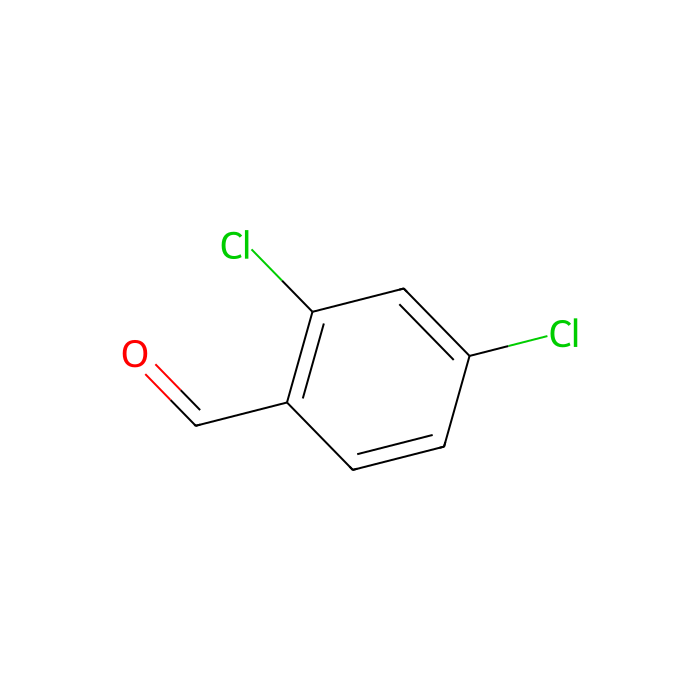
Determine the necessary mass, volume, or concentration for preparing a solution.
| Activity Type | Relation | Activity value | Units | Action Type | Journal | PubMed Id | doi | Assay Aladdin ID |
|---|

≥98% per flussi di lavoro cromatografici e analitici sensibili che richiedono un'interferenza minima della linea di base.
Protected from light,Room temperature,Argon charged Spedizione Normal. Consultare il COA specifico del lotto per le specifiche esatte.
SDS, COA, scheda tecnica e scheda delle specifiche disponibili per il download. COA specifico del lotto accessibile tramite ricerca per numero di lotto.
Citato in 3 pubblicazioni peer-reviewed su cromatografia, sintesi organica e reazioni di accoppiamento incrociato.
2,4-Dichlorobenzaldehyde on condensation with 4-amino-5-mercapto-3-methyl/ethyl-1,2,4-triazole yields bidentate Schiff base ligands and their metal complexes are potential antimicrobial agents
Documento completo su pericoli, manipolazione, stoccaggio e conformità normativa.
<<<<<<< HEAD Scarica SDS → ======= Scarica SDS → >>>>>>> release248-p3Dati di qualità specifici del lotto. Inserisci il numero di lotto per recuperare il COA esatto.
Cerca COA →Riepilogo di riferimento rapido delle specifiche e applicazioni del prodotto.
Visualizza scheda tecnica →Attributi di qualità completi e criteri di accettazione per questa qualità.
Visualizza scheda delle specifiche →Taxonomy Tree
| Kingdom | Organic compounds |
|---|---|
| Superclass | Benzenoids |
| Classe | Benzene and substituted derivatives |
| Subclass | Halobenzenes |
| Intermediate Tree Nodes | Chlorobenzenes |
| Direct Parent | Dichlorobenzenes |
| Alternative Parents | Benzoyl derivatives Benzaldehydes Aryl chlorides Vinylogous halides Organochlorides Organic oxides Hydrocarbon derivatives |
| Molecular Framework | Aromatic homomonocyclic compounds |
| Substituents | 1,3-dichlorobenzene - Benzoyl - Benzaldehyde - Aryl-aldehyde - Aryl halide - Aryl chloride - Vinylogous halide - Organic oxygen compound - Organic oxide - Hydrocarbon derivative - Organooxygen compound - Organochloride - Organohalogen compound - Aldehyde - Aromatic homomonocyclic compound |
| Descrizione | This compound belongs to the class of organic compounds known as dichlorobenzenes. These are compounds containing a benzene with exactly two chlorine atoms attached to it. |
| External Descriptors | Not available |
| Activity Type | Relation | Activity value | Units | Action Type | Journal | PubMed Id | doi | Assay Aladdin ID |
|---|
| Activity Type | Relation | Activity value | Units | Action Type | Journal | PubMed Id | doi | Assay Aladdin ID |
|---|
| Activity Type | Relation | Activity value | Units | Action Type | Journal | PubMed Id | doi | Assay Aladdin ID |
|---|
| Activity Type | Relation | Activity value | Units | Action Type | Journal | PubMed Id | doi | Assay Aladdin ID |
|---|
Find and download the COA for your product by matching the lot number on the packaging.
| Lot Number | Certificate Type | Data | Oggetto |
|---|---|---|---|
 L2417430 | Certificate of Analysis | Sep 07, 2026 | D100690 |
| L2417428 | Certificate of Analysis | Sep 07, 2026 | D100690 |
| B2315193 | Certificate of Analysis | Jul 30, 2026 | D100690 |
| F23061537 | Certificate of Analysis | Mar 04, 2025 | D100690 |
| I2118130 | Certificate of Analysis | Mar 04, 2025 | D100690 |
| I2118131 | Certificate of Analysis | Mar 04, 2025 | D100690 |
| I2118132 | Certificate of Analysis | Mar 04, 2025 | D100690 |
| G1523012 | Certificate of Analysis | Sep 04, 2024 | D100690 |
| D1903116 | Certificate of Analysis | Aug 08, 2024 | D100690 |
| H2522677 | Certificate of Analysis | Jul 10, 2024 | D100690 |
| H2522678 | Certificate of Analysis | Jul 10, 2024 | D100690 |
| D2003017 | Certificate of Analysis | Nov 03, 2023 | D100690 |
| F23061532 | Certificate of Analysis | Jun 15, 2023 | D100690 |
| Solubilità | Solubility in water: Practically insoluble; Very soluble in Alcohol,Ether,Toluene |
|---|---|
| Sensibilità | Light and Air sensitive |
| Punto di infiammabilità (°F) | 275 °F |
| Punto di infiammabilità (°C) | 135 °C |
| Punto di ebollizione (°C) | 233°C |
| Punto di fusione (°C) | 74.5°C |
| Peso molecolare | 175.010 g/mol |
| XLogP3 | 3.000 |
| Hydrogen Bond Donor Count | 0 |
| Hydrogen Bond Acceptor Count | 1 |
| Rotatable Bond Count | 1 |
| Exact Mass | 173.964 Da |
| Monoisotopic Mass | 173.964 Da |
| Topological Polar Surface Area | 17.100 Ų |
| Heavy Atom Count | 10 |
| Formal Charge | 0 |
| Complexity | 127.000 |
| Isotope Atom Count | 0 |
| Defined Atom Stereocenter Count | 0 |
| Undefined Atom Stereocenter Count | 0 |
| Defined Bond Stereocenter Count | 0 |
| Undefined Bond Stereocenter Count | 0 |
| The total count of all stereochemical bonds | 0 |
| Covalently-Bonded Unit Count | 1 |
No vendor-validated bioassay or analytical “application protocols” are specified for this item. However, below are general, literature-based procedural outlines for common uses of aryl aldehydes. These are not product specifications; adjust to your system.
Example 1: Schiff base formation (general)
Example 2: Oxime formation (general)
Example 3: Wittig olefination (general)
Quality control tips:
Always tailor stoichiometry, solvent, and temperature to your substrate set and scale.
Item is intended for research use only; no clinical/therapeutic claims.
General biochemical context (literature/general knowledge):
Caveats:
This compound is not a buffering agent and is not typically used to prepare biological or analytical buffers.
Practical notes:
For direct buffer recipes, pKa data and buffer capacity are irrelevant to this substrate; please consult the sections on Reaction & Applications and Reaction Conditions for guidance on using it within buffered or mixed-solvent systems.
Context: 2,4-Dichlorobenzaldehyde is itself a halogenated aromatic building block; there is no direct “green” substitute for its unique substitution pattern when it is the required target. However, greener choices can be made in solvents, reagents, and processing when using it.
Greener solvent choices (literature guidance):
Reagent/process improvements:
Trade-offs (balanced view):
Example comparison (literature):
Note: Selection should be guided by LCA metrics, PMI minimization, and solvent selection guides (e.g., GSK/CHEM21).
No excipient or pharmacopeial status is specified for this item; refer to CoA/Spec Sheet. For research use only.
General formulation/manufacturing context (literature):
Process considerations:
Item-specific properties: Not specified for this item; refer to CoA/Spec Sheet.
Literature/general reference values (typical for 2,4-dichlorobenzaldehyde; not product specifications):
Structural/physical implications (general knowledge):
Note: For exact specifications for this catalog item (e.g., assay, UV cutoff, residual solvents), consult the item’s CoA/Spec Sheet.
Item-specific grade/purity: Not specified for this item; refer to CoA/Spec Sheet.
Interpretive guidance (general):
Summary: Without an explicit grade on this listing, treat this as a general research-grade reagent and align acceptance criteria with your application requirements by reviewing the CoA and performing fit-for-use testing.
This aldehyde serves as a versatile electrophile and aryl platform. The 2,4-dichloro substitution withdraws electron density, modulating both carbonyl and ring reactivity.
Key transformations (literature):
Practical notes:
Applications include synthesis of halogenated aromatic scaffolds, ligands, and intermediates in agrochemical/materials research.
General literature guidance (not product specifications):
Imine formation: 2,4-dichlorobenzaldehyde (1.0 eq) with primary amine (1.0–1.2 eq) in toluene or EtOH, catalytic acid (acetic acid or p-TsOH, 0.1 eq). Reflux with Dean–Stark (toluene) 2–6 h, or room temp to 50 °C in EtOH with 3 Å molecular sieves. Typical isolated yields: 75–95% (substrate-dependent).
Oxime formation: Hydroxylamine hydrochloride (1.2–1.5 eq), base (pyridine or NaOAc), solvent EtOH/MeOH or MeCN/H2O, 25–60 °C, 2–8 h. Typical yields: 80–95%.
Wittig (non-stabilized ylide): THF, 0–25 °C to rt, 1–4 h under argon. For stabilized ylides/HWE (NaH/DBU base), THF/MeCN, 0–25 °C to reflux, 2–12 h. E/Z ratios depend on reagent class.
Grignard addition: RMgX (1.2–2.0 eq) in anhydrous THF/Et2O at −78 to 0 °C then warm to rt, 1–3 h; quench with NH4Cl. Yields: 70–95% for benzylic alcohols, sensitive to sterics and RMgX.
Reductive amination: Amine (1.1–2.0 eq), NaBH3CN (1.2–1.5 eq) or NaBH(OAc)3 in MeOH/EtOH/MeCN with AcOH (pH ~5–6), rt to 50 °C, 2–16 h. Alternative: H2 (1–5 bar), Pd/C in EtOH at rt–40 °C.
Suzuki–Miyaura on aryl chloride: Pd(II) precatalyst (e.g., Pd(dppf)Cl2 or Pd/XPhos system 1–3 mol%), base (K3PO4, Cs2CO3), solvent toluene/dioxane/H2O or DMF, 80–110 °C, 6–24 h. Protect aldehyde as acetal if needed to avoid side reactions.
Buchwald–Hartwig amination: Pd2(dba)3 (1–2 mol%) + BrettPhos/XPhos (3–6 mol%), NaOtBu or K3PO4, toluene/dioxane, 90–110 °C, 8–24 h.
Notes:
Item-specific hazard data (GHS, pictograms, H-statements): Not specified for this item; refer to SDS.
General safety considerations for aryl aldehydes (literature/guidance):
Always consult the product’s SDS for authoritative hazard classification and response guidance.
Applicability: As a solid aromatic aldehyde, solvent selection pertains to its use as a substrate/reagent in synthesis and purification rather than as a solvent itself.
General solubility/polarity considerations (literature):
Selection guidance by application:
Small comparison (literature trends):
Item-specific storage (from Product Data):
Best practices (general guidance for aryl aldehydes):
Reconstitution/handling:
Disposal:
Always refer to the product’s CoA and SDS for definitive storage limitations and handling instructions.
Brief overview: 2,4-Dichlorobenzaldehyde is an aromatic aldehyde bearing chloro substituents at the 2- and 4-positions, useful as an electrophilic building block in synthesis.
Item-specific (from Product Data):
Literature/computed identifiers and features (for reference; not item specifications):
2D structural description (general):
Functional group leverage (literature):
Named/typical reactions:
Strategic value:
Not applicable. This product is a small-molecule chemical reagent, not a biological targeting agent (e.g., antibody, enzyme inhibitor with defined biological target). No antigen/epitope, clone, isotype, or species reactivity applies.
For application-specific selectivity in synthesis (general):