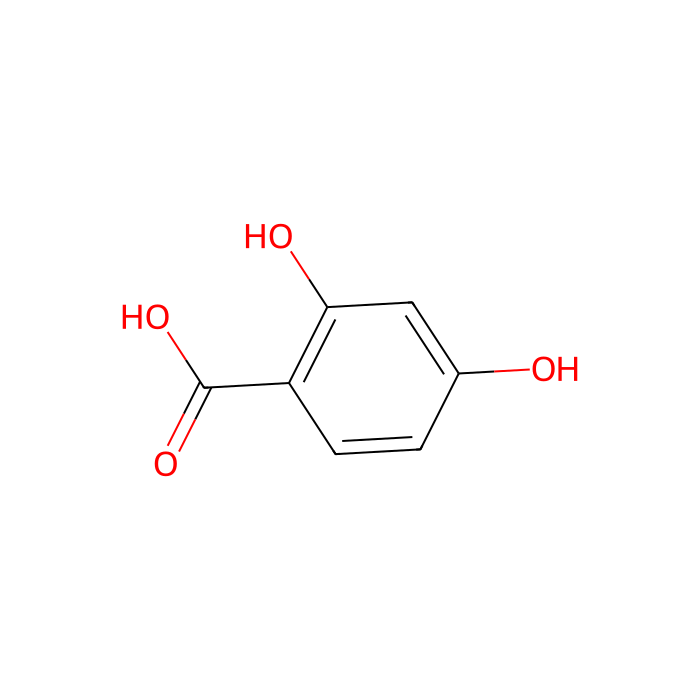
2,4-Dihydroxybenzoic acid - ≥98% , CAS No.89-86-1

CAS: 89-86-1 Cat. No.: D104371 Formula: C7H6O4 Peso molecolare: 154.12 Beilstein Registry Number: 1946213 Numero EC: 201-946-9
Disponibile su ordine
QUALITÀ & PUREZZA ≥98%
Storage
Protected from light,Room temperature
Shipped In
Normal
★
Dimensione
Germania (EU)
USA*
Prezzo
Qtà
25g
D104371-25g
—
3 Disponibile

8,59€

12,93€
Salva 4,34 € (33.56%)
100g
D104371-100g
—
9 Disponibile
19,87€
500g
D104371-500g
1 Disponibile
3 Disponibile

45,90€

69,33€
Salva 23,43 € (33.79%)
12×500g
D104371-12×500g
Su ordinazione · 8–12 settimane

467,62€

701,91€
Salva 234,29 € (33.38%)
Enter a quantity for the sizes you want to add.

Panoramica

It becomes anhydrous at 100°C.When coexisting with water, acid, or salt solutions, carbon dioxide is lost.Soluble in hot water, ethanol, ether, and olive oil, but practically insoluble in benzene.Irritating.Water solubility: 8 g/L (20°C).Iron titration reagent.Dyes and pharmaceutical intermediates.This compound possesses the chemical properties of resorcinol and salicylic acid, and is used for colorimetric determination of iron, titanium, and other elements in chemical reagents. In organic synthesis, it primarily serves as a dye and pharmaceutical intermediate.

Specifiche

Specifiche e purezza
≥98%
Condizioni di conservazione di stoccaggio
Protected from light,Room temperature
Spedito in
Normal
Purezza
≥98%
Product Line
D104371-25g
Nomi e identificatori
Pubchem Sid
Pubchem Sid Url
https://pubchem.ncbi.nlm.nih.gov/substance/488179626
SMILES
C1=CC(=C(C=C1O)O)C(=O)O
IUPAC Name
2,4-dihydroxybenzoic acid
InChIKey
UIAFKZKHHVMJGS-UHFFFAOYSA-N
InChI
1S/C7H6O4/c8-4-1-2-5(7(10)11)6(9)3-4/h1-3,8-9H,(H,10,11)
Isomeri SMILES
C1=CC(=C(C=C1O)O)C(=O)O
WGK Germania
1
RTECS
VH3708050
Peso molecolare
154.12
Beilstein
1946213
Reaxy-Rn
1946213
Reaxys-RN_link_address
https://www.reaxys.com/reaxys/secured/hopinto.do?context=S&query=IDE.XRN=1946213&ln=

Dati avanzati

Struttura 3D
Modello di struttura chimica interattiva


Obiettivi associati (umani)
CA2 Tclin Carbonic anhydrase II (17698 Activities)
Activity TypeRelationActivity valueUnitsAction TypeJournalPubMed IddoiAssay Aladdin ID
ALOX5 Tclin Arachidonate 5-lipoxygenase (6568 Activities)
Activity TypeRelationActivity valueUnitsAction TypeJournalPubMed IddoiAssay Aladdin ID
AR Tclin Androgen Receptor (11781 Activities)
Activity TypeRelationActivity valueUnitsAction TypeJournalPubMed IddoiAssay Aladdin ID
CYP19A1 Tclin Cytochrome P450 19A1 (6099 Activities)
Activity TypeRelationActivity valueUnitsAction TypeJournalPubMed IddoiAssay Aladdin ID
TYR Tclin Tyrosinase (717 Activities)
Activity TypeRelationActivity valueUnitsAction TypeJournalPubMed IddoiAssay Aladdin ID
TSHR Tclin Thyroid stimulating hormone receptor (29986 Activities)
Activity TypeRelationActivity valueUnitsAction TypeJournalPubMed IddoiAssay Aladdin ID
PPARG Tclin Peroxisome proliferator-activated receptor gamma (15191 Activities)
Activity TypeRelationActivity valueUnitsAction TypeJournalPubMed IddoiAssay Aladdin ID
CSNK2A1 Tchem Casein kinase II alpha (3512 Activities)
Activity TypeRelationActivity valueUnitsAction TypeJournalPubMed IddoiAssay Aladdin ID
CA1 Tclin Carbonic anhydrase I (13240 Activities)
Activity TypeRelationActivity valueUnitsAction TypeJournalPubMed IddoiAssay Aladdin ID
CA14 Tclin Carbonic anhydrase XIV (1305 Activities)
Activity TypeRelationActivity valueUnitsAction TypeJournalPubMed IddoiAssay Aladdin ID
MMP3 Tchem Matrix metalloproteinase 3 (3433 Activities)
Activity TypeRelationActivity valueUnitsAction TypeJournalPubMed IddoiAssay Aladdin ID
MMP8 Tchem Matrix metalloproteinase 8 (1942 Activities)
Activity TypeRelationActivity valueUnitsAction TypeJournalPubMed IddoiAssay Aladdin ID
ALDH1A1 Tchem Aldehyde dehydrogenase 1A1 (77053 Activities)
Activity TypeRelationActivity valueUnitsAction TypeJournalPubMed IddoiAssay Aladdin ID
CA12 Tclin Carbonic anhydrase XII (6231 Activities)
Activity TypeRelationActivity valueUnitsAction TypeJournalPubMed IddoiAssay Aladdin ID
CA9 Tclin Carbonic anhydrase IX (8255 Activities)
Activity TypeRelationActivity valueUnitsAction TypeJournalPubMed IddoiAssay Aladdin ID
MMP1 Tchem Matrix metalloproteinase-1 (7046 Activities)
Activity TypeRelationActivity valueUnitsAction TypeJournalPubMed IddoiAssay Aladdin ID
HFF (3142 Activities)
Activity TypeRelationActivity valueUnitsAction TypeJournalPubMed IddoiAssay Aladdin ID
Lymphoblastoid cell (5959 Activities)
Activity TypeRelationActivity valueUnitsAction TypeJournalPubMed IddoiAssay Aladdin ID
GMNN Tbio Geminin (128009 Activities)
Activity TypeRelationActivity valueUnitsAction TypeJournalPubMed IddoiAssay Aladdin ID
CBX1 Tbio Chromobox protein homolog 1 (92434 Activities)
Activity TypeRelationActivity valueUnitsAction TypeJournalPubMed IddoiAssay Aladdin ID
ATAD5 Tbio ATPase family AAA domain-containing protein 5 (122566 Activities)
Activity TypeRelationActivity valueUnitsAction TypeJournalPubMed IddoiAssay Aladdin ID
IDH1 Tclin Isocitrate dehydrogenase [NADP] cytoplasmic (40980 Activities)
Activity TypeRelationActivity valueUnitsAction TypeJournalPubMed IddoiAssay Aladdin ID
RAPGEF3 Tchem Rap guanine nucleotide exchange factor 3 (15528 Activities)
Activity TypeRelationActivity valueUnitsAction TypeJournalPubMed IddoiAssay Aladdin ID
GLS Tchem Glutaminase kidney isoform, mitochondrial (16997 Activities)
Activity TypeRelationActivity valueUnitsAction TypeJournalPubMed IddoiAssay Aladdin ID
HEK-293T (167025 Activities)
Activity TypeRelationActivity valueUnitsAction TypeJournalPubMed IddoiAssay Aladdin ID
Obiettivi associati (non umani)
Ca7 Carbonic anhydrase VII (3 Activities)
Activity TypeRelationActivity valueUnitsAction TypeJournalPubMed IddoiAssay Aladdin ID
Ppard Peroxisome proliferator-activated receptor delta (358 Activities)
Activity TypeRelationActivity valueUnitsAction TypeJournalPubMed IddoiAssay Aladdin ID
Nos2 Nitric oxide synthase, inducible (3573 Activities)
Activity TypeRelationActivity valueUnitsAction TypeJournalPubMed IddoiAssay Aladdin ID
Mmp2 Matrix metalloproteinase-2 (12 Activities)
Activity TypeRelationActivity valueUnitsAction TypeJournalPubMed IddoiAssay Aladdin ID
Mmp9 Matrix metalloproteinase 9 (38 Activities)
Activity TypeRelationActivity valueUnitsAction TypeJournalPubMed IddoiAssay Aladdin ID
Trypanosoma brucei (78846 Activities)
Activity TypeRelationActivity valueUnitsAction TypeJournalPubMed IddoiAssay Aladdin ID
Trypanosoma brucei brucei (13300 Activities)
Activity TypeRelationActivity valueUnitsAction TypeJournalPubMed IddoiAssay Aladdin ID
Plasmodium falciparum (966862 Activities)
Activity TypeRelationActivity valueUnitsAction TypeJournalPubMed IddoiAssay Aladdin ID
lef Anthrax lethal factor (7585 Activities)
Activity TypeRelationActivity valueUnitsAction TypeJournalPubMed IddoiAssay Aladdin ID
Nfe2l2 Nuclear factor erythroid 2-related factor 2 (214 Activities)
Activity TypeRelationActivity valueUnitsAction TypeJournalPubMed IddoiAssay Aladdin ID
Meccanismi d'azione
Certificati (CoA, COO, BSE/TSE e tabella di analisi)
C of A & Other Certificates(BSE/TSE, COO):
Analytical Chart:

Find and download the COA for your product by matching the lot number on the packaging.

24 results found

Lot NumberCertificate TypeDataOggetto
E2609312E2609312Certificate of AnalysisApr 22, 2026 D104371
E2609311E2609311Certificate of AnalysisApr 22, 2026 D104371
E2609313E2609313Certificate of AnalysisApr 22, 2026 D104371
C2631103C2631103Certificate of AnalysisApr 06, 2026 D104371
H2126082H2126082Certificate of AnalysisJun 09, 2025 D104371
C2127026C2127026Certificate of AnalysisJan 13, 2025 D104371
I2510126I2510126Certificate of AnalysisDec 16, 2024 D104371
C2512647C2512647Certificate of AnalysisDec 16, 2024 D104371
C2512648C2512648Certificate of AnalysisDec 16, 2024 D104371
K2427397K2427397Certificate of AnalysisNov 18, 2024 D104371
C2421317C2421317Certificate of AnalysisMar 02, 2024 D104371
C2408209C2408209Certificate of AnalysisFeb 28, 2024 D104371
C2408230C2408230Certificate of AnalysisFeb 28, 2024 D104371
A2009124A2009124Certificate of AnalysisOct 07, 2023 D104371
B2327035B2327035Certificate of AnalysisMar 01, 2023 D104371
B2327188B2327188Certificate of AnalysisFeb 17, 2023 D104371
B2327189B2327189Certificate of AnalysisFeb 17, 2023 D104371
B2327197B2327197Certificate of AnalysisFeb 17, 2023 D104371
L2322160L2322160Certificate of AnalysisFeb 25, 2022 D104371
C2219488C2219488Certificate of AnalysisFeb 25, 2022 D104371
C2219479C2219479Certificate of AnalysisFeb 25, 2022 D104371
B2301555B2301555Certificate of AnalysisFeb 25, 2022 D104371
B2327036B2327036Certificate of AnalysisNov 10, 2021 D104371
B2301230B2301230Certificate of AnalysisAug 12, 2021 D104371
Proprietà chimiche e fisiche
SolubilitàSoluble in 95% ethanol (50 mg/ml), ether, alcohols, water (8 mg/ml at 20 °C), and water (70 mg/ml at 70 °C).
SensibilitàLight sensitive.
Punto di fusione (°C)218°C
Peso molecolare154.120 g/mol
XLogP31.600
Hydrogen Bond Donor Count3
Hydrogen Bond Acceptor Count4
Rotatable Bond Count1
Exact Mass154.027 Da
Monoisotopic Mass154.027 Da
Topological Polar Surface Area77.800 Ų
Heavy Atom Count11
Formal Charge0
Complexity157.000
Isotope Atom Count0
Defined Atom Stereocenter Count0
Undefined Atom Stereocenter Count0
Defined Bond Stereocenter Count0
Undefined Bond Stereocenter Count0
The total count of all stereochemical bonds0
Covalently-Bonded Unit Count1
Citations of This Product
Calcolatori di soluzioni
Recensioni

Recensioni dei clienti

Application Protocols

No item-specific tested application protocols are provided for this product; refer to CoA/Spec Sheet.

General usage examples (literature-based; for research use only):

  • Preparation of stock solutions: Dissolve in DMSO (e.g., 100 mM) or in aqueous NaOH (e.g., 10–100 mM), then dilute into assay media while monitoring pH to avoid precipitation.
  • MALDI matrix screening: Prepare saturated solutions in MeOH/H2O or ACN/H2O with 0.1% TFA; co-crystallize with analyte and iterate matrix/analyte ratios. Note: 2,5-DHB is more commonly used; 2,4-DHB may be evaluated empirically.
  • Esterification setup: For Fischer conditions, combine alcohol solvent, catalytic acid, and the acid; heat to reflux with water removal; monitor by TLC/HPLC.

Always adapt conditions to your system and consult primary literature/SOPs.

Biological Roles

This section provides general biochemical context for 2,4-dihydroxybenzoic acid; it does not imply biological/clinical use of this catalog item.

  • Phenolic acid class: Dihydroxybenzoic acids are plant- and microbe-associated phenolics arising from shikimate/chorismate pathways and downstream transformations of benzoic acid frameworks.
  • Redox/antioxidant behavior: Phenolic OH groups can act as hydrogen atom donors and metal chelators, contributing to radical-scavenging capacity in model systems (literature). The ortho-OH relative to CO2H enhances intramolecular hydrogen bonding and can influence redox potential.
  • Metal binding: The 2-hydroxy–carboxylate arrangement forms salicylate-like chelates with transition metals, relevant in microbial siderophore fragments and coordination models (literature).
  • Interactions with biomacromolecules: Aromatic acids can bind via π–π and H-bond interactions to proteins and polysaccharides in vitro; binding strength depends on pH and ionization state (literature).

Notes:

  • pKa values govern ionization at physiological pH; deprotonation of the carboxyl group predominates near neutral pH, affecting transport and binding.
  • Any biological activity discussed here is general background. This product is supplied strictly for research use only, as noted by the manufacturer.
Buffer Applications

Not typically used as a primary buffering agent. While 2,4-dihydroxybenzoic acid has multiple acidic protons (carboxyl and phenolic), standard biological buffers (e.g., phosphate, Tris, HEPES) offer superior buffering capacity and compatibility.

Practical notes (general):

  • Stock solutions: Can be prepared in aqueous base (e.g., NaOH) to aid dissolution, then adjusted to target pH. Precipitation may occur if adjusted near the pKa values; verify solubility at working pH.
  • Chelation: The ortho-hydroxy/carboxylate motif can chelate metals; avoid using it in metal-sensitive assays unless complexation is desired.
Green Alternatives

Context: This product is a solid building block rather than a solvent; green considerations focus on solvent and reagent choices during its use and on sourcing.

Greener choices (general guidance):

  • Solvents for dissolution/coupling:
    • Prefer EtOH, i-PrOH, water (with pH control) over DMF/DMSO where feasible.
    • Replace DCM with ethyl acetate or 2-MeTHF for extractions or acylations when compatible.
  • Coupling reagents:
    • Consider carbodiimide couplings in water/EtOH (EDC·HCl) or green peptide-coupling alternatives that minimize hazardous byproducts, versus DCC in DCM.
  • Protection/deprotection:
    • Use catalytic methods (e.g., phase-transfer for O-alkylation in greener solvents) and hydrogenolysis (for benzyl ethers) under mild conditions to reduce waste.
  • Energy and work-up:
    • Employ crystallization-driven purifications (acid-base precipitation) to avoid chromatography when possible.

Illustrative comparison (general; example choices):

  • DMF vs. EtOH/H2O (pH-adjusted): EtOH/H2O reduces toxicity and facilitates work-up but may limit solubility for highly substituted derivatives.
  • DCM vs. 2-MeTHF/EtOAc: Greener solvents often provide comparable reaction performance; boiling points and miscibility differ—consider heat removal and separations.

Sourcing considerations:

  • Benzoic-acid derivatives can be prepared from renewable aromatics (e.g., biobased catechol/phenol streams); where relevant, inquire about supplier sustainability disclosures.
Pharmaceutical Uses

No item-specific pharmacopeial status or excipient use is specified for this product; refer to CoA/Spec Sheet if applicable.

General context (non-clinical, formulation/manufacturing focus):

  • Phenolic benzoic acids and their esters/amides are common intermediates in the synthesis of actives, auxiliaries, and UV-absorbing materials. 2,4-Dihydroxybenzoic acid can serve as a scaffold for derivatization (e.g., esterification, etherification) to access libraries of aromatic derivatives for screening.
  • As an excipient: Not commonly used directly as a pharmaceutical excipient. Its acidity and phenolic functionality could, in principle, affect stability of basic actives via salt formation or redox interactions; such use would require dedicated development and regulatory assessment.

Compliance note: This material is provided for research use only and is not intended for human or veterinary use or for incorporation into finished drug products without appropriate qualification.

Physical Properties

Item-specific specifications: Not specified for this item; refer to CoA/Spec Sheet.

Literature/general physical data (typical values; not item-specific):

  • Appearance: off-white to tan crystalline solid (literature)
  • Melting point: ~234–238 °C (literature)
  • Boiling point: decomposes before boiling; BP not commonly reported under ambient pressure (literature)
  • Density: ~1.6–1.7 g/cm³ (solid; literature estimates)
  • Acidity (pKa, aqueous, 25 °C): pKa(COOH) ~2.8–3.0; pKa(Ar–OH) ~8.8–9.5 (position-dependent; literature)
  • logP (octanol/water): ~1.1–1.3 (unionized form; literature)
  • Solubility: sparingly soluble in water at neutral pH; readily soluble in aqueous base (forms phenolate/carboxylate); soluble in polar organics such as ethanol, methanol, acetone, and DMSO (literature)
  • UV characteristics: strong UV absorption in the 200–300 nm region due to aromatic and phenolic chromophores (literature)

Notes for use (general):

  • Aqueous solubility increases markedly with pH; dissolution is facilitated by adjusting to basic pH (e.g., NaOH) and back-titrating if needed.
  • Hygroscopicity: generally low, but solid can hold surface moisture; dry prior to quantitative use if necessary (desiccator, mild vacuum).
Quality and Grades

Item-specific grade/purity information: Not specified for this item; refer to CoA/Spec Sheet.

General guidance on grades for solid organic building blocks:

  • Research grade: Suitable for most synthetic and analytical applications; typical assays specify mass purity by HPLC/GC/acid-base titration and limits on related phenolic impurities.
  • High-purity/trace-metal screened variants (when available): Useful for catalysis-sensitive transformations or materials applications; specifications may include metal content by ICP-MS and low residual solvents.
  • HPLC grade (for solvents) does not apply; for solids, “HPLC tested” often refers to assay method rather than chromatographic suitability.

Stabilizers/inhibitors:

  • Phenolic carboxylic acids like 2,4-dihydroxybenzoic acid generally do not require stabilizers. Absence/presence of any additive should be verified on the CoA if analytically critical.

What to check on receipt:

  • Assay method and result; identity confirmation (1H NMR/IR/MS match).
  • Water content (Karl Fischer) and residual solvents—if relevant to your application. If not listed on the item CoA: Not specified for this item; refer to CoA/Spec Sheet.
  • Appearance and melting point consistency with literature can serve as quick quality checks (recognizing polymorph/solvate possibilities).
Reaction and Applications

Expanded application context (general; literature-based):

  • Aromatic building block: The 2,4-dihydroxy pattern enables directed electrophilic substitution (e.g., sulfonation, nitration) with the ortho/para-directing phenolic groups and deactivating carboxyl group, allowing regiocontrol strategies.
  • Ester/amide derivatives: Carboxyl activation (SOCl2/oxalyl chloride; EDC/HOBt; DCC) affords acyl derivatives. Phenolic OH groups can be protected (e.g., methyl/benzyl ethers) to prevent side reactions during acylation.
  • O-Alkylation: Phenolic oxygens undergo SN2 alkylation under basic conditions (K2CO3, DMF or acetone) generating mono- or di-ethers; selectivity can sometimes be tuned via protecting groups or differential acidity.
  • Chelation/coordination: The salicylate-like 2-hydroxy motif adjacent to the carboxyl can chelate metals; the 4-hydroxy adds an additional donor site, supporting complexation studies.
  • Analytical matrices: Dihydroxybenzoic acids are widely used as matrices in MALDI-MS (2,5-DHB is most common). 2,4-DHB has been explored for certain analyte classes; matrix choice should be empirically optimized.

Practical tips:

  • Drying: For moisture-sensitive couplings, pre-dry the solid (vacuum, 50–60 °C) and use anhydrous solvents.
  • Selective functionalization: Temporarily protect phenols (e.g., MOM, Bn) to enable selective amide formation at the carboxyl.
  • Neutralization/isolation: After aqueous-base work, re-acidify to pH ~2 to precipitate the free acid (cold conditions aid crystallization).
Reaction Conditions

General literature guidance (illustrative; not item-specific specifications):

  • Fischer esterification:

    • Conditions: Neat ROH (MeOH/EtOH), catalytic H2SO4 or p-TsOH (1–5 mol%), reflux 4–24 h.
    • Notes: Water removal (Dean–Stark for higher alcohols) improves conversion. Protect phenols to suppress O-acylation or use Steglich conditions.
  • Steglich/EDC esterification:

    • Solvent: DCM/DMF or EtOAc; reagents: DCC (1.1–1.2 equiv) + DMAP (0.05–0.1 equiv) or EDC·HCl with catalytic DMAP.
    • Temperature: 0 °C to rt; time: 2–16 h. Filter off urea byproducts; wash to remove DMAP.
  • Amide coupling:

    • Reagents: HATU/HBTU (1.1–1.3 equiv) or EDC/HOBt alternatives; base: DIPEA (2–3 equiv).
    • Solvent: DMF/NMP/MeCN; Temperature: 0–25 °C, 2–12 h. Protect phenols if chemoselectivity is an issue.
  • O-Alkylation of phenols:

    • Base: K2CO3 or Cs2CO3 (2–3 equiv); electrophile: alkyl halide/sulfate (1.2–2 equiv).
    • Solvent: DMF/acetone/MeCN; Temperature: 25–60 °C; Time: 2–18 h. Use phase-transfer (TBAB) in greener solvents to reduce DMF usage.
  • Acid chloride formation:

    • Reagents: SOCl2 (3–5 equiv) with catalytic DMF; Solvent: toluene or neat; reflux 1–3 h.
    • Quench carefully; isolate and use in situ to avoid decomposition. Protect phenols before conversion when selective acylation is needed.
  • Metal complexation (salicylate motif):

    • Typical: M(II) salts (e.g., Cu, Ni, Co) in EtOH/H2O, pH 7–9 to generate phenolate/carboxylate ligation; stir at rt–reflux for 1–6 h; isolate complexes by filtration/crystallization.
Safety and Handling

Item-specific hazard classification: Not specified for this item; refer to the SDS for authoritative information.

General GHS considerations for phenolic carboxylic acids (literature-based guidance):

  • Likely hazards: Eye irritation, skin irritation, and respiratory tract irritation if dusts are inhaled. Phenolic compounds can cause defatting of skin.
  • Precautionary measures: Avoid breathing dust; prevent eye/skin contact; use with adequate ventilation or local exhaust.

Personal protective equipment (typical laboratory practice):

  • Safety glasses or chemical splash goggles; lab coat; appropriate gloves (e.g., nitrile). For dusty handling, consider a particulate respirator per institutional risk assessment.

Handling and storage:

  • From Product Data: Store protected from light, at room temperature. Ship under normal conditions.
  • Keep container tightly closed in a dry place. Minimize dust generation. Avoid incompatible materials (strong oxidizers; strong bases/acids for prolonged storage if purity must be maintained).

First-aid overview (general):

  • Inhalation: Move to fresh air; seek medical attention if symptoms persist.
  • Skin contact: Wash with soap and water; remove contaminated clothing.
  • Eye contact: Rinse cautiously with water for several minutes; remove contact lenses if present and easy.
  • Ingestion: Rinse mouth; do not induce vomiting; seek medical advice.

Disposal: Dispose in accordance with local regulations; phenolic acids are typically managed as organic laboratory waste.

Always consult the product’s SDS for definitive hazards, exposure limits, and emergency measures.

Solvent Selection

Applicability: As a solid phenolic carboxylic acid, solvent selection concerns its dissolution for reaction or analysis rather than its use as a solvent.

General solubility/polarity guidance (literature):

  • Water: Low solubility at neutral pH; high solubility in basic aqueous media (formation of phenolate/carboxylate salts).
  • Alcohols (MeOH, EtOH), acetone, acetonitrile: Moderate to good solubility when warmed.
  • DMSO/DMF: High solubility; common for stock solutions and coupling reactions.
  • Nonpolar solvents (hexanes, toluene): Poor solubility unless converted to an ester/ether derivative.

Selection tips:

  • For analytical stocks: DMSO or MeOH are convenient; dilute into aqueous buffers with pH adjustment to avoid precipitation.
  • For esterifications (Fischer): Use anhydrous ROH (solvent and reagent) with acid catalysis.
  • For amide couplings: DMF, NMP, or DCM with carbodiimides/uronium reagents.
  • For O-alkylation: Polar aprotic solvents (DMF/acetone/MeCN) with K2CO3/Cs2CO3.

Quick comparison (general):

  • DMSO: maximal solubility; high boiling, hygroscopic.
  • MeOH/EtOH: greener profile; may require heat.
  • Aqueous base: excellent solubility; requires downstream neutralization for isolating the free acid.
Storage and Reconstitution

Item-specific storage and shipping (from Product Data):

  • Storage conditions: Protected from light, Room temperature.
  • Shipped in: Normal conditions.

General storage guidance:

  • Keep tightly closed in original container. Store in a dry place; desiccation is recommended for long-term storage to maintain constant mass.
  • Avoid prolonged exposure to strong light and elevated temperatures to prevent discoloration or slow oxidation.

Reconstitution/preparation notes (general):

  • For aqueous work: Dissolve in minimal NaOH or buffer above the pKa to aid dissolution; adjust pH after dissolution if the free acid is required in solution.
  • For organic solutions: DMSO, DMF, MeOH, or EtOH provide convenient stock solutions. Filter if particulate remains.
  • If precise stoichiometry is critical, consider drying the solid under vacuum (e.g., 50–60 °C, several hours) prior to weighing.

Freeze-thaw considerations:

  • As a solid, not applicable. For prepared solutions, store aliquots at appropriate temperatures (e.g., 2–8 °C for short term; −20 °C for longer term) and protect from light; equilibrate to room temperature before use to avoid precipitation.
Structure and Identity

Brief description: 2,4-Dihydroxybenzoic acid is a dihydroxy-substituted benzoic acid (a phenolic carboxylic acid) with hydroxyl groups at the 2- and 4-positions relative to the carboxyl group.

  • Item-specific identifiers (from Product Data):

    • CAS: 89-86-1
    • PubChem CID: 1491
    • InChIKey: Not specified for this item; refer to CoA/Spec Sheet.
    • SMILES: Not specified for this item; refer to CoA/Spec Sheet.
  • Literature/general identifiers and composition (for reference; not item-specific):

    • Synonym: β-Resorcylic acid
    • Molecular formula: C7H6O4 (literature)
    • Molecular weight: 154.12 g/mol (literature)
  • Structural features (general description):

    • Aromatic ring bearing a carboxylic acid at C-1 and phenolic OH groups at C-2 (ortho) and C-4 (para) relative to the carboxyl.
    • Functional groups: one carboxylic acid (–CO2H), two phenols (Ar–OH).
    • Hydrogen-bond donors/acceptors: donors (2 phenolic OH, 1 carboxylic OH); acceptors (carboxylate O atoms and phenolic O when deprotonated).
    • 2D depiction in words: a benzene ring with –CO2H at position 1; –OH at positions 2 and 4.
Synthetic Utility

Functional group portfolio:

  • Carboxylic acid (–CO2H): amenable to esterification, amidation, and acyl chloride formation; can direct electrophilic aromatic substitution.
  • Two phenolic OH groups (at 2 and 4): enable O-alkylation/acylation and serve as handles for protecting group strategies. The ortho-OH engages in intramolecular H-bonding with the carboxyl, influencing reactivity and chelation.

Representative transformations (literature):

  • Esterification: Fischer conditions (ROH, catalytic H2SO4 or p-TsOH), Steglich (DCC/DMAP), or EDC-mediated in mixed solvents.
  • Amide formation: Via acid chloride (SOCl2, oxalyl chloride) or coupling reagents (HATU/HBTU/EDC) with amines; protect phenols if needed to avoid O-acylation.
  • O-Alkylation: K2CO3/Cs2CO3 with alkyl halides or sulfate esters in DMF/acetone/MeCN; phase-transfer catalysis can improve selectivity.
  • Electrophilic substitution: Nitration/sulfonation directed by phenolic activation; subsequent reduction/cross-coupling gives diversified scaffolds.
  • Cross-coupling via activated derivatives: Convert phenols to aryl triflates/mesylates for Pd-catalyzed C–C/C–N bond formation downstream.
  • Metal complexation: Formation of salicylate-type chelates useful as catalysts or functional materials.

Retrosynthetic value:

  • Serves as a regio-defined entry to 2,4-disubstituted aryl architectures; orthogonal manipulation of the three functional sites (CO2H, 2-OH, 4-OH) enables stepwise diversification.
Target Specificity

Not applicable. This product is a small-molecule chemical and is not an antibody, enzyme, or biological probe with defined target specificity. For functional uses, see Reaction & Applications and Synthetic Utility.

Domande frequenti

What is the purity of this product?
This product is supplied at ≥98% purity (chemical assay). Lot-specific values are stated on the Certificate of Analysis.
How should this product be stored?
Store at room temperature, protected from light. The material is light-sensitive — keep it in its original opaque or amber container.
How is this product shipped?
This product ships under standard ambient conditions. No temperature-controlled packaging is required.
What are the CAS number, molecular formula and molecular weight?
The CAS Number is 89-86-1, the molecular formula is C7H6O4, and the molecular weight is 154.12 g/mol. InChIKey UIAFKZKHHVMJGS-UHFFFAOYSA-N.
What documentation is provided?
Available product documentation, including Certificates of Analysis (COA), Safety Data Sheets (SDS), and specification sheets, is shown in the product document area. Document availability and access follow the current site policy.

Desidera che le inviamo un messaggio quando avremo sconti disponibili?

Ricordamelo più tardi

Grazie! Controlli la sua casella di posta per confermare.

Ops! Le notifiche sono disabilitate.