This compound belongs to the class of organic compounds known as nitrobenzoic acids and derivatives. These are compounds containing a nitrobenzoic acid moiety, which consists of a benzene ring bearing both a carboxylic acid group and a nitro group on two different ring carbon atoms.
External Descriptors
Not available
1. Djoumbou Feunang Y, Eisner R, Knox C, Chepelev L, Hastings J, Owen G, Fahy E, Steinbeck C, Subramanian S, Bolton E, Greiner R, and Wishart DS. ClassyFire: Automated Chemical Classification With A Comprehensive, Computable Taxonomy. Journal of Cheminformatics, 2016, 8:61.
Determine the necessary mass, volume, or concentration for preparing a solution.
Dilution Calculator
Determine the dilution needed to prepare a stock solution.
Reconstitution Calculator
Recensioni
Recensioni dei clienti
Application Protocols
No standardized bioassay or immunoassay protocols apply to this small-molecule building block.
General laboratory usage suggestions (non-specific):
Prepare stock solutions in dry DMSO (e.g., 10–100 mM) for HTS or reaction setup; aliquot to minimize freeze–thaw and moisture exposure.
For synthetic applications, follow the Reaction Conditions section for representative procedures (amide coupling, esterification, nitro reduction, decarboxylative coupling), adapting equivalents and solvents to your substrate set.
For any specific procedural needs, consult peer-reviewed literature or method notes relevant to your transformation.
Biological Roles
Item-specific bioactivity data are not provided for this SKU.
General context (literature/general):
Benzoic acid derivatives are common xenobiotics in biological systems and can undergo Phase I/II metabolism (e.g., reduction of nitro groups to amines by bacterial nitroreductases; conjugation of carboxylates as glycine or glucuronide conjugates in mammals).
Nitroaromatic compounds may display redox activity in microbial environments; the nitro group can be biotransformed to hydroxylamine/aniline under enzymatic or hypoxic conditions, potentially altering physicochemical properties (pKa, logD) and transport.
With two methyl groups and a nitro substituent, the compound is lipophilicity- and acidity-balanced, suggesting pH-dependent membrane partitioning and potential for transporter-mediated uptake in ionized form as benzoate salts.
Important: No medical or clinical claims are made. This product is supplied strictly for research use, including chemical biology, probe development, and method validation, without any implied therapeutic function.
Buffer Applications
This compound is not a conventional buffering agent. As an aromatic monocarboxylic acid, it can ionize near acidic pH, but its limited aqueous solubility and single pKa make it unsuitable as a primary buffer component.
Practical notes (general):
Solubilization in aqueous systems is markedly improved above its pKa by forming the benzoate salt with NaOH/KOH; this can aid preparation of analytical standards or for pH-dependent solubility studies.
For experiments requiring defined pH control, use dedicated buffer systems (e.g., citrate pH 3–6, acetate pH 3.6–5.6, phosphate pH 6–8) and dissolve this compound as a solute within the buffered matrix, adjusting with minimal organic cosolvent (DMSO ≤1–2% v/v) where necessary.
For buffer recipes and pH stability, rely on standard buffer components rather than this reagent.
Green Alternatives
While the compound itself is a solid building block (not replaceable per se), its use can be paired with greener media and processes. Consider the following substitutions in typical transformations (literature/general guidance):
Solvent choices:
Replace DMF/NMP with dimethyl carbonate (DMC), propylene carbonate, or Cyrene in certain coupling/esterification contexts when solubility allows.
Use 2-MeTHF or CPME instead of DCM/THF for Steglich esterifications or acyl chloride reactions to reduce peroxide formation and improve EHS profile.
Employ ethanol/water or PEG-400 as media for catalytic hydrogenations of the nitro group when compatible.
Coupling reagents and activation:
Use water-compatible carbodiimides (EDC) with catalytic NHS in mixed aqueous organics to minimize urea waste handling; or deploy enzymatic/biocatalytic amidations where feasible.
Consider green activating agents (e.g., T3P in EtOAc) versus DCC in DCM to ease workup and reduce allergenic urea byproducts.
Energy and catalysis:
Conduct reductions with transfer hydrogenation (e.g., HCOONH4 or isopropanol) instead of high-pressure H2 where appropriate.
Apply photoredox decarboxylative couplings under visible light in benign solvents, which can reduce reliance on preformed aryl halides.
Trade-offs:
Greener solvents may reduce solubility, impacting rate/yield; mild reagents can require longer times or higher catalyst loadings. Validate on small scale and monitor by HPLC/GC to optimize conditions.
Pharmaceutical Uses
No pharmacopeial monograph or excipient role is specified for this item.
General formulation/manufacturing relevance (non-clinical; literature/general):
Intermediate: Aromatic carboxylic acids bearing nitro groups are frequently used as intermediates en route to anilides, anilines, ureas, and heteroaryl linkages in API development campaigns.
Prodrug strategies: The carboxylate can be derivatized to esters to modulate permeability in discovery studies, with subsequent hydrolysis to unveil the acid (research context only).
Salt formation: Conversion to sodium/potassium benzoate salts can enhance aqueous handling in process development, though the nitro functionality requires attention to redox compatibility.
This product is supplied for research use only. No therapeutic, diagnostic, or clinical application is implied.
Physical Properties
Item-specific specifications (this lot):
Melting/boiling point, density, refractive index, UV cutoff, water/peroxide/metal content: Not specified for this item; refer to CoA/Spec Sheet.
General/literature expectations for the class (benzoic acids with nitro and methyl substituents):
Physical state: typically a crystalline solid; nitrobenzoic acids commonly form pale yellow to off-white crystals.
Acidity: pKa of nitrobenzoic acids is usually stronger than benzoic acid due to the –NO2 group; typical pKa range for m-nitrobenzoic acids is ~3.3–3.6 (literature, analogous compounds). The two methyl groups can slightly offset acidity via inductive/hyperconjugative effects.
Solubility (qualitative): sparingly soluble in water at neutral pH; readily soluble in polar organic solvents (DMSO, DMF, acetone) and in lower alcohols upon gentle heating; highly soluble in basic aqueous media as the benzoate salt.
Partitioning: aryl carboxylic acids with one –NO2 and two –Me substituents commonly show moderate hydrophobicity in the neutral form (logP often in the 1.5–2.5 range; literature for analogs), with strong pH-dependent distribution (high logD decrease above pKa).
Thermal behavior: nitroaromatic benzoic acids generally have relatively high melting points (often >150 °C; literature, analogs) and low volatility.
Note: The above are literature/analog-based descriptors intended for method planning. For exact acceptance criteria of this SKU, consult the Aladdin CoA/Spec Sheet.
Quality and Grades
Item-specific grade/purity and stabilizers:
Grade/Purity: Not specified for this item; refer to CoA/Spec Sheet.
Stabilizers/inhibitors: Not specified for this item; refer to CoA/Spec Sheet.
How to interpret typical grades (general guidance):
Research/technical grade: suitable for most synthetic applications; may have higher levels of trace impurities or residual solvents.
Analytical/AR grade: tighter limits on assay and inorganic residues; appropriate for quantitative analytical use.
High-purity screening grade: optimized for library generation and SAR studies, with stricter control of identity and purity (e.g., HPLC ≥98–99%); low residual metals and controlled water content beneficial for moisture-sensitive couplings.
Quality attributes relevant to this compound class:
Identity confirmation: 1H/13C NMR showing characteristic aromatic pattern with two methyl singlets, downfield carboxyl proton, and nitro-substituted ring shifts; HRMS consistent with C9H9NO4.
Purity evaluation: HPLC/UPLC purity profile with UV detection at 254–280 nm; nitroaromatics exhibit strong UV absorbance, enabling sensitive chromatographic monitoring.
Residual solvents/water: can impact coupling efficiency in amide bond formation; Karl Fischer and GC headspace are often monitored for library synthesis.
For this SKU (D303078), please consult the Aladdin CoA/Spec Sheet for the definitive grade, assay specification, and any special quality notes applicable to your lot.
Reaction and Applications
As a multifunctional aromatic building block, 2,4-dimethyl-5-nitrobenzoic acid supports diverse synthetic routes:
Carboxylic acid transformations:
Amide coupling to primary/secondary amines using carbodiimides (EDC/DIC) with HOBt/HOAt or uronium reagents (HATU, TBTU) in DMF/NMP; affords aryl amides for medicinal chemistry SAR.
Esterification (Fischer with alcohols under acid catalysis; or Steglich via DCC/DMAP in DCM/DMF) to tune lipophilicity or as protecting/activating derivatives.
Conversion to acid chlorides (SOCl2, oxalyl chloride) for subsequent acylations.
Nitro group as a convertible handle:
Reduction to the aniline (e.g., H2/Pd-C, Fe/AcOH, SnCl2/HCl), enabling access to 2,4-dimethyl-5-aminobenzoic acid, which can undergo diazotization, Sandmeyer, or amide/urea formation.
Nucleophilic aromatic substitution is generally disfavored without additional activation; however, the nitro group modulates electronics for further functionalization strategies.
Modern decarboxylative methodologies:
Preparation of N-hydroxyphthalimide (NHPI) esters followed by visible-light photoredox decarboxylative cross-coupling to forge C–C, C–N, or C–B bonds (literature, general).
Hunsdiecker-type halodecarboxylations (via silver salts or hypervalent iodine reagents) for aryl halide access under specialized conditions (recent variants enable aryl radical formation).
Substituent effects:
The nitro group deactivates the ring and is meta-directing; the methyl groups activate and direct ortho/para. This differentiated pattern aids regioselective planning for further substitution at C3/C6.
Applications include the synthesis of substituted benzamides, benzoate esters, azo dye intermediates (via aniline), and as a scaffold for fragment and lead optimization campaigns.
Reaction Conditions
Typical conditions (literature/general guidance; adjust to substrate/scale):
Amide coupling (to primary amine):
Reagents: HATU (1.1–1.5 equiv) or EDC·HCl (1.2–1.5 equiv) + HOBt/HOAt (0.1–1.0 equiv), base DIPEA (2–4 equiv).
Solvent: DMF, NMP, or DCM/DMF (anhydrous).
Temperature/time: 0–25 °C to start; 2–16 h. Monitor by HPLC. Typical isolated yields 70–95% for unhindered amines.
Temperature/time: 0 °C to rt; 4–18 h. Filter DCU; 60–90% yields commonly observed.
Acid chloride formation:
Reagents: SOCl2 (3–5 equiv) with catalytic DMF.
Solvent: neat SOCl2 or DCM; reflux 1–3 h; work up under dry conditions.
Nitro reduction to aniline:
H2 (1–5 bar) with 10% Pd/C (5–10 wt% of substrate) in EtOH/MeOH, rt–50 °C, 2–8 h; or Fe powder (3–5 equiv) in AcOH/EtOH, 50–80 °C, 3–6 h. Anilines often isolated in 70–95% yield.
Redox-active ester and photoredox decarboxylation:
NHPI (1.2 equiv), DIC (1.2 equiv), DMAP (0.1 equiv) in DCM to form RAE; then photocatalyst (e.g., Ir(ppy)3 0.5–2 mol%) with coupling partner under blue LEDs in MeCN/acetone. 25–40 °C, 4–24 h; yields vary (40–80%) depending on partner.
Notes:
Maintain anhydrous conditions for acid activation steps.
For scale-up, monitor exotherms during acid chloride formation and carbodiimide couplings; control addition and temperature.
Safety and Handling
Authoritative safety classification for this specific item:
GHS classification, signal word, pictograms, H-statements: Not specified for this item; consult the product SDS.
General safety considerations for nitro-substituted aromatic carboxylic acids (literature/generic guidance):
Expected hazards: may cause skin/eye irritation and respiratory tract irritation as dust; nitroaromatics can be harmful if swallowed in quantity. Avoid generating dust/aerosols.
PPE: laboratory coat, safety glasses or goggles, and suitable gloves (e.g., nitrile). Use local exhaust ventilation or a fume hood when weighing or dissolving.
Incompatibilities: strong bases (forms salts, heat on neutralization), strong oxidizers or reducing agents (the nitro group can undergo redox chemistry under forcing conditions), reactive acylating agents without control, and strong dehydrating agents. Avoid contact with finely divided metals in reducing environments.
Thermal/chemical stability: generally stable under ambient laboratory conditions; avoid prolonged heating above melting point and avoid strong UV/photoredox conditions unless intended.
First aid (overview; defer to SDS):
Inhalation: move to fresh air; seek medical attention if symptoms persist.
Skin/eye contact: rinse with water for several minutes; remove contaminated clothing; seek medical attention for persistent irritation.
Ingestion: rinse mouth; do not induce vomiting; seek medical attention.
Spill/cleanup: avoid dust; collect solids by gentle sweeping or HEPA vacuum; dispose according to institutional and local regulations.
Always refer to the SDS for definitive hazard classification and emergency procedures.
Solvent Selection
This product is a solid aromatic carboxylic acid used as a substrate/solute; solvent selection focuses on dissolution and on enabling downstream transformations.
DMSO or DMF: excellent solvating power; ideal for preparing concentrated stock solutions for HTS or coupling reactions.
Alcohols (MeOH, EtOH, i-PrOH): moderate–good solubility; can be improved by gentle heating or by adding a small amount of base.
Acetone/Acetonitrile/EtOAc: variable solubility; often adequate for chromatographic loading or reactions with in situ activation (e.g., DCC/DMAP esterifications in DCM/DMF mixtures).
Aqueous systems: sparingly soluble at neutral pH; readily soluble above its pKa as the benzoate in basic buffers.
When to choose vs alternatives:
Choose polar aprotics (DMF, NMP, DMSO) for amide couplings (EDC/HATU) or for forming redox-active esters prior to decarboxylative cross-coupling.
Choose alcoholic media for Fischer esterification or catalytic hydrogenation of the nitro group (EtOH/MeOH as solvent with Pd/C).
For crystallizations, toluene/EtOAc, hexanes/EtOAc, or EtOH/water pairs often provide tunable solubility contrasts.
Small comparison (general):
DMSO: highest solubility; difficult to remove; high bp.
DMF: excellent solubility; easier removal than DMSO; moisture sensitive reactions may require dry solvent.
MeOH/EtOH: greener, easy removal; solubility may be lower; acid/base catalysis convenient.
Storage and Reconstitution
Storage and shipping (Product Data):
Storage conditions: Room temperature, desiccated.
Shipped in: Normal.
Research Use Note: For research use only.
Practical handling guidance:
Container: keep tightly closed in a dry, inert atmosphere to limit moisture uptake and potential caking.
Light/air: store away from strong light and reactive vapors; normal laboratory lighting is acceptable.
Stability: nitroaromatic benzoic acids are generally stable solids under ambient conditions; avoid prolonged exposure to high humidity and heat.
Reconstitution/solution preparation (general):
Solvents: dissolve in anhydrous DMSO or DMF for concentrated stocks; for less polar media, use MeOH/EtOH or EtOAc where solubility permits. Adjust pH with a slight excess of base to form benzoate if aqueous dissolution is required.
Typical stock concentrations: 10–100 mM in DMSO are common for screening or as dosing solutions for reactions; filter through 0.22 µm if particulate is present.
Storage of solutions: store sealed at 2–8 °C or −20 °C (light-protected) for short-to-medium term; minimize freeze–thaw cycles by aliquoting. Assess stability by HPLC before critical use.
For lot-specific stability limits and retest dates, refer to the Aladdin CoA/Spec Sheet.
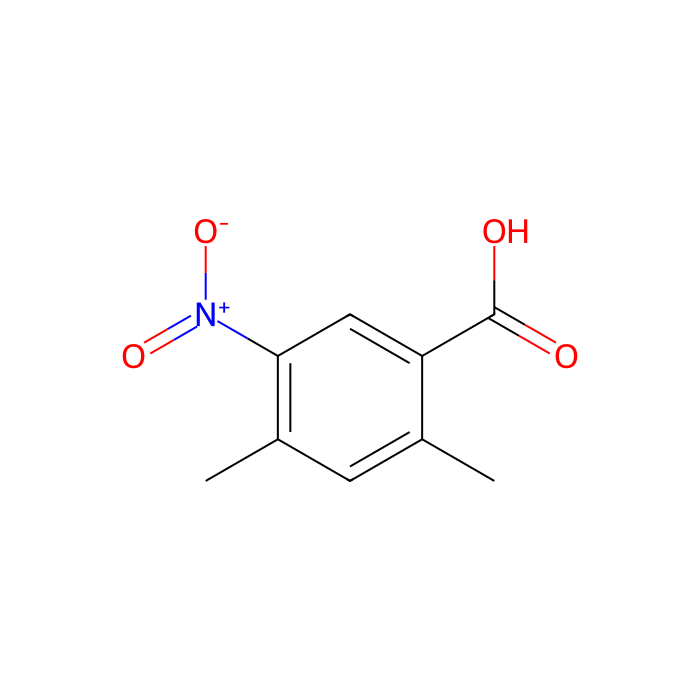
Structure and Identity
A nitro-substituted, dimethylated benzoic acid useful as a functionalized aromatic building block.
Preferred name: 2,4-Dimethyl-5-nitrobenzoic acid
CAS: 220504-75-6 (Product Data)
PubChem CID: 601141 (Product Data)
InChIKey: Not specified for this item; refer to CoA/Spec Sheet. (Product Data lists an incomplete key)
SMILES: Not specified for this item; refer to CoA/Spec Sheet.
Identity and structural features (literature/computed):
Molecular formula (computed from structure): C9H9NO4
Formula weight (calculated): ~195.17 g/mol
Core scaffold: monosubstituted benzoic acid ring bearing three ring substituents
Carboxylic acid at the 1-position (–CO2H) on the aromatic ring
Methyl groups at the 2- and 4-positions (o- and p- to the carboxyl)
Nitro group (–NO2) at the 5-position (meta to –CO2H; para to the 2-methyl)
Electronic character: nitro group deactivates the ring and is meta-directing; methyl groups are weakly activating and ortho/para-directing; the overall substitution pattern provides differentiated reactivity at remaining positions.
2D description in words: a benzoic acid ring with a carboxyl group as reference at C1; a methyl group ortho (C2), a methyl para (C4), and a nitro substituent at C5 (meta to the carboxyl), leaving C3 and C6 unsubstituted.
Synthetic Utility
Functional handles and retrosynthetic value:
Carboxylic acid: convertible to amides/esters/acid chlorides; enables convergent fragment coupling. Activation via carbodiimides, uronium salts, mixed anhydrides, or T3P streamlines assembly of benzamide libraries.
Nitro group: a classic masked amine; reductions furnish 2,4-dimethyl-5-aminobenzoic acid, unlocking diazotization, Sandmeyer substitutions (to CN, halides under specific conditions), or coupling to isocyanates/sulfonyl chlorides.
Aromatic core with directing effects: Two methyl groups provide modest activation, while the nitro group is strongly deactivating and meta-directing. This pattern supports selective functionalization at remaining positions under tailored conditions (e.g., directed metalation adjacent to methyl in presence of strong bases, with caution).
Steglich esterification (DCC/DMAP, DCM or toluene) to install probe handles (e.g., alkyl/aryl esters) for SAR tuning.
HATU- or EDC-mediated amide couplings in DMF/NMP for fragment-linking into benzanilide motifs.
Formation of redox-active esters (NHPI/DIC/DMAP) for photoredox decarboxylative couplings to generate substituted aryl products without preformed aryl halides.
Catalytic hydrogenation (H2, Pd/C, EtOH) or transfer hydrogenation (Fe/AcOH, or ammonium formate/Pd-C) to the aniline, followed by acylation to anilides and ureas.
Purification strategies:
Benzoic acids often purify well by acid–base extraction; amides/esters by silica chromatography using EtOAc/hexanes or DCM/MeOH gradients; recrystallization from EtOAc/hexanes or EtOH/water is common.
Target Specificity
Not applicable. This product is a small-molecule chemical building block and is not an antibody, protein, or targeted biological reagent. No target, epitope, clone, or species reactivity information applies.
Domande frequenti
What is the purity of this product?
This product is supplied at ≥98% purity (chemical assay). Lot-specific values are stated on the Certificate of Analysis.
How should this product be stored?
Store at room temperature, desiccated. Keep the container tightly closed with desiccant — the material is moisture-sensitive.
How is this product shipped?
This product ships under standard ambient conditions. No temperature-controlled packaging is required.
What are the CAS number, molecular formula and molecular weight?
The CAS Number is 220504-75-6, the molecular formula is C9H9NO4, and the molecular weight is 195.17 g/mol. InChIKey OVWSQNZKIRGLMK-UHFFFAOYSA-N.
What documentation is provided?
Available product documentation, including Certificates of Analysis (COA), Safety Data Sheets (SDS), and specification sheets, is shown in the product document area. Document availability and access follow the current site policy.
Utilizziamo i cookie per garantire il corretto funzionamento del sito web e, ove consentito, per migliorare la tua esperienza. Puoi gestire le tue preferenze in qualsiasi momento nelle Impostazioni. Per saperne di più, consulta la nostra Cookie Policy.
Desidera che le inviamo un messaggio quando avremo sconti disponibili?
Ricordamelo più tardi
Grazie! Controlli la sua casella di posta per confermare.
Products are supplied to verified businesses, institutions, and qualified professionals for research and development use only. Not for use in humans, animals, diagnosis, or therapy.

 I26161046