This compound belongs to the class of organic compounds known as benzoyl derivatives. These are organic compounds containing an acyl moiety of benzoic acid with the formula (C6H5CO-).
External Descriptors
Not available
1. Djoumbou Feunang Y, Eisner R, Knox C, Chepelev L, Hastings J, Owen G, Fahy E, Steinbeck C, Subramanian S, Bolton E, Greiner R, and Wishart DS. ClassyFire: Automated Chemical Classification With A Comprehensive, Computable Taxonomy. Journal of Cheminformatics, 2016, 8:61.
Determine the necessary mass, volume, or concentration for preparing a solution.
Dilution Calculator
Determine the dilution needed to prepare a stock solution.
Reconstitution Calculator
Recensioni
Recensioni dei clienti
Application Protocols
No assay-specific or immunoapplication protocols apply to this small-molecule reagent.
General laboratory usage tips (literature-based):
Handling: If solid at lab temperature, gently warm to liquefy before volumetric dosing; if liquid, dispense under inert gas using a dry syringe or pipette to minimize air/moisture exposure.
Purity checks: Quick IR (C=O around ~1700 cm−1) and TLC with 2,4-DNP stain can confirm aldehyde presence; NMR can quantify oxidation (carboxylic acid shows broad downfield OH and carbonyl at ~190–195 ppm for aldehyde vs ~167–172 ppm for acid in 13C).
Derivatization for GC: Form oximes (O-alkyloximes) to enhance chromatographic stability if direct GC shows tailing.
For detailed, application-specific procedures (e.g., a particular condensation or reductive amination), consult the Reaction Conditions section and primary literature. Always adapt conditions to your substrate scope and equipment.
Biological Roles
Item-specific biological data: Not specified for this item; refer to CoA/Spec Sheet. This product is for research use only.
General biochemistry (literature context for aromatic aldehydes):
Endogenous role: 2,4-dimethylbenzaldehyde is not an endogenous metabolite in humans; however, xenobiotic aromatic aldehydes are typically oxidized by aldehyde dehydrogenases (ALDH) to the corresponding benzoic acids (here, 2,4-dimethylbenzoic acid), and/or reduced by aldo-keto reductases to benzyl alcohols.
Reactivity with biomolecules: Aldehydes can form reversible Schiff bases with primary amines (e.g., lysine side chains), especially under mildly basic conditions. Electron-donating methyl groups can modestly influence reactivity by increasing ring electron density, though the formyl carbon remains the primary electrophilic site.
Transport and partitioning: With logP in the ~2.4–2.7 range (literature), such compounds are expected to have moderate hydrophobicity, partitioning into lipid phases; plasma protein binding to albumin through hydrophobic interactions and reversible imine formation with amino groups is possible in vitro.
Biodegradation: In environmental microbiology, aryl aldehydes undergo oxidative pathways (e.g., monooxygenases/oxidases) to acids, followed by ring cleavage in specialized organisms.
No clinical or therapeutic claims are made. Any biological testing should incorporate controls to account for Schiff base formation and potential cytotoxicity typical of aromatic aldehydes.
Buffer Applications
Not typically applicable. 2,4-Dimethylbenzaldehyde is not a buffering agent and is not used to prepare pH buffer systems.
Practical notes (general):
Aldehydes can react with amine-containing buffers (e.g., Tris, glycine, HEPES) via Schiff base formation, potentially altering both the analyte and buffer composition. If this aldehyde is present in a biochemical assay, prefer non-amine buffers (e.g., phosphate, acetate) and keep exposure time short.
For fixation chemistry, aliphatic dialdehydes (e.g., glutaraldehyde) are typically used rather than substituted benzaldehydes; thus, no standard buffer recipes apply here.
For work involving this compound, focus instead on sections addressing solvent choice, synthetic utility, and storage to prevent side reactions in aqueous media.
Green Alternatives
Scope: Alternatives here focus on greener solvents and conditions when using 2,4-dimethylbenzaldehyde; the aldehyde itself is the target substrate.
Greener solvent choices (literature-based):
Replace chlorinated solvents (e.g., DCM) with ethyl acetate or cyclopentyl methyl ether (CPME) for extractions and reactions, where compatible.
Use 2-MeTHF or CPME in place of THF/diethyl ether for organometallic additions; benefits include higher boiling points, better phase separation, and bio-based sourcing (2-MeTHF).
Favor ethanol or isopropanol as benign media for reductions/condensations when catalytically feasible.
Process-intensification and catalysis:
Employ organocatalysts (proline, piperidine, ammonium salts) for Knoevenagel/aldol at room temperature, minimizing heavy-metal waste.
Use O2 or air with cobalt/manganese catalysts or TEMPO/bleach for oxidations instead of chromium(VI) reagents.
Illustrative comparison (general):
THF vs 2-MeTHF: similar reactivity; 2-MeTHF is often renewable and enables easier workups; slight differences in coordination and solubility may affect rates/selectivity.
DCM vs EtOAc: EtOAc reduces halogenated solvent waste; may require temperature control due to higher boiling point and different polarity.
DMF/DMSO vs MeCN/EtOH: where high polarity is not strictly needed, MeCN or even EtOH can reduce EHS concerns; check solubility/conversion.
Trade-offs:
Greener solvents can alter selectivity (e.g., E/Z in olefinations) or rates; re-optimize conditions (catalyst loading, temperature, base).
Ensure product stability (aldehydes can self-condense in basic green solvents if water is present); maintain inert atmosphere as per Product Data (argon recommended).
Pharmaceutical Uses
Item-specific pharmacopeial status or excipient role: Not specified for this item; refer to CoA/Spec Sheet. For research use only.
General context (literature):
Role in drug discovery and process chemistry: Aromatic aldehydes like 2,4-dimethylbenzaldehyde serve as versatile intermediates for constructing substituted benzyl alcohols, cinnamaldehydes/cinnamates (via Wittig/HWE), and benzoic acids, which can become key fragments in API syntheses or impurities standards.
Derivatization utility: The aldehyde group enables rapid synthesis of libraries through reductive amination, oxime/hydrazone formation, and Ugi/Mannich-like multicomponent reactions (using preformed imines), facilitating SAR exploration.
Analytical standards: Can be used to develop/validate analytical methods (GC/HPLC) for related impurities in synthetic routes employing dimethylbenzenoid scaffolds; certification would be required for regulated use, but this is outside the scope of the current product specification.
No claims are made regarding therapeutic efficacy, safety in humans, or clinical use. Any application in regulated environments requires qualification per relevant pharmacopeias and internal quality systems.
Physical Properties
Item-specific specifications: Not specified for this item; refer to CoA/Spec Sheet.
Literature values (typical; for method development and planning only):
Molecular weight: ~134.18 g/mol
Appearance at ambient: typically a colorless to pale yellow liquid or low-melting solid depending on temperature (aromatic aldehydes near this MW often have mp near ambient).
Boiling point: ~225–229 °C (literature range)
Melting point: reported near ambient; values in the teens–low 20s °C have been noted for positional isomers; confirm experimentally for this isomer and batch.
Density: ~1.00–1.03 g/mL at 20–25 °C (literature)
Refractive index (n20 D): ~1.545–1.555 (literature)
LogP (octanol/water): ~2.4–2.7 (estimated)
Vapor pressure: low at room temperature relative to lower MW benzaldehydes.
Solubility: sparingly soluble in water; miscible with common organic solvents (ethanol, methanol, diethyl ether, DCM, toluene, acetonitrile) — literature generalization for dimethylbenzaldehydes.
General notes:
The aldehyde group can engage in hydrogen bonding as an acceptor; expect moderate polarity and good solubility in mid-polar aprotic solvents.
Because exact item specs (e.g., density, refractive index) are not provided for SKU D103125, treat the above as guidance and verify with your in-lab measurements or the item’s CoA.
Quality and Grades
Item-specific grade/purity and appearance: Not specified for this item; refer to CoA/Spec Sheet.
Interpretation and implications (general guidance):
Absence of a stated grade (e.g., ≥98%, GC; AR; HPLC) means method suitability (chromatography, spectroscopy, synthesis) should be verified with the item’s CoA. If low UV background is important (e.g., HPLC UV detection), ensure a low-UV-absorbance grade is specified.
Stabilizers: None are specified for this item. Aromatic aldehydes are sometimes stabilized simply via inert gas headspace (as indicated: argon charged). If a stabilizer is present in a future lot, consult the CoA for identity/percentage and compatibility with your application.
Typical quality controls for aldehydes (literature best practices): GC purity/area %, water content by Karl Fischer, identity by 1H/13C NMR and IR (C=O ~1700 cm−1), residual solvents, and acid number (to quantify oxidation to benzoic acids).
When selecting a grade:
Synthetic transformations (e.g., Grignard, Wittig): favor high GC purity and low water/peroxide/acid levels. For this item, specific impurity limits are Not specified for this item; refer to CoA/Spec Sheet.
Analytical applications: if using as a standard, obtain or request certified purity with uncertainty and reference methods.
Recommendation: On receipt, record GC or NMR to confirm aldehyde integrity, especially if storage was prolonged. The argon charge on this product supports aldehyde stability by minimizing oxidative degradation.
Reaction and Applications
As an electron-rich aromatic aldehyde, 2,4-dimethylbenzaldehyde serves as a versatile building block. Literature-typical applications include:
Nucleophilic additions:
Grignard/organolithium addition to form secondary alcohols. Ortho methyl substitution can influence sterics and reduce over-addition/side aldol reactions; low temperatures (−78 to 0 °C) are common.
Cyanohydrin and bisulfite adduct formation for purification/derivatization.
Carbon–carbon bond formations:
Wittig/Horner–Wadsworth–Emmons to install vinyl groups; E/Z selectivity controlled by ylide/phosphonate type and reaction temperature.
Knoevenagel condensations with active methylenes (malononitrile, ethyl cyanoacetate) using basic or amine catalysts (piperidine, ammonium acetate), often in EtOH, toluene (Dean–Stark), or solvent-free with grinding/ionic liquids.
Aldol-type condensations (under base) and related benzoin-like transformations (with NHC catalysts, though aryl aldehydes lacking cyanide acceptors may require specialized catalysts).
Redox transformations:
Reduction to the corresponding benzyl alcohol (e.g., NaBH4, catalytic hydrogenation) or to the tolyl derivative via Wolff–Kishner/Clemmensen sequences.
Oxidation to 2,4-dimethylbenzoic acid (e.g., KMnO4, Jones, TEMPO/bleach, or O2/Co-Mn-Br systems), useful for ligand/monomer precursors.
Electrophilic aromatic substitution (EAS) on the ring (nitration, sulfonation, halogenation) is directed by Me groups (o/p-directing) and deactivation/activation balance of the –CHO (meta-directing). The 2,4-Me pattern provides defined regioselectivity landscapes.
Materials and fragrance intermediacy: Often employed to construct substituted stilbenes, chalcones, and cinnamaldehydes by olefination/condensation (literature precedent).
Reaction Conditions
General conditions (literature guidance; optimize per system):
Grignard addition:
Solvent: anhydrous THF or 2-MeTHF.
Temperature: −78 to 0 °C during addition; warm to RT for completion.
Stoichiometry: 1.05–1.2 equiv RMgX per equiv aldehyde.
Workup: aqueous NH4Cl quench; isolate benzylic alcohol; typical yields 70–95% depending on reagent and sterics.
Reductant: NaBH3CN (pH 5–6) or NaBH(OAc)3 in DCE/MeCN; room temperature to 40 °C; 2–16 h; typical yields 60–90%.
Wittig/HWE olefination:
Base: n-BuLi or NaH to generate ylide/phosphonate carbanion.
Solvent: THF/DMF/MeCN; 0 to room temperature.
E/Z control via ylide type (stabilized vs non-stabilized) and temperature; yields 60–90% common.
Knoevenagel condensation:
Catalyst: piperidine/Et3N or ammonium acetate; sometimes L-proline or ionic liquids.
Solvent: EtOH, toluene (Dean–Stark), or solvent-free grinding; 25–110 °C; 1–8 h; often high E-alkene selectivity; yields up to ~90%.
Oxidation to acid:
Reagents: TEMPO/NaOCl (pH ~9–10) in biphasic CH2Cl2/H2O or EtOAc/H2O; or O2 with Co/Mn/Br catalyst in acetic acid.
Temperature: 0–25 °C (TEMPO) or 80–110 °C (autoxidation); monitor to avoid ring oxidation; yields 70–95%.
Notes:
Maintain argon atmosphere as per Product Data to limit autoxidation during prolonged reactions or storage between steps.
The 2-methyl group can slow ortho-approaches in additions; adjust temperature/time accordingly.
All yields and conditions are literature-general and must be validated on scale.
Safety and Handling
Item-specific hazard data: Not specified for this item; refer to SDS for SKU D103125 for authoritative GHS classification, H/P statements, and pictograms.
General safety profile for aromatic aldehydes (literature/general):
Likely hazards: eye/skin irritation; respiratory irritation from vapors; harmful if swallowed; combustible liquid at elevated temperatures (higher flash point than benzaldehyde analogs with fewer ring substituents).
Incompatibilities: strong oxidizers (risk of exothermic reaction); strong bases and amines (can undergo aldol/Schiff base formation); reducing agents (may reduce to alcohols); air/oxygen (slow oxidation to corresponding acid over time); acids/bases can catalyze self-condensation.
Special risks: prone to gradual oxidation to 2,4-dimethylbenzoic acid; polymerization/condensation under basic conditions.
PPE and engineering controls:
Use in a chemical fume hood to control aldehyde vapors.
Minimum PPE: lab coat, chemical-resistant gloves (e.g., nitrile), splash goggles; consider a face shield for bulk handling.
First aid (overview; consult SDS):
Eye contact: rinse cautiously with water for several minutes; remove contact lenses if present; seek medical attention.
Skin contact: wash with soap and water; remove contaminated clothing.
Inhalation: move to fresh air; monitor for irritation; seek medical advice if symptoms persist.
Ingestion: rinse mouth; do not induce vomiting; seek medical attention.
Storage and handling guidance (aligns with Product Data):
Store at room temperature under inert gas (argon) in a tightly closed container to minimize oxidation and aldolization.
Keep away from heat/ignition sources; segregate from oxidizers and strong bases.
Always defer to the SDS provided with the specific lot.
Solvent Selection
Applicability: 2,4-Dimethylbenzaldehyde is a moderately polar, hydrophobic aromatic aldehyde. Solvent choice typically targets dissolution, reaction selectivity, and ease of workup.
General solvent behavior (literature/general):
Polarity: moderate (aldehyde dipole) with hydrophobic ring; immiscible with water; readily soluble in mid-polar and nonpolar organics (EtOAc, toluene, DCM, MeCN, EtOH, IPA, THF, 2-MeTHF, CPME).
Dielectric context (solvent, 25 °C; literature): MeCN ~37; EtOAc ~6; THF ~7.6; toluene ~2.4; DCM ~9.1. Aldehyde is soluble across this range.
Selection guidance by application:
Nucleophilic additions (Grignard, organolithium): use rigorously dry ethereal solvents (THF, diethyl ether, 2-MeTHF). Maintain low temperatures (−78 to 0 °C) to control selectivity.
Condensations (Knoevenagel, aldol, Wittig): choose polar aprotic solvents (THF, MeCN, DMF) or alcohols depending on base/catalyst and substrate solubility. Toluene is common for water-removing azeotropes.
Oxidation/reduction: DCM/EtOAc/MeCN for mild oxidations; protic solvents (MeOH/EtOH) for NaBH4 reductions; IPA for transfer hydrogenation.
Chromatography: Elutes as a mid-polar aromatic; normal-phase silica gel typically uses hexanes/EtOAc 8:2 to 6:4; verify by TLC (UV-active, stains with 2,4-DNP).
Small comparison (literature-based):
THF vs 2-MeTHF: similar performance for organometallics; 2-MeTHF offers better phase separation and greener profile.
DCM vs EtOAc: EtOAc is greener and often adequate for extractions and workups when chlorinated solvents are undesirable.
Practical storage guidance (aligned with Product Data):
Container: Store in an amber, tightly sealed bottle with an inert-gas headspace (argon or nitrogen). Minimize headspace oxygen by sparging or performing a few vacuum/argon cycles after opening.
Atmosphere: Maintain under argon to reduce oxidation to 2,4-dimethylbenzoic acid and to limit base-catalyzed aldolization.
Environment: Keep away from heat and light sources. Segregate from oxidizers and strong bases.
In-use handling: Work quickly under inert atmosphere. For repeated use, consider transferring to a crimp-sealed septum vial to allow syringe withdrawal under argon.
Stability monitoring: Periodically check by GC or NMR for acid formation; add a small drying agent (e.g., 3 Å molecular sieves) externally in the desiccator if ambient humidity is high. Do not add unidentified stabilizers to the product itself.
Reconstitution: Not applicable. This product is supplied neat; no buffer or solvent reconstitution is required. If a solution is desired (e.g., stock in EtOH, MeCN, or toluene), prepare fresh under inert gas, store in sealed vials at room temperature or refrigerated as appropriate, and use within days to minimize degradation.
Always follow the SDS for definitive storage/handling instructions.
Structure and Identity
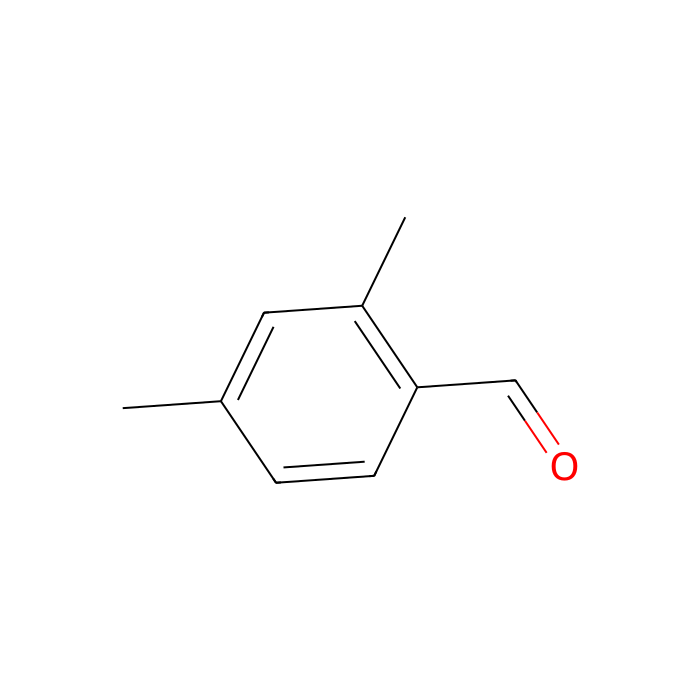
Brief overview: 2,4-Dimethylbenzaldehyde is an aromatic aldehyde (xylaldehyde) bearing two methyl substituents on the benzene ring at the 2- and 4-positions relative to the formyl group.
Item-specific (from Product Data):
CAS: 15764-16-6
PubChem CID: 61814
InChIKey: 103137 (as provided)
Storage: Room temperature, Argon charged
Shipped: Normal
Literature/Computed identifiers and features (for reference):
SMILES (literature): O=CC1=C(C)C=C(C)C=C1 (aromatic ring with –CHO, Me at ortho and para)
Structural features: one benzene ring; one aldehyde (formyl) group; two electron-donating methyl groups at ortho (2) and para (4) positions; no stereocenters; planar aromatic core.
2D structural description (verbal): A benzene ring bearing a formyl (–CHO) group at position 1; a methyl group at the adjacent ortho position (2-position) and another methyl at the para position (4-position). The aldehyde carbon is sp2-hybridized and conjugated with the aromatic ring, enhancing electrophilicity at the carbonyl carbon while methyl groups increase ring electron density by hyperconjugation.
Notes:
Where authoritative, defer to CoA/SDS for the definitive identifiers and any supplier-specific descriptors.
If an official SMILES/InChIKey is required for registration, consult PubChem (CID 61814) or the product CoA.
Synthetic Utility
Key functional elements: A conjugated aryl aldehyde activated toward nucleophilic addition at the carbonyl carbon; methyl substituents (2,4) modulate both electronic and steric properties of the ring.
Retrosynthetic and forward-synthesis value (literature):
Entry to benzylic alcohols and amines: Via NaBH4/catalytic hydrogenation (alcohols) or reductive amination (amines, using NaBH3CN, NaBH(OAc)3, or catalytic H2 with suitable catalysts). The 2-methyl substituent can influence approach trajectories and diastereocontrol in chiral additions.
Construction of styrenes and chalcones: Through Wittig/Horner–Wadsworth–Emmons or Claisen–Schmidt condensations with acetophenones; 2,4-dimethyl substitution biases regiochemistry and physical properties of the products.
Oxidation to acids/esters: Mild catalytic aerobic oxidations deliver 2,4-dimethylbenzoic acid, readily derivatized to esters or acid chlorides for further coupling (amide/ester formation).
Ring functionalization: EAS reactions consider the directing effects of methyl (o/p) vs –CHO (meta). Net outcomes depend on conditions; installing additional substituents at 3- or 5-positions is often feasible with controlled conditions (e.g., bromination, nitration under temperature control).
Protecting-group-like transformations: Temporary conversion to oximes/hydrazones allows purification or downstream transformations (e.g., Beckmann-type rearrangements for select systems).
Practical notes:
Maintain inert atmosphere (argon, per Product Data) to suppress auto-oxidation.
Track acid formation (titration or HPLC) in long reactions; neutralize acid if it impacts base-sensitive steps.
For organometallic additions, pre-dry substrate (vacuum over P2O5 or molecular sieves) to remove traces of water and acid.
Target Specificity
Not applicable. This product is a small-molecule chemical reagent, not a biological targeting agent (e.g., antibody, ligand with defined biomolecular target). No antigen, epitope, species reactivity, clone, or isotype information applies.
Domande frequenti
What is the purity of this product?
This product is supplied at ≥95% purity (chemical assay). Lot-specific values are stated on the Certificate of Analysis.
How should this product be stored?
Store at room temperature under argon. It is supplied under an argon blanket; reseal under inert gas after each use.
How is this product shipped?
This product ships under standard ambient conditions. No temperature-controlled packaging is required.
What are the CAS number, molecular formula and molecular weight?
The CAS Number is 15764-16-6, the molecular formula is C9H10O, and the molecular weight is 134.18 g/mol. InChIKey GISVICWQYMUPJF-UHFFFAOYSA-N.
What documentation is provided?
Available product documentation, including Certificates of Analysis (COA), Safety Data Sheets (SDS), and specification sheets, is shown in the product document area. Document availability and access follow the current site policy.
Utilizziamo i cookie per garantire il corretto funzionamento del sito web e, ove consentito, per migliorare la tua esperienza. Puoi gestire le tue preferenze in qualsiasi momento nelle Impostazioni. Per saperne di più, consulta la nostra Cookie Policy.
Desidera che le inviamo un messaggio quando avremo sconti disponibili?
Ricordamelo più tardi
Grazie! Controlli la sua casella di posta per confermare.
Products are supplied to verified businesses, institutions, and qualified professionals for research and development use only. Not for use in humans, animals, diagnosis, or therapy.

 C23311665