This compound belongs to the class of organic compounds known as benzoic acids. These are organic Compounds containing a benzene ring which bears at least one carboxyl group.
External Descriptors
dimethylbenzoic acid
1. Djoumbou Feunang Y, Eisner R, Knox C, Chepelev L, Hastings J, Owen G, Fahy E, Steinbeck C, Subramanian S, Bolton E, Greiner R, and Wishart DS. ClassyFire: Automated Chemical Classification With A Comprehensive, Computable Taxonomy. Journal of Cheminformatics, 2016, 8:61.
Determine the necessary mass, volume, or concentration for preparing a solution.
Dilution Calculator
Determine the dilution needed to prepare a stock solution.
Reconstitution Calculator
Recensioni
Recensioni dei clienti
Application Protocols
No item-specific tested application protocols are provided for this product. As a general-purpose research chemical/building block, experimental procedures will depend on the intended transformation (e.g., esterification, amidation, acid chloride formation).
General procedural pointers (literature/guidance):
Sample preparation for analytics: dissolve 1–5 mg/mL in acetonitrile, methanol, or DMSO for HPLC/LC–MS; add 0.1% formic acid if negative-mode ionization is weak (note acid-base compatibility with columns).
Recrystallization screen: try EtOAc/hexanes, toluene/hexanes, or ethanol/water mixtures; seed if oils form.
Salt/enrichment step: for workups, extract into bicarbonate (forms benzoate), wash organic impurities, then re-acidify to pH 1–2 to precipitate the acid.
For detailed, purpose-built SOPs (e.g., coupling, acyl chloride generation), refer to the Reaction Conditions tab and adapt to the scale and substrate scope of your project.
Biological Roles
Applicability: 2,4-Dimethylbenzoic acid is a synthetic aromatic carboxylic acid and is not known as a natural metabolite or cofactor.
General biochemical context (literature/guidance):
Not an endogenous human metabolite: unlike benzoic acid (which appears in metabolism as hippuric acid conjugates), dimethyl-substituted benzoic acids are primarily xenobiotic.
Metabolic fate (xenobiotic metabolism, general): likely undergoes phase I oxidation (hydroxylation at methyl groups to alcohols/aldehydes/acids) followed by phase II conjugation (glucuronidation or glycine conjugation) in organisms capable of such metabolism. Specific pathways for the 2,4-isomer are not comprehensively characterized in standard references.
Protein/ligand interactions: the compound lacks canonical biological targets; hydrophobic aromatic acids may show nonspecific binding to serum albumin and lipid membranes in vitro.
Research relevance:
Used as a reference substrate or hydrophobic modifier in SAR studies where the benzoic acid motif is preserved.
Can serve as a model compound for studying transport/partitioning of hydrophobic weak acids across membranes or sorbents.
Caveat:
No claims of biological efficacy or therapeutic activity are made. Any biological testing should be conducted under appropriate institutional guidelines, and findings should not be generalized beyond the experimental system.
Buffer Applications
Not typically applicable. 2,4-Dimethylbenzoic acid is not used as a laboratory buffer. While it is a weak acid (benzoic acid family, pKa ~4.3–4.5, literature), its poor water solubility at near-neutral pH and hydrophobicity make it unsuitable for standard aqueous buffer systems. For buffering in the acidic range, consider acetate, citrate, or phthalate buffers.
Practical note:
The conjugate base (2,4-dimethylbenzoate) is readily formed in basic aqueous solutions and can aid in pH-controlled extractions, but this is a partitioning tool rather than a true buffering application.
Green Alternatives
Context: 2,4-Dimethylbenzoic acid is a substrate; sustainability considerations focus on solvent/reagent choices used to transform it rather than on replacing the substrate itself.
Greener solvent choices (literature/guidance):
Replace chlorinated solvents (DCM) with ethyl acetate or 2-MeTHF for many esterifications and some amide couplings when solubility allows.
Use cyclopentyl methyl ether (CPME) or 2-MeTHF for acid chloride reactions if compatible with reagents, noting potential reactivity toward strong electrophiles.
Conduct extractions using MTBE/EtOAc instead of diethyl ether to lower peroxide risk and VOC emissions.
Greener coupling strategies:
Minimize carbodiimide waste by employing catalytic coupling systems (e.g., catalytic DMAP with acid anhydrides) or more atom-economical reagents (e.g., CDI) where suitable.
Enzymatic esterification in green solvents (2-MeTHF, supercritical CO2, or solvent-free) can be viable for simple esters.
Comparison highlights (general):
DCM vs EtOAc: EtOAc offers lower toxicity and better environmental profile; may require larger volumes due to solubility differences.
DMF/NMP vs Cyrene/PC: In some couplings, bio-based dipolar aprotics (e.g., Cyrene, propylene carbonate) can substitute, though reagent solubility and base selection must be optimized.
Waste and energy:
Favor crystallization-driven purifications over silica chromatography to reduce solvent use.
Where feasible, perform reactions at ambient temperature and use solvent recycling.
Note: The above are general green chemistry considerations; adapt to your specific transformation. No change to the identity of 2,4-dimethylbenzoic acid is implied.
Pharmaceutical Uses
Item-specific pharmacopeial status: Not specified for this item; refer to CoA/Spec Sheet.
General formulation/manufacturing context (no therapeutic claims):
Role as an intermediate: Aromatic carboxylic acids such as 2,4-dimethylbenzoic acid are frequently used as synthetic intermediates to prepare benzamides, esters, and acid chlorides that serve as building blocks in medicinal chemistry programs.
Excipients: This compound is not commonly employed as an excipient. Benzoic acid itself is used as a preservative in certain contexts, but dimethylated derivatives do not share established excipient roles.
Impurity standards: In API development, substituted benzoic acids can be relevant as process-related impurities or degradants for certain aromatic drug substances; authentic materials can support method development and validation.
Salt screening: While salts of simple benzoic acids are sometimes evaluated to modulate solubility/crystallinity of drug-like amines (as benzoates), 2,4-dimethylbenzoate may be explored in preformulation screens to adjust counterion hydrophobicity.
Regulatory note:
No claim of GMP manufacture or compendial compliance is made for SKU D101977 based on the Product Data provided. For any use beyond research, appropriate quality, regulatory documentation, and supplier qualification would be required.
Physical Properties
Item-specific specifications: Not specified for this item; refer to CoA/Spec Sheet.
Literature/general properties (for guidance only; not product specifications):
Physical state/appearance (literature): crystalline solid; colorless to white.
Melting point (literature): commonly reported in the mid- to high-150 °C range (consult primary references for exact isomer-specific value).
Boiling behavior: benzoic acids decompose/sublime upon strong heating; 2,4-dimethyl substitution generally raises melting point relative to toluic acids; vacuum sublimation may be observed.
Density (literature, solids): approximately 1.1–1.2 g/cm³ typical for substituted benzoic acids; check primary data for this isomer.
pKa (aqueous, 25 °C; literature): benzoic acids ~4.2; 2,4-dimethyl substitution tends to slightly raise pKa to approximately 4.3–4.5.
LogP (literature/estimated): increased hydrophobicity vs benzoic acid due to two methyls; typical cLogP for dimethylbenzoic acids ~2.0–2.5.
Solubility (qualitative):
Water: low at neutral pH; forms soluble benzoate salts under basic conditions (pH > ~5–6, complete above pH ~8).
Organic: good in polar aprotic solvents (DMF, DMSO, NMP, acetone, acetonitrile) and moderately good in moderately polar organics (EtOAc, THF, MeOH/EtOH with heating); limited in nonpolars unless warmed.
UV characteristics (literature): aromatic π→π* absorption with λmax typically ~230–275 nm; benzoate chromophore gives strong UV at 254 nm.
Notes:
Values above are provided as general literature guidance for this structural class and isomer; they are NOT specifications for SKU D101977. For analytical acceptance criteria (e.g., purity, residual solvents, water), consult the item’s CoA.
Quality and Grades
Item-specific grade/purity: Not specified for this item; refer to CoA/Spec Sheet.
General guidance for this compound class:
Typical commercial offerings for substituted benzoic acids include research grade (multi-gram synthesis and general lab use), analytical grade (tighter limits on inorganic/organic impurities), and high-purity/low-residual-solvent material for sensitive analytical or catalytic applications.
If HPLC/GC suitability is critical, verify:
Purity by NMR/HPLC/GC.
Identity via MS and/or FTIR.
Water content (Karl Fischer) and residual solvents, if relevant to your method. For this SKU, specific limits are not provided here.
Stabilizers: Generally not required for 2,4-dimethylbenzoic acid; it is a stable aromatic carboxylic acid under normal storage. No inhibitor/stabilizer is indicated in the Product Data.
UV suitability: For chromatographic UV detection around 230–254 nm, aromatic acids offer strong response; however, baseline noise is influenced by solvent and mobile phase purity rather than analyte grade.
Documentation and release testing:
For regulated or critical applications, request the CoA/Spec Sheet for acceptance criteria (assay/purity, identification tests, appearance, melting point range, and residuals as applicable). Where compendial conformity (USP/Ph. Eur.) is required, confirm explicitly—none is claimed here.
Reaction and Applications
General research applications (no specific manufacturer applications provided):
Carboxylate derivatization:
Esterification (Fischer–Speier, Steglich): preparation of 2,4-dimethylbenzoates for protecting or modulating lipophilicity.
Amide formation: peptide-style couplings (EDC·HCl/HOBt, DIC/DMAP, HATU/HBTU) to access 2,4-dimethylbenzamides—useful scaffolds in medicinal and materials chemistry.
Acid activation: conversion to the acid chloride with SOCl2 or oxalyl chloride (catalytic DMF) enables acylation of alcohols/amines under Schotten–Baumann or non-aqueous conditions.
Photoredox-catalyzed decarboxylative arylation/alkylation after converting to redox-active esters (e.g., N-hydroxyphthalimide esters).
Silver- or copper-mediated decarboxylative halogenation or cross-coupling to access 2,4-dimethylarenes bearing new substituents.
Directed metalation/cross-coupling:
The carboxyl group can serve as a weak directing/coordination site in ortho-functionalization prior to or after protection as an amide/ester.
Subsequent transformations on the aromatic ring (bromination, nitration under controlled conditions) leverage the deactivating/activating balance of CO2H and Me substituents.
Salt formation and purification: transient formation of sodium/potassium 2,4-dimethylbenzoate provides convenient phase switches for extractions and purifications.
Practical tips:
Ensure dryness for acid chloride formation; remove residual SOCl2 under reduced pressure and co-evaporate with toluene to strip HCl/SO2.
For couplings, pre-form the active ester at 0–5 °C, then warm to rt to minimize O→N acyl transfer and byproduct formation.
The two methyl groups increase lipophilicity and can improve crystallinity of derivatives, aiding purification by trituration or recrystallization.
Reaction Conditions
General laboratory conditions for common transformations (literature/guidance; adjust to your substrate and scale):
Acid chloride formation:
Reagents: thionyl chloride (SOCl2, 3–5 eq) or oxalyl chloride ((COCl)2, 1.2–2 eq) with catalytic DMF (1–5 mol%).
Solvent: anhydrous DCM or toluene.
Temperature/time: 0 °C to reflux; 1–4 h until gas evolution ceases.
Workup: evaporate volatiles; co-evaporate with toluene; use immediately or store at 0–4 °C under inert gas.
Esterification (Fischer–Speier):
Conditions: ROH (solvent/reagent), catalytic H2SO4 or p-TsOH, Dean–Stark if using toluene/benzene with azeotropic water removal.
Temperature: reflux of chosen alcohol/solvent; 2–24 h depending on sterics.
Steglich esterification:
Reagents: DCC (1.1 eq) or DIC with catalytic DMAP (0.05–0.2 eq).
Solvent: DCM or EtOAc; 0 °C to rt; 2–16 h. Filter urea byproduct.
Amide coupling:
Reagents: HATU/HBTU/EDC·HCl (1.1–1.5 eq) with base (DIPEA 2–3 eq).
Solvent: DMF/MeCN/DCM depending on partner solubility.
Temperature/time: 0 °C to rt; 1–18 h. Typical literature yields for unhindered partners: 70–95%.
Cross-coupling: Ni catalyst (e.g., NiCl2·dme 5–10 mol%), photoredox (Ir(ppy)3 0.5–1 mol%) under blue LEDs; solvent MeCN/DMF; rt; 2–12 h.
Notes:
Exclude moisture for acid chloride and coupling reactions.
Monitor by TLC/LC-MS; quench carefully to avoid emulsions (use brine and controlled acid/base washes).
Safety and Handling
Item-specific hazard information: Not specified for this item; refer to SDS.
General GHS considerations for substituted benzoic acids (literature/guidance; not product-specific classification):
Likely hazard classes: Eye Irritation, Skin Irritation (due to acidic functionality); may cause respiratory irritation as dust. Some benzoic acid derivatives are not classified as acutely toxic but can be irritant.
Pictograms (typical when classified): Exclamation mark (GHS07) for irritation. Definitive pictograms for this SKU are not specified; consult SDS.
Practical handling guidance (general laboratory best practices):
PPE: lab coat, safety glasses, and appropriate chemically resistant gloves (e.g., nitrile). Avoid breathing dust; use local exhaust or handle in a fume hood if dust generation is possible.
Avoid contact with: strong bases (neutralization to benzoate salts with CO2 evolution in some conditions), strong oxidizers (aromatic oxidation risk at high temperatures), and strong dehydrating agents (can form anhydrides at elevated temperatures, though benzoic anhydride formation from monocarboxylic acids is limited).
First aid (overview; defer to SDS):
Inhalation: move to fresh air, seek medical attention if symptoms persist.
Skin/eyes: rinse with water for several minutes; remove contaminated clothing; seek medical advice if irritation continues.
Ingestion: rinse mouth; do not induce vomiting; seek medical attention.
Fire safety: organic solid; combustible. Use water spray, dry chemical, CO2, or foam. Thermal decomposition may produce CO/CO2 and irritating fumes.
Dust control: minimize dust generation; use appropriate housekeeping to avoid accumulation.
Always consult the product SDS for authoritative hazard classification, exposure limits, spill response, and disposal procedures.
Solvent Selection
Applicability: As a solid aromatic carboxylic acid, 2,4-dimethylbenzoic acid is used as a substrate/building block rather than as a solvent. This section addresses solvent choices for dissolving it or running reactions.
Water: low at neutral pH; forms soluble benzoate salts in basic aqueous media (e.g., NaHCO3/Na2CO3/NaOH).
Alcohols: sparingly to moderately soluble; heating aids dissolution (MeOH/EtOH/IPA).
Polar aprotics: good solubility in DMF, DMA, NMP, DMSO, and acetonitrile.
Ethers/esters: moderate in THF/MTBE and EtOAc; may require warming.
Hydrocarbons: limited solubility; consider co-solvents or elevated temperature.
Selection tips by task:
Amide/ester couplings: DMF, NMP, or DCM (with carbodiimides); MeCN for uronium/phosphonium reagents; add base (DIPEA) where appropriate.
Acid chloride formation: anhydrous DCM or toluene with SOCl2 or (COCl)2; catalytic DMF often used to activate.
Crystallizations: EtOAc/hexanes or toluene/heptane pairs often give clean crystallization behavior for substituted benzoic acids.
Aqueous workups: dissolve in organic layer; wash with bicarbonate to remove acid as benzoate, then re-acidify aqueous to pH ~1–2 to re-precipitate the acid.
Comparison notes:
Versus benzoic acid: 2,4-dimethyl substitution increases hydrophobicity/logP, improving solubility in moderately nonpolar organics but decreasing water solubility.
For green process development, consider bio-derived solvents (2-MeTHF, CPME, EtOAc, propylene carbonate) where compatible with the chemistry.
General storage guidance (solid aromatic carboxylic acids):
Container: store in a tightly closed, clean, dry container to prevent moisture ingress and contamination. Glass with PTFE-lined cap is preferred for long-term storage.
Environment: ambient laboratory conditions away from strong oxidizers and bases. Protect from prolonged exposure to high heat and direct sunlight.
Stability: 2,4-dimethylbenzoic acid is generally stable under the above conditions for extended periods. No stabilizer is typically required.
Reconstitution/dissolution (as needed for use):
Solvents: dissolve in DMF, DMSO, MeOH, EtOH, acetone, acetonitrile, THF, or ethyl acetate. For aqueous systems, adjust to basic pH (e.g., 0.1–0.5 M NaOH or carbonate) to form the soluble benzoate.
Concentration: prepare stock solutions at 10–200 mg/mL depending on solvent and application; filter (0.2 µm PTFE) if particulate persists.
Freeze–thaw: not applicable to the solid; if preparing DMSO or DMF stocks, store aliquots at 2–8 °C or −20 °C to minimize water uptake; allow to reach room temperature before opening to prevent moisture condensation.
Note: For acceptance criteria (appearance, purity, water content) and any special handling unique to your lot, consult the CoA/Spec Sheet and SDS. Research use only (as stated in Product Data).
Structure and Identity
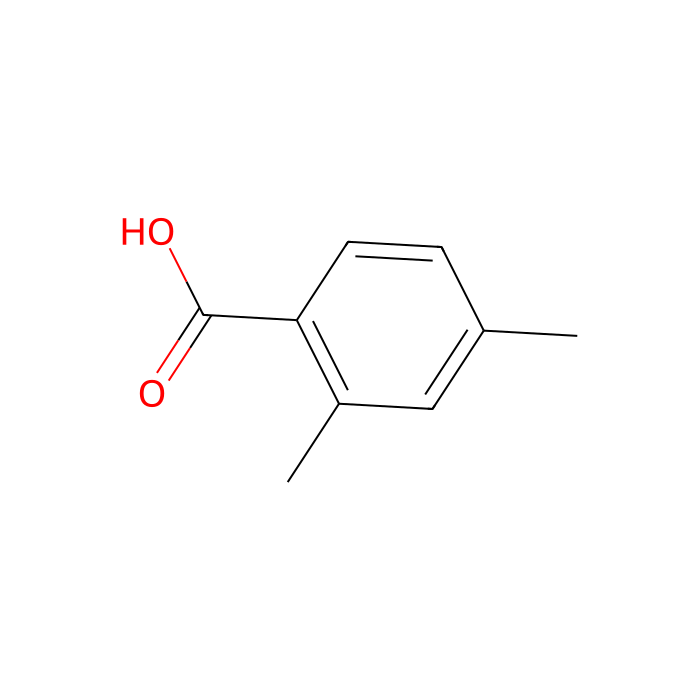
Brief overview: 2,4-Dimethylbenzoic acid is an ortho-/para-disubstituted benzoic acid bearing methyl groups at the 2- and 4-positions relative to the carboxyl group. The aromatic ring contains one carboxylic acid and two methyl substituents, with no stereocenters.
Item-specific (from Product Data):
Product Name: 2,4-Dimethylbenzoic Acid
SKU: D101977
CAS: 611-01-8
PubChem CID: 11897
InChIKey: 27586 (as provided)
Storage Conditions: Room temperature; shipped normal
Computed/literature identifiers (informational):
Molecular formula (literature): C9H10O2
Molecular weight (literature): 150.17 g/mol
Preferred IUPAC name (literature): 2,4-dimethylbenzoic acid
Structural features (general chemistry description):
Functional groups: one benzoic acid moiety (carboxyl group directly attached to an aromatic ring); two ring methyl substituents.
Ring system: monosubstituted benzene core bearing two additional methyl groups at 2- and 4-positions (ortho and para to the carboxyl).
Electron effects: the carboxyl group is strongly electron-withdrawing by induction and resonance; methyl groups are weakly electron-donating by hyperconjugation, modestly increasing ring electron density at adjacent/para positions.
Acidic site: the carboxylic proton is the sole Brønsted-acidic site; no basic heteroatoms present.
Stereochemistry: achiral; no stereoisomerism.
Tautomerism: none relevant beyond standard acid/base equilibria of the carboxyl group.
Synthetic Utility
Functional group leverage:
Carboxylic acid handles enable: esterification (Fischer, Steglich), amidation (EDC/HOBt, HATU, PyBOP, CDI), anhydride/acid chloride formation (SOCl2, (COCl)2), and Curtius/Schmidt transformations via acyl azides for access to amines/isocyanates.
Arene substitution landscape:
Two methyl groups at 2 and 4 positions subtly tune electronics and sterics. The carboxyl (meta-directing, deactivating) and methyls (ortho/para-directing, activating) create nuanced regioselectivity in electrophilic aromatic substitution. Nitration/halogenation tends to occur away from the strongly deactivating CO2H.
Modern decarboxylative strategies:
Via redox-active esters (RAEs, e.g., NHPI esters): engage in Ni/photoredox cross-couplings (decarboxylative arylation/alkylation), radical additions, and Minisci-type processes under mild conditions.
Copper/silver-mediated decarboxylative halogenation: access 2,4-dimethylaryl halides as cross-coupling linchpins.
Cross-coupling after prefunctionalization:
Transformations on the aryl ring (bromination, sulfonylation) followed by Suzuki, Negishi, or Buchwald–Hartwig couplings expand the substitution pattern while retaining or modifying the carboxylate functionality (e.g., via protected esters).
Purification/processing advantages:
The dimethyl pattern often enhances crystallinity and raises melting points of derivatives, facilitating isolation by crystallization rather than chromatography.
Retrosynthetic value:
Commercial availability of the 2,4-dimethyl substitution pattern at the benzoic acid stage provides a convergent entry to diverse 2,4-dimethylbenzamide and benzoate libraries without late-stage ring methylation.
Target Specificity
Not applicable. This product is a small-molecule chemical (aromatic carboxylic acid), not an antibody, enzyme, or biological probe with defined molecular targets. No antigen/epitope specificity, clone, isotype, or species reactivity applies.
Domande frequenti
What is the purity of this product?
This product is supplied at ≥98% purity (chemical assay). Lot-specific values are stated on the Certificate of Analysis.
How should this product be stored?
Store at room temperature.
How is this product shipped?
This product ships under standard ambient conditions. No temperature-controlled packaging is required.
What are the CAS number, molecular formula and molecular weight?
The CAS Number is 611-01-8, the molecular formula is C9H10O2, and the molecular weight is 150.17 g/mol. InChIKey BKYWPNROPGQIFZ-UHFFFAOYSA-N.
What documentation is provided?
Available product documentation, including Certificates of Analysis (COA), Safety Data Sheets (SDS), and specification sheets, is shown in the product document area. Document availability and access follow the current site policy.
Utilizziamo i cookie per garantire il corretto funzionamento del sito web e, ove consentito, per migliorare la tua esperienza. Puoi gestire le tue preferenze in qualsiasi momento nelle Impostazioni. Per saperne di più, consulta la nostra Cookie Policy.
Desidera che le inviamo un messaggio quando avremo sconti disponibili?
Ricordamelo più tardi
Grazie! Controlli la sua casella di posta per confermare.
Products are supplied to verified businesses, institutions, and qualified professionals for research and development use only. Not for use in humans, animals, diagnosis, or therapy.

 H2205888