This compound belongs to the class of organic compounds known as branched alkanes. These are acyclic branched hydrocarbons having the general formula CnH2n+2.
External Descriptors
Hydrocarbons
1. Djoumbou Feunang Y, Eisner R, Knox C, Chepelev L, Hastings J, Owen G, Fahy E, Steinbeck C, Subramanian S, Bolton E, Greiner R, and Wishart DS. ClassyFire: Automated Chemical Classification With A Comprehensive, Computable Taxonomy. Journal of Cheminformatics, 2016, 8:61.
Determine the necessary mass, volume, or concentration for preparing a solution.
Dilution Calculator
Determine the dilution needed to prepare a stock solution.
Reconstitution Calculator
Recensioni
Recensioni dei clienti
Application Protocols
No item-specific, validated application protocols are provided for this product. For general use as a solvent or GC reference hydrocarbon (literature/general):
GC retention index check
Prepare a hydrocarbon mixture at ~100–500 mg/L in an appropriate volatile solvent (e.g., dichloromethane or pentane).
Inject using split mode; verify 2,4-dimethylheptane retention relative to C9 isomer benchmarks.
Reaction medium use
Charge dried reactor with substrate and catalyst; add 2,4-dimethylheptane to desired concentration.
Inert, heat/irradiate as required; monitor by GC or NMR.
These are general suggestions only. Adapt conditions to your system and consult standard operating procedures and the SDS.
Biological Roles
Item-specific biological data: Not specified for this item; refer to literature as needed.
General/literature context for branched alkanes such as 2,4-dimethylheptane:
Biogenic occurrence: Straight- and branched-chain alkanes can be produced by certain microbes and plants in trace amounts (e.g., cuticular waxes), though 2,4-dimethylheptane is mainly associated with petroleum fractions.
Biochemical activity: Lacks functional groups; exhibits minimal specific biochemical interactions. Highly hydrophobic, partitions into lipid phases; at sufficient concentrations in vitro, can disrupt membrane integrity due to solvent effects (not a targeted biological role).
Metabolism: In organisms capable of hydrocarbon metabolism, oxidation can proceed via monooxygenase initiation to secondary/tertiary alcohols, then β-oxidation-like shortening; branched centers may slow biodegradation relative to n-alkanes (literature).
Environmental fate: Low water solubility, high volatility, and strong sorption to organic matter; undergoes atmospheric oxidation via OH radicals with typical lifetimes of hours to days (literature).
This product is designated for research use only; no clinical or diagnostic use is implied.
Buffer Applications
Not typically applicable. 2,4-Dimethylheptane is a hydrophobic alkane and is immiscible with aqueous buffers. For aqueous systems, select appropriate buffer chemistries (e.g., phosphate, Tris, HEPES) discussed under buffer-focused reagents. Consider this product only as a nonpolar phase or immiscible carrier in biphasic systems if required.
Green Alternatives
As a volatile petroleum-derived hydrocarbon, 2,4-dimethylheptane is a VOC with flammability and environmental footprint considerations. Where functionally acceptable, consider greener or safer alternatives.
Comparison (literature/general; evaluate per application):
Heptane (n- or iso- grades)
Pros: Broad availability, similar solvency, often lower cost; slightly higher volatility aids removal.
Cons: Still a VOC; petroleum-derived.
2-Methyltetrahydrofuran (2-MeTHF)
Pros: Bio-based, higher polarity than alkanes (facilitates some catalysis), better phase separation with water, recyclable.
Cons: Ethers are peroxide-formers; different solvency and reactivity profile; more water miscibility.
Cyclopentyl methyl ether (CPME)
Pros: Wider liquid range, low peroxide formation tendency relative to THF; good “green” profile.
Cons: Higher cost; different polarity may alter selectivity.
Cons: Equipment requirements; limited solubility for higher polarity substrates.
Trade-offs
Switching to ethers or esters increases polarity and may change kinetics/selectivity. Validate with small-scale trials.
If a hydrocarbon is essential, using iso- or n-heptane may simplify regulatory handling versus less common C9 isomers.
Pharmaceutical Uses
Item-specific pharmacopeial status and intended formulation uses: Not specified for this item; refer to CoA/Spec Sheet.
General/literature context:
Role: Aliphatic hydrocarbons can serve as process solvents, cleaning agents, or carriers in manufacturing development; however, 2,4-dimethylheptane is not a common excipient and is not typically listed in major pharmacopeias as a standalone material.
Considerations: Residual solvent control per ICH Q3C applies; alkanes in this carbon range are generally Class 2/3 depending on composition—process selection should minimize residues and enable robust purge.
Analytical control: GC headspace methods are standard for residual solvent quantification; set limits according to regulatory guidance for the specific process and risk assessment.
No therapeutic claims are made; this product is for research use only.
Physical Properties
Item-specific specifications: Not specified for this item; refer to CoA/Spec Sheet.
Literature/general properties for 2,4-dimethylheptane (for method development and planning; not product specifications):
Phase/appearance: Colorless, volatile liquid (literature, typical of C9 branched alkanes)
Molecular weight: ~128.26 g/mol (literature)
Boiling point: typically ~146–149 °C at 1 atm (literature for this C9 isomer)
Melting point: expected below −80 °C (literature, branched C9 alkanes are low-melting liquids)
Density: ~0.72–0.74 g/mL at 20 °C (literature range for branched C9 alkanes)
Refractive index n20/D: ~1.400–1.406 (literature)
Vapor pressure: on the order of a few mmHg at 25 °C (literature estimate for C9 isomers)
Water solubility: essentially insoluble in water; <1 mg/L at 25 °C (literature)
LogP (octanol/water): approximately 4.8–5.2 (literature; highly hydrophobic)
Dielectric constant: ~2.0 (literature, typical for alkanes)
Notes for practitioners
Nonpolar and low dielectric; behaves similarly to nonane and isoalkane mixtures in separations and partitioning.
Low UV absorbance above ~210–220 nm (literature), but alkanes are often avoided as HPLC mobile phases due to poor eluotropic strength and volatility considerations.
Quality and Grades
Item-specific grade/purity and stabilizers: Not specified for this item; refer to CoA/Spec Sheet.
General guidance for hydrocarbon quality considerations (literature/general):
Hydrocarbon purity matters for analytical uses (GC retention index standards, physical property standards). Trace aromatic or olefinic impurities can affect UV absorbance and detector response.
Typical grades you may encounter
Technical/industrial: adequate for noncritical applications; may contain broader isomer/impurity profiles.
Reagent/ACS grade: tighter purity; suitable for most synthetic uses.
GC/HPLC grade: low residue, low UV absorbance, and tightly controlled impurity profile for chromatography.
Stabilizers: Alkanes typically require no stabilizer. If present, inhibitors should be disclosed on the CoA; absence/presence influences suitability for kinetic or mechanistic studies.
Verification: Confirm identity and isomeric purity by GC-FID or GC–MS. For demanding applications, request a recent CoA with assay, water, and residue-on-evaporation data.
What is specific here: Only storage (room temperature) and DG shipping are specified in the Product Data. All other specifications should be confirmed against the CoA/SDS for this SKU.
Reaction and Applications
Item-specific applications: Not specified for this item; refer to CoA/Spec Sheet and catalog notes.
Literature/general applications for 2,4-dimethylheptane and similar branched alkanes:
Inert reaction medium
Nonpolar, non-coordinating medium for radical initiations, thermal rearrangements, and some photochemical processes where minimal solvent participation is desired.
Useful in hydrogenations when a purely aliphatic medium is preferred to avoid aromatic adsorption on catalysts (e.g., Pd/C). Monitor heat removal due to relatively low heat capacity and flammability.
Analytical and calibration uses
Hydrocarbon standard in GC for retention index determination and separation method development of C9 isomers.
Partitioning and hydrophobicity studies (e.g., model matrix to benchmark logP/logS predictions).
Materials and formulation
Volatile aliphatic carrier in coatings and polymer solution studies where aromatic solvents are restricted.
Practical notes
Dryness is generally not critical, but dissolved oxygen can impact radical or photochemical pathways—degassing (freeze–pump–thaw or sparging) is recommended when appropriate.
Because it is flammable with moderate vapor pressure, maintain efficient ventilation and avoid hot plates without spark-free controls.
For GC reference work, confirm isomeric purity by GC-FID to avoid coelution artifacts.
Reaction Conditions
General guidance from literature for using 2,4-dimethylheptane or similar alkanes as solvent; these are not product specifications:
Typical solvent role: Nonpolar, inert medium for thermal, radical, or catalytic hydrogenations.
Temperature: Ambient to reflux (up to ~146–149 °C, literature BP). For higher temperatures, consider higher-boiling alkanes (decane) or silicone oils.
Atmosphere: Inert (N2/Ar) recommended for oxygen-sensitive reactions; oxygen quenching can affect radical/photochemical pathways.
Concentration: Adjust to ensure substrate solubility; co-solvents (e.g., toluene, MTBE) may be needed for poorly soluble substrates.
Catalysts: Pd/C, PtO2, Ni-based hydrogenations operate well in alkanes; ensure adequate agitation to overcome mass transfer limits.
Drying/degassing: Not strongly hygroscopic; if water-sensitive reagents are used, dry over 3Å sieves. Degas by sparging or freeze–pump–thaw when needed.
Workup: Quench under inert atmosphere if pyrophoric catalysts are used; separate hydrocarbon phase from aqueous washes; remove solvent under reduced pressure with appropriate cold trap and ventilation.
Yields/selectivity: Highly system-dependent; alkanes often lower side reactions involving solvent participation compared to aromatics, but may slow rates due to reduced polarity.
Safety: Use spark-free equipment; reflux operations require condenser with adequate cooling and fire controls.
Safety and Handling
Item-specific GHS details: Not specified for this item; refer to the SDS for definitive hazard, classification, and first-aid information.
General safety information for branched alkanes (literature/general):
Primary hazards: Highly flammable liquid and vapor; may form explosive vapor–air mixtures in confined spaces. Narcotic effects (drowsiness/dizziness) possible at high vapor concentrations.
Incompatibilities: Strong oxidizers (e.g., peroxides, chromates), halogenating agents. Avoid ignition sources, static discharge, and hot surfaces.
PPE: Use chemical-resistant gloves (e.g., nitrile), safety glasses or splash goggles, lab coat; work in a well-ventilated hood to control vapors.
Handling: Ground/bond containers during transfer; use explosion-proof/ventilated equipment. Minimize vapor accumulation; keep containers tightly closed when not in use.
Storage (aligns with Product Data: room temperature): Store at ambient temperature in a flammable cabinet, away from oxidizers and ignition sources. Keep in tightly sealed hydrocarbon-compatible containers.
Spill/Fire response (overview): For small spills, absorb with inert material (vermiculite) and ventilate area; eliminate ignition sources. For fires, use dry chemical, CO2, or foam; water spray may be used for cooling containers only.
Stability: Alkanes are chemically stable; unlike ethers, they do not form peroxides under normal storage. Avoid prolonged exposure to strong UV and oxidants.
Always consult the SDS for this catalog item before use.
Solvent Selection
2,4-Dimethylheptane is a nonpolar, low-dielectric hydrocarbon solvent candidate; however, it is less commonly used than hexanes, heptane, or iso-octane in routine synthesis.
Polarity and miscibility (literature/general)
Polarity: Nonpolar; dielectric constant ~2.
Miscibility: Immiscible with water; miscible with nonpolar organics (alkanes, toluene) and moderately miscible with ethers.
Volatility: Intermediate (C9 range); slower evaporation than hexane/heptane, faster than decane.
When to choose it
As a hydrophobic medium that minimizes substrate coordination and ion-pair separation (e.g., radical or photochemical systems tolerant to low polarity).
As a reference solvent or carrier for GC calibration of C9 isomers.
Comparison to typical choices (literature/general)
n-Heptane: more widely available; slightly higher volatility; very similar solvency.
Isooctane (2,2,4-trimethylpentane): common for fuel-related work; lower polarity; comparable safety profile.
Toluene: higher solvency and boiling point; aromatic content may be undesirable for some radical or hydrogenation chemistries.
Practical tips
Ensure complete dryness is usually unnecessary for alkanes, but water can phase-separate; if needed, dry over 3Å molecular sieves.
Degas if oxygen-sensitive chemistry is planned; inert gas blanket improves reproducibility.
Additional guidance (general/best practice for alkanes):
Store tightly closed in a flammable cabinet away from oxidizers and ignition sources. Use hydrocarbon-compatible caps and liners to minimize permeation/evaporation.
Headspace inerting (N2 or Ar) is optional but can reduce dissolved oxygen for oxygen-sensitive applications.
No reconstitution required; the product is supplied neat as a liquid hydrocarbon. If phase dryness is critical, condition with 3Å molecular sieves and verify by Karl Fischer on the process stream if necessary.
Avoid repeated heating–cooling cycles; dispense under minimal exposure to air to limit volatile loss.
Always follow the SDS for container handling and long-term storage recommendations.
Structure and Identity
Branched aliphatic hydrocarbon (C9 isomer) used as a nonpolar reference hydrocarbon and inert medium.
Item-specific (Product Data)
SKU: D414618
Product name: 2,4-Dimethylheptane
CAS: 2213-23-2
InChIKey: 15214 (as provided)
Storage: Room temperature
Shipped In: FedEx DG Service
Research use: For research use only
Literature/computed identity (general reference; not item-specific specs)
Molecular formula: C9H20 (literature)
Molecular weight: ~128.26 g/mol (literature)
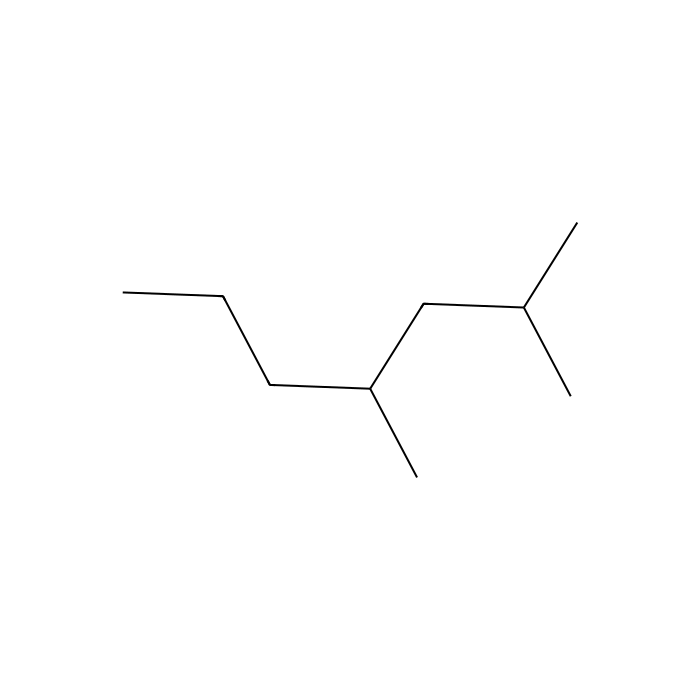
SMILES: CC(C)CC(C)CCC (literature depiction of 2,4-dimethylheptane)
2D structural description: a heptane backbone bearing methyl substituents at C-2 and C-4; i.e., CH3–CH(CH3)–CH2–CH(CH3)–CH2–CH2–CH3. No rings; fully saturated; no heteroatoms; achiral (meso-like due to symmetry along the chain).
Structural features
Functional groups: none beyond C–C and C–H bonds (alkane)
Saturation: fully saturated (no π-bonds)
Polarity: nonpolar; very low polarizability beyond dispersion interactions
Synthetic Utility
As a saturated, non-coordinating, nonpolar hydrocarbon, 2,4-dimethylheptane offers an inert reaction environment with minimal solvent–substrate interactions.
Utility (literature/general)
Inert medium for radical initiations (e.g., AIBN/thermal) and some photochemical transformations where hydrogen abstraction from solvent is disfavored versus more activated solvents.
Hydrogenation and hydrofunctionalization reactions where an aliphatic, aromatic-free solvent minimizes catalyst fouling or unintended π-complexation.
Extraction and phase-separation studies as a hydrophobic phase with well-defined partition characteristics.
Limitations
Low polarity limits solubility of polar substrates, salts, and many catalysts; mass transfer can be rate-limiting.
Boiling point in the ~146–149 °C range constrains high-temperature applications relative to decalin/mineral oil but exceeds that of hexanes/heptane.
Analytical/synthetic planning
Because it lacks UV chromophores, monitoring reactions by UV-based HPLC may require alternative detection (e.g., ELSD) if analytes also lack chromophores.
For kinetic studies seeking minimal solvent participation, branched alkanes provide a useful baseline relative to aromatics or ethers.
Confirm suitability with small-scale trials; consult the CoA for purity and any isomeric content that may affect reproducibility.
Target Specificity
Not applicable. This product is a small-molecule hydrocarbon and does not possess biological target specificity (no antibody/bioreagent attributes are provided in the Product Data).
Domande frequenti
What is the purity of this product?
This product is supplied at ≥97% purity (chemical assay). Lot-specific values are stated on the Certificate of Analysis.
How should this product be stored?
Store at room temperature.
How is this product shipped?
This product is classified as dangerous goods and ships via FedEx DG Service. Ground and other economy services are not available, and delivery to some destinations or address types may be restricted.
What are the CAS number, molecular formula and molecular weight?
The CAS Number is 2213-23-2, the molecular formula is C9H20, and the molecular weight is 128.26 g/mol. InChIKey AUKVIBNBLXQNIZ-UHFFFAOYSA-N.
What documentation is provided?
Available product documentation, including Certificates of Analysis (COA), Safety Data Sheets (SDS), and specification sheets, is shown in the product document area. Document availability and access follow the current site policy.
Utilizziamo i cookie per garantire il corretto funzionamento del sito web e, ove consentito, per migliorare la tua esperienza. Puoi gestire le tue preferenze in qualsiasi momento nelle Impostazioni. Per saperne di più, consulta la nostra Cookie Policy.
Desidera che le inviamo un messaggio quando avremo sconti disponibili?
Ricordamelo più tardi
Grazie! Controlli la sua casella di posta per confermare.
Products are supplied to verified businesses, institutions, and qualified professionals for research and development use only. Not for use in humans, animals, diagnosis, or therapy.

 D2503012