This compound belongs to the class of organic compounds known as biphenyls and derivatives. These are organic compounds containing to benzene rings linked together by a C-C bond.
External Descriptors
Not available
1. Djoumbou Feunang Y, Eisner R, Knox C, Chepelev L, Hastings J, Owen G, Fahy E, Steinbeck C, Subramanian S, Bolton E, Greiner R, and Wishart DS. ClassyFire: Automated Chemical Classification With A Comprehensive, Computable Taxonomy. Journal of Cheminformatics, 2016, 8:61.
Determine the necessary mass, volume, or concentration for preparing a solution.
Dilution Calculator
Determine the dilution needed to prepare a stock solution.
Reconstitution Calculator
Recensioni
Recensioni dei clienti
Application Protocols
No validated, item-specific application protocols are provided in the Product Data. The following general laboratory practices are commonly used with hydrophobic conjugated small molecules:
Thin-film preparation (general)
Dissolve in chlorobenzene or o-dichlorobenzene (typ. 2–20 mg/mL) with mild heating; hot-filter through 0.2 µm PTFE; spin coat at 1000–3000 rpm to target thickness; bake at 60–120 °C to remove residual solvent.
Solution spectroscopy (general)
Prepare ~10–100 µM solutions in CH2Cl2 or toluene; degas for oxygen-sensitive measurements; record UV–vis/PL; avoid concentrations that induce aggregation unless studied intentionally.
Purification (general)
Recrystallize from toluene/ethanol mixed solvents or perform Soxhlet extraction (e.g., hexane → toluene) followed by recrystallization. Gradient sublimation may further improve optical purity.
These are general guidelines only. Item-specific, tested protocols (WB, IHC, IF, FC, etc.) are not applicable to this chemical and are Not specified for this item.
Biological Roles
This compound is a synthetic, hydrophobic polyaromatic heteroarene intended for materials and chemical research. It has no established physiological role.
General considerations (literature/general)
Lacks ionizable functional groups in the physiological pH range; exhibits negligible aqueous solubility and limited bioavailability.
Expected to behave as an inert, lipophilic organic molecule with minimal specific interactions in aqueous biological systems.
No known role in metabolic pathways, signaling, or structural biology; not a cofactor, metabolite, or ligand of known biological macromolecules.
Laboratory interface with biology
If used in bioimaging or biosensing research as part of composite materials, compatibility must be engineered via formulation (e.g., nanoparticles, polymer matrices); such applications are outside the scope of the current product data and must be validated by the user.
Item-specific biological activity data, cytotoxicity, and biocompatibility are Not specified for this item; consult primary literature if contemplating any bio-adjacent experiments and adhere strictly to the Research Use Only restriction.
Buffer Applications
Not typically applicable. As a highly hydrophobic, nonionic polyaromatic, this compound is not used to formulate aqueous buffer systems and has negligible water solubility.
If dispersion in aqueous media is required for research, consider surfactant-stabilized emulsions, polymer carriers, or nanoparticle formulations; such methods are application-specific and are not provided in the Product Data for this item.
Green Alternatives
While the substance itself is a non-volatile, hydrophobic polyaromatic for which “green substitutes” are not directly applicable, greener choices can be made for processing solvents and transformation methods.
Greener processing solvents (literature/general)
Replace CH2Cl2/CHCl3 with anisole, toluene, or cyclopentyl methyl ether (CPME) where solubility permits.
For high-solids inks, consider propylene carbonate or dimethyl isosorbide as polar, higher-boiling alternatives if compatible with film formation.
Greener reaction media for derivatization
Substitute DMF/DMAc/NMP with Cyrene (dihydrolevoglucosenone) or propylene carbonate for certain borylation or cross-coupling protocols.
Aqueous micellar catalysis (e.g., TPGS-750-M) has been reported for cross-couplings of aryl systems; applicability depends on substrate solubility.
Energy and waste reduction
Use hot filtration and controlled crystallization to purify instead of column chromatography when feasible.
Employ continuous-flow photophysical measurements or thin-film deposition to minimize solvent volumes.
Boiling point/energy: o-DCB high (180 °C); toluene moderate (111 °C).
Solvency: o-DCB higher; toluene lower. Tradeoff between energy use and achievable solids content.
Item-specific solvent constraints and validated greener substitutions are Not specified for this item; verify performance empirically.
Pharmaceutical Uses
Not applicable. This material is not an excipient or active ingredient and has no pharmacopeial monograph indicated.
Formulation role: None specified.
Regulatory status: Not specified for this item; refer to CoA/Spec Sheet. Any use must remain within research and development contexts.
For any process development studies where this compound is used as a model hydrophobic aromatic, handle strictly as a research chemical and do not incorporate into products intended for human or veterinary use.
Physical Properties
Item-specific physicochemical specifications (melting point, purity, density, solubility limits, UV cutoff, etc.) are Not specified for this item; refer to CoA/Spec Sheet. The following are general/literature expectations for closely related materials and should be used only as guidance for method development.
Aggregate physical character (literature/general)
Likely a pale to off-white crystalline solid at ambient temperature due to high aromatic content and rigidity.
Strongly hydrophobic; practically insoluble in water.
Solubility profile (literature/general)
Aromatic and chlorinated aromatic solvents (toluene, chlorobenzene, o-dichlorobenzene) typically provide the best solubility; hot solutions may be required for concentrated processing inks.
Moderate solubility expected in chlorinated solvents (CH2Cl2, CHCl3) and high-boiling dipolar aprotics (DMF, DMAc, NMP) when warmed.
Poor solubility in alcohols and aliphatic hydrocarbons.
Thermal behavior (literature/general for analogous oligophenyl–thiophenes)
High melting point is typical (>150–200 °C), with thermal stability to well above common device-processing temperatures; exact MP/thermal transitions Not specified for this item.
Optical/electronic (literature/general)
Extended π-conjugation suggests strong π–π* absorption in the UV with tailing into the near-UV/visible; specific λmax and extinction coefficients Not specified for this item.
Partitioning (literature/general)
High logP is expected for such polyaromatic systems (>5 for related oligophenylenes); numeric logP for this exact compound Not specified for this item.
Density/refractive index
Not specified for this item; refer to CoA/Spec Sheet.
Quality and Grades
Item-specific grade/purity
Grade/Purity: Not specified for this item; refer to CoA/Spec Sheet for assay, residual solvents, and impurity profile.
What “research grade” commonly implies (general guidance)
Intended for R&D, method development, and materials screening; may not include pharmacopeial testing or lot release by compendial monographs.
Typical controls include identity (NMR/HRMS), appearance, and purity by HPLC/GC or NMR integration; trace metal analysis may not be routine unless specified.
Considerations for conjugated small molecules
Optical/electronic properties are sensitive to trace colored or polar impurities. For device studies (OLED/OPV/OFET), consider additional purification (gradient sublimation or Soxhlet extraction) if ultra-low impurity levels are required.
If using in cross-coupling derivatization, ensure halogen/boron content is as intended; for the parent hydrocarbon here, halogen content should be minimal unless functionalized.
Stabilizers/inhibitors
No stabilizers are listed in the Product Data. If present in any lot, they will be disclosed on the CoA; otherwise, assume neat material without intentional additives.
Documentation
For method validation and reproducibility, request the lot-specific CoA for: analytical purity, residual solvent profile, water content, and any spectral data. Absent explicit catalog specifications, treat all numeric quality attributes as Not specified for this item.
Reaction and Applications
Materials and photophysics (general research use)
The extended π-system and rigid framework make this compound a useful model chromophore and building block in organic electronics research (OLED/OPV/OFET), photoluminescent materials, and as a benchmark for charge-transport studies. It can serve as a host or inert diluent matrix in thin films to tune morphology and intermolecular coupling (literature/general; no device claims).
Direct C–H borylation on the phenyl rings (Ir-catalyzed, B2pin2) affords aryl boronates for Suzuki–Miyaura couplings to extend conjugation or introduce functionality.
Oxidation at sulfur (m-CPBA, peracids) to sulfoxide/sulfone variants modifies electronic properties and increases polarity.
Assembly into higher-order structures (literature/general)
Formation of co-crystals, H- or J-aggregates, and π–π stacked motifs can be probed via variable-temperature spectroscopy and XRD to explore excitonic coupling.
Practical tips
For thin-film fabrication, hot filtration (0.2 µm PTFE) immediately prior to deposition improves film uniformity.
Remove dissolved oxygen for sensitive photophysical measurements by thorough degassing (freeze–pump–thaw or sparging) to minimize triplet quenching.
Note
Manufacturer Applications: Not specified in Product Data. The above reflects general research practices for conjugated thiophene–biphenyl systems and should be adapted to your specific study.
Reaction Conditions
No item-specific reaction validation is provided. The following general conditions from the literature for related thiophene–biphenyl systems can guide derivatization; adapt to your substrate and scale.
Direct C–H borylation (to access Ar–Bpin derivatives)
Catalyst: [Ir(cod)OMe]2 (1–2 mol% Ir) with dtbpy ligand (4–8 mol%).
Reagents: B2pin2 (1.2–2.0 equiv per targeted C–H site).
Solvent/Temp: neat, or in cyclohexane, octane, or PhCF3; 80–120 °C; 6–24 h.
Notes: Regioselectivity on biphenyl rings depends on sterics/electronics; monitor by 1H NMR/LC–MS.
Electrophilic bromination of peripheral phenyl rings
Reagents: Br2 or NBS with radical initiator (AIBN/BPO) under light/heat; or selective bromination using NBS/AcOH in the presence of catalysts.
Solvent: CH2Cl2, CHCl3, or AcOH; 0–25 °C (mild) to reflux (vigorous); 1–12 h.
Notes: Over-bromination can occur; iterative protection or directing strategies may be required.
Sulfur oxidation (thiophene → sulfone)
Oxidant: m-CPBA (2–4 equiv) or Oxone; Solvent: CH2Cl2 or MeCN; Temp: 0–25 °C; 1–6 h.
Notes: Control stoichiometry/temperature to stop at sulfoxide if desired; sulfones increase polarity and can alter solubility.
Cross-coupling on halogenated derivatives
Suzuki–Miyaura: Pd(PPh3)4 or Pd-PEPPSI; base K3PO4/Cs2CO3; solvent toluene/PhMe–H2O or dioxane–H2O; 60–100 °C; 2–24 h.
Stille/Negishi/Kumada as alternatives where appropriate.
Yields, selectivities, and exact site selectivity are substrate- and condition-dependent and are Not specified for this item.
Safety and Handling
Item-specific hazard classifications and statements are Not specified for this item; refer to the SDS for authoritative information. The following prudent practices apply to polyaromatic, sulfur-containing heteroarenes in research settings.
GHS/SDS
Signal word, hazard statements, pictograms, and exact classification: Not specified for this item; consult the SDS prior to use.
Likely hazards (general)
Low volatility solid; primary risks are dust generation and potential eye/skin irritation typical of inert organic powders.
Combustible organic material; avoid ignition sources and accumulation of dust.
PPE and engineering controls
Wear safety glasses with side shields, lab coat, and suitable chemically resistant gloves (e.g., nitrile). Handle powders in a fume hood to minimize inhalation of particulates.
Avoid creating dust; use antistatic measures when weighing.
Incompatibilities (general)
Strong oxidizers may react with polyaromatic systems and with the thiophene sulfur; store away from oxidizing agents.
First aid (overview; defer to SDS)
Inhalation: move to fresh air; seek medical attention if symptoms occur.
Skin/eye contact: rinse with water for several minutes; remove contaminated clothing; seek medical advice if irritation persists.
Ingestion: rinse mouth; do not induce vomiting; seek medical attention.
Fire-fighting (general)
Use dry chemical, CO2, or foam. Combustion may produce CO/CO2 and sulfur oxides; firefighters should wear SCBA.
Storage per Product Data
Store at room temperature in a tightly closed container; protect from light and oxidants. Refer to SDS for detailed storage guidance.
Solvent Selection
This polyaromatic, weakly polar molecule dissolves best in aromatic and chlorinated organic solvents. Selection depends on the intended application (spectroscopy vs. thin-film processing vs. reactions).
Polarity class and miscibility (general/literature)
Effectively nonpolar to weakly polar donor aromatic. Water immiscible; soluble to varying degrees in toluene, chlorobenzene (PhCl), o-dichlorobenzene (o-DCB), and chlorinated solvents (CH2Cl2, CHCl3). Limited solubility in alcohols and aliphatic hydrocarbons.
Practical recommendations
Spectroscopy/analytical solutions: CH2Cl2 or CHCl3 for room-temperature UV–vis measurements; filter (0.2 µm PTFE) prior to use.
Film casting/spin coating: chlorobenzene or o-DCB allow higher loadings and slower evaporation for uniform films; mild heating (50–90 °C) can aid dissolution.
Reaction media (for subsequent functionalization): toluene, anisole, or chlorobenzene for electrophilic aromatic substitutions; polar aprotics (DMF, DMAc, NMP) for metal-catalyzed borylation/C–H activation.
Comparison highlights (literature/general)
Toluene: greener profile than chlorinated solvents; moderate solubility; bp 111 °C supports heated processing.
Chlorobenzene: better solvency for polyaromatics; bp 132 °C; common in device ink formulations.
o-DCB: highest solvency among listed; bp 180 °C; useful for high-solids or high-T operations.
Notes
Exact solubility limits and extinction coefficients in specific solvents are Not specified for this item; determine empirically for your lot and application.
Storage and Reconstitution
Storage conditions (from Product Data)
Store at room temperature. Keep container tightly closed in a dry, well-ventilated place. Protect from strong oxidizers and prolonged direct light.
Stability (general/literature)
Conjugated polyaromatic solids are typically air-stable and thermally robust. Long-term stability benefits from minimizing exposure to light and heat. No shelf-life specification is provided for this item.
Not supplied with a reconstitution buffer. To prepare solutions, use dry organic solvents such as chlorobenzene, o-dichlorobenzene, toluene, or CH2Cl2. Mild heating (50–90 °C) and sonication can assist dissolution.
Filter solutions (0.2 µm PTFE) before thin-film deposition or spectroscopic measurements to remove particulates.
Freeze–thaw considerations
Not applicable to the solid. If storing prepared solutions, keep in amber glass at 2–8 °C and equilibrate to room temperature before use; avoid repeated warm–cool cycles that may induce precipitation/crystallite growth.
Shipping
Shipped condition Not specified for this item; refer to CoA/Spec Sheet. Room-temperature shipment is generally suitable for air-stable organic solids.
For definitive stability, impurity limits, and any special handling for your lot, consult the SDS and the lot-specific CoA.
Structure and Identity
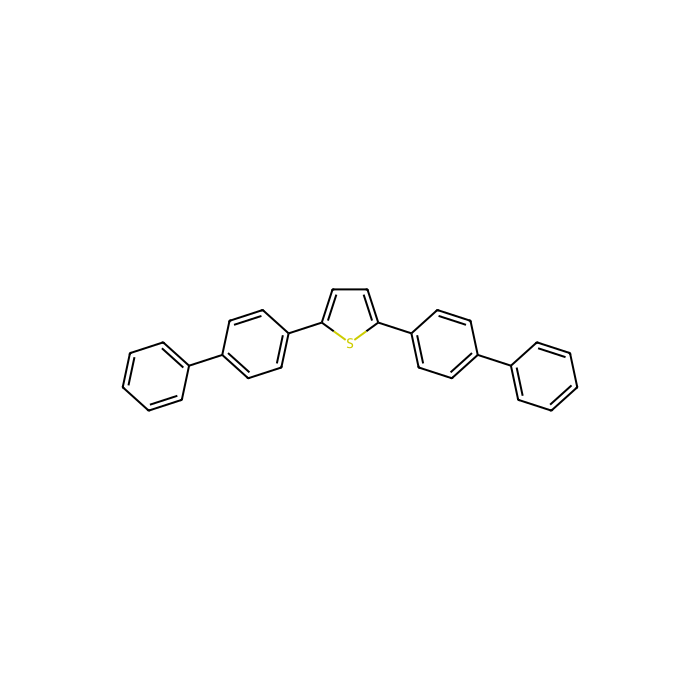
A rigid, fully conjugated thiophene–biphenyl triarylsulfide framework designed for organic materials research.
Item-specific identifiers (from Product Data)
SKU: B405167
Product Name: 2,5-Bis(4-biphenylyl)thiophene
CAS: 56316-86-0
Research Use: For research use only
InChIKey (catalog entry): 394200 (appears incomplete; see note below)
Structural features (general/literature description)
Core: a thiophene ring substituted at the 2- and 5-positions.
Substituents: two para-biphenyl groups (4-biphenylyl) attached symmetrically at C2 and C5 of thiophene, yielding a C2-symmetric, planarizable, extended π-system.
Functional groups: heteroaromatic sulfur (thiophene), multiple phenyl rings; no heteroatom donors/acceptors beyond the thiophene sulfur.
Conjugation: continuous π-conjugation from phenyl–phenyl–thiophene–phenyl–phenyl promotes strong π–π interactions and high molar absorptivity.
Stereochemistry: none (achiral, no stereocenters).
Empirical formula (calculated from name): C28H20S (literature/computed)
Formula weight: ~388.53 g/mol (literature/computed)
Representative 2D structure in words: a central five-membered thiophene ring with para-biphenyl “arms” at positions 2 and 5; each arm is a para-linked biphenyl directly bonded through the 4-position to thiophene.
Notes
Definitive structure strings (SMILES, InChI, InChIKey) are Not specified for this item; refer to CoA/Spec Sheet. The catalog InChIKey field appears truncated and should not be used for informatics without verification.
Synthetic Utility
As an electron-rich heteroaromatic embedded within an extended biphenyl framework, this molecule serves as a versatile platform for derivatization and structure–property studies (literature/general guidance).
Reactive sites and transformations
Peripheral phenyl C–H bonds: amenable to directed or nondirected C–H activation (Ir/Rh/Pd) for borylation (→ Ar–Bpin) and subsequent Suzuki–Miyaura couplings to build higher conjugation or introduce functional handles.
Electrophilic aromatic substitution: controlled bromination/chlorination on selected phenyl rings affords aryl halides for cross-coupling (Suzuki, Stille, Negishi, Kumada). Nitration/sulfonylation can tune electronics and solubility.
Sulfur-centered modifications: oxidation of thiophene to sulfoxide/sulfone (peracids) modulates donor strength and packing, enabling systematic photophysical comparisons.
Lithiation: while α-positions on thiophene are occupied (2,5-disubstituted), ortho-lithiation on outer phenyl rings may be feasible under directed conditions (e.g., with suitable directing groups introduced beforehand).
Utility in materials synthesis
Functions as a central donor unit or spacer in D–A and D–A–D architectures; rigidifies backbones, increases glass-transition temperatures, and enhances thermal stability (general literature trends).
Useful as a benchmark core in SAR studies correlating substitution pattern with HOMO/LUMO levels and solid-state packing.
Retrosynthetic value
Readily traceable to biphenyl and thiophene building blocks; halogenated or boronated derivatives accessible for modular expansion via cross-coupling toolkits.
Item-specific functional group tolerance, yields, and spectra are Not specified for this item; consult primary literature for detailed protocols.
Target Specificity
Not applicable. This product is a small-molecule organic compound, not a biological macromolecule or affinity reagent. No antigen/epitope, species reactivity, clone, or isotype information is relevant.
Utilizziamo i cookie per garantire il corretto funzionamento del sito web e, ove consentito, per migliorare la tua esperienza. Puoi gestire le tue preferenze in qualsiasi momento nelle Impostazioni. Per saperne di più, consulta la nostra Cookie Policy.
Desidera che le inviamo un messaggio quando avremo sconti disponibili?
Ricordamelo più tardi
Grazie! Controlli la sua casella di posta per confermare.
Products are supplied to verified businesses, institutions, and qualified professionals for research and development use only. Not for use in humans, animals, diagnosis, or therapy.

 I2602040