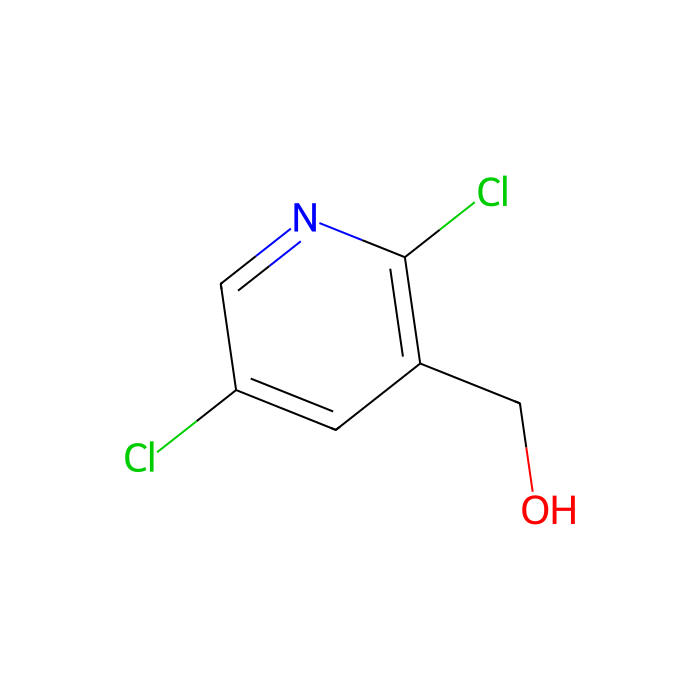
This compound belongs to the class of organic compounds known as polyhalopyridines. These are organic compounds containing a pyridine ring substituted at two or more positions by a halogen atom.
External Descriptors
Not available
1. Djoumbou Feunang Y, Eisner R, Knox C, Chepelev L, Hastings J, Owen G, Fahy E, Steinbeck C, Subramanian S, Bolton E, Greiner R, and Wishart DS. ClassyFire: Automated Chemical Classification With A Comprehensive, Computable Taxonomy. Journal of Cheminformatics, 2016, 8:61.
Certificati (CoA, COO, BSE/TSE e tabella di analisi)
C of A & Other Certificates(BSE/TSE, COO):
Analytical Chart:
Proprietà chimiche e fisiche
Peso molecolare
178.010 g/mol
XLogP3
1.600
Hydrogen Bond Donor Count
1
Hydrogen Bond Acceptor Count
2
Rotatable Bond Count
1
Exact Mass
176.975 Da
Monoisotopic Mass
176.975 Da
Topological Polar Surface Area
33.100 Ų
Heavy Atom Count
10
Formal Charge
0
Complexity
112.000
Isotope Atom Count
0
Defined Atom Stereocenter Count
0
Undefined Atom Stereocenter Count
0
Defined Bond Stereocenter Count
0
Undefined Bond Stereocenter Count
0
The total count of all stereochemical bonds
0
Covalently-Bonded Unit Count
1
Calcolatori di soluzioni
Molarity Calculator
Determine the necessary mass, volume, or concentration for preparing a solution.
Dilution Calculator
Determine the dilution needed to prepare a stock solution.
Reconstitution Calculator
Recensioni
Recensioni dei clienti
Application Protocols
No application protocols are specified for this item. As a small-molecule building block, usage is dictated by the chosen synthetic transformation.
General laboratory guidance (informational)
For solution preparation, weigh the required amount quickly under ambient or inert gas as appropriate, dissolve in a dry, compatible solvent (e.g., DMF, DCM, MeCN), and proceed with the intended reaction.
For analytical QC, typical methods include 1H/13C NMR (CDCl3, DMSO-d6, or CD3CN), LC–MS in ESI+ (monitor [M+H]+ ≈ 179, literature/computed), and HPLC purity assessment with UV detection (pyridine chromophore).
Refer to the primary literature and your internal SOPs for detailed, reaction-specific protocols.
Biological Roles
Item-specific biological information: Not specified for this item; refer to primary literature if a specific biological context is intended.
General context (informational)
Pyridine motifs are ubiquitous in bioactive small molecules, frequently modulating basicity, solubility, and binding through the ring nitrogen’s lone pair. However, 2,5-dichloro-3-hydroxymethylpyridine itself is a research chemical building block with no established endogenous biological role.
The benzylic alcohol functionality can serve as a synthetic handle to install linkers, heterocycles, or polar groups, enabling SAR exploration; dichloro substitution can increase lipophilicity and metabolic stability in lead fragments (general medicinal chemistry principles).
Any biological activity of derivatives derives from the specific substituent pattern introduced during downstream synthesis; intrinsic biological targets for this exact compound are not characterized here.
Research-use only: This material is supplied solely for laboratory research and development. No clinical or in vivo use is implied or supported.
Buffer Applications
This compound is not a buffering agent and is not typically used to prepare biochemical buffers or electrophoresis media.
If dissolution is required for biological assays, stock solutions are commonly prepared in DMSO or MeCN (general practice for hydrophobic heteroaromatics), then diluted into assay media; solubility and compatibility should be verified empirically for each system.
For true buffer preparation guidance, refer to dedicated buffering species (e.g., phosphate, HEPES, MOPS), which provide defined pH ranges and ionic strength control.
Green Alternatives
Greener choices relate mainly to solvent and reagent selection during transformations of this heteroaromatic intermediate.
Solvent alternatives (general guidance)
Replace DMF/DMAc/NMP with 2-MeTHF, CPME, propylene carbonate, EtOAc, or MeCN where solubility and reaction rates permit.
Favor alcohols (EtOH, i-PrOH) or water/MeOH mixtures for benign workups and certain SN2 steps on activated benzylic derivatives.
Oxidation and coupling chemistries
Oxidations: TEMPO/NaOCl in biphasic aqueous systems or O2-driven catalytic oxidations can replace chromium(VI)-based reagents.
Cross-couplings: modern Pd or Ni catalysts in aqueous micellar media (e.g., TPGS-750-M) or bio-derived solvents (2-MeTHF) reduce environmental impact vs toluene/1,4-dioxane.
Energy and waste
Continuous-flow SNAr or coupling can reduce solvent volumes and improve heat/mass transfer, often enabling lower catalyst loadings.
Comparison snapshot (general; not item-specific)
Traditional: DMF or dioxane for couplings; Swern/DMP for oxidations; DCM for acylations.
Greener option: 2-MeTHF/EtOAc/MeCN for couplings; O2/TEMPO or aqueous bleach systems for oxidations; EtOAc/MeCN in place of DCM.
Trade-offs
2-MeTHF and CPME may offer lower polarity than DMF, potentially reducing solubility; process optimization (cosolvents, temperature) may be needed.
Aqueous micellar media can change catalyst speciation; ligand and base choices require tuning.
Pharmaceutical Uses
Item-specific pharmacopeial/excipient status: Not specified for this item; no compendial listing is provided.
General context (informational)
Role: heteroaromatic intermediate used in the synthesis of APIs or advanced intermediates. It is not an excipient and is not intended for administration.
Utility in process chemistry: dichloro substitution enables sequential, regioselective cross-couplings; the –CH2OH group provides a handle for linker installation, pro-moiety elaboration, or oxidation to carboxylates for amide coupling.
Considerations for GMP scale-up (general): establish impurity fate-and-purge for chlorinated byproducts, define genotoxic impurity risk assessments where applicable (aryl chlorides), and validate residual palladium/nickel removal if used in couplings.
Research use only: This material is supplied for research and development. No medical or clinical claims are made or implied.
Physical Properties
Item-specific specifications
Appearance: Not specified for this item; refer to CoA/Spec Sheet.
Grade/Purity: Not specified for this item; refer to CoA/Spec Sheet.
Literature/computed properties (informational; not item specifications)
Expected polarity: moderately polar heteroaromatic due to ring N and benzylic –CH2OH; two aryl chlorides increase lipophilicity (general chemical knowledge).
Solubility tendency: typically soluble in polar aprotic organic solvents (e.g., DMF, DMSO, MeCN) and moderately in chlorinated solvents or esters; low aqueous solubility expected (general/literature trend for chloropyridyl benzyl alcohols). Specific solubility not established for this item.
Acid/base character: pyridine N is weakly basic (typical pyridine pKaH ~5.2, literature); benzylic alcohol pKa ~16–18 in water/MeOH (literature). Exact pKa values for this specific compound are not reported here.
Physical state, melting/boiling point, density, refractive index: Not specified for this item; refer to CoA/Spec Sheet.
Notes: All physical constants above, unless explicitly marked item-specific, are general expectations for the structure class and should be verified experimentally for method development.
Quality and Grades
Item-specific quality information
Grade/Purity: Not specified for this item; refer to CoA/Spec Sheet.
Interpretation and implications (general guidance)
In absence of a stated grade (e.g., “≥98%,” “AR,” or “HPLC grade”), method developers should verify assay purity and impurity profile on receipt via NMR/LC-MS/GC as appropriate.
For synthetic use, typical acceptance criteria include: assay purity, residual solvent content, and identity confirmation (1H NMR, 13C NMR, HRMS). For chromatographic or trace-metals–sensitive applications (e.g., cross-coupling), consider checking metal content and halide identity if relevant.
Stabilizers: None specified for this item. If long-term storage is planned, the manufacturer’s “argon charged” instruction suggests minimizing oxygen exposure to limit benzylic oxidation; no specific stabilizer is indicated.
Documentation
Request the lot-specific CoA/Spec Sheet for: assay, water content (Karl Fischer), residual solvents, and any chromatographic baselines relevant to your application.
Fit-for-purpose considerations
Medicinal chemistry/intermediate synthesis: ensure purity and known counter-ions or salts are absent (this is a neutral compound expected as a free base alcohol).
Analytical reference: if used as a reference material, obtain a certified purity value and uncertainty; otherwise, treat as a research-grade reagent per the Research Use Note.
Reaction and Applications
With its combination of a pyridine ring, two aryl chlorides, and a benzylic primary alcohol, 2,5-dichloro-3-hydroxymethylpyridine is a versatile intermediate for heteroaromatic derivatization.
Transformations at the benzylic alcohol (–CH2OH)
Oxidation to aldehyde/acid: TEMPO/bleach, Dess–Martin, Swern to afford 3-(formyl)pyridine analogues; further oxidation to carboxylic acid for cross-coupling or amide formation (literature).
Activation/derivatization: convert to halides (e.g., PBr3, SOCl2), sulfonates (Ms/Ts), or carbonates for downstream SN2, azidation, or etherification.
Protection: silyl ethers (TBS, TIPS) or esters (acetate, benzoate) to mask during metal-catalyzed couplings on the ring.
Reactivity at the aryl chlorides (2- and 5-positions)
SNAr: ring nitrogen activates the ortho (2-) and para (4-) positions; while 5-chloro is meta to N, both C–Cl bonds can participate under strong nucleophiles/elevated temperatures (literature behavior of chloropyridines).
Cross-couplings: Pd-catalyzed Suzuki–Miyaura, Buchwald–Hartwig amination, and Stille/Negishi couplings on chloro-pyridines using appropriate ligands (e.g., BrettPhos, XPhos; Ni catalysts for chloride activation). Sequential, regioselective couplings enable differential functionalization at C2 vs C5.
Applications (general, research)
Building block for medicinal and agrochemical discovery programs where dichloro substitution patterns modulate basicity, lipophilicity, and metabolic stability.
Precursor to 3-substituted pyridines via elaboration of the benzylic handle (linkers, heterocycles) while retaining or selectively replacing ring chlorides.
Practical considerations
Control moisture/oxygen during sensitive steps (manufacturer recommends argon storage).
Use base selection and ligand tuning to differentiate reactivity of C–Cl bonds when seeking regioselectivity in couplings.
Reaction Conditions
General, literature-based guidance for typical transformations of chloropyridyl benzylic alcohols (verify for your specific system):
Cross-coupling of aryl chlorides (C2/C5)
Suzuki–Miyaura: Pd2(dba)3 (1–2 mol%) + SPhos/XPhos (2–4 mol%), base K3PO4 or Cs2CO3, 2-MeTHF or toluene/H2O or dioxane/H2O, 60–100 °C, 2–16 h. NiCl2(dppp) or Ni(cod)2 with suitable ligands for challenging couplings.
Buchwald–Hartwig amination: Pd(OAc)2 (1–3 mol%) + BrettPhos/BippyPhos, NaOtBu or Cs2CO3, toluene/1,4-dioxane, 80–110 °C.
SNAr on chloropyridines
Strong nucleophiles (alkoxides, amines) in polar aprotics (DMF/DMSO) at 60–140 °C; electron-withdrawing activation by ring N aids substitution, typically C2 more reactive.
Benzylic alcohol derivatization
Oxidation to aldehyde: Dess–Martin (1.5 eq), DCM/EtOAc, 0–25 °C, 0.5–2 h; Swern (oxalyl chloride/DMSO, −78→0 °C) or TEMPO/NaOCl (pH ~9–10, 0–25 °C). Further oxidation (NaClO2, Pinnick) to acid.
Conversion to halides: SOCl2 or PBr3 (1.2–1.5 eq) with base (pyridine), 0–25 °C, 1–3 h; or Appel (PPh3/CBr4) in DCM.
Mitsunobu ether/ester formation: DIAD/DEAD with PPh3 in THF/THF–toluene, 0–25 °C.
Protection strategies
TBSCl/imidazole in DMF, 0–25 °C; acetate formation with Ac2O/DMAP in DCM or pyridine.
Notes: The pyridine nitrogen may coordinate catalysts/reagents; ligand/base optimization and protection can be critical. Conditions are literature-style guidelines, not item specifications; adjust for scale and desired selectivity.
Safety and Handling
Item-specific hazard data
Signal word: Not specified for this item; refer to SDS.
H-statements: Not specified for this item; refer to SDS.
GHS classification/pictograms: Not specified for this item; refer to SDS.
Storage and shipping (from Product Data)
Storage: Store at 2–8 °C, argon charged.
Shipping: Wet ice.
General safety considerations for chlorinated pyridyl alcohols (informational; consult SDS for authoritative guidance)
Likely hazards: may cause irritation to skin, eyes, and respiratory tract; harmful if swallowed (based on structural class). Avoid inhalation of dust/vapors and contact with skin/eyes.
Incompatibilities: strong oxidizers (can oxidize benzylic alcohol), strong bases or acids can promote substitution/elimination; reactive metals. Avoid prolonged exposure to air if oxidation to the corresponding aldehyde/acid is a concern; manufacturer’s argon recommendation indicates benefit from an inert atmosphere.
Peroxide formation: not an ether; peroxide risk is not a primary concern.
PPE and handling
Use in a fume hood. Wear lab coat, appropriate gloves (e.g., nitrile), and splash goggles.
First aid (overview): rinse skin/eyes with water for at least 15 minutes upon contact; move to fresh air if inhaled; seek medical attention if symptoms persist. If ingested, rinse mouth; do not induce vomiting; get medical aid.
Always consult the current SDS for definitive hazard classification, exposure limits, spill response, and disposal guidance.
Solvent Selection
This compound is a moderately polar heteroaromatic bearing a primary benzylic alcohol and two aryl chlorides.
Good solubility: DMSO, DMF, NMP, acetonitrile, dichloromethane, ethyl acetate, acetone (literature trends for chloropyridyl alcohols).
Moderate solubility: THF, MeOH, i-PrOH.
Poor solubility: water (anticipated low aqueous solubility due to dichloro substitution), alkanes (hexanes/heptane).
Choosing solvents by task
Nucleophilic substitutions/SNAr or cross-couplings: polar aprotic media (DMF, DMAc, DMSO, MeCN) or mixed with toluene/1,4-dioxane when using Pd catalysts.
Oxidations/reductions of the benzylic alcohol: choose based on reagent system (e.g., DCM/EtOAc for TEMPO-based oxidations; MeOH/EtOH for borohydride reductions of derived aldehyde/ketone; acetonitrile for Dess–Martin).
Protection steps (forming benzyl carbonates, acetates): dichloromethane, acetonitrile, or pyridine (acts also as base; beware competitive coordination).
Practical tips
The pyridine nitrogen can coordinate catalysts; bases or additives (e.g., NEt3, lutidine) can manage coordination in coupling chemistry.
Dry, oxygen-limited solvents are advisable given the manufacturer’s recommendation to store under argon (minimize oxidation of –CH2OH during prolonged operations).
Quick comparison (general)
DMF vs MeCN: DMF offers higher solubility for polar substrates but is harder to remove; MeCN is more volatile and greener but may dissolve less at high loadings.
Storage and Reconstitution
Item-specific storage and shipping
Storage conditions: Store at 2–8 °C, argon charged (per Product Data). Maintain container tightly closed. Minimize headspace oxygen exposure.
Shipping: Wet ice.
Practical handling and stability (general guidance consistent with storage instructions)
Inert atmosphere: Backfill vials with argon or nitrogen after each use. For repeated access, consider a septum-sealed vial and syringe/needle techniques to limit air ingress.
Moisture/oxygen: Keep dry and limit exposure to air and light to reduce risk of benzylic alcohol oxidation to the corresponding aldehyde/acid over time.
Packaging: Use amber glass if photosensitivity is suspected; store upright to prevent cap contamination.
Reconstitution/solution preparation
Solid/liquid state is not specified for this item. Dissolve the material in a dry, compatible solvent (e.g., DMSO, DMF, MeCN, DCM, EtOAc) to prepare stock solutions as needed. Filter if particulates are present (PTFE syringe filter, 0.45–0.2 µm).
Storage of solutions: For short-term (days to a few weeks), refrigerate under inert gas. For longer-term, aliquot and freeze if the solvent permits (avoid repeated freeze–thaw).
Always consult the lot-specific CoA and SDS for definitive guidance on stability and safe handling. Research use only.
Structure and Identity
2,5-Dichloro-3-hydroxymethylpyridine is a chlorinated, benzylic-alcohol–bearing heteroaromatic building block in the pyridine family.
Item-specific identifiers (from Product Data)
SKU: D185208
CAS: 558465-93-3
InChIKey: 262116 (as provided)
SMILES: Not specified for this item; refer to CoA/Spec Sheet.
Computed/literature identifiers (informational)
Molecular formula (derived from structure name): C6H5Cl2NO (literature/computed)
Structural features (general chemical description)
Core ring: six-membered aromatic pyridine (one ring nitrogen at position 1).
Substitution pattern: chlorine at the 2- and 5-positions; a hydroxymethyl group (–CH2OH) at the 3-position.
Functional groups: heteroaromatic ring nitrogen (basic/aromatic), two aryl chlorides (C–Cl on activated aza-arene), and a primary benzylic alcohol on the ring.
2D description: A pyridine ring with N at top (position 1). Proceeding clockwise: position 2 bears Cl; position 3 bears –CH2OH; position 4 is H; position 5 bears Cl; position 6 is H.
Stereochemistry: None (achiral).
Synthetic Utility
Key functional elements make this building block highly adaptable:
Functional groups and reactivity
Pyridine N: coordinates metals, influences electronic activation for SNAr; can be temporarily quenched by protonation or N-oxide formation to tune reactivity (literature tactic).
Two aryl chlorides: serve as electrophiles for Pd/Ni-catalyzed cross-couplings or SNAr with hard nucleophiles. Differential activation allows stepwise elaboration (C2 typically more reactive than C5 under many ligand/base sets).
Benzylic alcohol (–CH2OH): convertible to halides, sulfonates, carbonates; oxidizable to aldehyde/acid; deployable in ether/ester formation or cyclizations.
Retrosynthetic value
Serves as a convergence point: orthogonal reactivity at the ring vs benzylic position enables modular fragment assembly (e.g., introduce aryl/alkyl/amine at C2/C5, then elaborate side chain).
Named reaction contexts (general)
Suzuki–Miyaura, Buchwald–Hartwig, Negishi/Stille at aryl chlorides; Mitsunobu or Appel-type conversions at –CH2OH (with caution around heteroaromatic N coordination); TEMPO/Dess–Martin/Swern oxidations.
Protection/compatibility
Protect –CH2OH (TBS, benzyl carbonate, acetate) before strong basic or metal-catalyzed conditions if competitive side reactions or oxidation are concerns.
Manage pyridine coordination in catalysis via ligand choice, base, or temporary N-oxide formation, then reduction back to pyridine post-transformation.
Target Specificity
Not applicable. This product is a small-molecule research reagent/building block, not a biological targeting agent (e.g., antibody, ligand with defined receptor specificity). No antigen/epitope, species reactivity, clone, or isotype information applies.
We use cookies to ensure the website functions properly and, where permitted, to improve your experience. You can manage your preferences at any time in Settings. Learn more in our Cookie Policy.
Shall we send you a message when we have discounts available?
Remind me later
Thank you! Please check your email inbox to confirm.
Products are supplied to verified businesses, institutions, and qualified professionals for research and development use only. Not for use in humans, animals, diagnosis, or therapy.