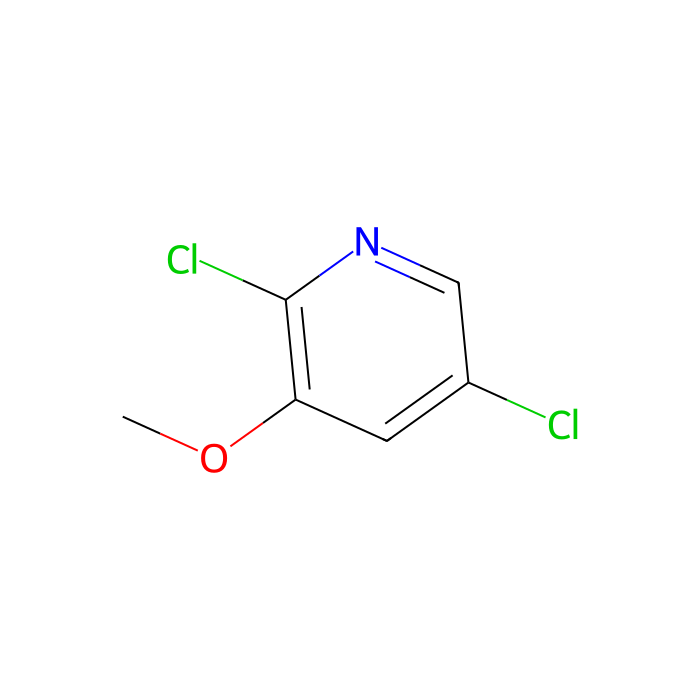
This compound belongs to the class of organic compounds known as polyhalopyridines. These are organic compounds containing a pyridine ring substituted at two or more positions by a halogen atom.
External Descriptors
Not available
1. Djoumbou Feunang Y, Eisner R, Knox C, Chepelev L, Hastings J, Owen G, Fahy E, Steinbeck C, Subramanian S, Bolton E, Greiner R, and Wishart DS. ClassyFire: Automated Chemical Classification With A Comprehensive, Computable Taxonomy. Journal of Cheminformatics, 2016, 8:61.
Certificati (CoA, COO, BSE/TSE e tabella di analisi)
C of A & Other Certificates(BSE/TSE, COO):
Analytical Chart:
Proprietà chimiche e fisiche
Peso molecolare
178.010 g/mol
XLogP3
2.500
Hydrogen Bond Donor Count
0
Hydrogen Bond Acceptor Count
2
Rotatable Bond Count
1
Exact Mass
176.975 Da
Monoisotopic Mass
176.975 Da
Topological Polar Surface Area
22.100 Ų
Heavy Atom Count
10
Formal Charge
0
Complexity
112.000
Isotope Atom Count
0
Defined Atom Stereocenter Count
0
Undefined Atom Stereocenter Count
0
Defined Bond Stereocenter Count
0
Undefined Bond Stereocenter Count
0
The total count of all stereochemical bonds
0
Covalently-Bonded Unit Count
1
Calcolatori di soluzioni
Molarity Calculator
Determine the necessary mass, volume, or concentration for preparing a solution.
Dilution Calculator
Determine the dilution needed to prepare a stock solution.
Reconstitution Calculator
Recensioni
Recensioni dei clienti
Application Protocols
Not applicable as a biological reagent. No validated protocols for WB, IHC, IF, or FC are associated with this product. For synthetic usage, refer to the Reaction Conditions and Reaction & Applications sections for literature-style setup guidance.
Biological Roles
This product is a synthetic heteroaromatic building block and is not a natural metabolite.
General context (literature)
Pyridine derivatives are common motifs in bioactive small molecules due to their ability to modulate basicity, polarity, and binding geometry.
The 2,5-dichloro, 3-methoxy substitution alters electronics and lipophilicity, providing a handle for SAR exploration when incorporated into larger scaffolds.
The ring nitrogen can hydrogen-bond as an acceptor; the methoxy contributes additional H-bond acceptor capability and affects conformation of adjoining linkers.
Biotransformation considerations
Aryl chlorides on heteroarenes can be sites for metabolic dehalogenation or oxidative processes once embedded in larger molecules; the isolated building block itself is not intended for biological systems.
No specific biological function or pathway involvement is attributed to this item; it is supplied strictly for laboratory research and synthesis.
Buffer Applications
Not typically applicable. 2,5-Dichloro-3-methoxypyridine is a non-buffering organic building block and is not used to prepare aqueous buffer systems. For practical usage, see the sections on Reaction & Applications, Synthetic Utility, and Reaction Conditions.
Green Alternatives
While the compound itself is a fixed building block, greener choices can be made in how it is transformed.
Greener solvent choices (literature)
Replace DMF/NMP with safer polar aprotics like Cyrene, propylene carbonate, or dimethyl isosorbide where compatible.
Use 2-MeTHF or CPME instead of THF/1,4-dioxane for cross-couplings and metalations when feasible.
Employ water/ethanol co-solvent systems for Suzuki couplings with water-tolerant catalysts and bases.
Catalyst and base selection
Highly active Pd catalysts (e.g., Pd-NHC, precatalysts such as Pd-PEPPSI) can run at lower loadings and lower temperatures, reducing energy and metal usage.
Consider nickel catalysis for certain couplings to reduce reliance on Pd, acknowledging potential scope limitations.
Process-intensification
Continuous flow for exothermic SNAr or metalation steps improves heat/mass transfer and safety.
Micellar catalysis (aqueous surfactant systems) has been reported for Suzuki/Buchwald couplings, reducing organic solvent demand.
Comparison (general)
Conventional: DMF/dioxane, 80–120 °C, 1–2 mol% Pd.
Greener option: 2-MeTHF or water/CPC micellar media, 0.1–0.5 mol% Pd or Ni, 40–80 °C.
Trade-offs: Greener media may impact substrate solubility or rate; ligand/catalyst re-optimization is often required.
Pharmaceutical Uses
Item-specific claims: None. This product is offered for research use only; not for human or veterinary use.
General formulation/manufacturing context (literature)
Role: Heteroaryl intermediate for synthesis of candidate drug molecules, reference standards, and impurity markers.
Quality expectations for process development: Reproducible purity with tight control of regioisomeric impurities; low residual palladium post-coupling if used downstream in GMP routes (measured by ICP-MS); documented residual solvent profile.
Regulatory documentation: While not a pharmacopeial article, downstream use in regulated settings typically requires vendor CoA, traceability, and change-control communication.
No excipient status or pharmacopeial monograph is associated with this compound.
Physical Properties
Item-specific specs (from Product Data)
Appearance: Not specified for this item; refer to CoA/Spec Sheet.
Molecular formula: Not specified for this item; refer to CoA/Spec Sheet.
Molecular weight: Not specified for this item; refer to CoA/Spec Sheet.
Literature/general information (for planning only; verify against CoA/SDS)
Approximate molecular weight (from literature): ~178.01 g/mol for C6H5Cl2NO.
Physical state: Many dichloro-methoxypyridines are low-melting solids or high-boiling liquids; exact MP/BP for this isomer not established here (consult CoA/SDS).
Volatility: Expected low to moderate (aryl chloride, heteroaromatic). Use reduced pressure for solvent removal after reactions.
Solubility profile (qualitative, literature): Typically soluble in common organic solvents (EtOAc, DCM, THF, toluene, MeCN); limited solubility in water due to halogenation and aromaticity.
Polarity/partitioning: Heteroatom-rich yet halogenated; expect moderate logP and limited aqueous partitioning relative to non-halogenated pyridines.
Spectroscopic features: Aromatic 1H NMR signals in 7–9 ppm region; methoxy singlet typically ~3.7–4.1 ppm (literature). 13C NMR shows methoxy carbon ~55–60 ppm; aryl C–Cl carbons downfield (literature).
Note: Definitive values for MP, BP, density, refractive index, UV cutoff, water content, or metal traces are not specified for this item; refer to CoA/Spec Sheet.
Quality and Grades
Item-specific details (from Product Data)
Grade/Purity: Not specified for this item; refer to CoA/Spec Sheet.
Interpreting grades (general guidance)
Research/technical grade: Suitable for most synthetic workflows where trace impurities do not dominate outcomes.
High-purity/99%+ grade (when offered): Preferred for SAR libraries, medchem, and analytical applications to minimize impurity carryover.
Low-residual-solvent / low-UV grades (when applicable): Useful if the compound will be monitored by HPLC/UV; lower baseline absorbance and interference.
Impurity considerations for chlorinated heteroaromatics (general)
Typical related impurities: Positional isomers (e.g., other dichloro/methoxy patterns), hydrodechlorinated species, and residual halogenated solvents.
Analytical verification: 1H/13C NMR, HRMS, HPLC/GC purity, and chloride content by elemental analysis.
Stabilizers: None are typical for this class; if any stabilizer is included it will be stated on the label/CoA.
Refer to the item’s CoA/Spec Sheet for the definitive purity specification, residual solvents, and analytical data.
Reaction and Applications
Typical roles (literature/general)
Electrophile in C–C and C–N bond formations. The 2- and 5-chloro positions can be addressed selectively with modern cross-coupling catalyst systems.
Substrate for nucleophilic aromatic substitution (SNAr), leveraging the electron-withdrawing effect of the ring nitrogen and substituent pattern.
Heteroaryl fragment for medicinal chemistry libraries; provides a polar, halogenated pyridyl motif.
Representative transformations (literature)
Suzuki–Miyaura coupling at C–Cl: Pd(0)/phosphine (e.g., XPhos/SPhos/BrettPhos) with aryl/heteroaryl boronates; bases like K3PO4, Cs2CO3; solvents: toluene/dioxane/H2O.
Buchwald–Hartwig amination: Pd2(dba)3 with dialkylbiaryl phosphine ligands (BrettPhos, RuPhos) or Pd-PEPPSI-type catalysts; NaOtBu/KOtBu bases; dioxane/toluene.
SNAr amination/alkoxylation: Strong nucleophiles (amine, alkoxide, thiolate) in DMF/DMSO, often with heat (80–140 °C), sometimes aided by fluoride or phase transfer.
Metal–halogen exchange: i-PrMgCl·LiCl (Turbo-Grignard) in THF at low temperature; subsequent electrophile trapping (formylation, acylation, halogenation).
Directed lithiation adjacent to heteroatoms may be feasible under cryogenic conditions with LiTMP/LDA, then quench with electrophiles.
Practical notes
Regioselectivity: The 2- vs 5-chloro reactivity can differ; steric hindrance near the ring nitrogen often biases couplings. Ligand choice is critical for aryl chlorides.
Protecting group strategy: The methoxy group is typically stable; demethylation to the phenoxy (pyridin-3-ol) analog is possible with BBr3/AlCl3 if needed.
Workup: Halogenated heteroaryl products may be lipophilic; use biphasic quench and charcoal to remove Pd residues. Employ scavengers when working at low ppm metal targets.
Reaction Conditions
Literature-based general conditions for similar substrates; optimize for your specific system.
Additives: Sometimes KF, CsF, or phase-transfer catalysts.
Temperature: 80–160 °C depending on nucleophile strength; 3–24 h.
Halogen–metal exchange/metalation
Reagent: i-PrMgCl·LiCl (1.2–1.5 equiv) in dry THF at −78 to 0 °C; quench with electrophile (e.g., DMF for aldehyde introduction).
Alternative: n-BuLi or LiTMP under cryogenic conditions with strict anhydrous control.
Notes: Aryl chlorides typically require stronger ligands or higher temperatures than bromides/iodides. In heteroarenes, proximity to ring nitrogen influences reactivity and may necessitate ligand screening.
Safety and Handling
Item-specific hazard data (from Product Data)
Signal word: Not specified for this item; refer to SDS.
H-statements: Not specified for this item; refer to SDS.
GHS classification/pictograms: Not specified for this item; refer to SDS.
General laboratory safety guidance (literature/general)
Likely hazards: Halogenated heteroaromatics may cause skin/eye irritation and respiratory irritation. Avoid inhalation of vapors and dust. Handle in a fume hood.
Personal protective equipment: Lab coat, safety glasses or splash goggles, and appropriate chemical-resistant gloves (e.g., nitrile). Where splash risk exists, use face shield.
Handling: Avoid contact with strong bases or nucleophiles unless intended; aryl chlorides can undergo SNAr under forcing conditions. Prevent prolonged exposure to strong oxidizers and strong acids/bases.
First aid (overview; defer to SDS):
Inhalation: Move to fresh air; seek medical advice if symptoms persist.
Skin contact: Wash with soap and water; remove contaminated clothing.
Eye contact: Rinse cautiously with water for several minutes; remove contact lenses if present and easy to do; continue rinsing.
Ingestion: Rinse mouth; seek medical attention.
Fire safety: Use CO2, dry chemical, or foam. Combustion may produce HCl/NOx; firefighters wear SCBA.
Spill response: Contain, absorb with inert material (vermiculite, sand), collect for disposal. Prevent entry into waterways.
Always consult the product-specific SDS for authoritative safety, exposure limits, and disposal guidance.
Solvent Selection
This product is an organic building block rather than a solvent. However, solvent choice is critical for its use in synthesis.
Polarity and miscibility (general expectations)
The compound is an aromatic heterocycle with two aryl chlorides and a methoxy group; it dissolves in many organic solvents (e.g., DCM, THF, dioxane, toluene, DMF, DMSO, MeCN). Water solubility is expected to be low.
Keep container tightly closed in a dry, well-ventilated place. Protect from prolonged exposure to moisture and strong light.
If long-term storage is anticipated, consider storing under inert gas after opening to minimize hydrolysis or oxidative discoloration.
Avoid contact with strong bases/acids and strong oxidizers.
Reconstitution/solubility
Solid or liquid form is not specified for this item; refer to CoA/Spec Sheet.
Readily dissolves in common organic solvents (e.g., DCM, THF, EtOAc, MeCN, DMF) per general behavior of methoxy-chloropyridines. Prepare solutions fresh for moisture/air-sensitive transformations.
Always consult the product label and CoA/SDS for definitive storage constraints and stability data.
Structure and Identity
Brief overview: 2,5-Dichloro-3-methoxypyridine is a chlorinated, methoxy-substituted pyridine useful as a heteroaryl coupling partner and SNAr electrophile.
Item-specific (from Product Data)
Product name: 2,5-Dichloro-3-methoxypyridine
CAS: 1214366-19-4
SKU: D180180
InChIKey: 289239 (as provided)
SMILES: Not specified for this item; refer to CoA/Spec Sheet.
Storage: Room temperature
Shipped: Normal
Research use: For research use only
Literature/computed identifiers and features (informational)
Molecular formula (literature): C6H5Cl2NO
Molecular weight (literature): ~178.01 g/mol
Core scaffold: Pyridine ring (six-membered aromatic heterocycle with one ring nitrogen)
Substitution pattern: Chlorine atoms at the 2- and 5-positions; methoxy group (–OCH3) at the 3-position.
2D structure (described): A pyridine ring with N at position 1; Cl substituents ortho (C-2) and meta (C-5) to the ring N; a methoxy substituent at C-3.
Stereochemistry: None (achiral, planar aromatic).
Synthetic Utility
Functional group reactivity (literature)
Two aryl chlorides enable orthogonal functionalization: selective coupling/amination at one position followed by transformation at the other.
The methoxy group is a stable placeholder that can be demethylated to the corresponding phenoxide (pyridin-3-olate) or participate in directed metalation effects.
The ring nitrogen tunes SNAr reactivity and can be exploited in N-oxidation (to pyridine N-oxide) for temporary activation or as a synthetic handle.
Retrosynthetic planning
Use as a linchpin heteroaryl fragment that can be diversified to biaryl, aryl–alkyl, or aryl–heteroatom derivatives via Pd-catalyzed cross-coupling.
Sequential strategy: (1) Preferentially couple at C-5 (less hindered) under milder conditions; (2) Employ stronger ligation/catalysis or SNAr for C-2, which is ortho to the ring N and sterically constrained.
Named reactions/platforms
Suzuki–Miyaura, Negishi, Kumada–Tamao–Corriu, Buchwald–Hartwig amination, and Ullmann-type couplings (Cu catalysis for O/N-arylation in some cases).
Halogen–metal exchange with i-PrMgCl·LiCl or n-BuLi at cryogenic temperatures for electrophile trapping (e.g., DMF for formylation).
Purification/analysis tips
Monitor by GC or LC–MS; aryl chlorides often ionize well in APCI/ESI with [M+H]+ ~178→179 (literature MW). Use silica gel flash with gradient hexanes/EtOAc or toluene/EtOAc; add 0.1–1% TEA if tailing from basic sites occurs.
Target Specificity
Not applicable. This product is a small-molecule building block and is not an antibody, enzyme, or biologic. No target specificity data (antigen, epitope, species reactivity, clone, isotype) are associated with this item.
We use cookies to ensure the website functions properly and, where permitted, to improve your experience. You can manage your preferences at any time in Settings. Learn more in our Cookie Policy.
Shall we send you a message when we have discounts available?
Remind me later
Thank you! Please check your email inbox to confirm.
Products are supplied to verified businesses, institutions, and qualified professionals for research and development use only. Not for use in humans, animals, diagnosis, or therapy.