QUALITÀ & PUREZZAAnalytical standard?Analytical standard — certified-purity material for quantitative calibration. Use to prepare calibration standards and validate analytical methods.
This compound belongs to the class of organic compounds known as dichlorobenzenes. These are compounds containing a benzene with exactly two chlorine atoms attached to it.
External Descriptors
dichlorophenol
1. Djoumbou Feunang Y, Eisner R, Knox C, Chepelev L, Hastings J, Owen G, Fahy E, Steinbeck C, Subramanian S, Bolton E, Greiner R, and Wishart DS. ClassyFire: Automated Chemical Classification With A Comprehensive, Computable Taxonomy. Journal of Cheminformatics, 2016, 8:61.
Determine the necessary mass, volume, or concentration for preparing a solution.
Dilution Calculator
Determine the dilution needed to prepare a stock solution.
Reconstitution Calculator
Recensioni
Recensioni dei clienti
Application Protocols
Not applicable as an antibody or assay kit. For use as an analytical standard, typical workflows include:
Stock preparation: Weigh an appropriate amount using a calibrated analytical balance and dissolve in a compatible solvent (e.g., acetonitrile, methanol, toluene) to prepare a gravimetrically traceable stock solution.
Calibration curves: Prepare serial dilutions in the method matrix or mobile phase. Use Class A glassware; record lot number, preparation date, and solvent.
Storage of standards: Use amber vials with PTFE-lined caps; minimize headspace. Refrigeration or freezing may be applied depending on solvent stability, though solid storage at room temperature is typical for the neat material.
System suitability: Spike known quantities into blank matrices to assess recovery, precision, and LOD/LOQ.
Item-specific tested applications/dilutions are not provided for this listing; refer to your internal method SOPs and the CoA/Spec Sheet.
Biological Roles
This section provides general literature context for chlorinated phenols and is not item-specific or implying biological/clinical use.
Interaction with biomolecules: Phenolic compounds can engage in hydrogen bonding and π–π interactions with proteins and membranes. Chlorination increases hydrophobicity, promoting membrane partitioning compared with unsubstituted phenol.
Biotransformation: In biological systems, phenols are often metabolized via conjugation pathways (e.g., glucuronidation, sulfation) and oxidative transformations. Chlorinated phenols may undergo slower biodegradation and can be subject to dechlorination under specific microbial conditions.
Environmental fate: Chlorophenols are monitored analytes due to potential persistence and aquatic toxicity; 2,5-dichlorophenol is commonly included in environmental analytical panels for water, soil, and sediment assessments.
Enzymatic interactions: Phenolic substrates can serve as probes or inhibitors in studies of oxidative enzymes (e.g., peroxidases, laccases) in vitro, although halogenation can alter turnover rates and binding.
Important: Aladdin Scientific supplies this compound strictly for research and laboratory use. No medical, diagnostic, or therapeutic claims are made or implied.
Buffer Applications
2,5-Dichlorophenol is not a buffering reagent and is not typically used to prepare biological or analytical buffer systems. Its weak acidity and hydrophobicity make it unsuitable as a primary buffer component. For work requiring aqueous compatibility, dissolve in an appropriate co-solvent or convert transiently to its phenolate in controlled basic media. Refer instead to the Solvent Selection and Reaction & Applications sections for practical handling guidance.
Green Alternatives
Context: 2,5-Dichlorophenol is a halogenated aromatic phenol. While effective as a building block and analytical standard, chlorinated aromatics can pose persistence and toxicity concerns. Consider greener strategies where appropriate.
Greener choices and strategies (literature/general)
Structural alternatives: If the chlorine atoms are not functionally required, evaluate less-halogenated or non-halogenated phenols (e.g., phenol, cresols, guaiacol) that offer improved biodegradability and lower ecotoxicity. Tradeoff: Reduced activation for cross-coupling and different electronic effects.
Process intensification: Use catalytic cross-couplings with highly active ligands to lower temperature and shorten reaction times, minimizing energy footprint.
Solvent selection: Favor greener solvents (EtOAc, 2-MeTHF, CPME, propylene carbonate, water/MeOH) over chlorinated solvents (DCM) or high-toxicity amides (NMP) when compatible with reactivity and analytical needs.
Protection minimization: Choose chemoselective conditions that avoid unnecessary protection/deprotection of the phenol, reducing steps and waste.
Waste management: Implement halogenated waste segregation and solvent recovery. Use micro-scale or flow chemistry for analytical standard preparations to reduce solvent and reagent consumption.
Comparison snapshot (qualitative)
2,5-Dichlorophenol: high reactivity handle via aryl–Cl; persistence risk; good analytical detectability.
Guaiacol/anisole derivatives: better EHS profile; may require different activation strategies.
Phenol/cresols: improved biodegradability; different directing/electronic properties affecting downstream chemistry.
Note: As this item is sold as an analytical standard, substitution may not be appropriate when method specificity requires this exact analyte.
Pharmaceutical Uses
Role: This product is provided as an analytical standard for research use only (product data). It is not an excipient, API, or DP component as supplied.
Formulation context (general): Chlorinated phenols are generally not used as pharmaceutical excipients due to toxicity and regulatory constraints. However, analytical standards of such compounds are often employed in pharmaceutical quality control to monitor impurities, degradants, or residuals in raw materials and finished products where relevant.
Compendial status: Not specified for this item; refer to CoA/Spec Sheet and applicable pharmacopeias to determine whether 2,5-dichlorophenol is listed for identification or limit tests.
Method development: Useful for establishing system suitability, calibration curves, and spike recoveries in GC/LC methods when monitoring chlorophenol contaminants or process-related impurities.
Note: For regulated applications, ensure traceability, validated methods, and appropriate handling per GMP/GLP where applicable. No therapeutic claims are made.
Physical Properties
Item-specific specifications
Appearance: Not specified for this item; refer to CoA/Spec Sheet.
Molecular Formula: Not specified for this item; refer to CoA/Spec Sheet.
Molecular Weight: Not specified for this item; refer to CoA/Spec Sheet.
Literature/general properties for 2,5-dichlorophenol (for context only; not product specifications)
Physical state: typically a crystalline solid with a phenolic odor.
Solubility: sparingly soluble in water; readily soluble in many organic solvents (e.g., ethanol, acetone, diethyl ether, dichloromethane, acetonitrile). Phenols generally dissolve well in basic aqueous media via phenolate formation.
Acid–base: phenolic OH is significantly more acidic than aliphatic alcohols; electron-withdrawing chloro substituents further increase acidity relative to phenol (qualitative).
Volatility: lower volatility than monochloro analogs; appreciable vapor pressure may exist at room temperature for fine powders—minimize dusting and inhalation.
Thermal behavior: melts to a mobile liquid and distills at elevated temperatures; avoid overheating to prevent decomposition.
Partitioning: chlorination increases hydrophobicity versus phenol, enhancing affinity for nonpolar phases.
Practical notes
For solution preparation, pre-wet with a miscible organic solvent before dilution. For aqueous work, dissolve in minimal ethanol/acetone or use slight base (e.g., NaHCO3) to form the phenolate if appropriate to the method.
Quality and Grades
Item grade: Analytical standard (product data).
Meaning/intent: Analytical standard grade materials are intended for calibration and qualification of analytical instruments and methods (e.g., GC/LC reference solutions, spike-and-recovery studies, system suitability) where identity and purity are tightly controlled and traceability is key.
Documentation: Expect a Certificate of Analysis (CoA) detailing identity confirmation (e.g., NMR/IR/MS, chromatographic purity), lot-specific purity, and where applicable, uncertainty/traceability statements. If quantitative reference concentration is required, use a certified reference material (CRM); this listing is an analytical standard, not explicitly a CRM unless stated on the CoA.
Impurities/limits: Not specified for this item; refer to CoA/Spec Sheet for chromatographic purity, residual solvents, and any stabilizers.
Stabilizers: Not specified for this item; refer to CoA/Spec Sheet. If no stabilizer is present, store to minimize oxidation or volatilization.
Use considerations:
Prepare stock standards gravimetrically with calibrated balances and Class A glassware.
Document lot number and expiry/retire date per your QA system.
Verify matrix compatibility (e.g., GC vs LC solvents) and light sensitivity before preparing long-term solutions.
Regulatory notes: For research use only (product data). Not for diagnostic or therapeutic use. If used in regulated testing, assess fitness-for-purpose and maintain full traceability.
Reaction and Applications
Scope and utility (general literature)
Electrophilic aromatic substitution (EAS): The phenolic OH is ortho/para-directing but the chloro substituents are deactivating and also ortho/para-directing. In 2,5-dichlorophenol, further EAS occurs with moderated rates and regioselectivity influenced by this substitution pattern; protection of the phenol (e.g., as benzyl or silyl ether) can tune directing effects.
O-derivatization: The phenolic OH undergoes efficient acylation/alkylation to give esters/ethers (e.g., Mitsunobu etherification, Williamson ether with appropriate bases, Steglich esterification for benzoates). Such derivatives serve as intermediates or analytical surrogates.
Cross-coupling on aryl chlorides: Both chloro sites can participate in Pd-catalyzed Suzuki–Miyaura, Buchwald–Hartwig amination, or Kumada/Negishi couplings using appropriate ligand sets (e.g., dialkylbiaryl phosphines) and elevated temperatures. The phenol may need protection or control (base choice) to avoid competitive O-arylation.
Nucleophilic aromatic substitution (SNAr): Chlorination and the phenolic ring environment can allow SNAr with strong nucleophiles if additional activation (e.g., nitro groups) is present; without further activation, Pd-catalyzed routes are generally favored.
Oxidation/reduction: Phenolic oxidation to quinone-like species is possible under strong oxidants; dechlorination (e.g., hydrogenolysis) can occur with Pd/H2 under forcing conditions.
Applications
Analytical chemistry: As an analytical standard for method development and calibration in environmental monitoring of chlorophenols (e.g., GC/LC methods).
Building block: Pre-functionalized aryl core for materials, agrochemical, and fine chemical synthesis where selective cross-coupling or O-derivatization is leveraged.
Reaction Conditions
General literature guidance (illustrative; adjust to your system). These are not product specifications.
O-Acylation/O-alkylation
Solvents: DCM, THF, acetone, MeCN, or toluene.
Bases/catalysts: Triethylamine or pyridine for acylations; K2CO3/Cs2CO3 for Williamson ether; DMAP (0.05–0.2 equiv) to accelerate acylation.
Temperature: 0–25 C for acylations; 25–80 C for etherifications depending on substrate/leaving group.
Suzuki–Miyaura coupling on aryl–Cl
Catalysts/ligands: Pd2(dba)3 or Pd(OAc)2 (1–3 mol%) with biaryl phosphines (e.g., SPhos, XPhos, RuPhos; 2–6 mol%).
Base: K3PO4, Cs2CO3, or Na2CO3 (2–3 equiv).
Solvents: 1,4-dioxane/H2O, toluene/H2O, or DMAc.
Temperature: 80–110 C; inert atmosphere. Consider protecting the phenol if competitive O-arylation occurs.
Buchwald–Hartwig amination
Catalyst/ligand: Pd2(dba)3 or Pd(OAc)2 with dialkylbiaryl phosphines (BrettPhos, tBuBrettPhos).
Base: NaOtBu, KOtBu, or Cs2CO3.
Solvent: Toluene, dioxane, or DMAc.
Temperature: 80–110 C.
Mitsunobu etherification (for O-aryl ether formation from alcohol partner)
Reagents: DEAD/DIAD with PPh3; solvent THF/THF–toluene; 0–25 C.
Workup and purification
Quench bases carefully; phenols can emulsify—use brine and phase modifiers if needed.
For chromatography, consider adding 0.1–1% TEA to eluents to reduce tailing of phenolic products.
Note: Expected yields vary widely with substrate/ligand choice; consult primary literature for your exact coupling partners.
Safety and Handling
Item-specific hazard fields (product data)
Signal word: Not specified for this item; refer to SDS.
H-statements: Not specified for this item; refer to SDS.
GHS classification/pictograms: Not specified for this item; refer to SDS.
Shipping: Shipped via FedEx DG Service (product data), indicating dangerous goods handling.
General safety considerations for chlorinated phenols (literature/good practice; not a substitute for SDS)
Hazards: Many chlorophenols are harmful if inhaled, ingested, or absorbed through skin; they can be irritating to skin, eyes, and respiratory tract. Some may pose acute aquatic toxicity. Handle as a toxic, irritant organic solid.
PPE: Wear lab coat, chemical-resistant gloves (e.g., nitrile), splash goggles; consider face shield for bulk handling. Use in a certified chemical fume hood to avoid inhalation of dust or vapors.
Incompatibilities: Strong oxidizers, strong bases (can form phenolates; vigorous reaction in concentrated conditions), strong acids (may release heat), reactive metals (with phenolate). Avoid contact with reducing agents that could generate heat or off-gassing.
Special risks: Phenols can penetrate skin; minimize contact time. Avoid aerosolizing or generating dust. Clean small spills with inert absorbent while maintaining ventilation; prevent entry to waterways.
First aid (overview): Eye/skin contact—immediately flush with water for ≥15 min and remove contaminated clothing; seek medical attention. Inhalation—move to fresh air; obtain medical attention if symptoms persist. Ingestion—rinse mouth; do not induce vomiting; seek medical attention.
Always consult the product-specific SDS for authoritative hazard classification and response measures.
Solvent Selection
This product is a solid aromatic phenol, not a bulk solvent. Solvent selection here refers to choosing media to dissolve and handle 2,5-dichlorophenol effectively in analytical or synthetic workflows.
General solvent guidance (literature/general)
Polarity/acid–base: As a weak acid, it dissolves in organic solvents of intermediate polarity and forms soluble salts in basic aqueous media.
Common organic solvents: High solubility is typical in acetone, acetonitrile, methanol/ethanol, isopropanol, ethyl acetate, diethyl ether, THF, DCM, and toluene. For GC, nonpolar solvents (hexane, iso-octane, toluene) are often used; for LC, ACN or MeOH are typical.
Aqueous handling: Sparingly soluble at neutral pH. Dissolution can be facilitated by adjusting pH to >pKa (forming phenolate) or by co-solvent addition (5–50% MeOH/ACN).
Reactivity considerations: Avoid strong base in presence of moisture-sensitive reagents if the phenolate could participate undesirably. For cross-coupling on the aryl chlorides, polar aprotic solvents (DMAc, NMP, dioxane, toluene) are common with Pd catalysts; protect or manage the phenol as needed.
Analytical standards: Choose solvent compatible with detector and method. For UV detection, ensure the solvent cutoff and potential phenolic absorbance bands do not interfere. For MS detection, use LC–MS-grade solvents and consider ionization suppression from chlorinated aromatics.
Practical tip: Pre-wet the solid with a small aliquot of your target solvent and sonicate gently to accelerate dissolution without heating.
Storage and Reconstitution
Storage temperature: Room temperature (product data). Store in a cool, dry, well-ventilated area away from incompatible materials and direct light.
Container: Keep tightly closed in the original container or in amber glass with PTFE-lined cap to minimize volatilization and adsorption. Segregate from oxidizers and strong bases/acids.
Stability: Not specified for this item; refer to CoA/Spec Sheet and SDS. In general, phenolic solids are stable if protected from heat and light. Avoid prolonged exposure to air and moisture to limit oxidation.
Reconstitution/preparation of solutions:
Choose solvent based on end use (e.g., GC: toluene/hexane; LC: acetonitrile/methanol; synthetic: acetone/THF/DMF, etc.).
Weigh gravimetrically; dissolve with gentle agitation or brief sonication. Filter if particulate matter is present (PTFE syringe filter recommended for organic solutions).
For aqueous applications, use co-solvent or adjust pH to form the phenolate as appropriate to your method.
Freeze–thaw: Not typically applicable to the neat solid. For prepared solutions, minimize freeze–thaw cycles and store aliquots if long-term use is anticipated.
Shelf life: Not specified for this item; refer to CoA/Spec Sheet. Monitor by periodic chromatographic check for analytical standard solutions.
Shipping: Supplied under FedEx DG Service (product data). Handle upon receipt per your institutional guidelines for dangerous goods.
Research Use Note: For research use only (product data). Not for human or animal therapeutic use.
Structure and Identity
Item-specific identifiers (from Product Data)
CAS: 583-78-8 (product data)
PubChem CID: 66 (product data; verify in external databases if needed)
Grade: Analytical standard (product data)
InChIKey: Not specified for this item; refer to CoA/Spec Sheet.
SMILES: Not specified for this item; refer to CoA/Spec Sheet.
Literature/General structural information (for 2,5-dichlorophenol)
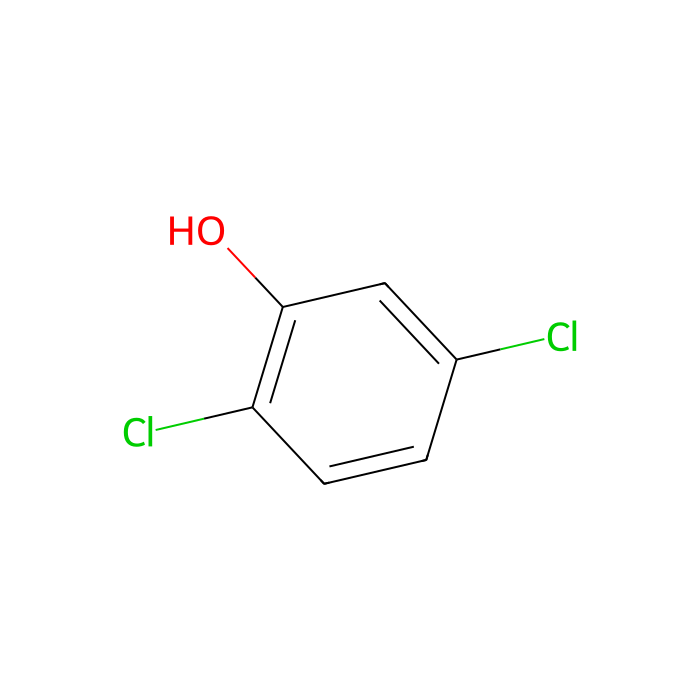
Core scaffold: a benzene ring bearing a phenolic hydroxyl group (–OH) and two chlorine substituents.
Substitution pattern: –OH at the 1-position; chlorine at the 2- and 5-positions (1,2,5-trisubstituted aromatic). The pattern is meta to one Cl and para to the other relative to the OH.
Functional groups: phenol (acidic Ar–OH), two aryl chlorides (deactivating, ortho/para-directing). No stereocenters; planar aromatic system.
2D description in words: a six-membered aromatic ring with an OH group; moving clockwise, a Cl substituent ortho to OH, two unsubstituted carbons, a Cl substituent para to OH, then two unsubstituted carbons back to the OH-bearing carbon.
Note: Exact structural strings (SMILES/InChI) and definitive identifiers for THIS lot/item should be taken from the CoA/Spec Sheet to ensure traceability for analytical use.
Synthetic Utility
Key functional elements
Phenolic OH: amenable to O-alkylation (Williamson; base such as K2CO3/Cs2CO3), O-acylation (acid chloride/anhydride; base or DMAP catalysis), Mitsunobu etherification (with inversion at alcohol partner), and formation of silyl/benzyl protecting groups.
Aryl–Cl bonds (two sites): enable Pd-catalyzed cross-couplings (Suzuki–Miyaura, Buchwald–Hartwig amination, Sonogashira after halide activation, Negishi/Kumada) using modern ligand systems tolerant of aryl chlorides (e.g., BrettPhos, XPhos, SPhos). Site-selectivity between the 2- and 5-chloro positions can be tuned by sterics/ligand choice and protecting the phenol.
Directed reactivity: The OH directs ortho/para EAS, but existing chloro groups are deactivating; net rates are moderated, allowing selective late-stage functionalization under controlled conditions.
Retrosynthetic value
Serves as a bifunctional node: orthogonal handles (phenol vs aryl chlorides) allow stepwise diversification—first derivatize OH (protection/ether/ester), then couple on the aryl chloride(s), or vice versa.
Access to materials/agro intermediates: Dichloro substitution patterns are common in performance materials; phenolic derivatization leads to aryl ethers, carbonates, and polymer precursors.
Practical considerations
Control basicity: Strong bases generate phenolates that may compete in O-arylation; choose bases and ligands to favor C–C/C–N coupling.
Protecting groups: TBDMS, Bn, or carbonate protections suppress undesired side reactions during metal-catalyzed steps.
Purification: Avoid strong basic alumina which can adsorb/decompose phenols; use buffered silica or add a small percentage of base to eluents if tailing is observed.
Target Specificity
Not applicable. This product is a small-molecule chemical standard, not a biological targeting reagent. No antigen/epitope, species reactivity, clone, or isotype information applies.
La nostra guida alla selezione delle qualità copre purezza, stato dello stabilizzatore e idoneità all'applicazione per tutte le varianti del nostro catalogo.
Utilizziamo i cookie per garantire il corretto funzionamento del sito web e, ove consentito, per migliorare la tua esperienza. Puoi gestire le tue preferenze in qualsiasi momento nelle Impostazioni. Per saperne di più, consulta la nostra Cookie Policy.
Desidera che le inviamo un messaggio quando avremo sconti disponibili?
Ricordamelo più tardi
Grazie! Controlli la sua casella di posta per confermare.
Products are supplied to verified businesses, institutions, and qualified professionals for research and development use only. Not for use in humans, animals, diagnosis, or therapy.
 A2417303
