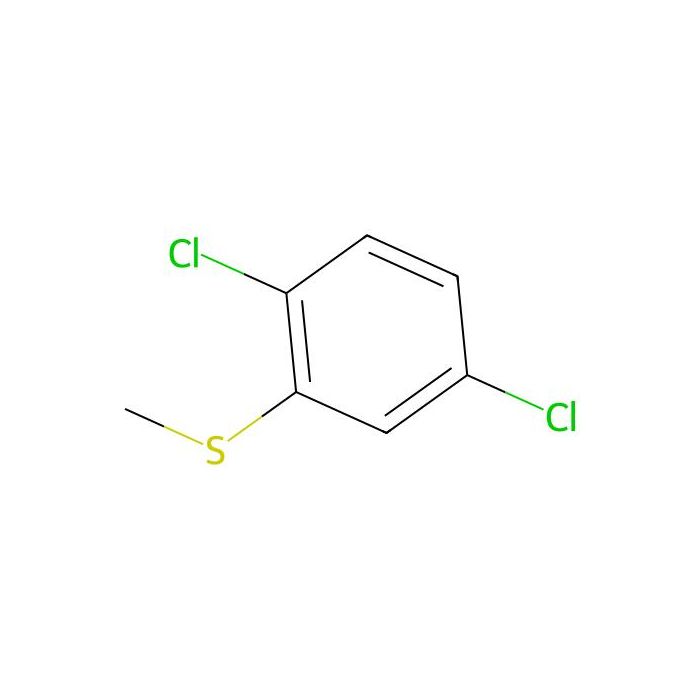
This compound belongs to the class of organic compounds known as dichlorobenzenes. These are compounds containing a benzene with exactly two chlorine atoms attached to it.
External Descriptors
Not available
1. Djoumbou Feunang Y, Eisner R, Knox C, Chepelev L, Hastings J, Owen G, Fahy E, Steinbeck C, Subramanian S, Bolton E, Greiner R, and Wishart DS. ClassyFire: Automated Chemical Classification With A Comprehensive, Computable Taxonomy. Journal of Cheminformatics, 2016, 8:61.
Certificati (CoA, COO, BSE/TSE e tabella di analisi)
C of A & Other Certificates(BSE/TSE, COO):
Analytical Chart:
Proprietà chimiche e fisiche
Peso molecolare
193.090 g/mol
XLogP3
3.700
Hydrogen Bond Donor Count
0
Hydrogen Bond Acceptor Count
1
Rotatable Bond Count
1
Exact Mass
191.957 Da
Monoisotopic Mass
191.957 Da
Topological Polar Surface Area
25.300 Ų
Heavy Atom Count
10
Formal Charge
0
Complexity
108.000
Isotope Atom Count
0
Defined Atom Stereocenter Count
0
Undefined Atom Stereocenter Count
0
Defined Bond Stereocenter Count
0
Undefined Bond Stereocenter Count
0
The total count of all stereochemical bonds
0
Covalently-Bonded Unit Count
1
Calcolatori di soluzioni
Molarity Calculator
Determine the necessary mass, volume, or concentration for preparing a solution.
Dilution Calculator
Determine the dilution needed to prepare a stock solution.
Reconstitution Calculator
Recensioni
Recensioni dei clienti
Application Protocols
No assay or bioanalytical protocols are specified for this item. Typical laboratory uses involve organic synthesis. If using in screening or biochemical assays, prepare stock solutions in a suitable organic solvent (e.g., DMSO or MeCN), verify solubility, and include appropriate vehicle controls.
Biological Roles
This compound is a synthetic, non-natural aryl thioether. No endogenous biological role is known.
General biochemical considerations (literature-based; not product-specific)
Thioethers can act as soft Lewis bases and may bind to metal centers in enzymes or model systems; however, 2,5-dichlorothioanisole is not a biological ligand and is intended for laboratory research use only.
Hydrophobicity and aromaticity suggest strong partitioning into nonpolar phases and potential for nonspecific interactions with lipidic media; these are physicochemical observations, not functional biological roles.
Oxidation in biological-like environments could convert thioethers to sulfoxides/sulfones; such transformations alter polarity and may be used in chemical biology probes, but this particular compound has no established biological function.
Note: All uses are for research and development; no medical, diagnostic, or therapeutic claims are implied.
Buffer Applications
Not typically applicable. 2,5-Dichlorothioanisole is a hydrophobic organic building block and does not serve as a buffering agent. For experimental work requiring aqueous handling, use an appropriate organic cosolvent (e.g., DMSO, MeCN, or small percentages of EtOH) to prepare stock solutions before dilution into buffered systems, verifying solubility and compatibility.
Green Alternatives
While 2,5-dichlorothioanisole is a specialty building block (not a solvent), greener choices can be made in reactions employing it.
Greener solvent choices (general guidance)
Consider 2-MeTHF or CPME instead of THF/diethyl ether (biomass-derived, lower peroxide risk than ethers like THF/Et2O; good for cross-coupling and reductions).
Use toluene, anisole, or dimethyl carbonate in place of chlorinated solvents where feasible; retain DCM/CHCl3 only if necessary for selectivity or solubility.
For polar media, propylene carbonate or Cyrene can sometimes replace DMF/DMAc/NMP (verify catalyst compatibility).
Greener oxidations at sulfur
Prefer H2O2-based systems (with catalytic tungstate/molybdate or Ti–silicalite) over stoichiometric peracids like m-CPBA to reduce halogenated waste.
Waste and EHS considerations
Thioethers are odorous; keep containers tightly closed to minimize fugitive emissions.
Avoid chromium(VI) or chlorinated oxidants. Design for telescoped sequences (e.g., in situ oxidation then coupling) to minimize solvent swaps.
Comparison snapshot (illustrative)
THF vs 2-MeTHF: similar polarity; 2-MeTHF offers higher boiling point and renewability.
DCM vs toluene: toluene reduces chlorinated waste; may require higher temperatures to maintain solubility.
m-CPBA vs H2O2: H2O2 generates water as byproduct; may need catalyst to achieve selectivity and rate.
Pharmaceutical Uses
No pharmacopeial excipient status or formulation role is indicated for this compound. It is best regarded as a synthetic intermediate/building block in discovery chemistry.
Potential roles in a manufacturing context (general; not product-specific)
Intermediate in the preparation of more polar or functionalized analogs (via oxidation at S, cross-coupling at C–Cl, or C–S activation) during SAR campaigns.
Possible use as a ligand or blocking group in metal-mediated steps, removed or transformed later in a synthesis.
Regulatory note
This product is supplied for research use only. It is not intended for human or veterinary use, APIs, or excipient applications without appropriate qualification and regulatory assessment.
Physical Properties
Item-specific specifications (this lot): Not specified for this item; refer to CoA/Spec Sheet.
Literature/computed (for reference; not product specifications)
Phase/appearance: Not located in supplier-independent handbooks; aryl thioethers of similar MW are typically low-melting solids or high-boiling liquids.
Molecular formula: C7H6Cl2S (computed)
Molecular weight: ~193.09 g/mol (computed from standard atomic weights)
Polarity/solubility (general): Expected to be sparingly soluble in water and miscible/soluble in common organic solvents (e.g., DCM, chloroform, toluene, THF, ethers) due to hydrophobic aryl core and polarizable S/Cl atoms.
Refractive index, density, melting/boiling point, logP, pKa: Not found in curated literature sources at the time of writing; consult SDS/primary databases or measure as needed.
Notes for practitioners
Aryl thioethers commonly exhibit strong UV absorbance around 220–280 nm (chromophore present); exact UV cutoff for this item is not specified.
Vapor pressure is expected to be low at ambient temperature relative to simple anisoles; handle in fume hood due to odor and potential volatility of sulfur aromatics.
Quality and Grades
Grade/Purity for this item: Not specified for this item; refer to CoA/Spec Sheet.
Appearance: Not specified for this item; refer to CoA/Spec Sheet.
Guidance on grades and implications (general)
Research grade vs. analytical/HPLC grade: Research-grade aryl thioethers are typically suitable for synthetic and mechanistic work. Analytical/HPLC grade (when offered) emphasizes low UV background and stringent impurity profiles for detection-critical applications.
Stabilizers: Thioethers generally do not require added stabilizers; however, minimizing air exposure can reduce slow oxidation. If a stabilizer were present, it would be disclosed on the CoA/label and may affect certain oxidative reactions; none is specified here.
Trace impurities: For cross-coupling or organometallic chemistry, residual metals/moisture/peroxides can affect outcomes. Specific impurity limits (metals, water, residual solvents, UV cutoff) are Not specified for this item; refer to CoA/Spec Sheet.
Recommendations
If using in Pd/Ni-catalyzed couplings, consider a brief pre-drying over activated molecular sieves or passing through a short plug of basic alumina to remove adventitious acids/oxidation products (verify compatibility first). Record lot-specific purity from the CoA for your methods section.
Reaction and Applications
Use as an aryl thioether building block and as a sulfur-containing ligand/auxiliary in synthesis.
Controlled oxidation to the sulfoxide or sulfone using m-CPBA, peracetic acid, Oxone, or H2O2 with catalysts (e.g., Ti- or Mo-based). Sulfoxides can serve as chiral auxiliaries (with chiral S where applicable) or directing groups; sulfones are valuable for Julia-type olefinations (after α-functionalization when benzylic positions are present) and as robust electron-withdrawing handles.
C–S bond activation/cross-coupling
Aryl thioethers undergo C–S activation with Ni(0)/Pd(0) catalysts enabling aryl–aryl, aryl–alkyl, or borylation reactions (e.g., Ni(cod)2/dppp or Pd/NHC systems). The 2,5-dichloro pattern allows orthogonal strategies: transform C–S or C–Cl selectively by tuning catalysts.
C–Cl cross-coupling
With suitable ligands, aryl chlorides participate in Suzuki–Miyaura, Buchwald–Hartwig, and Negishi couplings. Note: Thioethers can poison Pd; ligand/catalyst selection (bulky electron-rich phosphines, NHCs) and additives (Hg-free sulfur management strategies) mitigate inhibition.
Electrophilic aromatic substitution (EAS)
The methylthio group is ortho/para-directing and activating; chloro substituents are deactivating/orthogonal. Net reactivity is reduced vs. thioanisole, but nitration, Friedel–Crafts acylation/alkylation, and halogenation can be feasible under controlled conditions.
Metal binding and templating
The soft thioether can coordinate late-transition metals (Pt, Pd, Au) in model studies or serve as a labile ligand.
Practical tips
Work under inert gas when high chemoselectivity is required (to limit slow S-oxidation). Dry solvents and glassware for organometallic steps. Monitor by GC/GC–MS or HPLC–UV; oxidized byproducts elute later on silica.
Reaction Conditions
General guidance from literature; adjust to your substrate/catalyst system. These are not product specifications.
Oxidation at sulfur
To sulfoxide: m-CPBA (1.0–1.1 eq) in DCM, 0 °C to rt, 0.5–3 h. Quench with Na2SO3; typical isolated yields 70–90% for clean substrates.
To sulfone: m-CPBA (2.0–2.5 eq) or 30% H2O2 with catalytic tungstate in MeOH/H2O, 25–50 °C, 2–12 h; yields often 70–95% with careful control.
C–Cl Suzuki–Miyaura
Pd2(dba)3 or Pd(OAc)2 (1–3 mol%), SPhos/XPhos (2–6 mol%), base (K3PO4, Cs2CO3), 1,4-dioxane/H2O or toluene/H2O, 80–110 °C, 2–16 h. Thioether may inhibit catalysts; increasing ligand loading or switching to NHCs helps. Reported yields for activated aryl chlorides: 60–90%.
Buchwald–Hartwig amination
Pd2(dba)3 (1–2 mol%) with BrettPhos or tBuBrettPhos, NaOtBu, toluene or CPME, 90–120 °C, 6–18 h. Sulfur inhibition mitigated by higher ligand:Pd ratios; yields 50–85% depending on amine.
Ni-catalyzed C–S activation
Ni(cod)2 (5–10 mol%), bidentate phosphine (dppp/dppb), aryl boronic ester or Grignard as partner, toluene or THF, 80–120 °C (or rt for Grignard), 2–24 h. Yields 50–90% reported for aryl–aryl formations.
Workup and analysis
Monitor by GC–MS or HPLC–UV; oxidized products show increased polarity (later in RP-HPLC; earlier in NP TLC with more polar eluents). Scrub residual peracids with sulfite/bisulfite washes.
Safety and Handling
Item-specific GHS and hazard statements: Not specified for this item; refer to the product SDS for authoritative information.
General safety considerations for aryl thioethers and chlorinated aromatics (literature-based; not product-specific)
Likely hazards: Combustible organic compound; may cause skin/eye irritation and respiratory irritation. Many thioethers are malodorous; avoid inhalation and minimize headspace exposure.
PPE: Wear lab coat, chemical-resistant gloves (e.g., nitrile), splash goggles. Use in a fume hood to control odor and vapors.
Incompatibilities: Strong oxidizers (risk of rapid oxidation to sulfoxide/sulfone), strong electrophiles (can form sulfonium salts), and very strong bases/nucleophiles in the presence of reactive halides or at elevated temperature.
Reactivity notes: Sulfur center is readily oxidized (O2 slowly; faster with peracids, H2O2/catalyst). Aryl chlorides can undergo metal-catalyzed cross-coupling; some catalysts are inhibited by thioethers (ligand poisoning).
First aid (overview):
Inhalation: Move to fresh air; seek medical attention if symptoms persist.
Skin: Wash with soap and water; remove contaminated clothing.
Eyes: Rinse cautiously with water for several minutes; remove contacts if present; seek medical advice if irritation persists.
Ingestion: Rinse mouth; do not induce vomiting; seek medical attention.
Fire-fighting: Use CO2, dry chemical, or foam. Combustion may produce SOx and HCl/HCl-containing fumes.
Always consult the SDS for definitive hazard classification, exposure limits, and spill/accidental release procedures.
Solvent Selection
This product is a synthetic building block, not a routine laboratory solvent. Solvent choice pertains to dissolving it for reaction, purification, or analysis.
General solubility profile (literature-based expectations)
Low solubility: Water and highly protic aqueous media.
Selection tips by application
Cross-coupling at aryl C–Cl: Toluene, dioxane, anisole, or CPME/2-MeTHF often perform well under Pd/Ni catalysis; polar aprotic (DMF/DMAc/NMP) can accelerate challenging couplings but raise EHS concerns.
Oxidation at sulfur (to sulfoxide/sulfone): Mixed organic/aqueous media with MeOH, MeCN, or acetone are common, using H2O2 or peracids; temperature control limits over-oxidation.
Electrophilic aromatic substitutions (EAS): Use non-nucleophilic solvents (DCM, nitrobenzene, Ac2O) compatible with the electrophile and the thioether.
Chromatography: Normal-phase silica with hexanes/EtOAc gradients often separates parent sulfide vs. oxidized products (sulfoxide/sulfone more polar).
Polarity/dielectric context (qualitative)
The compound is hydrophobic but polarizable; solvents with moderate polarity (EtOAc, THF) balance solubility and catalyst compatibility. Avoid strong acids in aqueous media to limit hydrolysis/sulfonium formation.
Storage and Reconstitution
Storage conditions (item-specific): Room temperature (per Product Data). Store tightly capped.
Shipping: Not specified for this item; refer to CoA/Spec Sheet.
Good laboratory practice (general recommendations)
Protect from prolonged air exposure to limit slow oxidation of the thioether to sulfoxide/sulfone; consider storing under inert gas for long-term use.
Keep in a dry, cool place away from strong oxidizers and acids.
If crystallization or precipitation occurs, gently warm to redissolve (if liquid) or use anhydrous solvent to prepare solutions.
Reconstitution/solution preparation
Prepare stock solutions in dry, oxygen-free organic solvents (e.g., anhydrous DCM, toluene, THF, MeCN). Filter if particulates are present.
Record concentration and date; for sensitive applications, verify purity by NMR/GC before use.
Shelf-life and stability
Specific shelf-life and stabilizers: Not specified for this item; refer to CoA/Spec Sheet. Inspect periodically by TLC/NMR for signs of oxidation (appearance of sulfoxide/sulfone signals).
Structure and Identity
Brief overview: 2,5‑Dichlorothioanisole is a chlorinated aryl thioether (anisole analogue in which methoxy is replaced by methylthio), useful as a hydrophobic sulfur-containing building block and ligand.
Item-specific (from Product Data)
Product Name: 2,5-Dichlorothioanisole
CAS: 17733-24-3
PubChem CID: 2758225
InChIKey: 236672 (as provided)
Storage: Room temperature
Research Use: For research use only
Literature/computed identifiers (informational; not item-specific specifications)
Preferred IUPAC name (literature): 1,4-dichloro-2-(methylsulfanyl)benzene (synonyms vary; 2,5-dichlorophenyl methyl sulfide)
Molecular formula (computed): C7H6Cl2S
Molecular weight (computed): ~193.09 g/mol
SMILES (literature): CSc1cc(Cl)ccc1Cl
Structural features (general description)
Aromatic benzene ring bearing two chloro substituents at the 2- and 5-positions relative to the thioether attachment point.
Thioether (aryl–S–CH3) functionality: soft Lewis-basic sulfur with a methyl substituent.
No stereocenters; planar aromatic core; overall hydrophobic with polarizable sulfur and chlorine atoms.
Functional groups: aryl chloride (two sites), aryl thioether (sulfide). These impart distinctive reactivity (e.g., oxidative transformations at S, cross-coupling potential at C–Cl under suitable catalysis, and C–S activation under Ni/Pd).
Synthetic Utility
Functional group leverage
Aryl thioether (S–Me):
Oxidation to sulfoxide/sulfone expands polarity and directs further substitutions.
Formation of sulfonium salts (e.g., Me3OBF4, iodomethane) enables aryl–S bond activation and subsequent substitution.
Acts as a soft donor to metals; can modulate catalyst environment or serve as a removable directing group.
Aryl chlorides (2 and 5 positions):
Enable cross-coupling (Suzuki–Miyaura, Buchwald–Hartwig, Negishi) under Pd/Ni catalysis with appropriate ligand sets.
Allow orthogonal reactivity sequencing versus the S-functionality (e.g., first oxidize S, then couple C–Cl; or vice versa under selective conditions).
Retrosynthetic value
Serves as a convergent node: access diverse 2,5-disubstituted aryl sulfides via halide substitution, borylation then Suzuki, or C–S cleavage to unveil the aryl core for alternative substitution.
Named/representative transformations (literature)
Ni-catalyzed C–S bond cross-coupling to form biaryls (e.g., Ni(cod)2/dppp, 80–120 °C in toluene/dioxane).
Pd/NHC-catalyzed amination of aryl chlorides (Buchwald–Hartwig) using bulky electron-rich ligands at 90–120 °C.
Oxidation with m-CPBA to sulfoxide (1 eq, 0–25 °C) or sulfone (2 eq, 25–50 °C), monitoring by TLC/LC–MS for selectivity.
Target Specificity
Not applicable. This product is a small-molecule chemical building block and is not an antibody, enzyme, or affinity reagent. No target/epitope/isotype information is associated with this item.
We use cookies to ensure the website functions properly and, where permitted, to improve your experience. You can manage your preferences at any time in Settings. Learn more in our Cookie Policy.
Shall we send you a message when we have discounts available?
Remind me later
Thank you! Please check your email inbox to confirm.
Products are supplied to verified businesses, institutions, and qualified professionals for research and development use only. Not for use in humans, animals, diagnosis, or therapy.