This compound belongs to the class of organic compounds known as nitrobenzenes. These are compounds containing a nitrobenzene moiety, which consists of a benzene ring with a carbon bearing a nitro group.
External Descriptors
Not available
1. Djoumbou Feunang Y, Eisner R, Knox C, Chepelev L, Hastings J, Owen G, Fahy E, Steinbeck C, Subramanian S, Bolton E, Greiner R, and Wishart DS. ClassyFire: Automated Chemical Classification With A Comprehensive, Computable Taxonomy. Journal of Cheminformatics, 2016, 8:61.
Determine the necessary mass, volume, or concentration for preparing a solution.
Dilution Calculator
Determine the dilution needed to prepare a stock solution.
Reconstitution Calculator
Recensioni
Recensioni dei clienti
Application Protocols
Not applicable. No biological assay protocols (e.g., WB, IHC, IF, FC) are associated with this small-molecule building block. For synthetic applications, see the Reaction Conditions, Synthetic Utility, and Reaction & Applications sections.
Biological Roles
This product is a synthetic organic building block and does not possess a defined biological role.
General considerations (informational only)
Small nitroaromatics are not endogenous to biological systems; nitro groups are often metabolically reduced under hypoxic or enzymatic conditions, but such processes are context- and structure-dependent.
Aryl fluorides can modulate lipophilicity and metabolic stability in small molecules; the presence of two fluorines and a nitro group strongly affects electronic properties but does not confer a specific biological function.
Practical note
Any use in biochemical assays should recognize that nitro and aryl fluoride functionalities can interact nonspecifically with proteins and membranes due to hydrophobic and electron-withdrawing character.
No medical or clinical claims are made. For research use only (per Product Data).
Buffer Applications
Not typically applicable. 2,5-Difluoro-4-nitrotoluene is a neutral, hydrophobic aromatic compound and does not function as a buffering agent.
Guidance
For aqueous buffer needs, use conventional systems (e.g., phosphate, Tris, HEPES). This compound is not water soluble and lacks acid/base functionality suitable for buffering.
See the Synthetic Utility and Reaction & Applications sections for relevant uses of this product.
Green Alternatives
While the substrate itself is fixed, greener choices can be made around solvent, base, and reductant/oxidant selection.
Greener solvent choices (literature/general)
Replace DCM/DMF where possible with solvents like 2-MeTHF, CPME, ethyl acetate, propyl acetates, or anisole. For high-polarity needs, acetonitrile or sulfolane (with care) can substitute DMF/DMSO in some SNAr systems.
Bases and nucleophiles
Use carbonate bases (K2CO3, Cs2CO3) or organic superbases (DBU, TMG) instead of harsher inorganic bases when compatible; phase-transfer catalysis can enable milder, greener media.
Reduction/oxidation alternatives
Nitro reductions: Favor catalytic hydrogenation with H2 in EtOH/iPrOH over stoichiometric SnCl2/Fe/HCl to reduce waste and halide load.
Benzylic oxidation: Consider TEMPO/bleach or catalytic aerobic methods instead of permanganate/chromate, when selectivity permits.
Comparison snapshot (general)
DCM vs. EtOAc: EtOAc is biodegradable, lower toxicity; may require process optimization for solubility/boiling point.
DMF vs. 2-MeTHF: 2-MeTHF is bio-derived and water-immiscible aiding workup; lower polarity can slow SNAr without catalysts—consider higher temperature or catalysts.
Implement LCA-conscious choices (solvent recycling, minimized halogenated waste) and adopt continuous-flow for exothermic steps to improve safety and E-factor.
Pharmaceutical Uses
Item-specific pharmacopeial status/excipient role: Not specified for this item; refer to CoA/Spec Sheet.
General context (non-clinical; for research/manufacturing development only)
Fluorinated nitroaromatics like 2,5-difluoro-4-nitrotoluene can serve as intermediates in the synthesis of candidate APIs or agrochemicals, where the nitro group provides a handle for conversion to anilines and the aryl fluorides guide subsequent substitution patterns.
The benzylic methyl enables route diversification (e.g., oxidation to acids/amides, halogenation to benzyl halides for coupling), aiding scaffold elaboration.
Process considerations (general)
Control of isomeric purity and residual nitroaromatic precursors is critical in GMP settings; validate analytical methods (GC/HPLC, 19F NMR) for release.
Residual palladium or copper from downstream coupling steps should be monitored and removed per ICH Q3D when applicable.
No therapeutic claims are made. This product is for research use only (per Product Data).
Physical Properties
Item-specific physical properties: Not specified for this item; refer to CoA/Spec Sheet.
Literature/general expectations for difluoro-nitrotoluenes (informational only)
State/appearance: Typically low-melting solids or high-boiling liquids; nitroaromatics often appear pale yellow to orange (appearance for this item is not specified).
Volatility: Low to moderate; aryl nitro compounds generally have lower vapor pressures than corresponding toluenes due to the nitro group.
Solubility profile: Poorly soluble in water; soluble in common organic solvents (e.g., dichloromethane, chloroform, toluene, THF, acetone, ethyl acetate, acetonitrile), consistent with a nonpolar aromatic bearing polarizable substituents.
Acidity/basicity: No ionizable groups under neutral conditions; nitro is strongly electron-withdrawing and can acidify benzylic C–H bonds relative to toluene (facilitates benzylic deprotonation under strong base).
Refractive index/density: Nitroaromatics usually have higher densities and refractive indices than non-nitrated analogs, but values are structure-specific (not provided here).
Practical notes
Expect good chromatographic retention on silica due to aromaticity and nitro substituent; elute with medium-polar eluents (e.g., hexanes/EtOAc, hexanes/MTBE).
Aryl fluorides and nitro groups increase thermal stability relative to unsubstituted toluene, yet localized heating can cause decomposition; avoid prolonged exposure to high temperatures unless validated.
All numerical specifications for this item (bp/mp/density, etc.) are not specified; consult the CoA/Spec Sheet for definitive values.
Quality and Grades
Item-specific grade/purity: Not specified for this item; refer to CoA/Spec Sheet.
What grade typically implies (general guidance)
Research or synthetic grades for aromatic building blocks prioritize chemical identity and assay purity (e.g., GC/HPLC area percent), with control of residual solvents and isomeric impurities where relevant.
If an “HPLC” or “GC” assay is reported on the CoA, it generally reflects organic purity; inorganic residues (metals, ash) are usually not limiting unless explicitly specified.
For chromatography-sensitive applications, low UV-absorbing stabilizers/impurities are preferred; none are indicated for this item.
Stabilizers and additives
No stabilizer is specified for this item. If stabilizers are present, they would be listed on the CoA/Spec Sheet. In their absence, assume neat material.
Documentation to review
Certificate of Analysis (batch-specific assay, related substances, residual solvents)
For SNAr or benzylic functionalization, trace water/base-sensitive impurities can influence outcomes; consider simple pre-use checks (e.g., 1H/19F NMR for isomeric purity; GC for volatile residues).
For scale-up, confirm isomer ratio and absence of positional isomers via 2D NMR or GC–MS as appropriate.
Reaction and Applications
As an electron-deficient aryl fluoride bearing a para-nitro group, 2,5-difluoro-4-nitrotoluene is highly useful as a platform for regioselective aromatic substitutions and benzylic modifications.
The nitro group activates the ring to SNAr, especially at positions ortho/para to NO2. The C–F bonds serve as leaving groups under appropriate conditions.
Amination/aryloxylation/thiolation: Alkoxides, phenoxides, amines, and thiolates can displace aryl fluoride using polar aprotic solvents (DMF/DMSO/NMP) at 60–140°C, optionally with catalysts (Cu, Ni) for milder conditions.
Regiochemistry is influenced by the nitro group; with F substituents at 2 and 5, differentiated reactivity can enable stepwise, selective mono- then disubstitution.
Nitro group transformations (literature)
Reduction to aniline: Catalytic hydrogenation (Pd/C, PtO2) or transfer hydrogenation (e.g., Fe/AcOH, SnCl2/HCl) gives the para-amine, opening access to diazotization or cross-coupling sequences.
N–O bond manipulations: Partial reductions to hydroxylamine/anilide derivatives for further diversification.
Benzylic methyl chemistry (literature)
Oxidation: KMnO4 or catalytic aerobic oxidations can deliver the benzoic acid analog; more selective oxidations can give aldehyde.
Bromination: NBS or Br2 under radical conditions introduces a benzyl bromide handle for SN2 or metalation.
Applications
Assembly of polyfunctional aromatics for agrochemical/pharmaceutical discovery, and precursors for fluorinated materials where the nitro/fluoro pattern defines electronic properties.
Note: The above are general literature applications; optimize conditions and confirm regiochemistry experimentally for your specific system.
Reaction Conditions
General literature guidance for transformations of difluoro nitrotoluenes (optimize for your substrate and scale):
SNAr amination/aryloxylation (C–F displacement)
Solvents: DMF, DMSO, NMP, acetonitrile; greener: 2-MeTHF or CPME with phase-transfer.
Bases: K2CO3, Cs2CO3, t-BuOK (stronger); organic bases (DBU, TMG) can work for more activated systems.
Temperatures: 60–140°C depending on nucleophile strength and solvent. Reaction times from 1–24 h (monitor by TLC/GC/LC).
Catalysts (optional): CuI with diamine ligands for O/N coupling; Ni catalysts for challenging C–F activation.
Nitro reduction to aniline
Catalytic hydrogenation: Pd/C (5–10 wt%) in EtOH or iPrOH, 1–5 bar H2, 20–50°C; typical times 1–6 h. Add acid if necessary to suppress overreduction.
Transfer hydrogenation: Fe/AcOH or SnCl2/HCl at 20–60°C; workup generates salts/waste—prefer catalytic H2 when feasible.
Benzylic functionalization
Bromination: NBS (1.1–1.5 eq), AIBN (cat.), CCl4 or inert solvent, reflux or photochemical; or greener solvents (EtOAc) with photoredox.
Oxidation: TEMPO/NaOCl (0–25°C) for aldehyde; KMnO4 or Ru-catalyzed aerobic for acids (control exotherm and quench oxidants safely).
Workup and isolation
Typical quench into water, extract with EtOAc or MTBE, wash base/acid as needed, dry (Na2SO4), and purify by silica chromatography or crystallization. Monitor 19F NMR to assess substitution pattern and completeness (distinct aryl F resonances aid analysis).
Safety and Handling
Item-specific hazard information: Not specified for this item; refer to SDS for authoritative classification.
General GHS considerations for nitroaromatic/halogenated aromatics (informational only)
May cause skin/eye irritation and respiratory irritation; some nitroaromatics can be harmful if swallowed or inhaled. Avoid dust/vapor generation.
Combustible organic; nitro group can lead to toxic fumes (NOx, HF, CO/CO2) upon combustion/thermal decomposition.
PPE and engineering controls
Wear safety glasses or face shield, lab coat, and suitable gloves (e.g., nitrile). Handle in a fume hood to control vapors/aerosols.
Use closed transfer where possible; provide spill containment for liquids and minimize dust for solids.
Incompatibilities and reactivity (general)
Strong reducing agents (risk of uncontrolled nitro reduction), strong oxidizers (exothermic oxidation), strong bases under heating (possible benzylic deprotonation), and reactive metals.
Avoid prolonged heating above validated process temperatures.
First-aid overview (general; defer to SDS)
Inhalation: Move to fresh air; seek medical attention if symptoms persist.
Skin: Wash with soap and water; remove contaminated clothing.
Eyes: Rinse cautiously with water for several minutes; remove contact lenses if present and easy to do.
Ingestion: Rinse mouth; do not induce vomiting; seek medical attention.
Storage and transport (item-specific)
Storage: Store at 2–8°C (per Product Data). Keep container tightly closed in a dry, well-ventilated area.
Shipping: Shipped on wet ice (per Product Data).
Always consult the product’s SDS for exact GHS signal word, hazard statements, pictograms, and response measures.
Solvent Selection
This compound is a neutral, hydrophobic nitroaromatic with two aryl fluorides; it prefers moderately nonpolar to polar aprotic organic media.
Poor solvents: Aliphatic hydrocarbons can dissolve it but may require warming or co-solvents depending on concentration.
Selecting by application
SNAr with amines/phenoxides: Polar aprotics (DMF, DMSO, NMP) enhance nucleophilicity; for greener options, consider 2-MeTHF or CPME with phase-transfer or higher temperatures.
Benzylic functionalization (oxidation/bromination): Nonpolar aromatics (toluene) or halogenated solvents (DCM) are common; ensure temperature control.
Catalytic hydrogenation (nitro reduction): Alcohols (EtOH, iPrOH) or ethyl acetate with Pd/C are typical; avoid solvents that strongly poison catalysts (high sulfur content).
Quick comparison (literature, general)
DCM: high solubility, easy workup; environmental concerns.
THF/2-MeTHF: good solubility, enable base-mediated reactions; 2-MeTHF offers greener profile and easier phase separations.
Acetonitrile: polar aprotic with moderate boiling point; supports many nucleophilic substitutions.
Adjust solvent choice based on downstream isolation (e.g., crystallization vs. extraction) and the base/nucleophile system employed.
Storage and Reconstitution
Item-specific storage/shipping
Storage: Store at 2–8°C (per Product Data). Keep tightly closed in a dry, well-ventilated place. Protect from excessive heat.
Shipping: Supplied on wet ice (per Product Data).
General handling guidance
Allow container to equilibrate to room temperature before opening to minimize moisture condensation. Although not strongly hygroscopic, dry handling improves reproducibility in base-mediated reactions.
If solid, break up any agglomerates gently; if liquid, ensure homogeneity before dispensing. Use dry syringes/spatulas.
Reconstitution
Not applicable: the product is supplied neat. If a solution is desired, prepare freshly in a compatible anhydrous solvent (e.g., DCM, THF, EtOAc, MeCN) at the required concentration, and store aliquots cold if needed. Validate solution stability experimentally.
Stability notes (general)
Nitroaromatics are typically shelf-stable under cool, dry, dark conditions. Avoid prolonged exposure to strong light/heat. For long-term storage, consider inert atmosphere if frequent opening/closing is expected.
Refer to the CoA/Spec Sheet for any item-specific stability or impurity profile information.
Structure and Identity
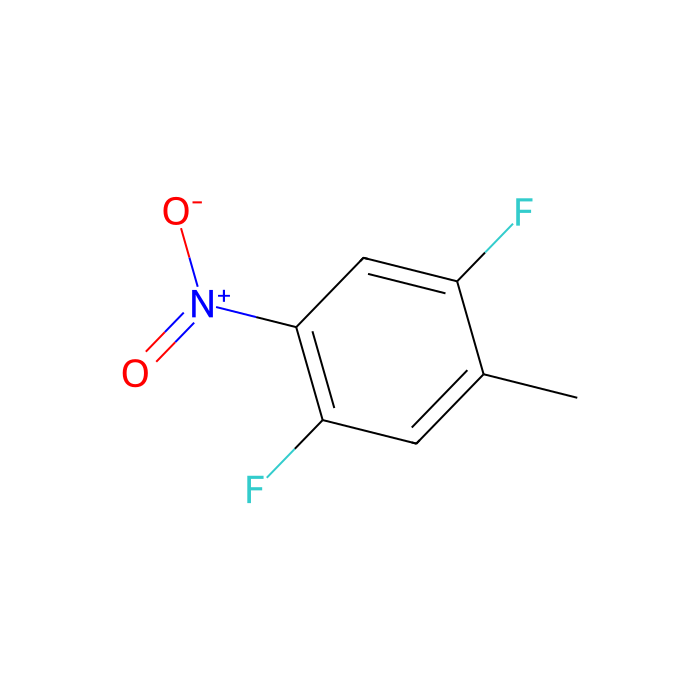
A fluorinated nitroaromatic building block featuring two aryl fluorides and a para-nitro substituent on a toluene core.
Item-specific identifiers (from Product Data)
Product Name: 2,5-Difluoro-4-nitrotoluene
CAS: 141412-60-4
CID (PubChem): 230658
InChIKey (as provided): 1407
SMILES: Not specified for this item; refer to CoA/Spec Sheet.
Literature/computed identity details (for general reference; not item specifications)
Molecular formula (literature): C7H5F2NO2
Molecular weight (literature): ~173.12 g/mol
Substitution pattern: A methyl group (toluene) on the aryl ring, a nitro group para to the methyl (4-position), and fluorine substituents at the 2- and 5-positions.
Functional groups: Aromatic ring, two aryl C–F bonds (strongly deactivating/ortho-para directing with nitro), one nitro (–NO2) group (strongly electron-withdrawing), and a benzylic methyl (–CH3).
Structural description (2D, qualitative)
Six-membered benzene ring bearing: CH3 at C1, NO2 at C4 (para to CH3), F at C2 (ortho to CH3) and F at C5 (meta to CH3; ortho to NO2). No stereocenters; planar aromatic core.
Synthetic Utility
Key reactive elements of 2,5-difluoro-4-nitrotoluene enable orthogonal functionalizations:
Aryl C–F bonds (activated by para-NO2) (literature)
Support SNAr with O-, N-, and S-nucleophiles under basic, polar aprotic conditions, often allowing stepwise and regioselective substitution (2- vs 5-position) by tuning base, temperature, and nucleophile strength.
Enable metal-catalyzed substitutions (e.g., Ullmann, Buchwald–Hartwig variants for aryl amination/etherification) under appropriate catalyst systems; C–F activation may require strong ligands or prior halogen exchange.
Nitro group as a convertible handle
Reduction to aniline affords a versatile locus for diazotization–Sandmeyer sequences, acylations/sulfonylations, or cross-couplings after halogenation.
Benzylic methyl transformations
Radical bromination (NBS, AIBN, light) to give benzyl bromide for nucleophilic substitution or metal insertion.
Oxidation to aldehyde/acid for convergent amide/ester formations.
Retrosynthetic value
Serves as an electron-poor aryl core primed for modular installation of heteroatom substituents, facilitating rapid analog libraries in discovery chemistry while preserving a fluorinated motif to tune electronics and lipophilicity.
Target Specificity
Not applicable. This product is a small-molecule building block and is not an antibody, enzyme, or affinity reagent. No target, epitope, clone, isotype, or species reactivity data apply.
Utilizziamo i cookie per garantire il corretto funzionamento del sito web e, ove consentito, per migliorare la tua esperienza. Puoi gestire le tue preferenze in qualsiasi momento nelle Impostazioni. Per saperne di più, consulta la nostra Cookie Policy.
Desidera che le inviamo un messaggio quando avremo sconti disponibili?
Ricordamelo più tardi
Grazie! Controlli la sua casella di posta per confermare.
Products are supplied to verified businesses, institutions, and qualified professionals for research and development use only. Not for use in humans, animals, diagnosis, or therapy.

 K22171028