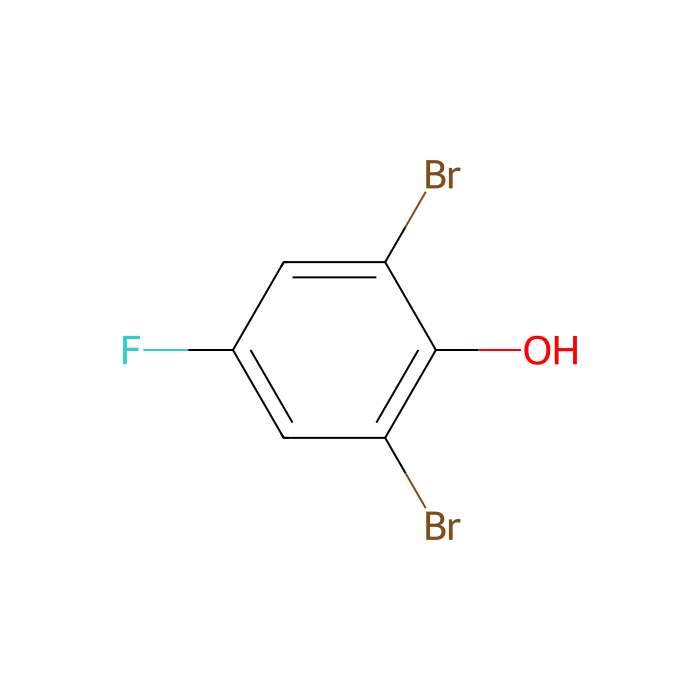
2,6-Dibromo-4-fluorophenol - ≥98% , CAS No.344-20-7

CAS: 344-20-7 Cat. No.: D122591 Formula: Br2C6H2(F)OH Peso molecolare: 269.89 Beilstein Registry Number: 1868033 Numero EC: 206-451-1
Disponibile su ordine
QUALITÀ & PUREZZA ≥98%
Synonyms
4-Fluoro-2,6-dibromophenol|2,6-Dibromo-4-fluorophenol|2,6-dibromo-4-fluoro-phenol|Phenol, 2,6-dibromo-4-fluoro-
Storage
Room temperature,Argon charged
Shipped In
Normal
★
Dimensione
Germania (EU)
USA*
Prezzo
Qtà
5g
D122591-5g
—
6 Disponibile
32,02€
25g
D122591-25g
—
Disponibile ≥10
122,26€
100g
D122591-100g
—
2 Disponibile
439,86€
Enter a quantity for the sizes you want to add.

Specifiche

Sinonimi
4-Fluoro-2,6-dibromophenol | 2,6-Dibromo-4-fluorophenol | 2,6-dibromo-4-fluoro-phenol | Phenol, 2,6-dibromo-4-fluoro-
Specifiche e purezza
≥98%
Condizioni di conservazione di stoccaggio
Room temperature,Argon charged
Spedito in
Normal
Purezza
≥98%
Nomi e identificatori
Pubchem Sid
Pubchem Sid Url
https://pubchem.ncbi.nlm.nih.gov/substance/488183975
SMILES
C1=C(C=C(C(=C1Br)O)Br)F
IUPAC Name
2,6-dibromo-4-fluorophenol
InChIKey
RRAZCUUOWIDAJS-UHFFFAOYSA-N
InChI
1S/C6H3Br2FO/c7-4-1-3(9)2-5(8)6(4)10/h1-2,10H
Isomeri SMILES
C1=C(C=C(C(=C1Br)O)Br)F
WGK Germania
3
Peso molecolare
269.89
Beilstein
1868033
Reaxys
1868033
Reaxys-RN_link_address
https://www.reaxys.com/reaxys/secured/hopinto.do?context=S&query=IDE.XRN=1868033&ln=

Dati avanzati

Taxonomic Classification

Taxonomy Tree

KingdomOrganic compounds
SuperclassBenzenoids
ClassePhenols
SubclassHalophenols
Intermediate Tree Nodes Fluorophenols
Direct ParentP-fluorophenols
Alternative Parents O-bromophenols  Fluorobenzenes  Bromobenzenes  Aryl fluorides  Aryl bromides  Organooxygen compounds  Organofluorides  Organobromides  Hydrocarbon derivatives  
Molecular FrameworkAromatic homomonocyclic compounds
Substituents 4-fluorophenol - 2-bromophenol - Bromobenzene - Fluorobenzene - Halobenzene - Aryl bromide - Aryl fluoride - Aryl halide - Monocyclic benzene moiety - Hydrocarbon derivative - Organic oxygen compound - Organooxygen compound - Organofluoride - Organohalogen compound - Organobromide - Aromatic homomonocyclic compound
DescrizioneThis compound belongs to the class of organic compounds known as p-fluorophenols. These are fluorophenols carrying a iodine at the C4 position of the benzene ring.
External Descriptors Not available
Struttura 3D
Modello di struttura chimica interattiva


Certificati (CoA, COO, BSE/TSE e tabella di analisi)
C of A & Other Certificates(BSE/TSE, COO):
Analytical Chart:

Find and download the COA for your product by matching the lot number on the packaging.

11 results found

Lot NumberCertificate TypeDataOggetto
A2310483A2310483Certificate of AnalysisOct 09, 2026 D122591
A2316011A2316011Certificate of AnalysisOct 09, 2026 D122591
K2217571K2217571Certificate of AnalysisSep 04, 2026 D122591
K2217572K2217572Certificate of AnalysisSep 04, 2026 D122591
K2217573K2217573Certificate of AnalysisSep 04, 2026 D122591
K2217574K2217574Certificate of AnalysisSep 04, 2026 D122591
K2217611K2217611Certificate of AnalysisSep 04, 2026 D122591
K2217612K2217612Certificate of AnalysisSep 04, 2026 D122591
F1404041F1404041Certificate of AnalysisJan 04, 2026 D122591
I1403057I1403057Certificate of AnalysisJun 22, 2022 D122591
I1402145I1402145Certificate of AnalysisJun 21, 2022 D122591
Proprietà chimiche e fisiche
SolubilitàSoluble in Methanol
SensibilitàAir Sensitive
Punto di fusione (°C)54-56°C
Peso molecolare269.89
XLogP33.800
Hydrogen Bond Donor Count1
Hydrogen Bond Acceptor Count2
Rotatable Bond Count0
Exact Mass269.851 Da
Monoisotopic Mass267.853 Da
Topological Polar Surface Area20.200 Ų
Heavy Atom Count10
Formal Charge0
Complexity110.000
Isotope Atom Count0
Defined Atom Stereocenter Count0
Undefined Atom Stereocenter Count0
Defined Bond Stereocenter Count0
Undefined Bond Stereocenter Count0
The total count of all stereochemical bonds0
Covalently-Bonded Unit Count1
Sicurezza e pericoli (GHS)
Pictogrammi
Segnale
Warning
Indicazioni di pericolo

H302:Harmful if swallowed

H312:Harmful in contact with skin

H315:Causes skin irritation

H319:Causes serious eye irritation

H332:Harmful if inhaled

H335:May cause respiratory irritation

Precauzioni

P261:Avoid breathing dust/fume/gas/mist/vapors/spray.

P264:Wash hands [and …] thoroughly after handling.

P270:Do not eat, drink or smoke when using this product.

P271:Use only outdoors or in a well-ventilated area.

P280:Wear protective gloves/protective clothing/eye protection/face protection.

P321:Specific treatment (see ... on this label).

P330:Rinse mouth.

P302+P352:IF ON SKIN: wash with plenty of water.

P304+P340:IF INHALED: Remove person to fresh air and keep comfortable for breathing.

P305+P351+P338:IF IN EYES: Rinse cautiously with water for several minutes. Remove contact lenses if present and easy to do - continue rinsing.

P362+P364:Take off contaminated clothing and wash it before reuse.

P405:Store locked up.

P403+P233:Store in a well-ventilated place. Keep container tightly closed.

P501:Dispose of contents/container to an approved waste disposal plant.

P264+P265:Wash hands [and …] thoroughly after handling. Do not touch eyes.

P301+P317:IF SWALLOWED: Get medical help.

P317:Get emergency medical help.

P337+P317:If eye irritation persists: Get medical help.

P332+P317:If skin irritation occurs: Get medical help.

P319:Get medical help if you feel unwell.

WGK Germania
3
Reaxys
1868033
Reaxys-RN_link_address
https://www.reaxys.com/reaxys/secured/hopinto.do?context=S&query=IDE.XRN=1868033&ln=
Calcolatori di soluzioni
Recensioni

Recensioni dei clienti

Application Protocols

No bioassay/diagnostic protocols are defined for this small-molecule reagent. For synthetic applications, consider the general procedures outlined under Reaction Conditions and Synthetic Utility.

  • If preparing solutions for screening or assays (general):
    • Prepare concentrated stocks in DMSO or DMF (e.g., 10–100 mM), then dilute into assay media ensuring final organic content is minimal to avoid precipitation or nonspecific effects.
    • Filter sterilization (0.22 μm) can be performed on organic solutions if required for cell-based research, acknowledging solubility limits and compatibility of filters with the solvent.

Always validate conditions on small scale and consult the primary literature and SDS for safety and compatibility.

Biological Roles

This product is a synthetic halogenated phenol primarily used as a chemical building block.

  • Item-specific (Product Data): Research Use Note: For research use only.

  • General/biochemical context (no clinical claims):

    • Phenolic scaffolds are prevalent in natural products and materials; halogenation modulates lipophilicity, acidity, and membrane interactions.
    • Multiple halogens typically increase hydrophobicity and can influence binding in enzyme or receptor assays; however, 2,6-dibromo-4-fluorophenol is not a known endogenous metabolite.
    • The phenolic OH can engage in hydrogen bonding, and the aryl halides may be leveraged to append probes or handles for bioconjugation in advanced research.
  • Practical implication:

    • When used in biochemical experiments, ensure appropriate solvent vehicles (e.g., DMSO) and maintain concentrations below solubility limits to avoid precipitation or nonspecific effects.

Any biological activity should be determined empirically in the intended assay system. No pharmacological or therapeutic uses are implied.

Buffer Applications

Not typically used as a buffering agent. This compound is a hydrophobic halophenolic building block and does not form conventional buffer systems.

  • Practical note:
    • If dosing into aqueous buffers for research, dissolve first in a miscible organic co-solvent (e.g., DMSO or ethanol), then dilute into buffer with vigorous mixing and keep final organic content low (commonly ≤1–2%) to avoid precipitation.
    • Adjust pH only with standard buffer components; the phenolic pKa is not leveraged here for buffering.
Green Alternatives

Greener strategy focuses on solvent and catalyst choices, since the substrate is a halogenated phenol.

  • Solvent alternatives (literature/general):

    • Replace DMF/DMSO with 2-MeTHF, CPME, or aqueous micellar media when feasible for cross-couplings or etherifications.
    • Use ethanol/water or isopropanol/water mixtures for Suzuki couplings with water-tolerant catalysts.
  • Catalysis and bases:

    • Employ ligand-optimized Pd catalysts that work at lower loadings and in greener solvents (e.g., XPhos/SPhos systems in 2-MeTHF or EtOH/H2O).
    • Consider nickel catalysis for some cross-couplings to reduce reliance on palladium (case-dependent).
    • Favor inorganic bases with lower EHS concerns (K3PO4, K2CO3) over strong organic bases when compatible.
  • Energy and workup:

    • Microwave or flow-assisted couplings can reduce time/energy.
    • Choose crystallization/trituration over chromatographic purification when possible to reduce solvent waste.

Small comparison (general guidance):

  • THF vs 2-MeTHF:
    • 2-MeTHF: bio-based, higher boiling (facilitates elevated-temperature couplings), improved phase separation; may retain more water and form peroxides more slowly than THF, but still requires peroxide management.
  • DMF vs EtOH/H2O:
    • EtOH/H2O: renewable, low-toxicity; may require different ligands/bases and careful water management of substrates.

Note: Validate green substitutions on small scale; substrate halogen pattern and phenol acidity may influence catalyst/solvent choices.

Pharmaceutical Uses

No excipient or pharmacopeial status is specified for this item; it is offered for research use only.

  • General formulation/manufacturing context (no therapeutic claims):

    • Halogenated phenols can serve as intermediates in the synthesis of active pharmaceutical ingredient (API) candidates, enabling late-stage diversification via cross-coupling at aryl bromides.
    • The phenolic OH allows prodrug or protecting-group strategies (e.g., carbonates, carbamates, ethers) during route scouting.
  • Quality considerations for process development (general):

    • Control of residual halogenated byproducts and metal catalysts after coupling steps is important for regulatory pathways.
    • Solid handling and polymorph control may be relevant if this intermediate is isolated in crystalline form.

Item-specific grade/purity and any pharmacopeial references are not specified for this item; consult the CoA/Spec Sheet if pursuing regulated applications at later stages.

Physical Properties
  • Item-specific (Product Data):

    • Appearance: Not specified for this item; refer to CoA/Spec Sheet.
    • Molecular Formula: Not specified for this item; refer to CoA/Spec Sheet.
    • Molecular Weight: Not specified for this item; refer to CoA/Spec Sheet.
  • Literature/Computed (for reference; not product specifications):

    • Molecular formula (literature): C6H3Br2FO
    • Molecular weight (literature): ~269.89 g/mol
    • Physical state: typically a crystalline solid for polyhalogenated phenols (literature, analogous compounds).
    • Solubility profile (general):
      • Water: low solubility expected for halophenols; solubility increases in basic aqueous media via phenoxide formation (literature, general trend).
      • Organic solvents: good solubility in polar aprotic solvents (DMF, DMSO, NMP) and moderate in acetone, acetonitrile, THF, ethyl acetate, chlorinated solvents (literature, analogous compounds).
    • Acid–base: phenolic pKa is typically reduced by halogenation; halophenols with multiple halogens often show pKa ~7–8 (literature range; phenol ~10.0).
    • Partitioning: heavy halogenation increases hydrophobicity; logP expected above phenol (literature trend).

Notes:

  • Where exact numerical values (mp, bp, density, refractive index, UV cutoff) are required for method development or safety assessments, consult the batch CoA/SDS. Do not use literature estimations as product specifications.
Quality and Grades
  • Item-specific (Product Data):

    • Grade/Purity: Not specified for this item; refer to CoA/Spec Sheet.
  • Interpreting common grades (general guidance):

    • Research or Reagent Grade: suitable for general synthesis and screening. Actual assay and impurity profile are determined per batch on the CoA.
    • High-purity grades (when specified): tighter controls on related halogenated impurities, low residual solvents, and water. Beneficial for metal-catalyzed couplings to minimize side reactions and catalyst poisoning.
    • HPLC grade (if solvent): not applicable here (solid building block). For solids, "screening," "synthetic," or "low-metal" descriptors may appear, each addressing different impurity controls.
  • Stabilizers/Inhibitors:

    • None are indicated for this item. If stabilizers are used to protect phenols from air-oxidation, they would be listed on the CoA (not specified for this item).
  • What to check on receipt (practical tips):

    • Confirm assay, residual solvents, and halogen content by CoA.
    • Review trace metal analysis if planning Pd-catalyzed cross-couplings.
    • Verify water content if moisture-sensitive transformations (e.g., lithium–halogen exchange) are planned.

Note: In the absence of a specified grade, rely on the batch CoA/Spec Sheet for definitive quality metrics.

Reaction and Applications

As a tri-substituted aryl system bearing two C–Br bonds and one phenolic OH, 2,6-dibromo-4-fluorophenol is a versatile platform for diversification.

  • Aryl bromide reactivity (literature/practice):

    • Suzuki–Miyaura couplings at C2/C6 with aryl/alkenyl/alkyl boron reagents (Pd catalysts) to access 2,6-disubstituted 4-fluorophenols.
    • Buchwald–Hartwig amination to introduce anilines or diarylamines at the bromo sites.
    • Kumada/Negishi/Stille couplings as alternatives when compatible with the phenol/protecting groups.
    • Halogen–lithium exchange at low temperature (e.g., n-BuLi, −78 °C) enabling formylation, carboxylation, or electrophile trapping; ortho bromines allow selective/lithiodirected chemistry.
  • Phenolic OH transformations:

    • Protection as silyl ethers (TBS, TBDPS), benzyl ethers, or carbonates to enhance compatibility with strong base or cross-coupling conditions.
    • O-alkylation/arylation (Williamson ether synthesis; Ullmann–type or Buchwald O-arylation) to furnish aryl ethers.
  • Aryl fluoride handle:

    • The para C–F bond is robust; SNAr typically requires strong activation (e.g., additional EWGs) and strong nucleophiles. It can serve as a spectroscopic handle or remain intact through many transformations.
  • Representative applications (general):

    • Synthesis of 2,6-disubstituted phenol motifs for ligands, materials, and agrochemical intermediates.
    • Stepwise functionalization: sequential coupling at one bromo site, protection/deprotection of the phenol, and diversification of the remaining sites.
Reaction Conditions

General literature conditions for transformations of aryl bromides and phenols (guidance only; optimize per substrate):

  • Suzuki–Miyaura coupling (at C–Br):

    • Catalyst: Pd(PPh3)4 (1–3 mol%) or Pd2(dba)3 (1 mol%) with XPhos/SPhos (2–4 mol%).
    • Base: K2CO3 or K3PO4 (2–3 equiv); aqueous or anhydrous depending on solvent.
    • Solvent: dioxane/H2O (3:1), toluene/EtOH/H2O, or 2-MeTHF; 70–100 °C, 2–16 h.
  • Buchwald–Hartwig amination (at C–Br):

    • Catalyst/ligand: Pd2(dba)3 (1–2 mol%) with BINAP, XPhos, or BrettPhos; or Pd(OAc)2 with t-BuXPhos.
    • Base: NaOtBu, Cs2CO3, or K3PO4 (2–3 equiv).
    • Solvent: toluene, dioxane, or tBuOH; 80–120 °C.
  • Williamson ether synthesis (phenol O-alkylation):

    • Base: K2CO3 or NaH in acetone, acetonitrile, or DMF; room temp to reflux, 1–12 h.
    • Protect phenol if incompatible with other steps.
  • Halogen–lithium exchange/electrophile trapping:

    • Reagent: n-BuLi (1.0–2.2 equiv per site) in anhydrous THF at −78 to −40 °C; quench with electrophiles (CO2, DMF, B(OMe)3).
    • Strict exclusion of moisture/air; consider prior phenol protection to avoid proton quench.
  • Notes:

    • The para C–F is inert under most Pd couplings; SNAr typically requires strong EWGs and forcing conditions.
    • For di-functionalization, consider differential reactivity of the two C–Br sites via sterics/ligand control.
Safety and Handling
  • Item-specific (Product Data):

    • Storage Conditions: Room temperature, Argon charged
    • Shipped In: Normal
    • GHS Classification / Signal Word / Pictograms / H-Statements: Not specified for this item; refer to SDS.
  • General safety guidance for halogenated phenols (literature/general):

    • Likely to cause skin and eye irritation; avoid inhalation of dust and contact with skin/eyes. Use in a fume hood.
    • PPE: lab coat, safety goggles, and suitable gloves (e.g., nitrile). Avoid open flames and minimize dust generation.
    • First aid (overview; defer to SDS):
      • Inhalation: move to fresh air; seek medical attention if symptoms persist.
      • Skin: wash with soap and water; remove contaminated clothing.
      • Eyes: rinse cautiously with water for several minutes; remove contact lenses if present and easy to do.
      • Ingestion: rinse mouth; seek medical attention; do not induce vomiting unless directed.
    • Incompatibilities: strong bases (forms phenoxides; may increase solubility/reactivity), strong oxidizers (risk of exotherm), and strong reducing agents/metals under halogen–metal exchange conditions.
    • Environmental: halogenated aromatics may be harmful to aquatic life; prevent release to the environment.

Always consult the product-specific SDS for authoritative hazard classifications, exposure limits, and spill/accidental release procedures.

Solvent Selection

This compound is a halogenated phenolic solid; solvent choice depends on the operation (dissolution vs. reaction vs. purification).

  • Polarity and interactions (general):

    • The phenolic OH enables H-bonding; bromine and fluorine increase polarizability and hydrophobicity.
    • Good solubility typically in polar aprotic media (DMF, DMSO, NMP) and moderate in THF, acetone, acetonitrile, ethyl acetate, and chlorinated solvents.
  • Useful solvent systems (literature/practice):

    • Cross-coupling of aryl bromides: toluene, dioxane, THF, or mixed aqueous systems (e.g., dioxane/H2O, toluene/EtOH/H2O) with a base.
    • Alkylation/etherification of the phenol: polar aprotics (DMF, DMSO, acetone, acetonitrile) after in situ base formation.
    • Halogen–lithium exchange: strictly anhydrous ethereal solvents (THF, tert-butyl methyl ether) at cryogenic temperatures.
  • Comparison (general guidance):

    • DMF/DMSO: maximum solubilization, high-boiling; harder to remove.
    • THF/2-MeTHF: good balance of polarity/volatility; enable cryogenic work; susceptible to peroxide formation (manage accordingly).
    • Toluene/dioxane: common for Pd catalysis; adjust with water/alcohol for phase transfer.

Note: Choose solvent based on downstream workup and safety requirements; confirm actual solubility with a small-scale trial.

Storage and Reconstitution
  • Item-specific (Product Data):

    • Storage Conditions: Room temperature, Argon charged
    • Shipped In: Normal
  • Practical storage guidance (general for halogenated phenols):

    • Store tightly closed under inert gas (argon or nitrogen) to minimize oxidative discoloration or slow oligomerization.
    • Keep in a cool, dry place away from strong bases and oxidants. Protect from prolonged light exposure.
    • If repeated access is expected, consider aliquoting to limit headspace oxygen and moisture ingress.
  • Reconstitution/solution preparation (general):

    • Dissolve in dry, compatible solvents (e.g., DMSO, DMF, THF, acetone, acetonitrile, ethyl acetate, DCM) depending on application.
    • For moisture- or base-sensitive steps (e.g., halogen–lithium exchange), protect the phenol and use rigorously anhydrous conditions.
    • Record exact concentration by weight-to-volume or quantitative NMR if using as a stock solution.
  • Stability notes:

    • No stabilizers are specified for this item. Check appearance and assay upon long-term storage per CoA guidance. If discoloration occurs, consider repurification (e.g., recrystallization) prior to critical transformations.
Structure and Identity

Brief overview: 2,6-Dibromo-4-fluorophenol is a halogenated phenolic building block bearing two ortho bromines and a para fluorine relative to the phenolic OH.

  • Item-specific (Product Data):

    • SKU: D122591
    • Product Name: 2,6-Dibromo-4-fluorophenol
    • CAS: 344-20-7
    • PubChem CID: 67654
    • InChIKey: Not specified for this item; refer to CoA/Spec Sheet. (Product Data lists “323732”, which is not a standard InChIKey)
    • SMILES: Not specified for this item; refer to CoA/Spec Sheet.
  • Literature/Computed identifiers (for reference only):

    • Molecular formula (literature): C6H3Br2FO
    • Molecular weight (literature): ~269.89 g/mol
    • Representative SMILES (literature): Oc1c(Br)cc(F)c(Br)c1
  • Structural features (general chemistry description):

    • Aromatic ring (phenyl) with a phenolic hydroxyl (–OH) at position 1.
    • Two ortho bromine substituents at positions 2 and 6; one para fluorine at position 4.
    • Functional group set: phenol (acidic OH, H-bond donor/acceptor), aryl bromides (good for Pd-catalyzed cross-coupling, metal–halogen exchange), aryl fluoride (strong C–F, low reactivity without activation).
    • 2D description: a six-membered aromatic ring; adjacent to the OH (at C1), bromines occupy both neighboring carbons (C2 and C6), while fluorine is directly opposite the OH (C4). No stereogenic centers; planar aromatic core with heavy-atom substitution increasing polarizability.
Synthetic Utility

Key reactivity elements and strategic value in synthesis:

  • Bifunctional aryl bromide platform:

    • Two ortho bromides provide handles for sequential or selective functionalization (Suzuki, Buchwald–Hartwig, Negishi, Stille). Orthogonal reactivity vs. the para C–F enables stepwise route design.
  • Phenolic OH as a switchable handle:

    • Protect (TBS, TBDPS, benzyl, carbonate) to tune electronics and compatibility. Deprotect under standard conditions to restore phenol.
    • Convert to ethers/esters to modulate solubility and reactivity, or to direct metalation events.
  • Metal–halogen exchange and directed strategies:

    • n-BuLi or t-BuLi at cryogenic temperatures can access aryllithiums for electrophile trapping (formylation, carboxylation, borylation), exploiting the ortho bromides.
  • Retrosynthetic value:

    • Serves as a convergent node for 2,6-disubstituted phenolic frameworks common in ligands, chelators, and material monomers. The para-fluoro often survives cross-coupling, preserving a robust handle or spectroscopic probe.
  • Purification/handling tips (general):

    • Protecting the phenol can sharpen chromatographic behavior and minimize tailing. For metal-catalyzed steps, remove Pd/Ni residues via scavengers or activated carbon, then crystallize to improve purity.
Target Specificity

Not applicable. This product is a small-molecule chemical building block, not a biological targeting reagent (e.g., antibody, enzyme inhibitor with defined target). No antigen/epitope, species reactivity, clone, or isotype applies.

Domande frequenti

How is this product shipped?
This product ships under standard ambient conditions. No temperature-controlled packaging is required.
What is the purity of this product?
This product is supplied at ≥98% purity (chemical assay). Lot-specific values are stated on the Certificate of Analysis.
How should this product be stored?
Store at room temperature under argon. It is supplied under an argon blanket; reseal under inert gas after each use.
What are the CAS number, molecular formula and molecular weight?
The CAS Number is 344-20-7, the molecular formula is C6H3Br2FO, and the molecular weight is 269.89 g/mol. InChIKey RRAZCUUOWIDAJS-UHFFFAOYSA-N.
What documentation is provided?
Available product documentation, including Certificates of Analysis (COA), Safety Data Sheets (SDS), and specification sheets, is shown in the product document area. Document availability and access follow the current site policy.

Desidera che le inviamo un messaggio quando avremo sconti disponibili?

Ricordamelo più tardi

Grazie! Controlli la sua casella di posta per confermare.

Ops! Le notifiche sono disabilitate.