Determine the necessary mass, volume, or concentration for preparing a solution.
| Activity Type | Relation | Activity value | Units | Action Type | Journal | PubMed Id | doi | Assay Aladdin ID |
|---|

Taxonomy Tree
| Kingdom | Organic compounds |
|---|---|
| Superclass | Benzenoids |
| Classe | Benzene and substituted derivatives |
| Subclass | Halobenzenes |
| Intermediate Tree Nodes | Chlorobenzenes |
| Direct Parent | Dichlorobenzenes |
| Alternative Parents | Benzoyl derivatives Benzaldehydes Aryl chlorides Vinylogous halides Organochlorides Organic oxides Hydrocarbon derivatives |
| Molecular Framework | Aromatic homomonocyclic compounds |
| Substituents | 1,3-dichlorobenzene - Benzoyl - Benzaldehyde - Aryl-aldehyde - Aryl halide - Aryl chloride - Vinylogous halide - Organic oxygen compound - Organic oxide - Hydrocarbon derivative - Organooxygen compound - Organochloride - Organohalogen compound - Aldehyde - Aromatic homomonocyclic compound |
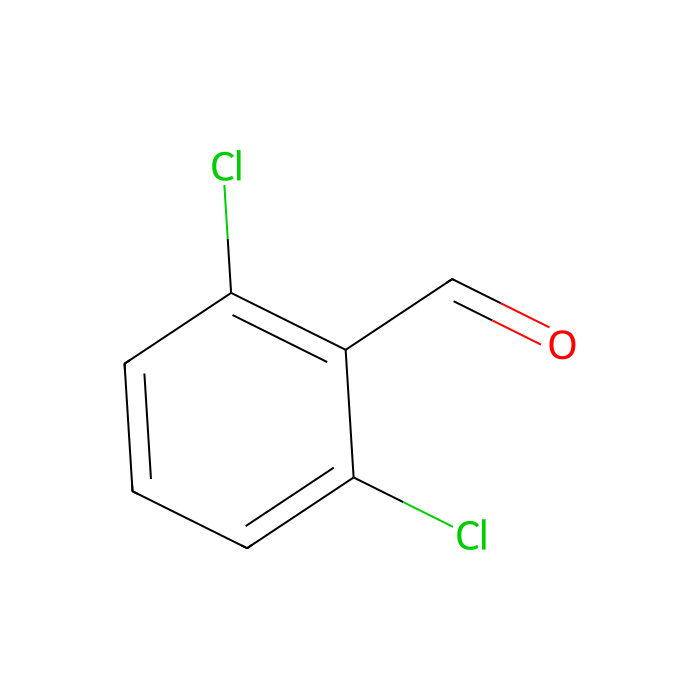
| Descrizione | This compound belongs to the class of organic compounds known as dichlorobenzenes. These are compounds containing a benzene with exactly two chlorine atoms attached to it. |
| External Descriptors | Not available |
| Activity Type | Relation | Activity value | Units | Action Type | Journal | PubMed Id | doi | Assay Aladdin ID |
|---|
| Activity Type | Relation | Activity value | Units | Action Type | Journal | PubMed Id | doi | Assay Aladdin ID |
|---|
| Activity Type | Relation | Activity value | Units | Action Type | Journal | PubMed Id | doi | Assay Aladdin ID |
|---|
| Activity Type | Relation | Activity value | Units | Action Type | Journal | PubMed Id | doi | Assay Aladdin ID |
|---|
| Activity Type | Relation | Activity value | Units | Action Type | Journal | PubMed Id | doi | Assay Aladdin ID |
|---|
| Activity Type | Relation | Activity value | Units | Action Type | Journal | PubMed Id | doi | Assay Aladdin ID |
|---|
| Activity Type | Relation | Activity value | Units | Action Type | Journal | PubMed Id | doi | Assay Aladdin ID |
|---|
| Activity Type | Relation | Activity value | Units | Action Type | Journal | PubMed Id | doi | Assay Aladdin ID |
|---|
| Activity Type | Relation | Activity value | Units | Action Type | Journal | PubMed Id | doi | Assay Aladdin ID |
|---|
| Activity Type | Relation | Activity value | Units | Action Type | Journal | PubMed Id | doi | Assay Aladdin ID |
|---|
| Activity Type | Relation | Activity value | Units | Action Type | Journal | PubMed Id | doi | Assay Aladdin ID |
|---|
| Activity Type | Relation | Activity value | Units | Action Type | Journal | PubMed Id | doi | Assay Aladdin ID |
|---|
| Activity Type | Relation | Activity value | Units | Action Type | Journal | PubMed Id | doi | Assay Aladdin ID |
|---|
| Activity Type | Relation | Activity value | Units | Action Type | Journal | PubMed Id | doi | Assay Aladdin ID |
|---|
Find and download the COA for your product by matching the lot number on the packaging.
| Lot Number | Certificate Type | Data | Oggetto |
|---|---|---|---|
 E2203202 | Certificate of Analysis | Feb 04, 2026 | D129145 |
| E2203236 | Certificate of Analysis | Feb 04, 2026 | D129145 |
| C1404098 | Certificate of Analysis | Nov 10, 2025 | D129145 |
| G2410065 | Certificate of Analysis | Feb 17, 2022 | D129145 |
| Sensibilità | Air Sensitive |
|---|---|
| Punto di infiammabilità (°F) | 212 °F |
| Punto di infiammabilità (°C) | >100℃ |
| Punto di ebollizione (°C) | 165°C |
| Punto di fusione (°C) | 71°C |
| Peso molecolare | 175.01 |
| XLogP3 | 2.600 |
| Hydrogen Bond Donor Count | 0 |
| Hydrogen Bond Acceptor Count | 1 |
| Rotatable Bond Count | 1 |
| Exact Mass | 173.964 Da |
| Monoisotopic Mass | 173.964 Da |
| Topological Polar Surface Area | 17.100 Ų |
| Heavy Atom Count | 10 |
| Formal Charge | 0 |
| Complexity | 117.000 |
| Isotope Atom Count | 0 |
| Defined Atom Stereocenter Count | 0 |
| Undefined Atom Stereocenter Count | 0 |
| Defined Bond Stereocenter Count | 0 |
| Undefined Bond Stereocenter Count | 0 |
| The total count of all stereochemical bonds | 0 |
| Covalently-Bonded Unit Count | 1 |
H314:Causes severe skin burns and eye damage
H411:Toxic to aquatic life with long lasting effects
P260:Do not breathe dust/fume/gas/mist/vapors/spray.
P264:Wash hands [and …] thoroughly after handling.
P273:Avoid release to the environment.
P280:Wear protective gloves/protective clothing/eye protection/face protection.
P321:Specific treatment (see ... on this label).
P363:Wash contaminated clothing before reuse.
P391:Collect spillage.
P301+P330+P331:IF SWALLOWED: Rinse mouth. Do NOT induce vomiting.
P304+P340:IF INHALED: Remove person to fresh air and keep comfortable for breathing.
P405:Store locked up.
P501:Dispose of contents/container to an approved waste disposal plant.
P305+P354+P338:IF IN EYES: Immediately rinse with water for several minutes. Remove contact lenses if present and easy to do. Continue rinsing.
P302+P361+P354:IF ON SKIN: Take off Immediately all contaminated clothing. Immediately rinse with water for several minutes.
P316:Get emergency medical help immediately.
No item-specific, tested bioassay or analytical protocols are provided in the Product Data. As a general-purpose building block, protocol choice depends on the intended synthetic transformation.
General synthetic handling (literature/typical):
If you require a validated, step-by-step protocol for a specific reaction class (e.g., Wittig, TEMPO oxidation, Suzuki coupling), request application notes tailored to your scale and equipment.
This compound is a synthetic aromatic aldehyde and is not a natural metabolite. No item-specific biological data are provided in the Product Data. The following are general, literature-based considerations for aldehydes; they are not clinical or therapeutic claims.
Conclusion: Use is primarily as a chemical intermediate or probe in biochemical research settings, not as a buffer component, nutrient, or biopolymer building block.
Not typically applicable. 2,6-Dichlorobenzaldehyde is a hydrophobic aromatic aldehyde and does not serve as a buffering agent. It is only sparingly soluble in water and lacks acid/base conjugate pairs in the physiological pH range. For aqueous biochemical work, consider using it as an organic-phase reagent or in biphasic/organic media and refer to the Reaction & Applications and Synthetic Utility sections for relevant uses.
As a substrate, 2,6-dichlorobenzaldehyde itself is not replaceable when its exact structure is desired. However, greener choices can be made for solvents and reagents in its transformations.
Greener solvent choices (literature/general):
Representative comparison (general; not item-specific):
DCM vs EtOAc
THF vs 2-MeTHF
Greener reagents/conditions:
Item-specific pharmacopeial status, GMP grade, and excipient suitability are not provided in the Product Data.
General, literature-based context (not item-specific; no therapeutic claims):
For regulated applications, request grade documentation and full CoA/SDS to confirm compliance with internal specifications.
Item-specific specifications (purity, appearance, exact numeric limits) are not provided in the Product Data. Consult the CoA/Spec Sheet for definitive values.
Literature/typical properties for 2,6-dichlorobenzaldehyde (reference only; not item-specific):
General considerations (chemistry knowledge):
Item-specific grade, purity, appearance, and detailed specification limits are not provided in the Product Data for SKU D129145.
General guidance (chemistry/manufacturing context):
Recommendation: For air-/oxidation-sensitive applications (e.g., low-level impurity studies), request most recent CoA, including assay, water content, and impurity profile. If trace metals or peroxides are critical, specify acceptance criteria and obtain a custom specification if needed.
2,6-Dichlorobenzaldehyde is a versatile electrophile whose reactivity is shaped by the ortho dichloro substituents (deactivating, weakly ortho/para directing) that modulate both the ring and carbonyl chemistry.
Key transformations (literature/general):
Applications:
Practical tips:
The following are general, literature-based conditions for common transformations of 2,6-dichlorobenzaldehyde; they are guidance only and not item-specific.
Grignard addition (to form secondary alcohols):
NaBH4 reduction (to benzyl alcohol):
TEMPO/bleach oxidation (to acid):
Wittig olefination:
Knoevenagel condensation:
Suzuki coupling (on aryl chloride):
Always dry solvents and exclude air/moisture, consistent with the Product Data’s argon storage guidance.
Item-specific GHS details (signal word, H-statements, pictograms) are not provided in the Product Data. Always refer to the product SDS for authoritative hazard, first-aid, and regulatory information.
General safety profile for aromatic aldehydes (literature/typical; not item-specific):
PPE and engineering controls (good laboratory practice):
Handling and storage:
First-aid measures (overview; defer to SDS):
Spill/fire response:
As a moderately lipophilic aromatic aldehyde, 2,6-dichlorobenzaldehyde dissolves readily in many organic solvents and poorly in water.
When to choose what:
Comparison (general considerations):
Item-specific storage (from Product Data): Store at room temperature under argon (argon charged). Ship under normal conditions. Keep container tightly sealed.
Additional handling guidance (general chemistry):
Reconstitution notes:
For precise shelf-life and re-test intervals, consult the product CoA/Spec Sheet.
A deactivated, ortho,ortho-dichloro–substituted aromatic aldehyde used as a versatile electrophilic building block.
Item-specific (from Product Data)
Computed/Literature structural identifiers (for reference; not item-specific)
Structural features (general chemistry)
Notes: Where the Product Data omit or differ (e.g., SMILES), literature identifiers above are provided for convenience; consult the CoA/Spec Sheet for definitive item identifiers.
Functional group handles and their leverage:
Retrosynthetic value:
Select named reactions (literature/general):
Process tips:
Not applicable. This product is a small-molecule chemical intermediate, not a biological targeting reagent (e.g., antibody, enzyme inhibitor with defined target panel, or nucleic acid). No target, epitope, clone, isotype, or species reactivity information is relevant.