(2,6-Dichlorophenyl)methanamine was one of the reactants used in making a library of highly selective and potent G protein-coupled receptor kinase 2 inhibitors.
This compound belongs to the class of organic compounds known as dichlorobenzenes. These are compounds containing a benzene with exactly two chlorine atoms attached to it.
External Descriptors
Not available
1. Djoumbou Feunang Y, Eisner R, Knox C, Chepelev L, Hastings J, Owen G, Fahy E, Steinbeck C, Subramanian S, Bolton E, Greiner R, and Wishart DS. ClassyFire: Automated Chemical Classification With A Comprehensive, Computable Taxonomy. Journal of Cheminformatics, 2016, 8:61.
Determine the necessary mass, volume, or concentration for preparing a solution.
Dilution Calculator
Determine the dilution needed to prepare a stock solution.
Reconstitution Calculator
Recensioni
Recensioni dei clienti
Application Protocols
No application protocols are provided for this item in the Product Data. As a general synthetic building block, protocol selection depends on the intended transformation (see Reaction Conditions, Synthetic Utility). For any assay-related use, develop and validate conditions empirically and consult relevant literature precedents for benzylic amines and aryl chloride cross-couplings.
Biological Roles
Applicability: This product is a synthetic organic building block intended for laboratory research. No intrinsic biological function is assigned for this specific compound in the product data.
General context (literature)
Benzylamines can act as substrates or inhibitors of copper-containing amine oxidases (SSAO) in biochemical studies; however, the presence of 2,6-dichloro substituents is non-natural and will alter interactions and physicochemical properties relative to benzylamine. Any such use should be validated experimentally.
Primary amines readily form salts with biological acids; protonation state (pKaH+ typically ~9–10 for benzylamines, lowered slightly by aryl chlorination) will influence membrane permeability and binding in biochemical assays.
Note
No medical or clinical claims are made. This product is supplied strictly for research use only, as stated in the Product Data.
Buffer Applications
Not typically applicable. 2,6-Dichlorobenzylamine is not used as a buffering agent or common biochemical buffer component. If aqueous handling is required, form a water-soluble salt (e.g., hydrochloride) and use standard laboratory buffers (phosphate, acetate, HEPES) appropriate to your system.
Green Alternatives
Context: As a halogenated benzylamine, 2,6-dichlorobenzylamine is a specialty building block rather than a bulk solvent. “Greener alternatives” typically concern choice of reagents/solvents or the selection of less halogenated scaffolds where chemistry permits.
Options to consider (general/literature)
Scaffold alternatives: If the 2,6-dichloro pattern is not essential, non-halogenated benzylamines or mono-chloro analogues may reduce halogenated waste without compromising activity in early SAR screening.
Solvent swaps: Conduct acylations/reductive aminations in greener media (EtOAc, 2-MeTHF, MeOH/EtOH, CPME) instead of DMF/DCM where feasible.
Catalysis and step economy: Employ catalytic amidation (e.g., CDI alternatives, enzyme-catalyzed acylations) and one-pot reductive aminations to minimize protecting-group steps and waste.
Illustrative comparison (general)
DCM vs EtOAc: EtOAc reduces chlorinated solvent waste; may require temperature control to manage exotherms during acylation.
DMF vs 2-MeTHF/CPME: 2-MeTHF/CPME improve EHS profile and ease of workup; solubility of salts and coupling reagents may differ.
Trade-offs
Replacing the dichloro motif changes electronics/sterics of the final molecule; evaluate impact on target properties. Chlorinated starting materials can enable strategic cross-couplings otherwise inaccessible with non-halogenated rings.
Pharmaceutical Uses
No pharmacopeial/excipient role is specified for this item. In medicinal and process chemistry (general context), 2,6-dichlorobenzylamine may serve as:
An intermediate for amide/urea/secondary amine motifs in drug discovery campaigns where ortho,ortho-dichloro substitution modulates lipophilicity and sterics.
A handle for late-stage diversification via cross-coupling at aryl–Cl positions while maintaining a benzylic amine for further derivatization.
Notes
This product is for research use only. No therapeutic, diagnostic, or clinical use is implied.
If intended for cGMP or regulatory pathways, specification, impurity profiles, and residual solvent limits must be established separately; none are provided here for SKU D154483.
Physical Properties
Item-specific specifications
Appearance: Not specified for this item; refer to CoA/Spec Sheet.
Grade/Purity: Not specified for this item; refer to CoA/Spec Sheet.
Literature/general reference values (for context only; not item specifications)
Empirical formula: C7H7Cl2N
Formula weight: ~176.05 g/mol
Acid–base: primary amine; typical benzylamine pKaH+ ~9–10 (literature; exact value for 2,6-dichloro analogue may be slightly lower due to electron-withdrawing Cl substituents)
LogP: aryl dichloro substituents generally increase lipophilicity relative to benzylamine (qualitative, literature)
Solubility profile: expected to be miscible with common organic solvents (EtOAc, alcohols, THF, DCM) and moderately soluble in water in free-base form; water solubility increases dramatically as hydrochloride or other acid salts (literature behavior for benzylamines)
Not provided for this specific item; consult CoA/Spec Sheet
Boiling point, melting point
Density
Refractive index
UV/Vis cutoff or ε
Residual water/peroxide/metal content
Practical notes (general)
The free base may be a low-melting solid or liquid near ambient temperature depending on purity and polymorph; if solidifies, gentle warming (ambient-to-30 °C) may liquefy (general handling tip, not a spec).
Quality and Grades
Item-specific quality data
Grade/Purity: Not specified for this item; refer to CoA/Spec Sheet.
Stabilizers/inhibitors: Not specified for this item; refer to CoA/Spec Sheet.
Guidance on interpreting grades (general)
Research/technical grade: Suitable for most synthetic applications; typical limits for water, metals, and UV-absorbing impurities are not standardized—verify against your method needs.
High-purity or GC/HPLC grade (if applicable): Emphasizes low volatile/UV-active impurities for analytics; for amines, low residual water and low aldehyde/ketone content may be critical for imine/reductive amination workflows.
Implications for this compound class (general)
Primary amines readily form salts and can pick up CO2/H2O; “anhydrous” claims are rare. If moisture-sensitive chemistry is planned (e.g., Grignard quench control, isocyanate formation), pre-dry by distillation over base or convert to a crystalline salt and regenerate the free base immediately before use.
UV-sensitive applications: Aryl chlorides and benzylic amines absorb in the UV; if using in trace-analysis or UV detection methods, verify background absorbance of your lot.
Recommendation
For critical applications (e.g., medicinal chemistry SAR or polymer modifiers), obtain and review the CoA for assay, water, color, and residual solvent profile specific to SKU D154483.
Reaction and Applications
Use case: 2,6-Dichlorobenzylamine is a sterically encumbered benzylamine building block; the ortho,ortho-dichloro pattern combines electronic deactivation of the ring with benzylic nucleophilicity. Typical applications include:
Amide formation: Acylation with acyl chlorides, anhydrides, or activated esters to give 2,6-dichlorobenzylamides. The steric bulk near the benzylic position can modulate amide conformations and reduce N-acylation side reactions at neighboring sites.
Urea/carbamate synthesis: Reaction with isocyanates or chloroformates; Boc/CBz/Fmoc protections are straightforward for temporary masking of the amine.
Reductive amination: As the amine component with aldehydes/ketones to form secondary benzylic amines; NaBH3CN/NaBH(OAc)3 or catalytic hydrogenation are common protocols.
Alkylation and quaternization: SN2 alkylations (e.g., alkyl halides, sulfonates) to generate secondary/tertiary amines or ammonium salts; control over over-alkylation via stoichiometry and base.
Formation of imines/Schiff bases: Useful intermediates for further transformations (e.g., Strecker, cyclizations).
Aryl ring diversification: The aryl dichloro motif can engage in Pd/Ni-catalyzed cross-couplings (Buchwald–Hartwig amination, Suzuki–Miyaura, or C–O/C–S couplings) to selectively replace one or both chloro substituents, enabling late-stage diversification while preserving the benzylic amine.
Practical tips (general)
Acid scavenging: Use non-nucleophilic bases (DIPEA, 2,6-lutidine) during acylations.
Moisture considerations: Free amine can absorb CO2/H2O; if precise stoichiometry is critical, titrate the amine (e.g., with standard HCl in MeOH) or prepare the hydrochloride then neutralize in situ.
Metal-catalyzed couplings on aryl–Cl often benefit from bulky, electron-rich ligands (e.g., t-BuXPhos, BrettPhos) and elevated temperatures.
Reaction Conditions
General literature guidance (not item-specific specifications)
Acylation to amides
Typical solvents: DCM, THF, dioxane, EtOAc
Base: DIPEA, Et3N, or 2,6-lutidine (1.5–3.0 equiv)
Temperature/time: 0–25 °C, 0.5–4 h for acid chlorides; 20–40 °C, 2–16 h for carbodiimide couplings
Notes: Control exotherm during acyl chloride addition; use imidazole/DMAP for activated esters.
Reductive amination (secondary amine synthesis)
Solvent: MeOH, EtOH, i-PrOH, or MeCN
Conditions: Aldehyde/ketone (1.0–1.2 equiv), NaBH3CN (1.2–1.5 equiv) or NaBH(OAc)3 (2.0–3.0 equiv), AcOH (0.2–0.5 equiv) at 20–25 °C, 2–16 h
Alternative: H2 (1–5 bar) with Pd/C (5–10 wt%) in alcohol at RT–40 °C
Notes: Molecular sieves or Ti(OiPr)4 can accelerate imine formation.
Aryl–Cl cross-coupling (ring diversification)
Catalyst/ligand: Pd2(dba)3 or Pd(OAc)2 with BrettPhos/SPhos/XPhos (1–5 mol% Pd)
Base: K3PO4, Cs2CO3 (2–3 equiv)
Solvent: Toluene, dioxane, or DMAc; 80–120 °C; 6–24 h
Notes: The benzylic amine may need protection (Boc/CBz) to avoid catalyst inhibition.
Protection/deprotection
Boc protection: Boc2O (1.1–1.5 equiv), base (NaHCO3/Et3N) in THF/MeOH, 0–25 °C, 1–3 h
Boc deprotection: TFA in DCM or HCl/dioxane at 0–25 °C, 0.5–2 h
Expected yields are substrate- and method-dependent; consult primary literature for the specific transformation of interest.
Safety and Handling
Authoritative safety information must be taken from the product SDS. The following are general considerations for benzylic primary amines bearing aryl chlorides.
GHS classification (item-specific): Not specified for this item; refer to SDS.
Signal word, H-statements, pictograms: Not specified for this item; refer to SDS.
General hazards and precautions (literature/typical for amines)
Hazards: Primary amines can be skin/eye irritants and may cause respiratory irritation. Aromatic chlorides are not inherently unstable but may enhance lipophilicity and skin penetration.
PPE: Use chemical-resistant gloves (e.g., nitrile), lab coat, eye protection; handle in a fume hood to avoid inhalation of vapors/aerosols.
Incompatibilities: Strong oxidizers; acylating agents and acid chlorides (vigorous exotherm upon neutralization/acylation); carbonyl electrophiles; may react with CO2 from air over time to form carbamates at the surface; forms salts with strong acids.
First aid (overview; consult SDS):
Skin/eye contact: Rinse with water for 15 minutes; remove contaminated clothing; seek medical attention if irritation persists.
Inhalation: Move to fresh air; seek medical attention if symptoms occur.
Ingestion: Rinse mouth; do not induce vomiting; seek medical advice.
Handling tips: Keep containers tightly closed under inert gas as provided. Avoid prolonged air exposure if low odor threshold or CO2 salt formation is a concern. Ground/earth containers when transferring flammable solvents used with the amine.
Peroxide formation: Not applicable to this amine itself; however, commonly used ether solvents can form peroxides—check solvent SDS.
Solvent Selection
Applicability: 2,6-Dichlorobenzylamine is typically used as a reagent/building block rather than a solvent. This section summarizes solvent choices for dissolving and reacting this compound.
General solubility/miscibility tendencies (literature/general)
Organic solvents: Good solubility in polar aprotic (DMF, DMSO, MeCN), moderately polar (EtOAc, THF, dioxane), and chlorinated solvents (DCM, CHCl3). Often readily soluble in alcohols (MeOH, EtOH).
Aqueous media: Moderate solubility for the free base; high solubility when converted to acid salts (e.g., HCl, H2SO4). Buffering near neutral can lead to partial protonation and improved aqueous handling.
Solvent selection guidance by operation
Acylation/carbamoylation: DCM, THF, dioxane, or toluene with base (Et3N, DIPEA) to manage HCl.
Reductive amination: Alcohols (MeOH, EtOH, i-PrOH) or MeCN; water-tolerant catalysts (Pd/C + H2 or NaBH3CN/NaBH(OAc)3) in mixed solvents.
Salt formation/purification: IPA/Et2O or EtOAc/hexanes for crystallizing the hydrochloride or other salts.
Metal-catalyzed aryl functionalization (on the dichloro ring): High-boiling polar aprotics (dioxane, toluene, DMAc) under Pd/Ni catalysis if performing cross-coupling at aryl–Cl positions.
Comparison notes (general)
DMSO/DMF maximize solubility for difficult substrates but are harder to remove; THF/EtOAc balance volatility and solvation; MeOH/EtOH enable greener processing but may participate in transesterification or H-bonding with the amine.
Storage and Reconstitution
Item-specific conditions (from Product Data)
Storage: Room temperature, Argon charged.
Shipped: Normal.
Research use note: For research use only.
General handling guidance (literature/typical for primary benzylic amines)
Keep container tightly closed under inert gas to limit moisture/CO2 uptake and oxidative discoloration.
If the material arrives as a crystalline solid that partially liquefies/solidifies around room temperature, warm gently (to ~25–30 °C) to homogenize before dispensing.
For aqueous operations, consider preparing a defined salt (e.g., hydrochloride) by treatment with anhydrous HCl in ether/IPA; regenerate the free base by basification immediately prior to use when required.
Avoid prolonged exposure to strong light/air if color formation is observed; store in amber glass if available.
Stability
No item-specific shelf-life or stability data are provided; consult the CoA/Spec Sheet and SDS for definitive guidance.
Structure and Identity
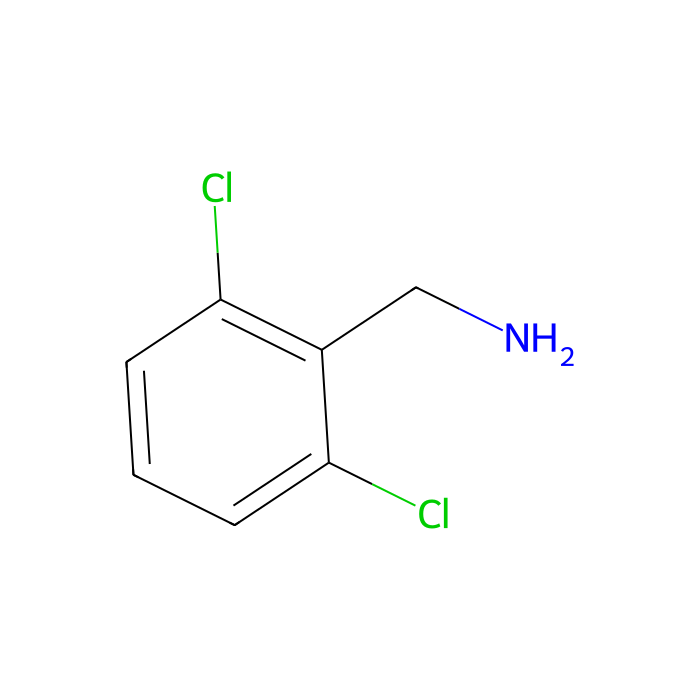
Brief description: 2,6-Dichlorobenzylamine is a benzylic primary amine bearing two chloro substituents at the 2- and 6-positions of the aromatic ring; it is a halogenated benzylamine building block for organic synthesis.
Item-specific identifiers (from Product Data)
SKU: D154483
Product name: 2,6-Dichlorobenzylamine
CAS: 6575-27-5
PubChem CID: 485432
InChIKey: 382338 (as provided)
Storage note: Room temperature, Argon charged (see Storage tab)
Structure overview (literature/general)
Core scaffold: benzylamine (Ph–CH2–NH2) with ring chlorination at ortho/ortho (2,6-positions)
2D description: an anilide-like benzene ring carries Cl substituents flanking the benzylic –CH2–NH2 side chain; no stereocenters; planar aromatic ring, sp3 benzylic carbon, primary amine capable of salt formation and H-bonding.
The item-specific SMILES and exact identity parameters not listed in Product Data beyond the above; for authoritative identifiers, consult the CoA/Spec Sheet.
Synthetic Utility
Key functional elements
Nucleophilic primary amine (benzylic): participates in acylation, alkylation, imine formation, reductive amination, and cyclizations.
Two aryl chlorides at the 2,6-positions: electron-withdrawing and deactivating toward EAS; valuable for Pd/Ni-catalyzed cross-couplings, enabling selective mono- or di-substitution.
Amide synthesis: coupling with carboxylic acids via EDCI/HOBt or DIC/DMAP; or with acyl chlorides under basic conditions (Et3N/DIPEA/2,6-lutidine).
Ureas/carbamates: reaction with CDI followed by amine/alcohol; or direct reaction with isocyanates/chloroformates.
Reductive amination: condensation with aldehydes/ketones (Ti(OiPr)4 or molecular sieves to drive imine formation), then reduction (NaBH3CN, NaBH(OAc)3, or H2/Pd-C).
Benzylic derivatization: oxidation to the corresponding aldehyde/acid requires protection of –NH2 (e.g., Boc) to avoid over-oxidation.
Cross-coupling on the ring: Suzuki–Miyaura (B(pin) partners), Buchwald–Hartwig amination (secondary amines), or C–S/C–O couplings using tailored ligands for aryl chlorides (BrettPhos, SPhos, XPhos) with bases such as Cs2CO3/K3PO4 in toluene/dioxane/DMAc.
Strategic value
The ortho,ortho-dichloro pattern introduces steric hindrance adjacent to the benzylic arm, useful to bias conformations or attenuate metabolic aromatic hydroxylation in lead design.
Target Specificity
Not applicable. This product is a small-molecule building block, not a biological targeting reagent (e.g., antibody, ligand with defined receptor selectivity) in the context of the Product Data.
Utilizziamo i cookie per garantire il corretto funzionamento del sito web e, ove consentito, per migliorare la tua esperienza. Puoi gestire le tue preferenze in qualsiasi momento nelle Impostazioni. Per saperne di più, consulta la nostra Cookie Policy.
Desidera che le inviamo un messaggio quando avremo sconti disponibili?
Ricordamelo più tardi
Grazie! Controlli la sua casella di posta per confermare.
Products are supplied to verified businesses, institutions, and qualified professionals for research and development use only. Not for use in humans, animals, diagnosis, or therapy.

 K2117063