This compound belongs to the class of organic compounds known as polyhalopyridines. These are organic compounds containing a pyridine ring substituted at two or more positions by a halogen atom.
External Descriptors
Not available
1. Djoumbou Feunang Y, Eisner R, Knox C, Chepelev L, Hastings J, Owen G, Fahy E, Steinbeck C, Subramanian S, Bolton E, Greiner R, and Wishart DS. ClassyFire: Automated Chemical Classification With A Comprehensive, Computable Taxonomy. Journal of Cheminformatics, 2016, 8:61.
Determine the necessary mass, volume, or concentration for preparing a solution.
Dilution Calculator
Determine the dilution needed to prepare a stock solution.
Reconstitution Calculator
Recensioni
Recensioni dei clienti
Application Protocols
Not applicable. No biological assay or immunoassay protocols are associated with this small-molecule building block. For synthetic applications, refer to the Reaction Conditions and Synthetic Utility sections for general procedural guidance.
Biological Roles
This product is a small heteroaromatic building block used in chemical synthesis. It does not have a defined endogenous biological role.
General context (literature)
Pyridine-containing scaffolds and nitriles appear in many bioactive molecules, but 2,6-dichloroisonicotinonitrile itself is typically an intermediate for SAR exploration rather than a probe or ligand with characterized biological activity.
The nitrile is metabolically robust; when incorporated into drug candidates it can modulate polarity and metabolic stability, but such roles pertain to derivatives, not to this starting material.
Research use note (item-specific)
For research use only (per Product Data). Not for human or veterinary use.
Buffer Applications
Not typically applicable. 2,6-Dichloroisonicotinonitrile is an organic building block and is not used as a buffering agent. For aqueous systems, consider dedicated buffer components (e.g., phosphate, HEPES). Refer instead to the Synthetic Utility, Reaction & Applications, and Solvent Selection sections for relevant guidance.
Green Alternatives
Greener processing considerations (general)
While the substrate is fixed, greener choices often revolve around solvent and catalyst selection during its use in synthesis.
Alternative solvents (literature/green chemistry guidance)
Replace DMF/NMP/DMAc (reprotoxic, high EHS concern) with MeCN, 2-MeTHF, CPME, propylene carbonate, or water/PEG systems when compatible.
For SNAr: MeCN or propylene carbonate can sometimes substitute DMSO/DMF at modest temperature increases.
For cross-coupling: 2-MeTHF, CPME, and aqueous ethanol with micellar catalysis (e.g., TPGS-750-M) are reported to support Pd-catalyzed couplings, reducing environmental impact.
Catalyst/ligand efficiency
Employ highly active Pd or Ni catalysts (e.g., biaryl phosphines, NHCs) at ppm–0.1 mol% loadings to reduce metal waste and improve E-factor.
Workup and purification
Favor crystallization or antisolvent precipitations over silica chromatography when feasible to cut solvent usage.
Greener option: 2-MeTHF/CPME/MeCN or aqueous micellar media; Pd or Ni ≤0.5 mol%; base K2CO3/Cs2CO3; minimized chlorinated solvent use.
All green alternatives should be validated for your specific transformation and impurity profile.
Pharmaceutical Uses
Item-specific status
No pharmacopeial grade or excipient designation is provided for this item; Not specified for this item, refer to CoA/Spec Sheet.
General context (non-clinical)
Heteroaromatic nitriles like this compound are commonly used as synthetic intermediates to access libraries of pyridine derivatives during lead discovery and process development.
Potential roles in pharmaceutical R&D are as an intermediate in the synthesis of APIs or advanced intermediates, not as a formulated excipient. No medical or therapeutic claims are made or implied.
Quality considerations for GMP pathways (general)
If transitioning toward GMP, control of residual metals (from cross-couplings), halide content, and genotoxic impurities should be evaluated. Specifications must be established per ICH guidelines for the intended intermediate stage.
Physical Properties
Item-specific property data
Appearance: Not specified for this item; refer to CoA/Spec Sheet.
Grade/Purity: Not specified for this item; refer to CoA/Spec Sheet.
Literature/general expectations for this structural class (for reference only)
Physical state: typically a crystalline solid for 2,6-dichloro–substituted 4-cyanopyridines (literature, analogous compounds).
Volatility: low-to-moderate vapor pressure relative to low-MW aromatics; substantially nonvolatile at ambient conditions (literature trend for aryl chlorides/nitriles).
Solubility profile: low solubility in water; good solubility in polar aprotic organic solvents (e.g., DMF, DMSO, NMP, acetonitrile) and moderate solubility in chlorinated and aromatic solvents (CH2Cl2, chloroform, toluene) (literature/experience with chloropyridine nitriles).
Acid/base: weakly basic ring nitrogen; nitrile is neutral and non-ionizable under most conditions (general chemical knowledge).
Quantitative values (for this specific item)
Melting point, boiling point, density, refractive index, logP, pKa, water content, UV cutoff: Not specified for this item; refer to CoA/Spec Sheet.
Practical implications
For weighing/handling, treat as a moisture-stable but air-sensitive-to-hydrolysis substrate only when strongly basic nucleophiles are present; otherwise generally stable as a solid.
Dissolve for reactions or analyses using dry polar aprotic solvents to maximize solubility and minimize competitive hydrolysis.
Quality and Grades
Item-specific quality information
Grade/Purity: Not specified for this item; refer to CoA/Spec Sheet.
Stabilizers/additives: Not specified for this item; refer to CoA/Spec Sheet.
Guidance on typical grades (general)
Research-grade heteroaromatic building blocks are commonly specified by assay (%), residual solvents, and key impurities (e.g., mono-chloro isomers, hydrolyzed amide/acid from nitrile, inorganic salts). For chromatography-critical work, a higher assay and lower UV-active impurities are preferred.
If designated as “98%+” or higher in a CoA, materials usually meet thresholds suitable for most synthetic steps and medicinal chemistry SAR studies. HPLC/GC or qNMR are often used for assay.
What to check on the CoA (practical tips)
Identity confirmation: 1H/13C NMR consistent with 2,6-disubstitution pattern; HRMS for [M+H]+ ≈ 173.0 + 1; IR showing strong nitrile stretch ~2220–2260 cm−1 (literature values).
Purity profile: area % by HPLC, limits on regioisomers (e.g., 2-chloro-6-substituted or 3,5-dichloro analogs), and hydrolysis byproducts (amide/acid).
Residual solvents and water (KF): ensure compatibility with intended reactions (especially moisture-sensitive couplings or metalations).
Reaction and Applications
Role in synthesis (general/literature)
Versatile electron-deficient pyridine bearing two activated aryl chlorides and a para nitrile, enabling chemoselective derivatization for heteroaryl libraries and medicinal chemistry.
Representative application families (literature)
Nucleophilic aromatic substitution (SNAr): Displacement of Cl at C-2 and/or C-6 by amines, alkoxides, thiolates; often stepwise to craft 2- and 6-heteroatom patterns. The ring N and nitrile synergistically activate the aryl chlorides.
Cross-coupling: Pd- or Ni-catalyzed Suzuki–Miyaura, Buchwald–Hartwig, Negishi, or Stille couplings at C–Cl positions, typically requiring tailored ligands for hindered 2,6-disubstituted pyridines.
Nitrile transformations: Hydrolysis to amide/carboxylic acid (4-carboxypyridine derivatives), reduction to primary amine (via DIBAL, borane, or catalytic hydrogenation after coupling steps), or addition (e.g., organometallics) to build imines/ketimines.
Directed metalation/minor pathways: Though less common due to deactivation, lithiation adjacent to N under strong bases (e.g., s-BuLi/TMEDA, −78 to 0 °C) can enable further substitutions after halogen/Cl manipulation (advanced practice).
Practical tips
Sequence planning: Use differential reactivity to install the most sensitive group last; C-2 vs C-6 selectivity can be tuned by base, solvent, and temperature.
Dry, oxygen-free handling improves cross-coupling performance; use degassed solvents and an inert atmosphere.
For SNAr with amines, carbonate or alkoxide bases and 80–140 °C (solvent-dependent) are typical; isolated yields often benefit from using high-boiling polar aprotics and excess nucleophile (literature practice).
Reaction Conditions
General, literature-informed guidance for transformations of 2,6-dichloroisonicotinonitrile (not item-specific specifications):
SNAr (amines/alkoxides/thiolates)
Solvents: DMSO, DMF, NMP, MeCN (polar aprotics)
Base: K2CO3, Cs2CO3, NaOtBu, or the nucleophile itself (for amines)
Temperature: 60–140 °C depending on nucleophile and solvent bp
Time: 2–24 h; monitor by LC/MS or HPLC
Notes: Electron-deficient ring promotes substitution; C-2/C-6 selectivity can be influenced by sterics and nucleophile hardness.
Buchwald–Hartwig amination
Catalyst: Pd2(dba)3 or Pd(OAc)2 (0.5–3 mol%) with ligands such as XPhos, BrettPhos, RuPhos (ligand choice tunes reactivity on 2,6-dichloropyridines)
Base: NaOtBu, KOtBu, Cs2CO3
Solvent: toluene, dioxane, or t-BuOH; sometimes DMF/MeCN
Temperature: 80–120 °C; inert atmosphere
Suzuki–Miyaura coupling
Catalyst: Pd(PPh3)4 or Pd-precatalysts with SPhos/XPhos (0.5–2 mol%)
Base: K2CO3, K3PO4, Cs2CO3 (aqueous or anhydrous)
Solvent: dioxane/water, toluene/water, or MeCN; 60–110 °C
Notes: Heteroaryl chlorides may require more active ligands; consider aqueous micellar media for greener conditions.
Nitrile hydrolysis (to amide/acid)
Acidic: H2SO4 or HCl(aq), 80–120 °C → amide/acid depending on time
Basic: NaOH/KOH (aq/alcoholic), reflux → amide/acid after workup
Nitrile reduction
Reagents: BH3·THF, DIBAL-H (−78 to 0 °C for partial reductions), or catalytic hydrogenation (Raney Ni/Pd/C) under H2 for full reduction to primary amine.
Always optimize on small scale; heteroaryl chlorides often benefit from carefully chosen ligand/base combinations and rigorous exclusion of moisture/air.
Safety and Handling
GHS/SDS information for this item
Signal Word: Not specified for this item; refer to SDS.
H-Statements: Not specified for this item; refer to SDS.
GHS Classification: Not specified for this item; refer to SDS.
Pictograms: Not specified for this item; refer to SDS.
General hazards for aromatic nitriles and chloropyridines (literature/chemical-class guidance)
May cause skin/eye/respiratory irritation; harmful if swallowed or inhaled. Handle in a fume hood.
Dust can be irritating; avoid aerosolization and inhalation.
PPE and engineering controls
Use chemical-resistant gloves (e.g., nitrile), lab coat, splash goggles.
Work in a certified chemical fume hood; avoid open handling outside containment.
Storage and incompatibilities
Storage (item-specific): Store at 2–8 °C, argon charged. Shipped on wet ice (per Product Data).
Keep container tightly closed under inert atmosphere. Protect from moisture and strong bases/nucleophiles that can promote substitution/hydrolysis.
Incompatibilities (general): strong bases/nucleophiles (risk of SNAr), strong oxidizers, strong reducing agents, and powerful Lewis acids that can activate the nitrile undesirably.
First-aid overview (general; defer to SDS)
Inhalation: move to fresh air, seek medical attention if symptoms persist.
Skin/eye contact: flush with water for at least 15 minutes; remove contaminated clothing; obtain medical advice.
Ingestion: rinse mouth; do not induce vomiting; seek medical attention.
Always consult the product SDS for definitive hazard, exposure limits, and first-aid instructions.
Solvent Selection
This product is a heteroaromatic solid used as a synthetic building block rather than as a solvent. Solvent choice pertains to dissolving it for reactions or analyses.
Polarity and solubility considerations (literature/general)
Best solubility: polar aprotic solvents (DMF, DMAc, DMSO, NMP, MeCN) due to combined aryl chloride and nitrile functionalities.
Moderate solubility: chlorinated (CH2Cl2, CHCl3) and aromatic solvents (toluene); solubility can be enhanced by gentle warming.
Poor solubility: water and aliphatic hydrocarbons.
Typical use scenarios and recommendations
SNAr with amines/alkoxides: employ high-boiling polar aprotics (DMSO, DMF, NMP) or MeCN for milder cases; consider phase-transfer when using inorganic bases.
Pd-catalyzed cross-couplings: toluene/1,4-dioxane/THF or MeCN with appropriate base (K2CO3, Cs2CO3) and ligated Pd; DMF or dioxane often improve rates with 2,6-disubstituted pyridines (literature practice).
Analytical prep: dissolve in DMSO-d6 or CD3CN for NMR; MeCN/MeOH for LC; avoid aqueous buffers without co-solvent.
Small comparison (general)
DMF/DMSO: maximal solubilization; high bp enables elevated temperatures, but removal can be difficult.
MeCN: cleaner workup, lower bp; sometimes limited solubility at RT.
Toluene/dioxane: favored in cross-coupling with strong bases and elevated temperature.
Storage and Reconstitution
Item-specific storage and shipping
Storage Conditions: Store at 2–8 °C, argon charged (per Product Data).
Shipped In: Wet ice (per Product Data).
Handling and preparation
Bring to room temperature under inert atmosphere prior to opening to avoid moisture ingress by condensation.
If a solution is required, prepare stock solutions in dry, oxygen-free solvents (e.g., anhydrous MeCN, DMF, DMSO). Filter if particulates are present.
Working solutions: For short-term use, store tightly capped under inert gas at 2–8 °C. For longer-term storage of solutions, consider aliquoting and freezing (check solvent freezing points and stability in your system).
Stability notes (general)
The solid is generally stable when protected from moisture and air; avoid prolonged exposure to strong bases or nucleophiles that may induce substitution/hydrolysis.
No reconstitution buffer is required; this is not a bioreagent.
Documentation
Refer to the CoA/SDS for any item-specific stability, impurity, or re-test date information.
Research Use Note
For research use only (per Product Data).
Structure and Identity
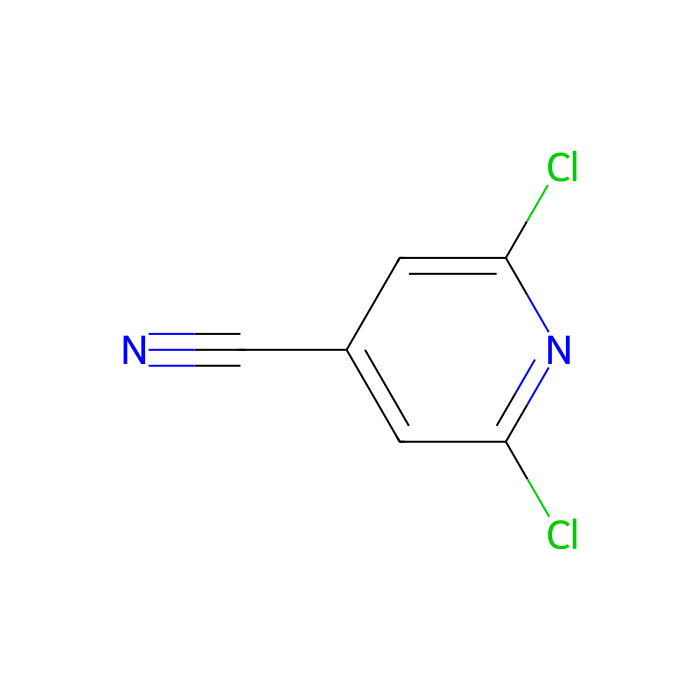
Brief description: 2,6-Dichloroisonicotinonitrile is a chlorinated, nitrile-bearing pyridine derivative (isonicotinonitrile = 4-cyanopyridine), functionalized with chloro substituents at the 2- and 6-positions.
SMILES: Not specified for this item; refer to CoA/Spec Sheet.
Computed/literature structural information (for reference; not item-specific specs)
Core scaffold: pyridine ring (one ring nitrogen) bearing a nitrile at the 4-position (isonicotinonitrile) and chloro substituents at the 2- and 6-positions.
Typical molecular formula (literature/computed): C6H2Cl2N2
2D description: A six-membered aromatic ring with N at position 1; –C≡N at para (4-position) relative to N; Cl atoms at ortho positions 2 and 6.
Notes
The provided InChIKey appears incomplete; consult the SDS/CoA for definitive identifiers.
Stereochemistry: none (achiral aromatic).
Synthetic Utility
Functional handles and reactivity (literature)
Two activated aryl chlorides (C-2 and C-6) on an electron-poor pyridine enable stepwise SNAr or cross-coupling, while the para nitrile can be retained as a bioisostere or transformed later (hydrolysis/reduction).
The ring N further activates the ortho C–Cl bonds, providing enhanced reactivity vs benzene analogs.
Strategic uses
Divergent synthesis: install distinct substituents at C-2 and C-6 via orthogonal conditions (e.g., SNAr at one site, Pd-coupling at the other), then manipulate the nitrile.
Late-stage diversification: reserve one C–Cl for rapid library generation (e.g., Buchwald–Hartwig amination or Suzuki coupling).
Polarity tuning: the nitrile modulates electronics and can direct site-selectivity during subsequent substitutions.
Named reaction contexts (examples from literature)
Buchwald–Hartwig amination to form 2- or 6-arylamino-4-cyanopyridines.
Suzuki–Miyaura coupling with boronic acids/esters generating 2- or 6-aryl products.
SNAr with alkoxides/thiolates to give 2- or 6-alkoxy/alkylthio derivatives under basic, high-boiling solvents.
Nitrile hydrolysis (acidic or basic) to 4-carboxamide or 4-carboxylic acid derivatives; nitrile reduction to primary amine for subsequent acylation/urea formation.
Practical advice
Control moisture and oxygen for cross-couplings; pre-activate catalysts and use appropriate ligands for hindered heteroaryl chlorides (e.g., bulky biaryl phosphines).
For SNAr chemoselectivity, temperature, base strength, and solvent polarity are key levers; consider stepwise installations with protection of sensitive nucleophiles where needed.
Target Specificity
Not applicable. This product is a small-molecule building block and is not an antibody, enzyme, or affinity reagent. No target specificity, clone, isotype, or species reactivity data apply.
Utilizziamo i cookie per garantire il corretto funzionamento del sito web e, ove consentito, per migliorare la tua esperienza. Puoi gestire le tue preferenze in qualsiasi momento nelle Impostazioni. Per saperne di più, consulta la nostra Cookie Policy.
Shall we send you a message when we have discounts available?
Remind me later
Thank you! Please check your email inbox to confirm.
Products are supplied to verified businesses, institutions, and qualified professionals for research and development use only. Not for use in humans, animals, diagnosis, or therapy.

 I2616038