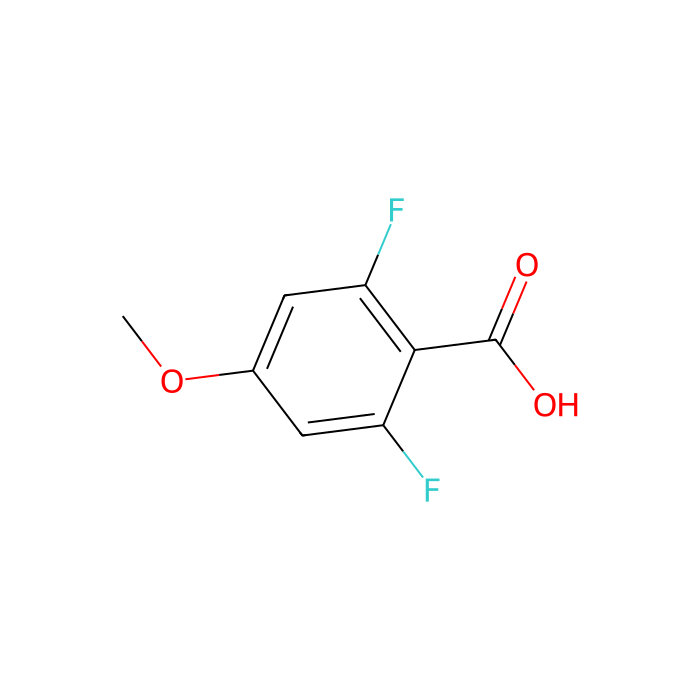
This compound belongs to the class of organic compounds known as p-methoxybenzoic acids and derivatives. These are benzoic acids in which the hydrogen atom at position 4 of the benzene ring is replaced by a methoxy group.
External Descriptors
Not available
1. Djoumbou Feunang Y, Eisner R, Knox C, Chepelev L, Hastings J, Owen G, Fahy E, Steinbeck C, Subramanian S, Bolton E, Greiner R, and Wishart DS. ClassyFire: Automated Chemical Classification With A Comprehensive, Computable Taxonomy. Journal of Cheminformatics, 2016, 8:61.
Determine the necessary mass, volume, or concentration for preparing a solution.
Dilution Calculator
Determine the dilution needed to prepare a stock solution.
Reconstitution Calculator
Recensioni
Recensioni dei clienti
Application Protocols
Not applicable. No biologically validated application protocols (e.g., WB, IHC, IF, FC) are associated with this chemical building block. For synthetic applications, refer to the Reaction Conditions and Synthetic Utility tabs for literature-style procedures and setup guidance.
Biological Roles
This product is a small-molecule aromatic carboxylic acid intended for chemical synthesis. It is not a biological reagent per se.
General context (literature):
Aromatic carboxylic acids can act as weak acids and hydrophobic ligands in biochemical assays, but 2,6-difluoro-4-methoxybenzoic acid is primarily used as a synthetic intermediate rather than a biological modulator.
The methoxy and fluoro substituents modulate lipophilicity and electronic properties of derived amides/esters, which can influence binding in structure–activity studies once transformed into target molecules.
No endogenous role: This fluorinated benzoic acid is not known to occur naturally in metabolism and has no defined physiological role.
Research use note: For research use only. Not for human or animal therapeutic, diagnostic, or food use.
Buffer Applications
Not typically used as a buffering agent. As an aromatic monocarboxylic acid with a pKa in the acidic range (literature, ~3–4 for similar compounds), it lacks the conjugate acid–base pair range and solubility characteristics ideal for laboratory buffers.
Practical note: If used in bioconjugation or labeling workflows, prepare stock solutions in DMSO/DMF and perform amide coupling into amines in buffered aqueous media (e.g., pH 8–9) using water-soluble coupling systems. Otherwise, select established buffers (e.g., acetate, phosphate, Tris) suitable for your pH range.
Green Alternatives
Solvent and reagent choices can materially reduce environmental footprint during transformations of this aromatic acid. Below are greener alternatives and tradeoffs (literature guidance):
Greener solvent choices:
Replace DCM with 2-MeTHF, CPME, or EtOAc for acylations and esterifications when feasible; they offer lower toxicity and better sustainability metrics.
Use ethanol or isopropanol for Fischer esterification instead of less green solvents; apply azeotropic removal of water.
Coupling/activation strategies:
Favor EDC·HCl/HOAt or CDI-mediated amidation in aqueous-compatible media over DCC (reduces urea waste handling). Enzymatic esterifications in solvent-free/green solvents may be explored for simple esters.
For aryl–C–C formation, decarboxylative cross-coupling (Ni/photoredox) can obviate preformed aryl halides, potentially lowering halogenated waste compared to traditional cross-couplings.
Workup and purification:
Employ liquid–liquid extractions with EtOAc or MTBE instead of chlorinated solvents; consider crystallization-driven purifications to minimize silica waste.
Comparison snapshot (general):
DCM vs 2-MeTHF: similar polarity window for many acylations; 2-MeTHF is bio-based and has better EHS profile, but may swell some elastomers and can absorb moisture.
DMF vs Cyrene/PC: Cyrene or propylene carbonate can replace DMF in some couplings; viscosity and solubility constraints may require higher temperature or dilution.
Note: Verify performance equivalence on small scale; maintain product specifications while implementing green substitutions.
Pharmaceutical Uses
Item-specific pharmacopeial/excipient status: Not specified for this item; refer to CoA/Spec Sheet.
General context (non-clinical):
2,6-Difluoro-4-methoxybenzoic acid is commonly employed as a synthetic intermediate to access fluorinated benzamides, esters, and related scaffolds during medicinal chemistry lead discovery and process development.
Its electron-withdrawing difluoro pattern and para-methoxy substituent provide a tunable balance of electronics and lipophilicity when incorporated into API candidates via amide/ester linkages.
Formulation role: Not typically used as an excipient. If carried into salt forms (e.g., sodium/amine salts) for intermediate handling, such salts are process aids rather than final formulation components.
Compliance and documentation: For any use in regulated environments, request detailed impurity profiles, residual solvent data, and trace elements from the batch CoA; establish in-house specifications as appropriate. No therapeutic claims are made; for research and manufacturing development use only.
Physical Properties
Item-specific specifications: Not specified for this item; refer to CoA/Spec Sheet.
Literature/general values (approximate; for reference only):
Physical state: typically a crystalline solid (aromatic carboxylic acids of this class)
Melting point: often in the 150–200 °C range for similar difluoro-methoxy benzoic acids (literature – specific value for this isomer should be confirmed from primary sources)
Boiling point: not practical (decomposes before boiling at atmospheric pressure; literature behavior for benzoic acids)
Solubility: sparingly soluble in water as free acid; soluble in polar organics (MeOH, EtOH, AcOEt/EtOAc, acetone, acetonitrile) and strongly soluble in DMSO/DMF (literature).
Acid dissociation (pKa, CO2H): typically ~3.2–4.2 for substituted benzoic acids; ortho-F substitution tends to lower pKa relative to anisic acid (literature trend; verify experimentally for this isomer).
Partitioning: aryl acids with OMe and F substituents generally exhibit moderate hydrophobicity in the neutral form; ionized form is water-soluble (literature trend).
UV characteristics: aromatic systems absorb in UV; specific ε/λmax not compiled here (literature – method dependent).
Density/refractive index: not commonly reported for solids; not specified.
Practical notes:
The free acid can form water-soluble salts with alkali metals or amines, greatly increasing aqueous solubility for workup or bioconjugation steps (general practice).
Quality and Grades
Item-specific grade/purity: Not specified for this item; refer to CoA/Spec Sheet.
How to interpret grades (general guidance):
Research or synthetic grade indicates suitability for routine organic synthesis; trace metal/UV specifications are typically not controlled unless stated (e.g., HPLC grade, LC–MS grade). For aromatic building blocks, “purity” commonly refers to HPLC/GC area % and/or NMR purity.
If an inhibitor or stabilizer is present, it is explicitly stated on the label/CoA. None is indicated here.
Impurity considerations for this class (general):
Potential related substances include positional isomers, residual anisole derivatives, unreacted precursors, or halogen-exchange byproducts.
Residual solvents/moisture may affect coupling efficiency; dry prior to moisture-sensitive steps.
Recommended verifications on receipt (best practices):
Confirm identity by 1H/13C NMR and HRMS; 19F NMR is highly diagnostic for 2,6-difluoro pattern (two equivalent ortho-F signals or characteristic coupling).
Check purity by HPLC/GC and record MP range for batch tracking.
Documentation: Request the batch-specific CoA and/or Specification Sheet for exact assay, residual solvents, and any controlled impurities.
Reaction and Applications
As a 2,6-difluoro-4-methoxy-substituted benzoic acid, this molecule serves as a versatile aromatic acyl and aryl building block.
Typical uses in synthesis (literature):
Amide formation via carbodiimide (EDC·HCl, DIC) or uronium reagents (HATU, HBTU) to access benzamides bearing the 2,6-difluoro-4-methoxy motif.
Esterification (Fischer, Steglich with DCC/DMAP) to install tailored protecting or functional groups.
Acid chloride formation (SOCl2 or (COCl)2, cat. DMF), enabling Friedel–Crafts acylation or acylations of alcohols/amines.
Decarboxylative cross-coupling: Ni/Cu/photoredox-catalyzed aryl–C(sp2)/C(sp3) bond formation from in situ or pre-formed redox-active esters (e.g., NHPI esters) derived from the acid.
Directed metalation/functionalization: ortho-fluorines modulate acidity and coordination; conversion to amides/esters can enable further electrophilic aromatic substitution or halogen–metal exchange.
Influence of substituents:
2,6-Difluoro substitution deactivates the ring toward electrophilic substitution but enhances chemoselectivity and can stabilize acyl intermediates; para-methoxy can direct reactivity for certain transformations when the carboxyl is derivatized.
Practical tips:
Ensure dryness for coupling/activation steps; residual water lowers yields.
For poorly soluble substrates, form soluble salts (triethylamine, DBU) or use co-solvents (DMSO) before aqueous additions.
19F NMR provides rapid monitoring of conversions; distinct chemical shifts for 2,6-F are useful kinetic probes.
Reaction Conditions
General laboratory conditions reported in the literature for this class of substrates (guidance only; optimize per substrate):
Acid chloride formation:
Reagents: SOCl2 (3–5 eq) or (COCl)2 (2–3 eq), cat. DMF (1–2 drops per 10 mmol).
Solvent: anhydrous DCM or toluene; inert atmosphere.
Temperature/time: reflux 1–3 h (SOCl2) or 0–25 °C to reflux 1–2 h (oxalyl chloride).
Workup: evaporate volatiles under reduced pressure; use immediately or store cold/dry.
Amide coupling (to give benzamides):
HATU (1.1–1.5 eq), DIPEA (2–3 eq), DMF or DCM/DMF, 0–25 °C, 1–16 h; or EDC·HCl (1.2–1.5 eq) with HOAt/HOBt/NHS additives, pH 7–8 for aqueous-compatible protocols.
Esterification:
Steglich: DCC (1.2 eq), DMAP (0.1 eq), DCM, 0 °C to RT, 2–18 h; filter DCU.
Fischer: alcohol solvent, catalytic H2SO4 or p-TsOH, Dean–Stark (if non-aqueous), 60–120 °C.
Redox-active ester formation and decarboxylative couplings:
NHPI (1.1 eq), DIC (1.1 eq), DMAP (0.1 eq), DCM to form RAE; coupling under Ni(II) (5–10 mol%), photoredox catalyst (Ir/Ru organic dye, 0.5–2 mol%), base (e.g., Cs2CO3), blue LEDs, 25–40 °C, 2–12 h (yield and exact conditions substrate-dependent).
Notes:
Ensure complete dissolution (use DMSO or base to form salts if needed) for kinetic reliability.
Monitor by 19F and 1H NMR or LC–MS; fluorine signals facilitate conversion tracking.
Safety and Handling
Item-specific hazard data: Not specified for this item; refer to the SDS for authoritative safety information.
GHS/Classification (from Product Data): Not specified for this item (Signal Word, H-Statements, pictograms not provided). Always consult the SDS prior to use.
General hazards for aromatic carboxylic acids (literature/analog-based):
May cause skin and eye irritation; dust may irritate respiratory tract.
Low volatility; ingestion or prolonged contact may be harmful.
Handling recommendations (general laboratory good practice):
Use in a fume hood to control dust and solvent vapors during reactions or workup.
Wear appropriate PPE: lab coat, safety glasses, and nitrile gloves; consider dust mask if handling powders at scale.
Avoid contact with strong bases (can form salts; exotherm upon neutralization) and strong oxidizers.
During acid chloride formation (if performed), handle thionyl/oxalyl chloride under dry inert conditions with adequate ventilation; quench cautiously.
First-aid overview (general):
Eye/skin contact: rinse with water for ≥15 minutes; remove contaminated clothing. Seek medical attention if irritation persists.
Inhalation: move to fresh air; seek medical advice if symptoms occur.
Ingestion: rinse mouth; do not induce vomiting; seek medical attention.
Storage incompatibilities and stability:
Store away from strong bases, oxidizers, and incompatible reactive acylation reagents.
Protect from moisture when a strictly dry solid is required for coupling chemistry. Defer to SDS for detailed measures.
Solvent Selection
This compound is an aromatic carboxylic acid with moderate hydrophobicity in the neutral form and strong polarity when ionized.
Moderate: dichloromethane, THF, toluene (often requires warming or base to form salt).
Aqueous media: sparingly soluble as free acid; soluble as alkali or amine salts (adjust pH > pKa).
Polarity/dielectric considerations:
For amide couplings, polar aprotic solvents (DMF, NMP, DCM with DMF cosolvent) are common to ensure full dissolution during activation.
For esterifications, toluene, DCM, or 2-MeTHF with azeotropic water removal can be effective.
Choosing among options:
For bioconjugation-like amidations: DMSO or DMF stock solutions, then dilute into aqueous buffers at pH 8–9.
For acid chloride formation: anhydrous DCM or toluene with catalytic DMF under inert atmosphere.
For crystallizations: EtOAc/hexane or toluene/heptane systems often provide good control for aromatic acids.
Small comparison (general):
DMSO/DMF maximize solubility but complicate workup; 2-MeTHF and EtOAc are greener and ease removal; DCM provides rapid kinetics in acylations but has higher environmental burden.
Storage and Reconstitution
Storage (from Product Data): Room temperature. Shipped under normal conditions.
General best practices for this class of solids:
Keep tightly sealed in a dry container; protect from prolonged exposure to moisture and light to maintain assay and handling quality.
For moisture-sensitive transformations, dry the solid under vacuum (e.g., 40–50 °C, several hours) prior to use.
Solution handling (general):
Prepare stock solutions in dry DMSO, DMF, MeOH, or acetonitrile as appropriate for your application. Store aliquots at 2–8 °C or −20 °C to minimize degradation and repeated freeze–thaw; equilibrate to ambient temperature before opening to prevent condensation.
Avoid prolonged storage of acid chlorides or other activated derivatives; generate in situ.
Stability notes:
Aromatic carboxylic acids are generally stable at ambient conditions. No stabilizer is indicated for this item. Always consult the product CoA/SDS for batch-specific guidance.
Research use note: For research use only.
Structure and Identity
A fluorinated anisic-acid derivative useful as an aromatic carboxylic-acid building block.
Substitution pattern: 1-carboxyl, 2,6-difluoro, 4-methoxy (para to carboxyl)
2D description: a benzene ring with a carboxylic acid at C1; fluorine atoms at the two ortho positions (C2 and C6) relative to the acid; a methoxy substituent para to the acid (C4). No stereocenters; planar aromatic system.
General notes:
The 2,6-difluoro motif increases ring deactivation and can influence reactivity (e.g., acylation, cross-coupling after derivatization). The para-methoxy group is electron-donating but its effect is moderated by the ortho fluorines.
Synthetic Utility
This benzoic acid is a multifunctional handle for constructing fluorinated aromatic architectures.
Transformations (literature):
Acyl derivatives: Convert to acid chlorides/anhydrides for rapid acylation of nucleophiles; use SOCl2/(COCl)2 with catalytic DMF under inert atmosphere.
Amide couplings: HATU/DIPEA, EDC·HCl/NHS (or HOAt) enable coupling to amines, including hindered and aniline substrates.
Esterifications: Steglich (DCC/DMAP), Fischer (alcohol + acid, acid catalysis), Mitsunobu (for inversion at alcohol centers via the acid as nucleophile).
Late-stage modification: The aryl C–F bonds can participate in SNAr when activated (e.g., with strong nucleophiles under polar aprotic solvents) or serve as handles for metal-catalyzed defluorinative functionalization under specialized conditions.
Retrosynthetic value:
Provides access to the 2,6-difluoro-4-methoxybenzoyl motif, which is difficult to introduce regioselectively via direct electrophilic substitution on anisole derivatives.
Selectivity/electronics:
The para-OMe donates electron density while 2,6-F substituents withdraw and impose steric hindrance, collectively shaping regioselectivity and reactivity across downstream transformations.
Target Specificity
Not applicable. This product is a small-molecule chemical building block, not a biological targeting reagent (e.g., antibody, enzyme, or ligand with defined biological target). No antigen, epitope, or species reactivity data are associated with this item.
Domande frequenti
What is the purity of this product?
This product is supplied at ≥97% purity (chemical assay). Lot-specific values are stated on the Certificate of Analysis.
How should this product be stored?
Store at room temperature.
How is this product shipped?
This product ships under standard ambient conditions. No temperature-controlled packaging is required.
What are the CAS number, molecular formula and molecular weight?
The CAS Number is 123843-65-2, the molecular formula is C8H6F2O3, and the molecular weight is 188.13 g/mol. InChIKey LGHVYSAINQRZJQ-UHFFFAOYSA-N.
What documentation is provided?
Available product documentation, including Certificates of Analysis (COA), Safety Data Sheets (SDS), and specification sheets, is shown in the product document area. Document availability and access follow the current site policy.
Utilizziamo i cookie per garantire il corretto funzionamento del sito web e, ove consentito, per migliorare la tua esperienza. Puoi gestire le tue preferenze in qualsiasi momento nelle Impostazioni. Per saperne di più, consulta la nostra Cookie Policy.
Desidera che le inviamo un messaggio quando avremo sconti disponibili?
Ricordamelo più tardi
Grazie! Controlli la sua casella di posta per confermare.
Products are supplied to verified businesses, institutions, and qualified professionals for research and development use only. Not for use in humans, animals, diagnosis, or therapy.

 C2612170