This compound belongs to the class of organic compounds known as phenanthraquinones. These are phenanthrene derivatives containing two ketone groups at position C9 and C10, respectively.
External Descriptors
Not available
1. Djoumbou Feunang Y, Eisner R, Knox C, Chepelev L, Hastings J, Owen G, Fahy E, Steinbeck C, Subramanian S, Bolton E, Greiner R, and Wishart DS. ClassyFire: Automated Chemical Classification With A Comprehensive, Computable Taxonomy. Journal of Cheminformatics, 2016, 8:61.
Determine the necessary mass, volume, or concentration for preparing a solution.
Dilution Calculator
Determine the dilution needed to prepare a stock solution.
Reconstitution Calculator
Recensioni
Recensioni dei clienti
Application Protocols
Not applicable. No validated bioassay protocols (e.g., WB, IHC, IF, FC) or analytical application methods are provided for this small-molecule building block.
General synthetic workflow suggestion (literature; not item-specific):
Conduct a solubility screen (CH2Cl2, toluene, DMF) to choose medium.
Set up Pd-catalyzed cross-coupling under inert gas with degassed solvent and chosen base; monitor by TLC/HPLC.
Purify by recrystallization or flash chromatography using neutral conditions; confirm by NMR/HRMS.
Consult primary literature and your lab’s SOPs for detailed, reaction-specific protocols.
Biological Roles
This compound is a synthetic, halogenated polycyclic quinone designed as a building block for materials and organic synthesis. It is not a metabolite or a common biochemical cofactor.
Not typically associated with natural biological roles. Quinones in biology (general context; literature) include ubiquinone, plastoquinone, and menadione, which participate in electron transport and redox cycling. The current compound differs substantially in size, halogenation, and hydrophobicity, and is not known to be part of endogenous pathways.
Potential interactions (general, not item-specific):
Quinone motifs can act as Michael acceptors toward nucleophilic residues in proteins (e.g., cysteine, lysine) and can redox cycle under certain conditions to generate ROS. Such behavior is context-dependent and is discussed here solely to inform laboratory handling and experimental design in chemical biology assays.
Research positioning:
Primarily relevant to materials chemistry, photophysics, and synthetic methodology rather than to biochemistry or cell biology.
No biological activity claims are made. Use is strictly for research and laboratory investigations.
Buffer Applications
Not typically applicable. As a hydrophobic, non-ionic aromatic solid, this compound is not used to prepare aqueous buffer systems.
If working in bioconjugation or chemical biology contexts, dissolution is generally in DMSO/DMF prior to dilution into assay media, with attention to final solvent percentages to avoid precipitation.
For aqueous buffer choices related to other components in your workflow, consult standard buffer references (PBS, HEPES, Tris) appropriate to the biomolecular system under study.
Green Alternatives
While the substrate itself is a brominated PAH quinone (intrinsically non-benign), greener choices can be made around solvents, catalysts, and process design.
Replace CH2Cl2/CHCl3 with ethyl acetate, 2-MeTHF, or anisole where solubility and reactivity allow.
For high-temperature couplings, consider anisole or propyl acetate over chlorobenzene/o-DCB when feasible.
For Suzuki couplings, water/EtOH/2-MeTHF mixtures can perform comparably to dioxane/toluene systems.
Catalysis and bases:
Employ ligand-efficient Pd systems (e.g., XPhos/SPhos) at ppm–low mol% loading; explore Ni-catalyzed cross-coupling with aryl bromides to reduce precious metal usage.
Choose milder, safer bases (e.g., K2CO3, K3PO4) over strong alkoxides when possible.
Workup and purification:
Favor aqueous micellar catalysis or solvent-minimized protocols; use column-free crystallizations from greener solvents.
Implement metal scavengers to reduce heavy-metal waste in downstream steps.
Trade-offs (balanced view):
Greener solvents may reduce solubility of this hydrophobic substrate, requiring higher temperatures or longer times.
Ni catalysis can be more substrate-sensitive than Pd, potentially lowering yields or necessitating tailored ligands.
Comparison snapshot (literature):
Chlorobenzene vs anisole: anisole offers better EHS profile but may require higher temperatures for equivalent rates.
Dioxane vs 2-MeTHF: 2-MeTHF is bio-derived and less problematic; water content control is more critical for reproducibility.
Pharmaceutical Uses
No pharmacopeial status or excipient role is indicated for this item.
Item-specific status: Not specified for this item; refer to CoA/Spec Sheet.
General note (non-clinical): Halogenated polycyclic quinones like this are primarily synthetic intermediates and materials precursors, not pharmaceutical actives or excipients. They may be employed in discovery-stage chemistry to build scaffolds for structure–property investigations in materials or as photoactive motifs in research tools.
No therapeutic or clinical claims are made. For GMP or regulatory applications, separate qualification and sourcing would be required.
Physical Properties
Item-specific properties (Product Data):
Appearance: Not specified for this item; refer to CoA/Spec Sheet.
Storage conditions: Room temperature (per Product Data)
Other specifications (mp, bp, density, solubility, refractive index, UV cutoff, water/peroxide/metal content): Not specified for this item; refer to CoA/Spec Sheet.
Literature/general expectations for class context (not item specifications):
Quinone polycyclic aromatics of this size are typically crystalline solids with high melting points (often >200 °C). Substitution with bromine frequently increases crystallinity and thermal stability.
Volatility: Negligible; high-boiling, decomposition may precede boiling under ambient pressure.
Solubility: Quinones are generally sparingly soluble in water and are soluble in chlorinated solvents (CH2Cl2, CHCl3), aromatics (toluene, chlorobenzene), and polar aprotic media (DMF, DMSO, NMP).
Polarity/logP: Aromatic quinones are relatively hydrophobic; heavy-atom substitution (Br) further increases logP.
Redox behavior: Quinones display reversible/irreversible redox couples to semiquinone/hydroquinone states (observable by cyclic voltammetry in aprotic electrolytes). Substituents and conjugation modulate E1/2.
Spectroscopy: Conjugated quinones show strong visible absorption (yellow–orange solids are common) with n→π* and π→π* bands; aryl bromides show characteristic C–Br stretches in IR (~500–700 cm−1).
These literature notes are provided to aid planning; consult the item’s CoA/SDS for definitive specifications and handling parameters.
Quality and Grades
Item-specific grade/purity: Not specified for this item; refer to CoA/Spec Sheet.
Interpreting grades (general guidance for synthetic building blocks; not item-specific):
Reagent grade: suitable for most organic transformations; may contain trace inorganic/organic impurities.
98–99% purity (typical for aryl halide building blocks) supports cross-coupling and materials synthesis with minimal background. When required for device-grade applications (e.g., OFETs/OPVs), sublimation-grade purification or HPLC trace-metal screening can be important.
Trace metals/peroxides/water: Not typically specified for solids like this, but residual Pd/Cu (from upstream synthesis) can affect downstream catalysis or device performance. Request ICP-MS data if critical.
Stabilizers/inhibitors:
Quinone solids generally do not require added stabilizers. If present (rare), they should be disclosed on the CoA. For sensitive electronic applications, avoid stabilizers and verify by NMR/HRMS before use.
What to check on receipt:
Confirm identity (1H/13C NMR in CDCl3 or DMSO-d6; HRMS for isotopic Br pattern), purity (HPLC/GC if applicable), appearance, and water content by Karl Fischer if moisture-sensitive steps follow.
For specific release criteria and acceptance limits, consult the product’s CoA/Spec Sheet.
Reaction and Applications
Core reactivity (literature; not item-specific performance claims):
The molecule presents two electrophilic aryl bromides (C–Br) at the 2,7-positions suited for Pd-catalyzed cross-coupling (Suzuki–Miyaura, Stille, Negishi, Kumada) enabling symmetric or unsymmetric 2,7-disubstitution.
The 9,10-quinone is a conjugated Michael acceptor that can participate in nucleophilic additions (e.g., amines, thiols) and cycloadditions (e.g., Diels–Alder), though conditions must avoid undesired reduction to hydroquinone.
Representative application spaces:
Organic electronic materials: Construction of donor–acceptor small molecules/polymers (2,7-linkages provide extended conjugation and planar backbones). Post-coupling oxidation or reduction toggles electronic character.
Ligand/scaffold design: Introduction of aryl/heteroaryl substituents at 2,7 allows tuning of LUMO levels and packing, relevant to n-type semiconductors and photoredox antennae.
Photochemistry/redox: Quinone cores serve as electron acceptors; the dibromo handle permits installation of chromophores or charge-transport units for studies in photoinduced electron transfer.
Practical considerations:
Use anhydrous, degassed solvents; oxygen and moisture can affect Pd-catalyzed couplings and quinone redox.
Bases for Suzuki (K2CO3, Cs2CO3) should be matched to solvent; water content assists boronic acid activation but excessive water can reduce solubility.
For sensitive downstream applications, minimize residual Pd/Cu by scavenging (silica–thiol, SiliCycle) and/or recrystallization.
Late-stage diversification:
Orthogonal reactivity enables stepwise strategies: first cross-couple one bromide (via steric/kinetic control), then selectively manipulate the quinone (e.g., protect/reduce/re-oxidize) to elaborate the core.
Reaction Conditions
General guidance from literature for aryl bromide couplings and quinone manipulations (not item-specific specifications):
Base: K2CO3 or Cs2CO3 (2–3 equiv); aqueous component (H2O or EtOH/H2O) assists transmetalation.
Solvent: toluene, dioxane, anisole, or 2-MeTHF; add H2O (10–30%) as needed.
Temperature/time: 80–110 °C, 6–24 h; higher T (120–140 °C) in chlorobenzene/o-DCB for low-solubility systems.
Stille/Negishi/Kumada:
Catalyst: Pd(PPh3)4 or PdCl2(dppf)·DCM (1–5 mol%).
Solvent: toluene or DMF; inert atmosphere.
Notes: Organostannanes/organomagnesiums are moisture-sensitive; quinone carbonyls generally tolerate but monitor for side additions.
Buchwald–Hartwig amination (C–N):
Catalyst/ligand: Pd2(dba)3 (1 mol%) + BINAP/XantPhos (2–3 mol%) or precatalysts.
Base: NaOtBu or K3PO4.
Solvent: toluene or dioxane; 90–120 °C.
Quinone transformations:
Reduction: Na2S2O4 (aq/organic biphasic) or SnCl2/HCl (chemoselective) to hydroquinone; re-oxidation with DDQ, Ag2O, or air (Cu-catalyzed) to restore quinone.
Diels–Alder: dienes in toluene/xylene; 80–140 °C; adduct aromatization possible with oxidants.
Workup/purification:
Avoid silica with basic eluents after couplings (risk of quinone reduction). Use neutral alumina or quick silica passes; recrystallize from toluene/chlorobenzene or anisole.
Adjust conditions based on coupling partner electronics/sterics and solubility constraints.
Safety and Handling
Item-specific hazard data (GHS, signal word, H-statements, pictograms): Not specified for this item; refer to SDS.
General safety considerations for halogenated quinones (literature; not item-specific):
May cause skin/eye irritation and respiratory irritation; quinones can be sensitizers in some cases due to Michael-acceptor reactivity.
Quinones can engage in redox cycling, potentially generating reactive oxygen species under certain conditions; avoid contact with strong reducing agents unless intended.
Avoid incompatible materials: strong bases (risk of nucleophilic addition), strong reducing agents (e.g., hydrides, metals in protic media), and strong oxidizers (uncontrolled reactions).
Light and air: many quinones are photoactive; minimize prolonged light exposure to avoid unintended photoreactions. Work under ambient light is typically acceptable, but store in amber containers when feasible.
Recommended PPE and engineering controls (good laboratory practice):
Nitrile gloves, lab coat, splash goggles; handle powders in a fume hood to avoid dust inhalation.
Use dedicated weigh boats/spatulas to prevent cross-contamination; promptly clean spills with inert absorbent.
First aid (general guidance; defer to SDS):
Eye/skin contact: rinse with water for ≥15 min; remove contaminated clothing.
Inhalation: move to fresh air; seek medical attention if symptoms persist.
Ingestion: rinse mouth; do not induce vomiting; seek medical advice.
Always consult the product-specific SDS for authoritative hazard classifications and response procedures.
Solvent Selection
This compound is a non-ionic, halogenated, polycyclic quinone solid. Solvent choice is driven by solubility, process safety, and compatibility with the intended transformation (e.g., cross-coupling).
Polarity/solubility profile (literature trends; not item-specific specs):
Good solubility: chlorinated solvents (CH2Cl2, CHCl3), aromatics (toluene, chlorobenzene, o-dichlorobenzene), and polar aprotics (DMF, DMAc, DMSO, NMP).
Poor solubility: water and very nonpolar alkanes (hexanes) unless heated or mixed with aromatic co-solvents.
Typical selection by application:
Suzuki/Stille/Negishi: toluene, dioxane, or anisole; often with water/EtOH co-solvent for Suzuki. For challenging solubility, chlorobenzene or o-DCB at elevated temperatures (120–160 °C) are common in materials synthesis.
Buchwald–Hartwig amination: toluene, xylene, or dioxane; stronger bases (NaOtBu) tolerate these media.
Nucleophilic additions to the quinone: employ polar aprotic (DMF/DMSO) to stabilize anionic intermediates; control temperature to limit over-reaction to hydroquinones.
Practical tips:
Begin with ~10–20 mg/mL solubility screens in CH2Cl2, toluene, and DMF at RT and 60–80 °C.
For device-scale crystallization, hot chlorobenzene or anisole often affords well-formed crystals with minimized defects.
Brief comparison (literature):
CH2Cl2: excellent solubility, low bp, but poor EHS profile.
Toluene: safer profile; moderate solubility; amenable to Pd-catalysis.
Chlorobenzene/o-DCB: higher bp; good for high-T couplings on poorly soluble PAHs.
Additional handling guidance (general best practice for quinone PAH solids; not item-specific specifications):
Store in a tightly closed, inert-container (glass) under dry conditions. Consider amber glass or dark storage to minimize light exposure.
If long-term storage is planned, keep in a desiccator or with desiccant; avoid prolonged exposure to humid air to prevent surface reduction or aggregation.
No reconstitution is required for the solid. For stock solutions, prepare in dry CH2Cl2, toluene, DMF, or DMSO; filter if necessary through a PTFE membrane. Label solutions with solvent, concentration, and date; store at RT or 2–8 °C depending on solvent stability and lab SOPs.
Stability notes (general):
Quinones are generally chemically robust but may undergo slow redox changes with contaminants. Avoid contact with reactive metals or strong reducing agents during storage.
Always refer to the product’s CoA and SDS for definitive storage and handling instructions.
Structure and Identity
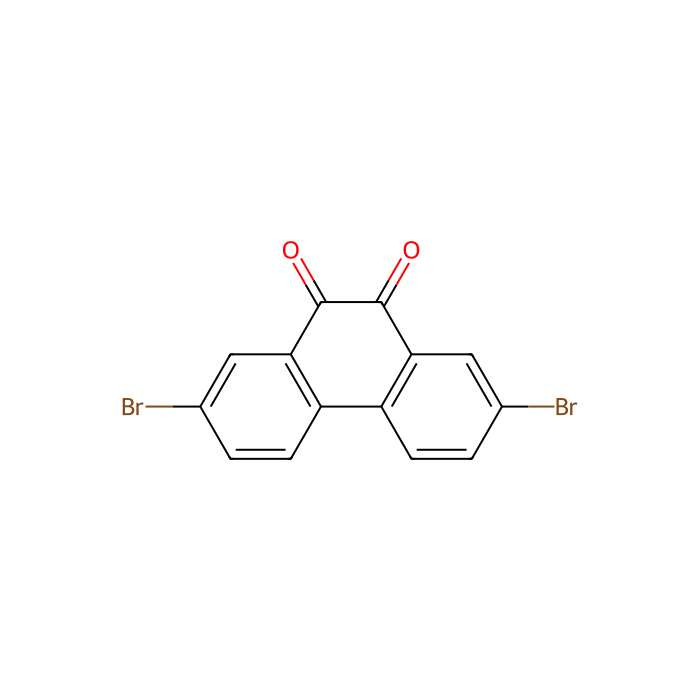
A dibrominated phenanthrenequinone building block featuring two peri carbonyls and two aryl bromides positioned for cross-coupling and late-stage diversification.
Item-specific identifiers (from Product Data):
CAS: 84405-44-7
SKU: D154583
InChIKey: 209116 (as provided)
SMILES: Not specified for this item; refer to CoA/Spec Sheet.
Molecular formula: Not specified for this item; refer to CoA/Spec Sheet.
Molecular weight: Not specified for this item; refer to CoA/Spec Sheet.
Literature/computed identity (for reference; not item specifications):
Expected formula for 2,7-dibromophenanthrene-9,10-dione: C14H6Br2O2 (computed from name)
Structural features: phenanthrene-9,10-dione (quinone) core with two carbonyl (C=O) groups at C9/C10; aryl bromides at C2 and C7; fully aromatic, planar PAH scaffold.
2D structure (described): three linearly fused benzene rings (phenanthrene). The central ring bears a para-quinone motif (two opposing carbonyls replacing the 9 and 10 positions). The outer rings carry bromine substituents at positions 2 and 7, roughly symmetrically disposed across the long axis of the molecule; no stereocenters present; conjugated π-system extending across the framework.
Synthetic Utility
This reagent integrates two orthogonal reactive elements enabling diversified synthesis:
2,7‑Aryl bromides (C–Br):
Ideal for Pd- or Ni-catalyzed cross-coupling (Suzuki, Stille, Negishi, Kumada, Sonogashira after bromide activation). The symmetrical 2,7-disposition allows construction of linear, extended π-systems; unsymmetrical substitution achievable via sequential coupling with differential reactivity.
Post-coupling intramolecular cyclizations or Scholl reactions can further annulate the framework to nanographenes.
9,10‑Quinone (1,4-diketone on central ring):
Functions as a Michael acceptor; amenable to nucleophilic additions (e.g., amines, thiols, enolates) giving hydroquinone adducts after reduction.
Can be chemoselectively reduced (Na2S2O4, SnCl2, or catalytic hydrogenation) to the corresponding hydroquinone, enabling redox toggling strategies; re-oxidation with Ag2O, DDQ, or air/O2 (with catalyst) reinstates the quinone.
Participates in [4+2] cycloadditions with dienes, expanding structural diversity.
Retrosynthetic value:
Serves as a convergent core scaffold for donor–acceptor oligomers/polymers via twofold coupling.
The bromides permit late-stage installation of solubilizing groups (alkyl/alkoxy aryls), heteroaryl acceptors/donors, or functional handles (boronates, stannanes for iterative couplings).
Practical notes:
Protect or temporarily reduce the quinone if conditions risk side reactions (e.g., strong nucleophiles/bases at high T).
Verify halogen content by HRMS (isotopic pattern) and monitor couplings by HPLC/UPLC with UV–Vis, leveraging the quinone’s strong absorption.
Target Specificity
Not applicable. This product is a small-molecule synthetic building block and does not have biological target specificity, antigen recognition, clone, isotype, or species reactivity. No application-specific binding data are provided.
Domande frequenti
What is the purity of this product?
This product is supplied at ≥97% purity (chemical assay). Lot-specific values are stated on the Certificate of Analysis.
How should this product be stored?
Store at room temperature.
How is this product shipped?
This product ships under standard ambient conditions. No temperature-controlled packaging is required.
What are the CAS number, molecular formula and molecular weight?
The CAS Number is 84405-44-7, the molecular formula is C14H6Br2O2, and the molecular weight is 366.01 g/mol. InChIKey LTZIIBSPYWTOQV-UHFFFAOYSA-N.
What documentation is provided?
Available product documentation, including Certificates of Analysis (COA), Safety Data Sheets (SDS), and specification sheets, is shown in the product document area. Document availability and access follow the current site policy.
Utilizziamo i cookie per garantire il corretto funzionamento del sito web e, ove consentito, per migliorare la tua esperienza. Puoi gestire le tue preferenze in qualsiasi momento nelle Impostazioni. Per saperne di più, consulta la nostra Cookie Policy.
Desidera che le inviamo un messaggio quando avremo sconti disponibili?
Ricordamelo più tardi
Grazie! Controlli la sua casella di posta per confermare.
Products are supplied to verified businesses, institutions, and qualified professionals for research and development use only. Not for use in humans, animals, diagnosis, or therapy.

 J2621009