This compound belongs to the class of organic compounds known as alkyl-phenylketones. These are aromatic compounds containing a ketone substituted by one alkyl group, and a phenyl group.
External Descriptors
Not available
1. Djoumbou Feunang Y, Eisner R, Knox C, Chepelev L, Hastings J, Owen G, Fahy E, Steinbeck C, Subramanian S, Bolton E, Greiner R, and Wishart DS. ClassyFire: Automated Chemical Classification With A Comprehensive, Computable Taxonomy. Journal of Cheminformatics, 2016, 8:61.
Determine the necessary mass, volume, or concentration for preparing a solution.
Dilution Calculator
Determine the dilution needed to prepare a stock solution.
Reconstitution Calculator
Recensioni
Recensioni dei clienti
Application Protocols
Not applicable. No immunoassay or cell-based application protocols (e.g., WB, IHC, IF, FC) are associated with this small-molecule reagent. For synthetic or analytical workflows, refer to the Reaction & Applications and Reaction Conditions sections for general literature guidance.
Biological Roles
This catalog item is intended strictly for research use; no clinical or diagnostic claims are made.
Structural motif: o-Aminoaryl ketones appear in numerous bioactive scaffolds (e.g., quinazolinones, benzimidazoles), serving as key intermediates during medicinal chemistry campaigns.
Metabolite note: 2-Aminoacetophenone (the free base corresponding to this salt) has been reported in the literature as a microbial volatile/secondary metabolite and as a flavor-impact compound in certain fermented systems; such roles are contextual and matrix-dependent.
Reactivity in bioconjugation: The anilinium salt can be deprotonated to reveal an aniline nucleophile, which in principle may participate in acylations or imine formations in bioconjugation model studies; however, selectivity and reaction rates are typically inferior to aliphatic amines (literature generalization).
Caveat: Any biological assay use should be performed under appropriate approvals and controls. Consult the SDS and institutional biosafety guidelines for handling, and do not infer biological safety or efficacy from the chemical’s presence in natural systems.
Buffer Applications
This compound is not a conventional buffering agent. As an anilinium hydrochloride salt, it does not provide a well-defined, high-capacity buffering range suitable for biochemical buffers.
Practical notes (general)
pH control: If used in aqueous systems, the salt will contribute acidity consistent with anilinium ions, but buffering capacity is low and not recommended for pH control.
Recommendation: Use established buffer systems (e.g., phosphate, HEPES, acetate, Tris) for controlled pH environments. This product is better suited as a synthetic intermediate rather than as a buffer component.
Green Alternatives
Considerations: While the substrate is a solid salt, the environmental footprint is driven largely by solvent and reagent choices in downstream reactions.
Greener choices (literature/guidance)
Solvent selection:
Prefer water, ethanol, or isopropanol when the salt’s high polarity can be leveraged.
For aprotic needs, dimethyl carbonate (DMC), propylene carbonate (PC), or 2-MeTHF can replace chlorinated and petroleum ether solvents in certain steps (after converting to the free base for organic solubility).
Avoid chlorinated solvents (DCM, chloroform) when feasible; replace with EtOAc or CPME for extractions.
Catalysis and energy:
Use acid solid catalysts (e.g., Amberlyst, Nafion) for condensations to enable easier workup and recycling.
Microwave or flow chemistry can reduce reaction time/energy use for heterocyclizations (case-dependent).
Reagent economy:
Reductive cyclizations with transfer hydrogenation (e.g., HCO2H/Et3N) instead of metal hydrides where applicable.
Illustrative comparison (general)
DCM extraction of free base vs. EtOAc: EtOAc typically offers lower toxicity and easier disposal, with similar partitioning once basified.
Lewis acids: Replace AlCl3 with Zn(OTf)2 or organic acids when compatible to reduce corrosive waste.
Note: Always validate green substitutions with small-scale trials to confirm selectivity and yield.
Pharmaceutical Uses
No therapeutic or clinical uses are claimed for this product; it is for research use only.
General/literature formulation context
Intermediate: 2-Aminoacetophenone derivatives are frequently employed as intermediates en route to heterocyclic scaffolds in medicinal chemistry programs (e.g., quinazolinones, benzimidazoles). The hydrochloride salt is preferred for ease of handling, dosing accuracy, and improved aqueous solubility during process development.
Salt handling: The HCl salt can reduce volatility and odor vs. the free base and often crystallizes well, facilitating purification and solid-form screening.
Specifications: For any GMP-relevant development work, define assay, chloride content, water (KF), residual solvents, and polymorph/hydrate state. None of these parameters are specified for this catalog item; consult the CoA if needed.
Note: Any use in pharmaceutical manufacturing must follow applicable regulations and is outside the scope of this research-grade listing.
Physical Properties
Item-specific values
Appearance: Not specified for this item; refer to CoA/Spec Sheet.
Molecular formula: Not specified for this item; refer to CoA/Spec Sheet. (Literature for the HCl salt: C8H10ClNO.)
Molecular weight: Not specified for this item; refer to CoA/Spec Sheet. (Literature for the HCl salt: ~171.62 g/mol.)
General/literature physical behavior for the hydrochloride salt of 2-aminoacetophenone
Physical state: Typically a crystalline solid (literature, salt form).
Melting point: Reported for the hydrochloride salt in the literature; exact value varies by source and hydration state. Not specified for this item; refer to CoA/Spec Sheet.
Boiling point: Not applicable for ionic salts prior to decomposition (literature note).
Density: Not specified for this item; refer to CoA/Spec Sheet.
Solubility: Expected to be highly soluble in water and polar protic solvents (e.g., ethanol, methanol) due to salt character; limited solubility in nonpolar solvents (literature).
pKa: The conjugate acid (anilinium) is present; deprotonation restores the aniline (literature). Specific pKa values are context-dependent and not specified here.
LogP/partitioning: Salt form displays low apparent logP and favors aqueous phases (literature trend for anilinium hydrochlorides).
UV-Vis: Aryl ketones show π→π* absorption in the UV; anilinium protonation shifts spectra (literature). No item-specific UV cutoff is provided.
Note: All numeric specifications for this catalog item should be confirmed against the item’s CoA/Spec Sheet.
Quality and Grades
Item-specific grade/purity: Not specified for this item; refer to CoA/Spec Sheet.
Context and guidance (general)
Grade meaning: When provided, research or analytical grades indicate suitability for general laboratory use, with impurity profiles appropriate to synthesis and routine analysis. HPLC grade (when applicable to solvents) emphasizes low UV absorbance; for solids, “≥98%” or higher denotes assay by a defined method (e.g., HPLC/GC/NMR).
Identity confirmation: Typical methods include 1H/13C NMR, IR (carbonyl ~1680–1700 cm−1 for aryl ketone, literature), MS, and melting range. Chloride can be verified by ion chromatography or argentometric titration.
Impurities to consider (literature): Free base (amine) vs. salt ratio, over-acylated or oxidized species, hydrolysis products, inorganic chloride content, residual solvents/water of crystallization.
Stabilizers: None are generally required for this class of solid; if present, they will be listed on the CoA.
Batch-specific documentation: Request CoA for assay (%), identification tests, residual solvent (ICH), water (Karl Fischer), and heavy metals if relevant to your application.
Recommendation: For sensitive syntheses (e.g., heterocycle formation, metal-catalyzed couplings post-derivatization), verify assay and counterion content to ensure stoichiometric accuracy.
Reaction and Applications
Scope: 2-Aminoacetophenone hydrochloride serves as a robust, storable precursor to o-aminoacetophenone for synthesis. The ortho relationship of an aniline and aryl ketone enables diverse transformations.
Representative application families (literature)
Heterocycle synthesis: Key building block for quinazolin-4-ones/quinazolines via condensation with formamides/formic acid derivatives or amidines; benzimidazoles and benzoxazoles through condensations with diamines/diols under dehydrating conditions; indazoles via hydrazine-mediated cyclizations with the acetyl group.
Imine/Schiff base formation: Condensation of the aniline with aldehydes/ketones to form imines/Schiff bases, useful as ligands or intermediates.
Enamine/oxime chemistry at the acetyl: Oxime formation with hydroxylamine; enamine formation under secondary amine catalysis.
Reductive amination and acyl transfer: Aniline can be acylated/carbamoylated; the aryl ketone reduced to secondary alcohols (e.g., NaBH4) with orthogonal protection strategies.
Electrophilic substitution on the ring: Directed ortho/para substitution leveraging the anilide (after protection) for halogenation, sulfonylation, and metalation.
Practical tips (literature)
Using the salt: Convert to free base prior to nucleophilic reactions at nitrogen by basification (pH >9) and extraction. Keep temperatures moderate during neutralization to avoid side reactions.
Drying: If water-sensitive steps follow, dry the free base over molecular sieves or by azeotrope.
Catalysis: Lewis acids (e.g., ZnCl2, BF3·OEt2) can activate the ketone toward cyclizations; Brønsted acids (p-TsOH) promote dehydrative ring closures.
Reaction Conditions
The following are general literature-guided conditions for common transformations of o-aminoacetophenone (obtained from its hydrochloride salt). They are not item-specific specifications.
Quinazolin-4-one formation
Typical conditions: 2-aminoacetophenone with formamide or ammonium formate/DMF in the presence of an acid or Lewis acid (e.g., POCl3, ZnCl2, or p-TsOH), 80–140°C, 2–16 h.
Notes: Dehydrate under azeotropic removal (toluene or xylene) or employ microwave heating to shorten times.
Indazole synthesis
Conditions: Condense with hydrazine hydrate or substituted hydrazines, catalytic acid (AcOH or HCl), 60–120°C, 2–12 h.
Notes: Oxime formation may precede cyclization; control stoichiometry to avoid bis-addition.
Oxime formation/reduction
Conditions: Hydroxylamine hydrochloride, base (pyridine or NaOAc), EtOH/H2O, 25–80°C, 1–6 h; subsequent reduction with NaBH4 or catalytic hydrogenation (Pd/C) at ambient pressure/temperature.
N-acylation/N-sulfonylation
Conditions: Acyl/sulfonyl chloride, base (Et3N, pyridine), DCM or EtOAc, 0–25°C, 0.5–4 h.
Reduction of the ketone
Conditions: NaBH4 in MeOH/EtOH at 0–25°C, 0.5–2 h to afford benzylic alcohols.
General tips
Convert from HCl salt to free base prior to reactions needing the amine’s nucleophilicity.
Use anhydrous conditions where Lewis acids are involved; quench cautiously.
Monitor by TLC/HPLC; typical isolated yields vary widely (40–90%) depending on substitution/catalysis (literature range).
Safety and Handling
Authoritative safety data must be taken from the SDS for this exact product/lot.
Item-specific hazard information from Product Data
Signal word: Not specified for this item; refer to SDS.
H-statements: Not specified for this item; refer to SDS.
GHS classification: Not specified for this item; refer to SDS.
Pictograms: Not specified for this item; refer to SDS.
General safety guidance for aromatic amine hydrochloride salts (literature/typical practice)
Likely hazards: Eye/skin/respiratory irritation are common concerns with amine salts; aryl ketones may also cause irritation. Avoid dust generation and inhalation.
PPE: Laboratory coat, safety glasses/goggles, appropriate chemical-resistant gloves (e.g., nitrile), and use of a fume hood for weighing/handling powders.
Handling: Minimize dust; avoid contact with bases that could liberate the free amine as vapors or aerosols. Keep containers tightly closed.
Incompatibilities: Strong bases (will deprotonate the anilinium), strong oxidizers (general precaution for aromatic amines), and strong reducing agents (literature cautions). Avoid moisture ingress if a specific hydration state is required for your application.
First aid (overview; consult SDS): Rinse eyes/skin with water for several minutes; remove contaminated clothing; move to fresh air if inhaled; seek medical attention if symptoms persist.
Spill response: Avoid dust, collect with inert absorbent, dispose per institutional and regulatory requirements.
Always defer to the SDS for definitive classification, exposure limits, and emergency procedures for this specific SKU.
Solvent Selection
Relevance: This product is a polar ionic organic salt. Solvent choice is driven by desired speciation (salt vs. free base) and reaction requirements.
General/literature guidance
Polarity/miscibility: The hydrochloride salt is typically highly soluble in water and polar protic solvents (methanol, ethanol). Solubility in polar aprotics (DMF, DMSO) is also generally good. It is poorly soluble in nonpolar solvents (hexanes, toluene) in the salt form.
Switching to free base: For nonpolar organic media, generate the free base in situ by basification (e.g., aqueous NaHCO3/Na2CO3) and extract into an organic solvent (EtOAc, DCM). Dry and use immediately if air-/base-sensitive downstream.
Spectroscopy/analysis: For NMR, DMSO-d6 or D2O (salt) are common; for free base, CDCl3 may be suitable (literature practice).
When to choose water vs. alcohols: Use water when performing salt metathesis or bioconjugation-compatible steps; use ethanol/methanol when crystallization or faster dissolution is desired.
Acid–base control: Maintain mildly acidic conditions to keep the substrate in its salt form (enhances aqueous solubility, reduces volatility). For nucleophilic reactions requiring the amine, adjust to neutral/free-base conditions.
Comparison (literature trends)
Salt form: maximum aqueous solubility, minimal volatility, easy weighing.
Free base: better solubility in common organic solvents, higher nucleophilicity, compatible with base-mediated steps.
Storage and Reconstitution
Item-specific logistics (from Product Data)
Storage conditions: Room temperature.
Shipped in: Normal.
Research use: For research use only.
General handling guidance (literature/good practice)
Container: Store tightly closed in a dry place away from incompatible materials (strong bases, strong oxidizers). Protect from excessive humidity to maintain defined salt/hydrate state.
Stability: The hydrochloride salt is typically more stable and less volatile than the free base. For long-term storage, maintain at room temperature in desiccated conditions.
Reconstitution/dissolution: The salt generally dissolves readily in water, methanol, ethanol, and DMSO (literature). If organic-solvent solubility is required and poor, convert to the free base by basification and extract into an organic solvent (e.g., EtOAc, DCM), then dry thoroughly before use.
Freeze–thaw: Not typically relevant for a dry solid. If stored as a solution, avoid repeated freeze–thaw; prepare single-use aliquots as needed.
Labeling: Record date opened and lot number; reference the CoA for any batch-specific water content or assay if stoichiometry is critical.
Always consult the product’s CoA and SDS for definitive storage constraints and solution stability data.
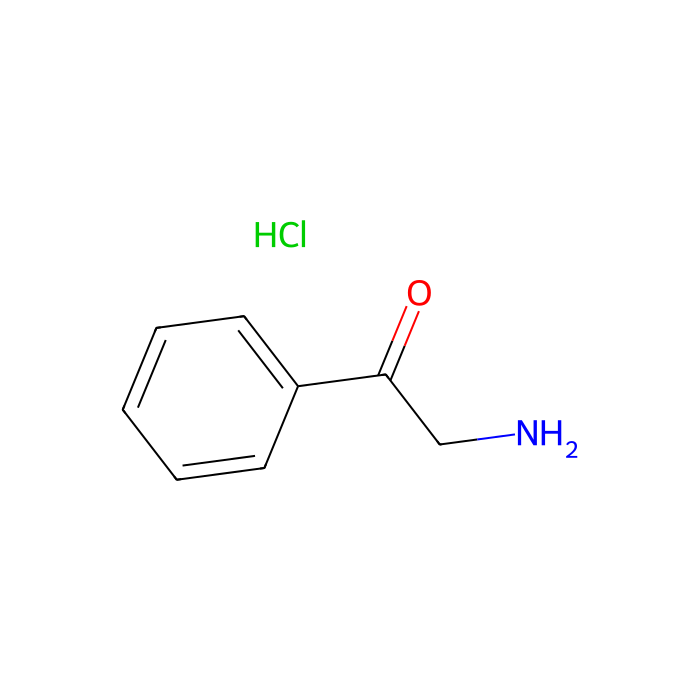
Structure and Identity
Brief description: 2-Aminoacetophenone hydrochloride is the hydrochloride salt of o-aminoacetophenone, combining an anilinium cation with chloride. The molecule features an anilinium group ortho to an acetyl substituent on a benzene ring.
Item-specific identifiers (from Product Data)
SKU: A123237
Product name: 2-Aminoacetophenone hydrochloride
CAS: 5468-37-1
PubChem CID: 2723597
InChIKey: Not specified for this item; refer to CoA/Spec Sheet.
SMILES: Not specified for this item; refer to CoA/Spec Sheet.
Structural features (general/literature)
Core: substituted benzene ring bearing an anilinium (–NH3+) group and an acetyl (–CO–CH3) group in the ortho (1,2) relationship.
Typical (literature) neutral-base SMILES for the free base: O=C(C)C1=CC=CC=C1N; the hydrochloride salt is commonly represented as [O]=C(C)C1=CC=CC=C1[NH3+].[Cl−].
Stereochemistry: none (achiral, no stereocenters).
Empirical formula and formula mass (literature values for the HCl salt)
2D structure in words: a benzene ring with adjacent substituents—one is an anilinium group (–NH3+) and the other is an acetyl group (–CO–CH3); chloride serves as the counterion to the protonated amine.
Synthetic Utility
Synthetic value arises from having both an aniline (after neutralization) and an aryl methyl ketone in ortho disposition.
Key transformations (literature)
Quinazolinone synthesis: Condensation with formamide/formic acid derivatives or anthranilamide-type manifolds under acidic or Lewis acidic conditions.
Indazole formation: Reaction with hydrazine/hydrazones to cyclize onto the acetyl group, often under acid catalysis.
Benzimidazoles/benzoxazoles: Cyclocondensation with 1,2-diamines or o-aminophenols after appropriate activation/dehydration.
Oximes and reductions: Oximation (NH2OH·HCl), followed by reduction or cyclization; NaBH4 or catalytic hydrogenation reduces the ketone to the benzylic alcohol for further elaboration.
Directed ortho metalation (DoM): Protection as anilide (e.g., acetanilide or sulfonamide) enables metalation and substitution guided by the ortho-directing group.
N-acylation/N-sulfonylation: Install protecting groups to modulate aniline reactivity and direct downstream steps.
Operational guidance
Start from the HCl salt for weighing and storage; generate free base right before use when nucleophilicity is required.
Control acid/base to avoid undesired iminium formation or overacylation.
Choice of catalysts (e.g., ZnCl2, Sc(OTf)3, p-TsOH) can improve rates/selectivity in cyclizations; screen mild conditions first to preserve the aniline functionality.
Target Specificity
Not applicable. This product is a small-molecule chemical reagent, not a biological targeting reagent (e.g., antibody, enzyme, or ligand with defined biomolecular specificity). No antigen/epitope, clone, isotype, or species reactivity information applies.
Domande frequenti
How is this product shipped?
This product ships under standard ambient conditions. No temperature-controlled packaging is required.
Utilizziamo i cookie per garantire il corretto funzionamento del sito web e, ove consentito, per migliorare la tua esperienza. Puoi gestire le tue preferenze in qualsiasi momento nelle Impostazioni. Per saperne di più, consulta la nostra Cookie Policy.
Desidera che le inviamo un messaggio quando avremo sconti disponibili?
Ricordamelo più tardi
Grazie! Controlli la sua casella di posta per confermare.
Products are supplied to verified businesses, institutions, and qualified professionals for research and development use only. Not for use in humans, animals, diagnosis, or therapy.

 J2109131