This compound belongs to the class of organic compounds known as benzophenones. These are organic compounds containing a ketone attached to two phenyl groups.
External Descriptors
Not available
1. Djoumbou Feunang Y, Eisner R, Knox C, Chepelev L, Hastings J, Owen G, Fahy E, Steinbeck C, Subramanian S, Bolton E, Greiner R, and Wishart DS. ClassyFire: Automated Chemical Classification With A Comprehensive, Computable Taxonomy. Journal of Cheminformatics, 2016, 8:61.
Determine the necessary mass, volume, or concentration for preparing a solution.
Dilution Calculator
Determine the dilution needed to prepare a stock solution.
Reconstitution Calculator
Recensioni
Recensioni dei clienti
Application Protocols
Not applicable as a validated bioassay reagent.
No tested applications (e.g., WB, IHC, IF, FC) or recommended dilutions are provided for this small-molecule building block.
Practical synthetic handling (general)
Weigh and transfer under standard laboratory conditions.
For solution preparation, dissolve in an appropriate organic solvent (e.g., DCM, THF, MeOH, DMF) based on your application; filter if needed.
For solid-phase or library synthesis workflows, standard parallel synthesis and purification (flash chromatography or preparative HPLC) apply.
Biological Roles
This product is supplied for research and synthetic use. It is not intended for biological or clinical applications.
General context (literature)
2-Aminobenzophenone is a synthetic aromatic compound; it is not a known endogenous metabolite.
The aniline functionality can interact with proteins and nucleophiles via reversible imine formation under certain conditions, but such interactions are nonspecific and context-dependent.
Aromatic ketones display characteristic UV absorption; derivatives can be used as chromophores or photoprobes after appropriate modification.
Research relevance
Frequently employed as a precursor to heteroaromatic scaffolds (e.g., benzoxazoles, quinazolinones) that are studied in chemical biology once separately synthesized and characterized.
No biological function, pathway involvement, or pharmacology is claimed for this item. For any work involving cells or biomolecules, ensure appropriate purity, endotoxin considerations, and controls as dictated by your protocol.
Buffer Applications
Not typically applicable.
Rationale
2-Aminobenzophenone is an organic synthetic building block, not a buffering agent. It lacks conjugate acid/base pairs suitable for maintaining physiological pH ranges in aqueous media.
Practical suggestion
For aqueous workups or extractions involving this compound, choose buffer systems that match your reaction’s pH requirements (e.g., acetate pH ~4–5 to keep an aniline largely protonated and water-soluble; carbonate pH ~10 to keep it deprotonated and organic-soluble). These are general extraction strategies rather than “buffer applications.”
Green Alternatives
While 2-aminobenzophenone itself is a fixed substrate, greener choices often center on solvent, reagent, and energy inputs for its transformations.
Solvent substitutions (literature-guided)
Replace DCM/CHCl3 with toluene, EtOAc, or 2-MeTHF where solubility and selectivity permit.
Use MeOH/EtOH or water–cosolvent systems for imine formation when feasible; apply solid-supported drying agents to minimize waste.
Reagent choices
Cyclodehydrations to benzoxazoles: Consider catalytic oxidative systems (e.g., I2/DMSO, iodine/TBHP, or catalytic Cu under O2) instead of stoichiometric POCl3 or PPA, balancing yield vs EHS profile.
Acylations: Use propylene carbonate or green acylating agents; swap pyridine with less toxic bases (e.g., DIPEA) and use catalytic DMAP.
Energy and process intensification
Microwave or flow conditions can shorten reaction times and reduce solvent volumes.
Employ solvent recycling (distillation of toluene/2-MeTHF) and in-process controls to reduce over-reactions.
Illustrative comparison (general)
Traditional: DCM, POCl3, reflux, stoichiometric dehydrants → high waste/halogenated solvent.
Greener: 2-MeTHF or toluene, catalytic iodine or Cu/O2, controlled heating or microwave → reduced halogenated waste, improved E-factor.
Always pilot greener substitutions on small scale to confirm kinetics, selectivity, and impurity profiles.
Pharmaceutical Uses
No medical or therapeutic claims are made for this product.
Formulation/excipient role: None (not used as an excipient to our knowledge).
Industrial/research context (literature)
Serves as a synthetic intermediate for heterocyclic frameworks (e.g., benzoxazoles, quinazolinones) that may be explored in medicinal chemistry programs.
The bifunctional nature (aniline + aryl ketone) enables convergent routes to libraries via acylation, condensation, and cyclization steps.
Regulatory status
No pharmacopeial monograph is known for 2-aminobenzophenone as a finished excipient (literature perspective). Any use in GMP settings would require internal specification, validated analytical methods, and change control.
All uses are confined to R&D and laboratory synthesis unless otherwise qualified under appropriate regulatory frameworks.
Physical Properties
Item-specific (from Product Data)
Appearance: Not specified for this item; refer to CoA/Spec Sheet.
Grade/Purity: Not specified for this item; refer to CoA/Spec Sheet.
Molecular Formula: Not specified for this item; refer to CoA/Spec Sheet.
Molecular Weight: Not specified for this item; refer to CoA/Spec Sheet.
Literature/general properties (for context; not item-specific specifications)
Physical state: Typically a crystalline solid (literature).
Color: Often off-white to pale yellow (literature), may vary with purity/age.
Melting point: Reported ~50–60 °C (literature range; different sources may vary).
Boiling point: High (literature reports >300 °C, often with decomposition); not typically distilled.
Density: Not readily consolidated in literature; consult primary references if critical.
Solubility: Sparingly soluble in water; soluble in common organic solvents (e.g., alcohols, ethers, chlorinated and aromatic solvents) (literature).
pKa: Aniline-like basicity; conjugate acid pKa typically ~4–5 for analogous anilines (literature, qualitative guidance only).
UV/Vis: Aromatic ketones exhibit π→π* and n→π* bands; exact λmax depends on solvent and conditions (literature).
Note: For any numerical property required for method validation or specification purposes, use the item’s CoA/Spec Sheet or measure under your lab conditions.
Quality and Grades
Item-specific
Grade/Purity: Not specified for this item; refer to CoA/Spec Sheet.
Stabilizers/Inhibitors: Not specified for this item; refer to CoA/Spec Sheet.
Interpreting common grades (general guidance)
Research grade: Suitable for most synthetic and screening work; typical impurity controls but not guaranteed for trace analysis.
AR/ACS grade: Tight limits on inorganic/organic contaminants; appropriate for analytical applications.
HPLC grade: Optimized for low UV background and minimal particulates for chromatography; generally not applicable to solid building blocks unless used as standards.
Practical notes for 2-aminobenzophenone quality assessment
Typical impurities (literature): Isomeric aminobenzophenones, unreacted benzophenone, anilide byproducts, and oxidative dimers. Check by HPLC/GC and 1H/13C NMR.
Appearance checks: Color darkening over time can indicate oxidation; re-purification by recrystallization may restore quality if specifications allow.
Water/volatile content: For moisture-sensitive transformations (e.g., acylations, metal-catalyzed couplings), verify by KF or TGA as needed (not item-specified).
Reaction and Applications
2-Aminobenzophenone is a versatile bifunctional building block. The aniline and aryl ketone moieties enable orthogonal or tandem transformations.
Transformations leveraging the amino group (literature)
Acylation/sulfonylation: Formation of amides/sulfonamides; useful handles for further cyclizations.
Reductive amination on external carbonyls: The aniline couples with aldehydes/ketones to give Schiff bases, then reduced to secondary amines.
Diazotization: Access to aryl diazonium salts for Sandmeyer-type substitutions or intramolecular rearrangements (use caution; diazonium chemistry requires strict controls).
Transformations leveraging the aryl ketone (literature)
Oxime/hydrazone formation and subsequent Beckmann/Schmidt-type rearrangements (where applicable).
Aromatic substitutions/functionalizations on either ring (e.g., halogenation, nitration under controlled conditions) enabling cross-coupling.
Carbonyl reductions (e.g., NaBH4, catalytic hydrogenation) to benzhydrol derivatives while retaining/analyzing amine protection strategies.
Tandem and cyclization chemistry (literature)
Benzoxazole formation via intramolecular cyclodehydration (e.g., with POCl3, PPA, or oxidative systems such as I2/DMSO, DDQ) from o-aminoaryl ketones.
Quinazolinone/quinazoline scaffolds via condensation with formamide, orthoesters, or nitriles under dehydrating/acidic conditions.
Acridone and related ring systems via intramolecular annulation under oxidative/acidic conditions.
Practical tips
Protecting strategies: Boc/CBz/acyl protections can modulate amine reactivity when targeting carbonyl chemistry.
Order of operations: Functionalize the more reactive site first or protect it to avoid competitive side reactions.
Analysis: Monitor by LC–MS and 1H NMR (distinct signals for aniline NH2 and benzophenone carbonyl region ~195–200 ppm in 13C NMR).
Reaction Conditions
General guidance based on literature precedents (not item-specific specifications):
Amide/sulfonamide formation (from the aniline)
Solvent: DCM, THF, or 2-MeTHF; base: Et3N or DIPEA; catalyst: DMAP (cat.) for acylations.
Temperature: 0 °C to rt (acylation); 0–50 °C for sulfonylations.
Workup: Aqueous quench with bicarbonate or dilute acid depending on reagent; extract into organic.
Dehydrating route: POCl3 (excess) or PPA, 60–110 °C; quench cautiously into ice/water; neutralize and extract.
Oxidative route: I2/DMSO (cat./stoich.), 80–120 °C; or CuI/Cu(OAc)2 with O2/air in DMSO or toluene, 80–120 °C.
Notes: Remove water (Dean–Stark in toluene/xylene) to drive equilibrium when using milder dehydrants.
Imine/Schiff base formation
Solvent: Toluene, EtOH, or MeOH; additive: 3 Å molecular sieves; catalyst: trace acid (AcOH) as needed.
Temperature: rt to reflux (depending on solvent); monitor by TLC/LC–MS.
Carbonyl reduction
Reagents: NaBH4 or catalytic hydrogenation (Pd/C) can reduce the benzophenone carbonyl to benzhydrol derivatives; protect or modulate the amine to avoid overreduction.
Analytics and controls
Monitor reactions by HPLC/LC–MS; 1H NMR for disappearance of NH2 singlet/broad signals or carbonyl 13C ~195–200 ppm.
Dry conditions recommended for acylations/condensations; verify residual water by KF when sensitive.
Safety and Handling
Item-specific hazard information (from Product Data)
Signal Word: Not specified for this item; refer to SDS.
H-Statements: Not specified for this item; refer to SDS.
GHS Classification/Pictograms: Not specified for this item; refer to SDS.
General safety considerations for aromatic amines/aryl ketones (literature/good practice)
Likely hazards: May cause skin/eye irritation and respiratory irritation; aromatic amines can be harmful if swallowed or inhaled. Avoid dust formation and inhalation.
PPE: Use chemical-resistant gloves (e.g., nitrile), safety goggles, lab coat; handle in a fume hood to minimize exposure to dust/vapors.
Incompatibilities: Strong oxidizers (may react exothermically); strong acids/bases may lead to salt formation or decomposition; acylating agents can react with the amine.
First aid (overview; defer to SDS):
Inhalation: Move to fresh air; seek medical attention if symptoms persist.
Skin contact: Wash with soap and water; remove contaminated clothing.
Eye contact: Rinse cautiously with water for several minutes; seek medical attention if irritation persists.
Ingestion: Rinse mouth; do not induce vomiting; seek medical advice.
Fire safety: Combustible organic solid; use dry chemical, CO2, or foam. Avoid water jets that may spread material.
Always consult the product’s SDS for authoritative hazard classifications, exposure limits, spill response, and disposal guidance.
Solvent Selection
This compound is a moderately polar, multifunctional aromatic solid with an aniline-type amine and an aryl ketone.
General solubility/miscibility (literature)
Good solubility in polar aprotic solvents (DMF, DMSO, NMP), chlorinated solvents (DCM, CHCl3), and aromatic solvents (toluene); moderate in alcohols; low in water.
Polarity and interactions (general)
The amine enables hydrogen bonding; the aryl ketone enhances π–π interactions. Polar aprotic solvents often maximize solubility without protonating the amine.
When to choose what
Synthesis (acylations, condensations): Use dry DCM, THF, or toluene with a base (e.g., Et3N) to keep the amine unprotonated.
Cyclodehydrations/heterocycle formation: High-boiling solvents (PhMe, xylene, sulfolane) or dehydrating media (PPA/POCl3—observe safety) are common.
Metal-catalyzed couplings on the aryl rings: Polar aprotics (DMAc/DMF) can assist catalyst solubility; toluene or 2-MeTHF can be alternatives for greener profiles.
Quick comparison (general)
DMF/DMAc: High solubility, good for nucleophilic steps; consider toxicity and workup.
DCM: Excellent for acylations and rapid extractions; volatile and regulated.
Toluene/2-MeTHF: Greener options with adequate solubility for many steps; better recyclability than DCM.
Select solvent according to transformation, base/acylating agent compatibility, and desired temperature profile.
Storage and Reconstitution
Item-specific (from Product Data)
Storage Conditions: Room temperature.
Shipped In: Normal.
General storage guidance (supplementary; not item-specific specs)
Keep tightly closed in a dry, well-ventilated area; protect from excessive heat and direct sunlight.
Minimize exposure to air and moisture to limit oxidation or discoloration; use desiccant if long-term storage is planned.
If preparing stock solutions, use dry, oxygen-free solvents when sensitive transformations are anticipated; store solutions in amber vials at 2–8 °C if stability allows and use within a few weeks (verify by analytical check).
Reconstitution (solution preparation)
Select a compatible solvent for your intended reaction (e.g., DCM, THF, toluene, MeOH, DMF).
Warm gently and sonicate if necessary to aid dissolution; avoid strong acids/bases unless part of the protocol.
Filter through a PTFE syringe filter (0.45 µm) to remove particulates for analytical or microreactor applications.
Always refer to the product’s CoA and SDS for any stability limits, incompatibilities, or special handling requirements specific to your lot.
Structure and Identity
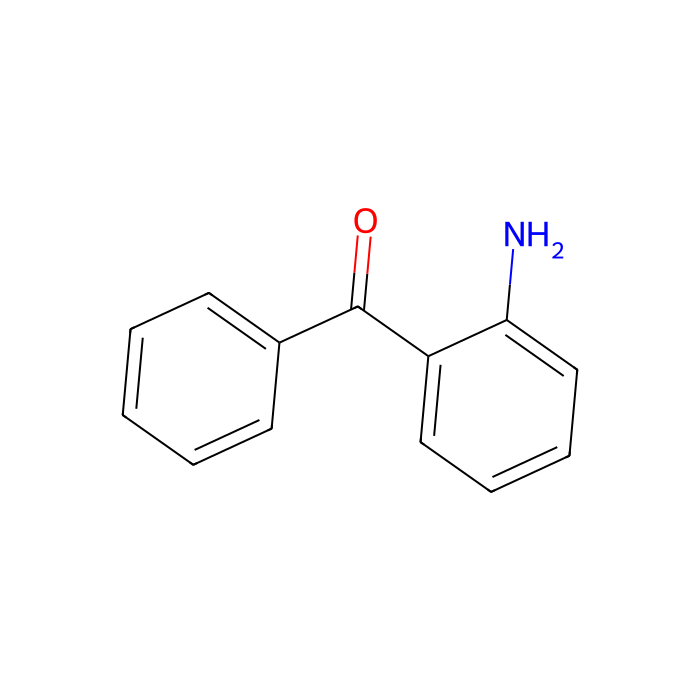
Brief overview: 2-Aminobenzophenone (o-aminobenzophenone) is an ortho-anilide-substituted benzophenone bearing both an aniline-type amino group and an aryl ketone, enabling bifunctional reactivity.
Item-specific (from Product Data)
Product name: 2-Aminobenzophenone
CAS: 2835-77-0
CID: 76080
InChIKey (as provided): 214051
Storage: Room temperature; shipped in: Normal
Category: Chemical and Biochemical Reagents; For research use only
Literature/computed identifiers (general reference; not item-specific)
Molecular formula: C13H11NO (literature)
Molecular weight: ~197.23 g/mol (literature)
Common SMILES: O=C(c1ccccc1)c2c(N)cccc2 or Nc1ccccc1C(=O)c2ccccc2 (literature)
Carbonyl: Oxime/hydrazone formation, reductive transformations to benzhydrols, Wittig/olefination on derived benzoin-like systems, enolate chemistry is limited (aryl ketone, no α-H if fully arylated) but facilitates electrophilic aromatic substitutions via activation.
Intramolecular annulations (literature)
Benzoxazoles via dehydrative cyclization.
Quinazolinones via condensation with carbonyl equivalents (formamides, orthoesters) and oxidants.
Acridones and related polycycles under oxidative conditions.
Cross-coupling platform
After halogenation/nitration of either ring, standard Pd-catalyzed Suzuki, Buchwald–Hartwig (on amine after protection), or Ullmann-type couplings can elaborate the scaffold.
Retrosynthetic planning tips
Site-selective protection permits differentiation of amine vs carbonyl chemistry.
Electrophile choice and directing effects around the ortho-amino ring strongly influence regioselectivity in EAS.
For library synthesis, parallel acylation/sulfonylation followed by cyclization offers rapid heterocycle diversification.
Target Specificity
Not applicable.
This product is a small-molecule building block, not a biological targeting reagent (e.g., antibody, enzyme inhibitor with defined target profile). No antigen/epitope/species specificity data are provided or implied for this item.
Domande frequenti
How should this product be stored?
Store at room temperature.
How is this product shipped?
This product ships under standard ambient conditions. No temperature-controlled packaging is required.
What are the CAS number, molecular formula and molecular weight?
The CAS Number is 2835-77-0, the molecular formula is C13H11NO, and the molecular weight is 197.23 g/mol. InChIKey MAOBFOXLCJIFLV-UHFFFAOYSA-N.
What is the purity of this product?
This product is supplied at ≥98% purity (chemical assay). Lot-specific values are stated on the Certificate of Analysis.
What documentation is provided?
Available product documentation, including Certificates of Analysis (COA), Safety Data Sheets (SDS), and specification sheets, is shown in the product document area. Document availability and access follow the current site policy.
Utilizziamo i cookie per garantire il corretto funzionamento del sito web e, ove consentito, per migliorare la tua esperienza. Puoi gestire le tue preferenze in qualsiasi momento nelle Impostazioni. Per saperne di più, consulta la nostra Cookie Policy.
Desidera che le inviamo un messaggio quando avremo sconti disponibili?
Ricordamelo più tardi
Grazie! Controlli la sua casella di posta per confermare.
Products are supplied to verified businesses, institutions, and qualified professionals for research and development use only. Not for use in humans, animals, diagnosis, or therapy.

 H2109083