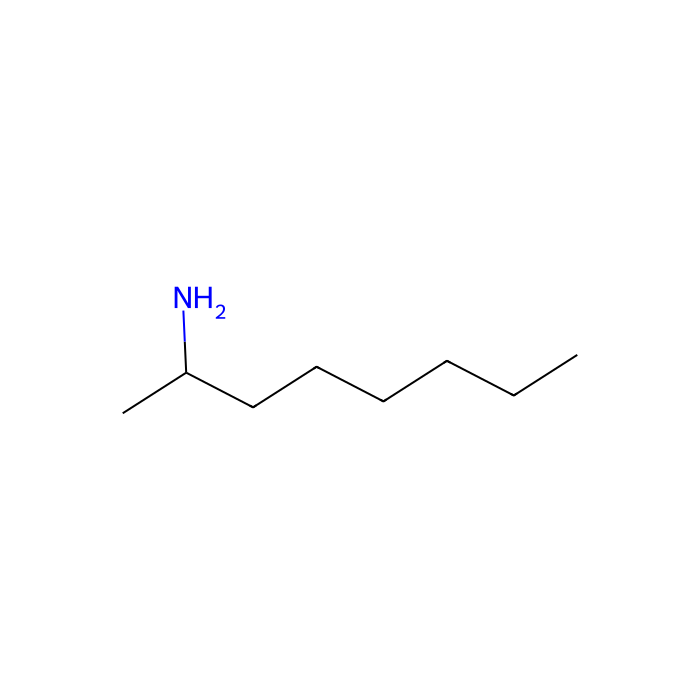
Determine the necessary mass, volume, or concentration for preparing a solution.
Taxonomy Tree
| Kingdom | Organic compounds |
|---|---|
| Superclass | Organic nitrogen compounds |
| Classe | Organonitrogen compounds |
| Subclass | Amines |
| Intermediate Tree Nodes | Primary amines |
| Direct Parent | Monoalkylamines |
| Alternative Parents | Organopnictogen compounds Hydrocarbon derivatives |
| Molecular Framework | Aliphatic acyclic compounds |
| Substituents | Organopnictogen compound - Hydrocarbon derivative - Primary aliphatic amine - Aliphatic acyclic compound |
| Descrizione | This compound belongs to the class of organic compounds known as monoalkylamines. These are organic compounds containing an primary aliphatic amine group. |
| External Descriptors | Not available |
Find and download the COA for your product by matching the lot number on the packaging.
| Lot Number | Certificate Type | Data | Oggetto |
|---|---|---|---|
| Certificate of Analysis | Dec 10, 2025 | A151716 | |
| Certificate of Analysis | Dec 10, 2025 | A151716 | |
| Certificate of Analysis | Dec 10, 2025 | A151716 | |
| Certificate of Analysis | Dec 10, 2025 | A151716 | |
| Certificate of Analysis | Dec 10, 2025 | A151716 | |
| Certificate of Analysis | Mar 06, 2023 | A151716 | |
| Certificate of Analysis | Mar 06, 2023 | A151716 |
| Sensibilità | Air sensitive |
|---|---|
| Indice di rifrazione | 1.42 |
| Punto di infiammabilità (°C) | 50 °C |
| Punto di ebollizione (°C) | 165°C(lit.) |
| Peso molecolare | 129.24 |
| XLogP3 | 2.600 |
| Hydrogen Bond Donor Count | 1 |
| Hydrogen Bond Acceptor Count | 1 |
| Rotatable Bond Count | 5 |
| Exact Mass | 129.152 Da |
| Monoisotopic Mass | 129.152 Da |
| Topological Polar Surface Area | 26.000 Ų |
| Heavy Atom Count | 9 |
| Formal Charge | 0 |
| Complexity | 52.500 |
| Isotope Atom Count | 0 |
| Defined Atom Stereocenter Count | 0 |
| Undefined Atom Stereocenter Count | 1 |
| Defined Bond Stereocenter Count | 0 |
| Undefined Bond Stereocenter Count | 0 |
| The total count of all stereochemical bonds | 0 |
| Covalently-Bonded Unit Count | 1 |
H226:Flammable liquid and vapor
H301:Toxic if swallowed
H314:Causes severe skin burns and eye damage
P210:Keep away from heat, hot surface, sparks, open flames and other ignition sources. - No smoking.
P233:Keep container tightly closed.
P240:Ground/bond container and receiving equipment.
P241:Use explosion-proof [electrical/ventilating/lighting/.../] equipment.
P242:Use only non-sparking tools.
P243:Take precautionary measures against static discharge.
P260:Do not breathe dust/fume/gas/mist/vapors/spray.
P264:Wash hands [and …] thoroughly after handling.
P270:Do not eat, drink or smoke when using this product.
P280:Wear protective gloves/protective clothing/eye protection/face protection.
P321:Specific treatment (see ... on this label).
P330:Rinse mouth.
P363:Wash contaminated clothing before reuse.
P301+P330+P331:IF SWALLOWED: Rinse mouth. Do NOT induce vomiting.
P303+P361+P353:IF ON SKIN (or hair): Take off Immediately all contaminated clothing. Rinse SKIN with water [or shower].
P304+P340:IF INHALED: Remove person to fresh air and keep comfortable for breathing.
P370+P378:In case of fire: Use ... to extinguish.
P405:Store locked up.
P403+P235:Store in a well-ventilated place. Keep cool.
P501:Dispose of contents/container to an approved waste disposal plant.
P301+P316:IF SWALLOWED: Get emergency medical help immediately.
P305+P354+P338:IF IN EYES: Immediately rinse with water for several minutes. Remove contact lenses if present and easy to do. Continue rinsing.
P302+P361+P354:IF ON SKIN: Take off Immediately all contaminated clothing. Immediately rinse with water for several minutes.
P316:Get emergency medical help immediately.
No vendor-tested bioassay protocols are provided for this small-molecule reagent.
General laboratory guidance (literature/general):
Refer to the CoA/SDS for any lot-specific handling notes. Adapt conditions to your specific substrates and scale.
This product is intended for research use only. No clinical/medical claims are made.
General biochemical context for long-chain aliphatic amines (literature/general):
Note: 2-Aminooctane itself is not a common metabolite or buffer component; biological effects depend on derivatization and context. Handle as a basic organic chemical; consult institutional biosafety policies for any in vitro exposure studies.
Not typically used as a buffer. Primary aliphatic amines with long hydrophobic chains have limited aqueous solubility; while the conjugate acid of 2-aminooctane would exhibit a pKa in the ~10–11 range (literature-general for primary aliphatic amines), practical buffering near this pH is not common due to solubility and odor concerns.
If an amine buffer is required, consider dedicated systems such as Tris (pKa ~8.1), Bicine, TAPS, or ethanolamine, chosen for water solubility, low UV absorbance, and well-characterized buffering ranges.
Perspective (general; not item-specific): greener choices focus on solvent and reagent selection when using 2-aminooctane rather than replacing the amine itself.
Greener process choices:
Example comparison (literature-general):
No therapeutic claims. Research-use-only.
General formulation/manufacturing context (literature/general):
For GMP or pharmacopeial applications, confirm:
Item-specific specifications: Not specified for this item; refer to CoA/Spec Sheet for any measured values (bp, density, refractive index, water/peroxide/metal content, UV cutoff, etc.).
Literature/general values and qualitative behavior (for planning only; not item specifications):
Always confirm working properties on your lot via the CoA/SDS before process use.
Item-specific grade/purity: Not specified for this item; refer to CoA/Spec Sheet for assay, residual solvents, water, and impurity profiles.
Guidance on grades (general; not item-specific):
What to verify on receipt:
Use-cases (literature/general; expandable from typical catalog applications for primary aliphatic amines):
Practical tips:
General, literature-based guidance (not item-specific; optimize per substrate):
Yields vary widely with substrate sterics/electronics; consult primary literature for specific pairings.
Item-specific hazard classification: Not specified for this item; consult the SDS for definitive GHS, pictograms, signal word, and H-statements.
General safety guidance for aliphatic primary amines (literature/general; not item-specific):
Storage/handling per Product Data:
This product is a reactive substrate (primary amine), not typically used as a chromatography-grade solvent. Selection here refers to solvents for dissolving 2-aminooctane during reactions, extractions, or purifications.
General guidance (literature/general):
Note: Avoid aqueous strong base during workup to limit emulsions; perform acid–base extraction exploiting amine protonation for clean phase separations.
Item-specific instructions (from Product Data):
Practical guidance (general):
Reconstitution: Not applicable; supplied neat. If crystallized or viscous at low temperature, warm gently to ambient and mix thoroughly before use. Verify concentration by titration or GC where accurate stoichiometry is required.
Professional summary: 2-Aminooctane is a branched primary aliphatic amine (chiral at C2) used as a hydrophobic nucleophile and cationic headgroup precursor in materials and synthesis.
Item-specific registry data (from Product Data):
Computed/literature identity (general information; not item specifications):
Stereochemistry: Contains one chiral center at C2; unless specified, assume racemic mixture (R/S).
Functional group profile:
Representative transformations (literature/general):
Retrosynthetic value: Serves as a convenient hydrophobic amine synthon to introduce a C8 sec-alkyl group onto nitrogen, tuning cLogP and membrane interaction without adding aromaticity.
Not applicable. This product is a small-molecule amine, not a biological targeting reagent or antibody. No antigen/epitope, species reactivity, clone, or isotype information applies.