This compound belongs to the class of organic compounds known as ketals. These are acetals derived from ketones by replacement of the oxo group by two hydrocarbyloxy groups R2C(OR)2 ( R not Hydrogen ). This term, once abandoned, has been reinstated as a subclass of acetals.
External Descriptors
Not available
1. Djoumbou Feunang Y, Eisner R, Knox C, Chepelev L, Hastings J, Owen G, Fahy E, Steinbeck C, Subramanian S, Bolton E, Greiner R, and Wishart DS. ClassyFire: Automated Chemical Classification With A Comprehensive, Computable Taxonomy. Journal of Cheminformatics, 2016, 8:61.
Determine the necessary mass, volume, or concentration for preparing a solution.
Dilution Calculator
Determine the dilution needed to prepare a stock solution.
Reconstitution Calculator
Recensioni
Recensioni dei clienti
Application Protocols
Not applicable. There are no immunoassay or bioanalytical application protocols (e.g., WB, IHC, IF, FC) associated with this small-molecule building block.
General laboratory usage tips (chemical handling):
For SN2 reactions, pre-dry solvents over molecular sieves and maintain inert atmosphere.
Add nucleophiles incrementally to manage exotherm and control selectivity.
For radical reactions, degas solutions (freeze-pump-thaw or sparging) and protect from oxygen.
For chromatography, use neutral alumina or silica (avoid acidic media) to prevent acetal hydrolysis.
Biological Roles
This compound is a synthetic small-molecule building block without assigned biological function.
No endogenous role: Spiroacetal bromides of this structure are not known biometabolites or cofactors.
Bioactivity: Any interactions with biological targets would be incidental to structure and require dedicated screening; none are claimed or provided for this item.
Chemical biology utility (general): The acetal can serve as a protected diol motif that, after deprotection, yields polar handles for probe attachment. The bromide enables installation of reporter groups (e.g., alkyne, azide) via substitution for subsequent bioconjugation chemistry. Such uses remain strictly research-oriented and require validation for compatibility, purity, and stability.
Stability in biological media (general/literature):
The acetal is susceptible to acid-catalyzed hydrolysis; acidic cellular compartments or low-pH buffers may cleave it. At neutral pH, hydrolysis is slower but can occur in the presence of enzymes or metal ions.
The alkyl bromide is reactive toward nucleophiles, including thiols; non-specific alkylation is possible. Handle with caution and avoid unnecessary biological exposure.
Compliance note: As stated in the Product Data, this material is for research use only and not for use in humans or animals. No clinical, diagnostic, or therapeutic claims are made or implied.
Buffer Applications
Not typically applicable. 2-bromo-5,8-dioxaspiro[3.4]octane is a neutral, hydrophobic building block and is not used to prepare laboratory buffers. Moreover, the acetal function is acid-sensitive and can hydrolyze under acidic buffer conditions.
Practical guidance:
If handling in aqueous media is unavoidable (e.g., biphasic PTC reactions), maintain near-neutral pH and minimize exposure time. Avoid acidic buffers entirely; basic buffers may trigger substitution/elimination.
For extractions or workups, choose neutral saline or carbonate-free brines to avoid undesired reactions. Perform rapid separations and dry organic phases promptly over neutral drying agents.
Green Alternatives
Context: This product is a specialized electrophilic building block, not a commodity solvent. “Greener” considerations therefore center on solvent selection and process design rather than replacing the reagent itself.
Greener process choices (literature/practice):
Prefer greener solvents for substitutions:
Replace DCM/DMF where feasible with MeCN, 2-MeTHF, EtOAc, CPME, or dimethyl carbonate, balancing rate vs. selectivity.
Catalysis and energy:
Use phase-transfer catalysis (PTC) to run SN2 reactions in biphasic water/green organic solvents at lower temperatures.
Consider photoredox catalysis under visible light as an alternative to AIBN/thermal initiators for radical steps.
Waste minimization:
Minimize halogenated solvent use; segregate brominated waste for appropriate disposal.
Employ continuous flow for hazardous nucleophiles (e.g., azide, cyanide) to reduce inventory and improve heat/mass transfer.
Illustrative solvent comparison (general; not product specs):
DCM: High performance, high regulatory burden; VOC, chlorinated.
MeCN: Polar aprotic, good rate; toxicity manageable; recyclable by distillation.
2-MeTHF: Bio-based, water-immiscible, enables extractions; may slow SN2 vs. MeCN.
EtOAc: Readily biodegradable, low toxicity; may require longer times/phase-transfer.
Tradeoffs:
While greener solvents can reduce impact, they may alter selectivity or promote acetal transacetalization if acidic impurities are present. Maintain neutral conditions and verify stability by control experiments.
Note: No greener “drop-in” alternative exists for the unique spiroacetal bromide motif; sustainability gains are primarily from solvent, energy, and waste choices.
Pharmaceutical Uses
No pharmacopeial or excipient role is indicated for this item. It is provided strictly as a research-grade chemical building block.
Context for process chemists (general/literature):
Potential role: May serve as an intermediate in the synthesis of drug-like molecules, where the spiroacetal ring imparts three-dimensionality and polarity. The bromide allows convergent installation of amines, thioethers, or C–C bonds.
Regulatory status: Not listed here in USP/Ph.Eur. or other pharmacopeias; no compendial specifications are claimed. If using in a development setting, internal specifications (identity, assay, impurities, residual solvents, elemental impurities) should be established.
Quality considerations:
Control of hydrolysis products (diols, carbonyls) and elimination by-products is important.
Residual bromide-containing impurities may affect downstream toxicity profiles; ensure adequate purge in subsequent steps.
Note: For any application related to pharmaceuticals, this material should be treated as a research intermediate only. It is not intended for human or veterinary use and should not be used in clinical or diagnostic applications.
Physical Properties
Item-specific specifications (from Product Data):
Appearance: Not specified for this item; refer to CoA/Spec Sheet.
Molecular Weight: Not specified for this item; refer to CoA/Spec Sheet.
General/literature expectations for compounds of this scaffold (for planning only; not product specs):
Phase: Small, brominated spiroacetals are commonly low-melting solids or high-boiling liquids (literature trend). Exact MP/BP for this CAS is not specified here; check CoA/SDS.
Density: Organobromides typically exhibit densities >1.2 g/mL (literature trend), but this specific item’s density is not specified; refer to CoA.
Refractive index (nD): Often 1.45–1.55 for comparable brominated acetals (literature range). Not specified for this item.
Solubility: Expected to be miscible with many aprotic organic solvents (e.g., DCM, THF, EtOAc) and sparingly soluble in water due to the hydrophobic carbon framework, despite two oxygens (literature expectation). Quantitative solubilities are not specified for this item.
Polarity/logP: Acetal oxygens impart moderate polarity; however, the neutral acetal and alkyl bromide typically yield a moderate logP (literature expectation). Not specified for this item.
pKa: No acidic protons; acetals are neutral in water; hydrolyze only under acidic conditions (literature).
Important notes:
Treat any boiling/melting behavior as unknown until verified on your batch. For distillation or drying, use gentle conditions and monitor by GC/GC–MS.
Always defer to the CoA/Spec Sheet and SDS for authoritative physical constants of the supplied lot.
Quality and Grades
Item-specific quality information:
Grade/Purity: Not specified for this item; refer to CoA/Spec Sheet.
Guidance on interpreting grades (general information):
Research grade vs. analytical/HPLC grade: For building-block organics like this spiroacetal bromide, “research grade” typically prioritizes identity and assay (e.g., GC/HPLC purity) over trace metal/ionic and UV-absorbing impurity cutoffs. If you require low-UV background (e.g., photochemical kinetics, UV detection), request an HPLC-grade solvent or a low-UV assay for your specific application.
Purity reporting: Purity for small molecules is commonly established by GC, HPLC, or NMR. If you require a specific basis (area% vs. weight%), residual solvent profile, or water content (Karl Fischer), please consult the CoA for this SKU/lot.
Stabilizers/inhibitors: No stabilizer is indicated in the Product Data. If present, stabilizers would be listed on the CoA. The acetal is generally stable at neutral pH; avoid acid exposure to limit hydrolysis by-products that can appear in purity assays.
Trace metals/spec limits: Not specified for this item; refer to CoA/Spec Sheet. If you plan organometallic transformations (e.g., lithiation, Mg insertion), you may wish to request a metals screen.
Lot-to-lot documentation: For regulated workflows (e.g., GMP-adjacent R&D), retain the lot-specific CoA, NMR/GC traces, and any moisture/peroxide tests run at receipt.
Recommendation: Define your acceptance criteria (assay, residual solvents, water, acidity) and align with the CoA prior to scale-up.
Reaction and Applications
This brominated spiroacetal is a compact, oxygen-rich electrophile useful for installing functionality while preserving a masked 1,2-diol motif. Typical uses (literature/general; adapt to your system):
Nucleophilic Substitution (SN2):
Displacement of bromide with azide (NaN3) to access spiroacetal azides, which can be reduced to amines (Staudinger/hydrogenation).
Reaction with cyanide (KCN) to introduce nitriles (handle CN with extreme care), or with thiolates to give thioethers.
Alkoxide substitution provides ether-extended spiroacetals; control conditions to minimize acetal opening.
Cross-coupling via in situ metalation (advanced):
Direct Mg or Li insertion into secondary alkyl bromides is often inefficient and may cause acetal cleavage; if attempted, use strongly anhydrous, cryogenic conditions and rapid trapping (literature caution).
Radical chemistry:
Photoredox or AIBN/initiator conditions can generate radicals from alkyl bromides, enabling Giese-type additions to Michael acceptors or atom-transfer radical reactions (ATRA). The adjacent oxygen substitution can stabilize or direct radical reactivity.
Protective group strategy:
The 5,8-dioxaspiro framework behaves as a cyclic acetal protecting a vicinal diol. After diversification at C-2, acidic deprotection (aqueous AcOH, TFA/water, or dilute HCl in acetone/THF) can reveal the corresponding diol (optimize to avoid rearrangements).
Building-block roles:
Introduction of polarity and 3D shape into libraries for medicinal chemistry.
Precursor to hydroxy-functionalized fragments after deprotection/oxidation.
Practical tips:
Use dry, neutral to slightly basic media for substitutions; exclude acids to protect the acetal.
Monitor by GC/LC–MS to distinguish substitution from elimination or ring-opening products.
If β-elimination competes, reduce temperature and switch to less basic nucleophiles in polar aprotic solvents.
Reaction Conditions
The following are general, literature-based guidelines for secondary alkyl bromides bearing acetal functions. They are not product specifications; optimize for your system.
SN2 with azide (to give alkyl azide):
Reagents: NaN3 (1.2–2.0 equiv)
Solvent: DMF or MeCN (dry)
Temperature: 25–60 °C
Time: 2–16 h
Notes: Ensure anhydrous, neutral conditions to avoid acetal hydrolysis. Work up by aqueous quench, extract with EtOAc, neutral silica for purification.
SN2 with thiolate (to give thioether):
Reagents: NaSR or KSR (1.2–1.5 equiv), generated in situ from RSH + base (e.g., K2CO3) in MeCN or acetone
Temperature: 0–40 °C
Notes: Softer nucleophiles favor substitution over elimination; avoid strong bases.
SN2 with amines (alkylation):
Reagents: Primary amine (1.5–3.0 equiv), base scavenger (e.g., DIPEA)
Solvent: MeCN, toluene, or EtOAc
Temperature: 25–80 °C (sealed tube if needed)
Notes: Monitor for over-alkylation; add amine slowly or use excess amine as solvent.
Radical Giese addition (debromination/addition):
Catalyst: Photoredox (e.g., Ir/Ru complex) with Hantzsch ester; or AIBN/tributyltin hydride alternatives (avoid tin if possible)
Solvent: MeCN, DCM, or acetone (degassed)
Light/Temp: Blue LEDs, ambient; or thermal 60–80 °C for AIBN
Notes: Maintain inert atmosphere; acetal generally stable under neutral radical conditions.
Deprotection (acetal hydrolysis):
Reagents: Aqueous AcOH (50–80%), or dilute HCl in acetone/THF–water
Temperature: 0–25 °C
Notes: Proceed cautiously—optimize to avoid rearrangement or over-hydrolysis; monitor by TLC/LC–MS.
Yields: Secondary bromide substitutions often afford 60–90% under optimized conditions (literature range). Verify on small scale first.
Safety and Handling
Item-specific hazard data provided:
Signal Word: Not specified for this item; refer to SDS.
H-Statements: Not specified for this item; refer to SDS.
GHS Classification: Not specified for this item; refer to SDS.
Pictograms: Not specified for this item; refer to SDS.
General safety considerations for brominated spiroacetals and alkyl bromides (literature/good practice; not product-specific):
Likely hazards: Alkyl bromides are often harmful if inhaled or absorbed through skin and can be irritants to skin, eyes, and respiratory tract. Some may be suspected carcinogens or cause organ effects depending on structure; consult SDS for this CAS before use.
PPE: Use lab coat, nitrile gloves, splash goggles. Handle in a functioning chemical fume hood.
Incompatibilities: Strong bases and strong acids can promote elimination or acetal hydrolysis, respectively. Avoid contact with strong nucleophiles unless intended. Avoid strong oxidizers and reductants.
Moisture/acid sensitivity: Acetal function can hydrolyze under acidic aqueous conditions; keep dry and avoid acid.
Peroxide formation: Cyclic acetals are generally less prone than dialkyl ethers but may form peroxides slowly on air exposure (literature caution). Store under inert gas as specified.
First aid overview (always defer to SDS):
Inhalation: Move to fresh air; seek medical attention if symptoms persist.
Skin: Wash with soap and water; remove contaminated clothing.
Eyes: Rinse cautiously with water for several minutes; remove contact lenses if easy.
Ingestion: Rinse mouth; do not induce vomiting; seek medical advice.
Fire: Use CO2, dry chemical, or foam. Combustion may release HBr and other corrosive fumes; firefighters should wear SCBA.
Storage/handling from Product Data:
Store at 2–8 °C, under argon. Shipments on wet ice. Keep container tightly closed; minimize headspace air; use dry, oxygen-free techniques.
Solvent Selection
Applicability: This product is a synthetic building block, not a solvent. However, appropriate reaction/handling solvents are important for performance and stability.
General solvent behavior (literature/expected for acetal bromides):
Polarity/miscibility: Moderately polar, neutral organic compound. Expected to dissolve well in DCM, chloroform, THF, MTBE, EtOAc, acetone, acetonitrile, and aromatic hydrocarbons; limited water solubility.
Stability in solvents: Stable in aprotic, neutral media. Avoid acidic alcohols or aqueous acids (risk of acetal hydrolysis). Strong basic alcohols (alkoxides) will react (substitution/elimination) rather than serve as benign solvents.
Solvent choice by operation (general guidance):
Nucleophilic substitution (SN2):
Polar aprotic (DMSO, DMF, NMP, MeCN) accelerate SN2 with anionic nucleophiles; ensure rigorous dryness to protect acetal.
For softer nucleophiles (thiolates), EtOH/MeOH may be used with base, but acetal stability must be verified; neutral non-protic solvents (MeCN, acetone) are safer.
Radical transformations (AIBN/photoredox):
Chlorinated solvents (DCM), MeCN, or acetone commonly used; ensure degassing to limit side reactions.
Protective handling/stock solutions:
Use anhydrous DCM or MeCN with molecular sieves for short-term stock solutions; store cold and inert.
Quick comparison (literature-based tradeoffs):
DCM: Excellent solubility and inertness; volatile and regulated.
MeCN: Polar aprotic, good for SN2; higher bp, easier thermal control; nitrile odor/toxicity considerations.
THF: Good solubility; basic nucleophiles may cause side reactions; ensure low water/peroxide.
EtOAc: Greener profile; may be slower for SN2; watch for alcoholysis if acidic impurities present.
Storage Conditions: Store at 2–8 °C, argon charged.
Shipped In: Wet ice.
Additional handling guidance (good practice):
Inert atmosphere: Maintain argon or nitrogen blanket to limit moisture/air exposure and suppress any slow peroxide formation common to cyclic ethers/acetals (general caution).
Container: Use amber, tightly sealed bottles with PTFE-lined caps. Minimize headspace and avoid repeated warm/cold cycling.
Transfers: Use dry syringes or cannula under inert gas for liquids; quickly recap solids. Purge with argon after each use.
Drying: If needed, dry over neutral desiccants (4 Å sieves) in an aprotic solvent (e.g., MeCN, DCM). Avoid basic drying agents that could induce substitution or acidic agents that could hydrolyze the acetal.
Stock solutions: Prepare in anhydrous DCM or MeCN; store at 2–8 °C under inert gas and use within a few days. Check stability by TLC/LC–MS before critical use.
Freeze–thaw: Not typically required; if long-term storage at lower temperatures is pursued, aliquot to avoid multiple temperature cycles.
Reconstitution: Not applicable—supplied neat. If crystallization occurs on cold storage, allow to warm to room temperature under inert gas and swirl to homogeneity before dispensing.
Note: Always consult the lot-specific CoA/Spec Sheet and SDS for definitive storage and stability information.
Structure and Identity
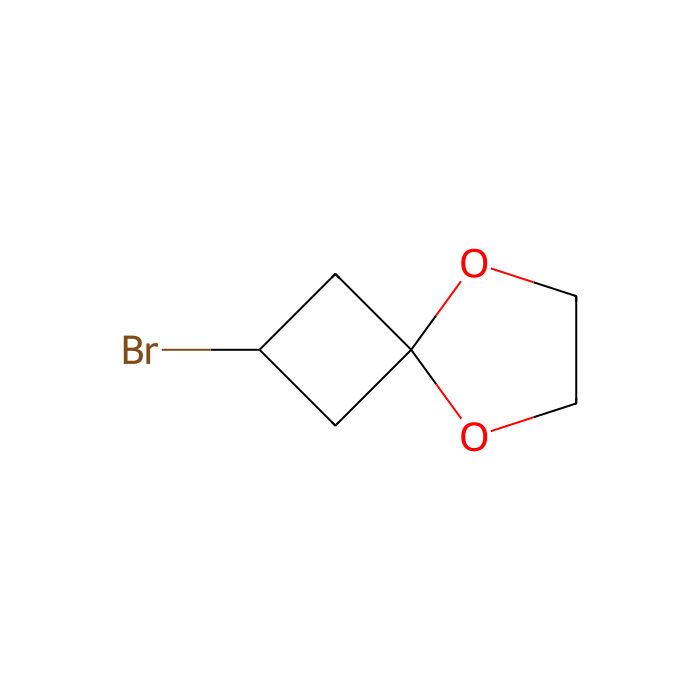
Brief overview: 2-bromo-5,8-dioxaspiro[3.4]octane is a brominated spiroacetal featuring a constrained bicyclic acetal (two oxygens) and a benzylic-like secondary bromide at the 2-position of the smaller ring. This makes it a compact electrophilic building block that can unmask a 1,2-diol after deprotection.
Product identifiers (item-specific):
SKU: B173052
Product Name: 2-bromo-5,8-dioxaspiro[3.4]octane
CAS: 1257996-82-9
PubChem CID: 67004316
InChIKey: 321682 (as provided)
SMILES: Not specified for this item; refer to CoA/Spec Sheet.
Molecular Formula: Not specified for this item; refer to CoA/Spec Sheet.
Molecular Weight: Not specified for this item; refer to CoA/Spec Sheet.
Structural features (general description based on name, literature):
Core scaffold: Spiro[3.4]octane, meaning two rings share a single tetrahedral carbon (the spiro center). The ring sizes are a 4-member fragment and a 5-member fragment totaling eight ring atoms when counted with the shared spiro atom (literature/interpretation).
Heteroatoms: Two oxygens incorporated as a cyclic acetal (a 1,3-dioxacycle fused at the spiro center), i.e., a spiroacetal/dioxolane-like substructure (literature).
Functional group: Secondary alkyl bromide at C-2 of the smaller ring, serving as the principal electrophilic handle (literature/interpretation).
Stereochemistry: The spiro center is tetrahedral; unless otherwise specified, this material is typically supplied as a racemate (no stereochemical specification provided for this item; consult CoA).
2D description in words (literature/interpretation): A five-membered 1,3-dioxacycle spiro-fused to a cyclobutane-like fragment; the carbon adjacent to one ring oxygen bears bromine, creating a constrained, oxygen-activated secondary bromide.
Synthetic Utility
Key reactive elements:
Secondary alkyl bromide: Good leaving group enabling SN2 substitution with a broad range of nucleophiles; potential for E2 elimination under strong base.
Spiroacetal (1,3-dioxacycle): Functions as a protecting group for a vicinal diol; stable to bases/nucleophiles under neutral to mildly basic conditions, but cleavable under acid.
SN2 displacement with NaN3, KCN, NaSR, NaOAc, or secondary amines (with base) to generate diverse functionalities.
Reductive functionalization via radical pathways (e.g., photoredox-catalyzed debromination or Giese additions) to access C–C bonds.
Preparation of alcohol derivatives: Displacement with alkoxides to forge new C–O bonds, or sequence: azide displacement → reduction → acetal deprotection → diol elaboration.
Convergent fragment coupling: Use as an electrophilic partner in PTC conditions to couple with water-soluble nucleophiles.
Retrosynthetic value:
The spiroacetal can be traced back to carbonyl + diol precursors; therefore, after diversification at the brominated center, selective acetal removal reveals orthogonal handles for late-stage diversification.
Practical considerations:
Stereochemical outcome: SN2 at a secondary center proceeds with inversion; the rigid spiro framework may influence rate/selectivity.
Competing pathways: Strong bases may promote E2 to form alkenes; acidic media may open the acetal. Use neutral, polar aprotic solvents for clean substitutions.
Workup: Avoid silica pretreated with acid; neutral silica/alumina or rapid basified workups help preserve the acetal.
Target Specificity
Not applicable. This product is a small-molecule chemical building block and is not an antibody, enzyme, or biological probe with defined target specificity. No target, epitope, clone, or isotype information applies.
We use cookies to ensure the website functions properly and, where permitted, to improve your experience. You can manage your preferences at any time in Settings. Learn more in our Cookie Policy.
Shall we send you a message when we have discounts available?
Remind me later
Thank you! Please check your email inbox to confirm.
Products are supplied to verified businesses, institutions, and qualified professionals for research and development use only. Not for use in humans, animals, diagnosis, or therapy.

 E2327890