Determine the necessary mass, volume, or concentration for preparing a solution.
A halogenated compound used for biochemical research.
Taxonomy Tree
| Kingdom | Organic compounds |
|---|---|
| Superclass | Organoheterocyclic compounds |
| Classe | Pyridines and derivatives |
| Subclass | Halopyridines |
| Intermediate Tree Nodes | Not available |
| Direct Parent | Polyhalopyridines |
| Alternative Parents | 2-halopyridines Aryl chlorides Aryl bromides Heteroaromatic compounds Azacyclic compounds Organopnictogen compounds Organonitrogen compounds Organochlorides Organobromides Hydrocarbon derivatives |
| Molecular Framework | Aromatic heteromonocyclic compounds |
| Substituents | Polyhalopyridine - 2-halopyridine - Aryl halide - Aryl chloride - Aryl bromide - Heteroaromatic compound - Azacycle - Organic nitrogen compound - Organopnictogen compound - Hydrocarbon derivative - Organonitrogen compound - Organochloride - Organobromide - Organohalogen compound - Aromatic heteromonocyclic compound |
| Descrizione | This compound belongs to the class of organic compounds known as polyhalopyridines. These are organic compounds containing a pyridine ring substituted at two or more positions by a halogen atom. |
| External Descriptors | Not available |
Find and download the COA for your product by matching the lot number on the packaging.
| Lot Number | Certificate Type | Data | Oggetto |
|---|---|---|---|
| Certificate of Analysis | Apr 03, 2025 | B136352 | |
| Certificate of Analysis | Apr 03, 2025 | B136352 | |
| Certificate of Analysis | Apr 03, 2025 | B136352 | |
| Certificate of Analysis | Apr 03, 2025 | B136352 | |
| Certificate of Analysis | Mar 05, 2025 | B136352 |
| Solubilità | soluble in MeOH |
|---|---|
| Sensibilità | Moisture sensitive |
| Punto di fusione (°C) | 90 °C |
| Peso molecolare | 192.44 |
| XLogP3 | 2.200 |
| Hydrogen Bond Donor Count | 0 |
| Hydrogen Bond Acceptor Count | 1 |
| Rotatable Bond Count | 0 |
| Exact Mass | 190.914 Da |
| Monoisotopic Mass | 190.914 Da |
| Topological Polar Surface Area | 12.900 Ų |
| Heavy Atom Count | 8 |
| Formal Charge | 0 |
| Complexity | 78.800 |
| Isotope Atom Count | 0 |
| Defined Atom Stereocenter Count | 0 |
| Undefined Atom Stereocenter Count | 0 |
| Defined Bond Stereocenter Count | 0 |
| Undefined Bond Stereocenter Count | 0 |
| The total count of all stereochemical bonds | 0 |
| Covalently-Bonded Unit Count | 1 |
H302:Harmful if swallowed
H312:Harmful in contact with skin
H315:Causes skin irritation
H318:Causes serious eye damage
H319:Causes serious eye irritation
H332:Harmful if inhaled
H335:May cause respiratory irritation
P261:Avoid breathing dust/fume/gas/mist/vapors/spray.
P264:Wash hands [and …] thoroughly after handling.
P270:Do not eat, drink or smoke when using this product.
P271:Use only outdoors or in a well-ventilated area.
P280:Wear protective gloves/protective clothing/eye protection/face protection.
P321:Specific treatment (see ... on this label).
P330:Rinse mouth.
P302+P352:IF ON SKIN: wash with plenty of water.
P304+P340:IF INHALED: Remove person to fresh air and keep comfortable for breathing.
P305+P351+P338:IF IN EYES: Rinse cautiously with water for several minutes. Remove contact lenses if present and easy to do - continue rinsing.
P362+P364:Take off contaminated clothing and wash it before reuse.
P405:Store locked up.
P403+P233:Store in a well-ventilated place. Keep container tightly closed.
P501:Dispose of contents/container to an approved waste disposal plant.
P264+P265:Wash hands [and …] thoroughly after handling. Do not touch eyes.
P301+P317:IF SWALLOWED: Get medical help.
P305+P354+P338:IF IN EYES: Immediately rinse with water for several minutes. Remove contact lenses if present and easy to do. Continue rinsing.
P317:Get emergency medical help.
P337+P317:If eye irritation persists: Get medical help.
P332+P317:If skin irritation occurs: Get medical help.
P319:Get medical help if you feel unwell.
Not applicable. No standardized bioassay or imaging protocols are associated with this small-molecule building block. For synthetic applications, refer to the Reaction Conditions and Synthetic Utility sections for representative procedures and optimization guidance.
This product is a synthetic heteroaromatic building block and is not intended for biological administration. No endogenous biological role is associated with 2-bromo-6-chloropyridine.
General context for chemists (not clinical/therapeutic claims):
Research Use Note: For research use only (per Product Data). Any biological testing should be performed on appropriately derivatized compounds with full safety and compliance review.
Not typically applicable. 2-Bromo-6-chloropyridine is a neutral, poorly water-soluble organic building block and is not used to formulate aqueous buffer systems. For experimental workflows involving this substrate, focus on the Solvent Selection, Reaction & Applications, and Synthetic Utility sections for relevant guidance.
Greener choices for processes involving 2-bromo-6-chloropyridine primarily concern solvent and catalyst selection. Replace traditional high-toxicity or high-VOC solvents and minimize precious-metal loadings where feasible.
Comparison snapshot (general):
| Use case | Conventional | Greener alternative | Trade-offs | |---|---|---|---| | Suzuki in THF/H2O | THF | 2-MeTHF/H2O | Slightly different solubility; similar performance with base tuning | | Amination in toluene | Toluene | CPME or anisole | Higher bp aids heat; may require ligand/base re-optimization | | Workup/partition | DCM | EtOAc | Slower phase disengagement with some salts; safer profile |
Remember: Verify stability of this dihalopyridine in new solvent matrices and ensure acceptable impurity profiles before scale-up.
No excipient or pharmacopeial status is specified for this item; it is supplied for research use only.
Context for process and medicinal chemists (general, non-clinical):
No therapeutic or clinical claims are made or implied for this product.
Item-specific specifications are not provided in the Product Data; refer to the CoA/Spec Sheet for guaranteed values. The following are literature/general properties to guide method development (not certificate specifications):
Always confirm critical parameters experimentally under your specific conditions and by consulting the SDS/CoA for authoritative values.
Context for professional users (general guidance):
If your application demands HPLC-grade solvents or metal-screened reagents during coupling, align internal SOPs with target impurity specifications prior to campaign manufacture.
2-Bromo-6-chloropyridine is a versatile dihalopyridine enabling orthogonal functionalization. The C–Br bond is generally more reactive than C–Cl, allowing sequential coupling strategies.
The following are representative literature-style conditions for method development (general guidance; not item-specific specifications):
Suzuki–Miyaura at C–Br (selective):
Buchwald–Hartwig amination at C–Cl (after C–Br functionalization):
Negishi/Kumada couplings:
Halogen–lithium exchange (on C–Br):
N-oxide/SNAr route:
Always verify selectivity between C–Br and C–Cl under your catalyst system; ligand choice is pivotal for engaging the aryl chloride.
Safety classifications (GHS signal word, hazard statements, pictograms) are not specified in the Product Data for this item. Always consult the product SDS for authoritative hazard information before use. The following guidance reflects general practices for halogenated heteroaromatics.
As a neutral, moderately polar heteroaromatic, 2-bromo-6-chloropyridine dissolves well in many organic solvents. Selection should be driven by the planned transformation (e.g., cross-coupling, lithiation, or SNAr) and workup considerations.
Always consult the SDS for detailed handling and storage safety information. For extended storage after opening, re-purge the container headspace with argon before re-sealing.
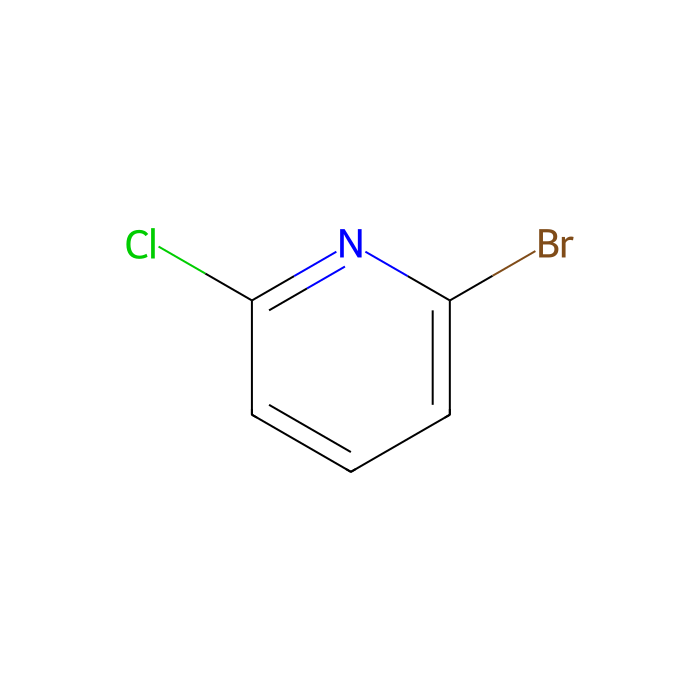
A dihalogenated heteroaromatic building block featuring a pyridine ring bearing bromine at C2 and chlorine at C6 (both α to the ring nitrogen). Suitable for orthogonal halogen chemistry.
Note: Where an exact identifier is not present in Product Data, literature values are supplied for chemical context only.
Key features that make 2-bromo-6-chloropyridine valuable in synthesis:
Practical: Begin with the bromide for high-yield couplings; reserve the chloride for the second, more demanding transformation, selecting ligands that specifically accelerate C–Cl activation.
Not applicable. This product is a small-molecule chemical building block, not a biological targeting reagent (e.g., antibody, enzyme inhibitor standard, or probe). No antigen, epitope, or species reactivity information applies.