≥97%(GC) per flussi di lavoro cromatografici e analitici sensibili che richiedono un'interferenza minima della linea di base.
🌡
Stoccaggio e spedizione
Room temperature Spedizione Normal. Consultare il COA specifico del lotto per le specifiche esatte.
📋
Documenti di qualità
SDS, COA, scheda tecnica e scheda delle specifiche disponibili per il download. COA specifico del lotto accessibile tramite ricerca per numero di lotto.
📚
Prova documentale
Citato in 0 pubblicazioni peer-reviewed su cromatografia, sintesi organica e reazioni di accoppiamento incrociato.
This compound belongs to the class of organic compounds known as pyridinecarboxylic acids. These are compounds containing a pyridine ring bearing a carboxylic acid group.
External Descriptors
Not available
1. Djoumbou Feunang Y, Eisner R, Knox C, Chepelev L, Hastings J, Owen G, Fahy E, Steinbeck C, Subramanian S, Bolton E, Greiner R, and Wishart DS. ClassyFire: Automated Chemical Classification With A Comprehensive, Computable Taxonomy. Journal of Cheminformatics, 2016, 8:61.
Determine the necessary mass, volume, or concentration for preparing a solution.
Dilution Calculator
Determine the dilution needed to prepare a stock solution.
Reconstitution Calculator
Recensioni
Recensioni dei clienti
Application Protocols
No vendor-tested bioassay protocols are specified for this small-molecule building block. Typical usage is in synthetic organic chemistry. For reaction setup:
Weigh the solid under a fume hood; minimize hygroscopic exposure if converting to acid chloride or performing moisture-sensitive couplings.
Choose solvent/base as outlined under Reaction Conditions and Solvent Selection.
Monitor reactions by HPLC/UPLC or TLC with appropriate visualization (UV 254 nm; stain if needed). Carboxylic acids often show as streaks on silica unless esterified or run with acid modifiers.
Workup: Neutralize bases/acids appropriately. Acidify aqueous layers to pH ~2–3 to precipitate the free acid for isolation (general practice), then filter and dry under reduced pressure.
For any specialized application (e.g., high-throughput library synthesis, flow chemistry), adapt concentrations, residence times, and supported catalysts accordingly. Always validate on small scale before scale-up.
Biological Roles
This product is supplied strictly for research use; no clinical or diagnostic claims are made.
General, literature-based context on structural class:
Nicotinic acid (pyridine-3-carboxylic acid) is a known biological motif. Substitution at the 2- and 6-positions (chloro and hydroxy) substantially alters physicochemical properties, acidity, and potential interactions with biomolecules compared to niacin itself.
The 2,6-disubstituted pattern can modulate hydrogen-bonding and metal-binding behavior relative to unsubstituted nicotinic acid, potentially relevant in coordination studies or as a heteroarene fragment in probe development.
The 6-hydroxypyridine/pyridone tautomerism may influence binding modes in enzyme or receptor model systems (as hydrogen-bond donor/acceptor switching), though specific biological targets for this exact compound are not established in the public domain.
Applications in biochemical research (non-clinical):
Fragment-based screening or structure–activity relationship (SAR) exploration around nicotinic-acid-derived chemotypes.
Model substrate for studying SNAr/cross-coupling effects on heteroarene fragments under biocompatible conditions (e.g., late-stage diversification for probe synthesis).
Important: Any assessment of biological activity, ADME, or toxicity requires dedicated studies. For this catalog item, no biological role or activity is specified; consult primary literature if using as a fragment or scaffold in biochemical research.
Buffer Applications
Not typically used as a classical buffering agent. As a heteroaromatic di-acidic functionality (carboxylic acid and phenolic OH), it does not constitute a defined, widely used buffer system with a conventional, narrow pH working range.
Practical notes (if handling in aqueous media):
Solubility increases markedly upon neutralization to its carboxylate salt (e.g., with NaHCO3/K2CO3). This can aid in preparing stock solutions for synthetic or analytical workflows.
If pH control is required in processes (e.g., coupling in aqueous-organic media), use established buffers (phosphate, acetate, bicarbonate, TRIS, HEPES). Choose buffers with minimal nucleophilicity if preserving the aryl chloride is crucial.
Recommendation:
For bioconjugation-like conditions or aqueous coupling, employ standard buffers in the appropriate pH range for your reaction (often pH 7–10). This compound itself should be considered a substrate, not a buffer component.
Green Alternatives
Opportunities to improve sustainability relate mainly to solvent, base, and coupling reagent selection, since the substrate is fixed.
Greener solvent choices (literature-based):
Replace DMF/NMP with safer polar aprotics such as Cyrene, propylene carbonate (PC), or dimethyl carbonate (DMC) when compatible with the reaction (e.g., some SNAr and Suzuki couplings).
Use bio-based ethers such as 2-MeTHF for coupling reactions when substrate solubility allows; CPME is another low-peroxide, hydrophobic option.
For amidations/esterifications, consider ethanol or water/ethanol mixtures with water-soluble carbodiimides.
Greener bases and reagents:
Favor inorganic bases with lower EHS burdens (K2CO3, Cs2CO3) over strong, hazardous bases where feasible.
For amide couplings, use catalytic coupling strategies (e.g., catalytic DMAP with green activating agents) or modern reagents with improved safety profiles; consider enzyme-catalyzed amidation/esterification in aqueous media for library generation.
Comparison snapshot (general):
DMF/NMP: excellent solvation, but reproductive toxicity concerns; disposal burden higher.
PC/Cyrene: lower toxicity; higher viscosity may require temperature or dilution.
2-MeTHF/CPME: renewable or safer peroxide profiles; hydrophobic—may need co-solvent for ionic substrates.
Process tips:
Exploit pH-switch crystallization to minimize chromatographic purification.
Use aqueous micellar catalysis for cross-couplings to reduce organic solvent volumes (surfactants like TPGS-750-M have precedent in literature).
Pharmaceutical Uses
No excipient grade or pharmacopeial status is specified for this item; it is supplied for research use only.
General, non-clinical context (literature-based):
Nicotinic-acid-derived heteroarenes are common scaffolds in discovery chemistry. 2-Chloro-6-hydroxynicotinic acid can serve as a synthetic intermediate to generate amide, ester, ether, and biaryl derivatives for structure–property exploration.
The carboxylic acid can be converted to prodrug-like esters or activated intermediates during lead optimization studies (purely in research settings). The 2-chloro handle enables cross-coupling to access substituted analogs.
Formulation/manufacturing relevance (general):
As a solid heteroaromatic acid, it is not typically used as a pharmaceutical excipient. If derivatives are pursued, control of residual solvents, polymorph, and salt form could become relevant in later-stage research, but no such claims are made for this catalog item.
Important: No therapeutic or clinical uses are claimed or implied for this product. For any work approaching regulated development, obtain GMP-grade materials and comprehensive characterization per applicable guidelines.
Physical Properties
Item-specific specifications (this product):
Appearance: Not specified for this item; refer to CoA/Spec Sheet.
Grade/Purity: Not specified for this item; refer to CoA/Spec Sheet.
Molecular Formula: Not specified for this item; refer to CoA/Spec Sheet.
Molecular Weight: Not specified for this item; refer to CoA/Spec Sheet.
Literature/estimated properties (for general reference only; not product specifications):
Molecular formula (literature): C6H4ClNO3
Molecular weight (literature): ~173.45 g/mol
Acid–base profile (literature, qualitative):
Carboxylic acid pKa typically in the ~3–5 range for nicotinic acid derivatives; electron-withdrawing 2-Cl and 6-OH/pyridone can modestly modulate this.
Phenolic OH pKa often in the ~9–11 range on heteroarenes; intramolecular H-bonding and tautomerism can shift effective acidity.
Ring nitrogen basicity (pKaH) is low (often ~1–2 for nicotinic acids) and further reduced by adjacent EWGs.
Solubility (qualitative, literature): sparingly soluble in nonpolar solvents; increased solubility in polar protic/aprotic solvents and under basic conditions (carboxylate salt formation). Alcohols, DMF/DMSO, and aqueous base typically dissolve well.
LogP/logD: expected low to moderate hydrophilicity due to –CO2H and –OH (literature expectation; data-dependent on pH/tautomer).
Thermal behavior: no item-specific MP/BP available. Many nicotinic acid derivatives are crystalline solids with decomposition near/above melting; exact values should be taken from CoA/SDS for this lot.
Note: Use the product CoA for any numerical specifications required for method development or regulatory documentation.
Quality and Grades
Item-specific quality details:
Grade/Purity: Not specified for this item; refer to CoA/Spec Sheet.
Stabilizers/Additives: Not specified for this item; refer to CoA/Spec Sheet.
How to interpret typical grades (general guidance for research chemicals):
Research/technical grade: Fit for general laboratory synthesis and screening, typically meeting internal purity criteria (e.g., NMR/HPLC area %). Trace impurity limits (water, metals, residual solvents) vary by supplier and batch.
Analytical/HPLC grade (if offered): Tight UV cutoffs and low fluorescent background; suitable for trace analytics. Not claimed unless explicitly stated in the product listing.
Low-water or anhydrous designations: Relevant to moisture-sensitive reactions; not typically applicable to carboxylic acid solids unless a special drying specification is provided.
Verification & documentation:
For this product, consult the Aladdin CoA for: purity assay method (e.g., HPLC, qNMR), residual solvent profile, and identity confirmation (NMR, IR, MS). If your application is cross-coupling or SNAr, review metal content data if provided.
If UV-transparent performance is needed (analytical method development), request a spectrum or HPLC baseline data.
Practical tips:
If particle size or polymorph can affect your process (e.g., slurry handling, filtration), inquire about lot-specific information.
For regulated workflows, maintain traceability by archiving CoA lot numbers and any supplementary QC reports.
Reaction and Applications
As a 2-chloro-6-hydroxynicotinic acid, this scaffold offers complementary handles for derivatization of the pyridine ring and the carboxylate.
Palladium-catalyzed cross-couplings (Suzuki–Miyaura, Buchwald–Hartwig, Sonogashira). The 2-chloro position adjacent to N is activated; use electron-rich ligands/catalyst systems amenable to heteroaryl chlorides.
SNAr with hard nucleophiles (e.g., alkoxides, amines) under basic/thermal conditions, aided by the ring N and 3-CO2H as activating groups.
Hydroxy/pyridone handle:
O-alkylation or O-acylation to access ethers/esters; under basic conditions the 6-oxyanion forms readily (consider N- vs O-selectivity depending on tautomerism and conditions).
Directed metalation or coordination chemistry exploiting the 6-pyridone tautomer and adjacent N.
Carboxylic acid elaboration:
Amidation (carbodiimide/HOBt, HATU, or mixed anhydride methods) to produce amides of heteroaromatic scaffolds.
Esterification (Fischer or via acid chloride) for protection/solubility tuning; subsequent transesterification or hydrolysis for deprotection.
Use contexts:
Heteroarene libraries for medicinal chemistry (scaffold hopping around nicotinic acid motifs).
Ligand design and coordination compounds where 2,6-heteroatom patterning supports chelation.
Precursors to biaryl systems via C2 coupling while preserving or later manipulating the 6-OH and 3-CO2H.
Practical tips:
Control speciation (acid vs carboxylate; hydroxypyridine vs pyridone) with solvent and base to steer O- vs N-alkylation and coupling selectivity.
Protect the acid if incompatibilities (e.g., with strong bases/nucleophiles) are anticipated.
Reaction Conditions
General literature-based conditions for typical transformations (provide starting points; optimize per system):
Suzuki–Miyaura coupling at C(2)–Cl:
Catalyst: Pd2(dba)3 (1–2 mol%) with SPhos/XPhos (2–4 mol%) or Pd(OAc)2 with RuPhos.
Base: K3PO4 or Cs2CO3 (2–3 equiv).
Solvent: 1,4-dioxane/H2O or toluene/H2O; greener options include 2-MeTHF/H2O or aqueous micellar media.
Temp/time: 60–100 °C, 4–16 h. Heteroaryl chlorides may require the higher end of temperature.
Buchwald–Hartwig amination:
Catalyst/ligand: Pd2(dba)3 with BrettPhos or tBuBrettPhos; or Pd-PEPPSI-type precatalysts.
Base: NaOtBu, KOtBu, or Cs2CO3.
Solvent: Toluene, dioxane, or CPME; 80–110 °C.
SNAr with alkoxides/amines:
Base: NaOMe/NaOtBu or K2CO3 (for amines).
Solvent: MeOH, DMF, or DMSO; 50–120 °C depending on nucleophile strength.
O-alkylation of 6-OH:
Base: K2CO3 or Cs2CO3 (1.5–2 equiv).
Electrophile: alkyl halide/sulfate.
Solvent: Acetone, acetonitrile, or DMF; 25–70 °C.
Amidation of 3-CO2H:
Activators: EDC·HCl/HOBt, HATU, or CDI (for imidazolide formation).
Base: DIPEA or NMM.
Solvent: DMF, DCM (if soluble), or MeCN; 0–25 °C to start, then warm as needed.
Notes:
Tautomer control: More polar, basic media favor pyridone character; this can impact N- vs O-alkylation outcomes.
Protecting groups: As needed, protect –CO2H (as methyl/benzyl ester) to avoid salt formation and to improve organic solubility for couplings.
Safety and Handling
Hazard data for this specific item:
Signal Word: Not specified for this item; refer to SDS.
H-Statements: Not specified for this item; refer to SDS.
GHS Classification/Pictograms: Not specified for this item; refer to SDS.
General safety considerations for halogenated heteroaromatic carboxylic acids (literature-based guidance):
Irritation/sensitization: Carboxylic acids and phenolic OH can cause skin/eye irritation. Avoid contact and inhalation of dusts.
PPE: Lab coat, safety glasses or chemical splash goggles, and suitable gloves (e.g., nitrile). Use a dust mask or respirator if airborne particulates may form and engineering controls are insufficient (per institutional policy).
Engineering controls: Handle powders in a fume hood to avoid dust exposure. Utilize local exhaust during weighing and transfers.
Incompatibilities: Strong oxidizers (general caution). Strong bases will form salts; strong acids may promote dehydration/side reactions at elevated temperatures. Avoid reactive acid chlorinating agents unless intended for synthesis.
Thermal stability: Many nicotinic acid derivatives char/decompose upon overheating rather than boiling; avoid open heating. Use oil-bath or controlled blocks and monitor closely.
First aid (overview; defer to SDS):
Skin/eye contact: Rinse with water for ≥15 minutes; remove contaminated clothing; seek medical attention if irritation persists.
Inhalation: Move to fresh air; seek medical attention if symptoms occur.
Ingestion: Rinse mouth; do not induce vomiting; seek medical advice.
Always consult the product-specific SDS for authoritative hazard, exposure limits, and spill/cleanup procedures.
Solvent Selection
This compound is a moderately polar, multifunctional heteroaromatic acid. Solvent choice should balance dissolution of the acid (or its salt) and compatibility with downstream chemistry.
Polarity class (general): polar protic/aprotic compatible; poor solubility in nonpolar hydrocarbons.
Good: DMSO, DMF, DMAc, NMP; ethanol/methanol; aqueous base (carboxylate salt formation greatly enhances solubility).
Moderate: Acetone, acetonitrile (may need warming or small base additive).
Poor: Hexanes, toluene, MTBE (as free acid).
pH leverage: Dissolve as the sodium/potassium carboxylate in water or mixed aqueous-organic media for bioconjugation-like workflows or salt-coupling steps; acidify post-reaction for isolation.
When to choose this substrate vs alternatives:
Compared to unsubstituted nicotinic acid, the 2-Cl and 6-OH motifs enable orthogonal reactivity (SNAr/cross-coupling from C–Cl; O-functionalization/metalation from C6–OH/pyridone tautomer).
For cross-couplings, use polar aprotics (DMF/DMAc/NMP) or high-boiling alcohols; water/organic micellar media can work with appropriate catalyst systems.
Small comparison (literature-based):
DMSO/DMF: maximizes solubility and SNAr kinetics; harder to remove, consider aqueous workup with salt crash-out.
Alcohols (MeOH/EtOH): greener profile; may require base and heat for dissolution and can transesterify acid chlorides.
Aqueous carbonate/bicarbonate: excellent for salt formation and phase-switch strategies; may suppress some electrophile reactivity.
Storage and Reconstitution
Item-specific conditions:
Storage Conditions: Room temperature (as provided in Product Data).
Shipped In: Normal (ambient) conditions.
General handling and reconstitution guidance:
Keep container tightly closed in a dry, well-ventilated place. Protect from prolonged exposure to moisture to avoid inadvertent salt formation or caking.
If preparing stock solutions:
Organic stocks: Dissolve in DMSO, DMF, or alcohols to desired concentration; store aliquots in airtight vials. Assess stability before long-term storage.
Aqueous stocks: Dissolve with mild base (e.g., NaHCO3) to form the carboxylate; filter-sterilize if needed for analytical workflows. Adjust pH to target value. Note that prolonged storage in basic solution may promote hydrolysis of sensitive derivatives (if present).
Drying: If needed prior to moisture-sensitive transformations (e.g., acid chloride formation), dry under high vacuum over P2O5 or in a desiccator. Avoid excessive heat.
Freeze–thaw: Not generally applicable to the solid. For solutions, minimize freeze–thaw cycles by aliquoting.
Stability note:
No stabilizers are specified for this item. Consult the CoA/SDS for any lot-specific stability information and recommended shelf life.
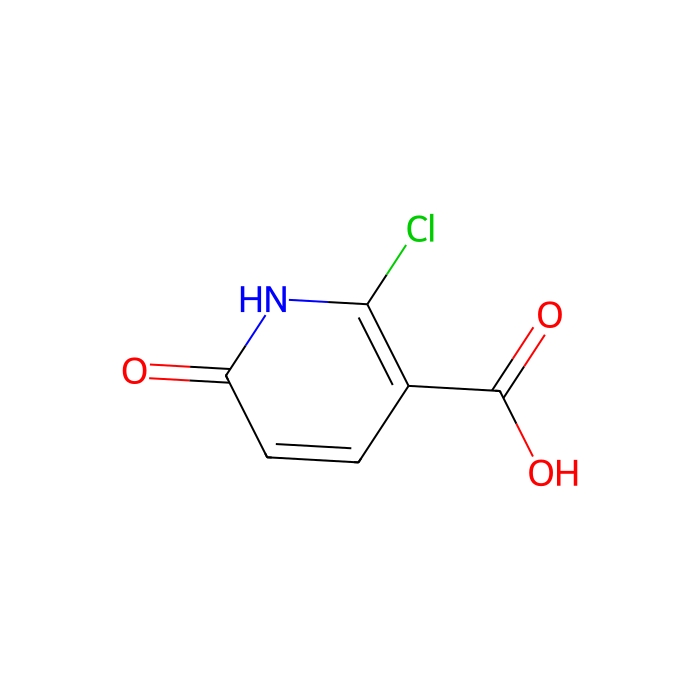
Structure and Identity
A halogenated, hydroxy-substituted nicotinic acid derivative featuring both acidic and heteroaromatic functionality; useful as a bifunctional building block in heteroarene chemistry.
InChIKey (item-specific): Not specified for this item; refer to CoA/Spec Sheet.
SMILES (literature): O=C(O)c1nc(Cl)ccc1O
Molecular formula (literature): C6H4ClNO3
Molecular weight (literature): ~173.45 g/mol
Structural features (general, literature-based):
Core ring system: a pyridine (nicotinic acid) ring bearing a carboxylic acid at the 3-position (pyridine-3-carboxylic acid framework).
Substituents: chloro at C-2 (α to the ring nitrogen) and hydroxy at C-6 (the other α position), creating a 2,6-disubstituted pattern around the ring nitrogen.
Functional groups: carboxylic acid (–CO2H), phenolic/aryl hydroxyl (–OH) that can tautomerize with the ring nitrogen (pyridone–pyridinol tautomerism), and an aryl chloride (C–Cl) amenable to cross-coupling or SNAr under activating conditions.
2D structure in words: a six-membered aromatic ring containing one nitrogen (pyridine). Moving clockwise from the ring nitrogen (position 1), position 2 carries chlorine, position 3 carries the carboxylic acid, positions 4 and 5 are unsubstituted carbons, and position 6 carries a phenolic OH.
Notes:
Tautomerism between 6-hydroxypyridine and 6-pyridone forms may influence acidity, N basicity, and reactivity in polar media (literature).
Synthetic Utility
Key reactive elements and their strategic value (literature-based):
C(2)–Cl (heteroaryl chloride):
Cross-coupling platform to install aryl, heteroaryl, alkynyl, or amine substituents (Suzuki, Buchwald–Hartwig, Sonogashira). Heteroaryl chlorides often benefit from electron-rich ligands and optimized bases.
SNAr handle with hard nucleophiles (alkoxides, primary amines) under thermal or microwave conditions; ring N and 3-CO2H enhance activation.
6-HO (pyridinol/pyridone):
O-alkylation/acylation to modulate lipophilicity and block tautomerism; potential for selective derivatization via transient silylation or phase-transfer.
Tautomeric keto (pyridone) form can alter regioselectivity and chelation, enabling directed transformations.
3-CO2H:
Convergent amide coupling to introduce diverse amines. Masking as esters facilitates protecting-group strategies or enables orthogonal reactions at C(2) and C(6).
Retrosynthetic perspective:
The scaffold enables branching syntheses: first elaborate C(2) via coupling, protect/modify 6-OH, then functionalize the acid. Alternatively, preform amides/esters, then cross-couple.
Practical guidance:
Control acid/base state to minimize competing salt formation that can sequester catalysts. Carboxylate salts may reduce solubility in nonpolar media; consider in situ acidification for extraction.
If forming the acid chloride, manage competitive decarboxylation or intramolecular acylation by using mild reagents (e.g., Ghosez’s reagent or mixed anhydrides) and low temperatures.
Target Specificity
Not applicable. This product is a small-molecule reagent, not an antibody, enzyme, or affinity reagent. No antigen/epitope specificity, clone, isotype, or species reactivity applies.
Domande frequenti
What is the purity of this product, and how is it determined?
This product is supplied at ≥97% purity, determined by gas chromatography (GC). Lot-specific values are stated on the Certificate of Analysis.
How should this product be stored?
Store at room temperature.
How is this product shipped?
This product ships under standard ambient conditions. No temperature-controlled packaging is required.
What are the CAS number, molecular formula and molecular weight?
The CAS Number is 38025-90-0, the molecular formula is C6H4ClNO3, and the molecular weight is 173.55 g/mol. InChIKey BSCFFOOWFVZSSK-UHFFFAOYSA-N.
What documentation is provided?
Available product documentation, including Certificates of Analysis (COA), Safety Data Sheets (SDS), and specification sheets, is shown in the product document area. Document availability and access follow the current site policy.
Utilizziamo i cookie per garantire il corretto funzionamento del sito web e, ove consentito, per migliorare la tua esperienza. Puoi gestire le tue preferenze in qualsiasi momento nelle Impostazioni. Per saperne di più, consulta la nostra Cookie Policy.
Desidera che le inviamo un messaggio quando avremo sconti disponibili?
Ricordamelo più tardi
Grazie! Controlli la sua casella di posta per confermare.
Products are supplied to verified businesses, institutions, and qualified professionals for research and development use only. Not for use in humans, animals, diagnosis, or therapy.

 D1710106