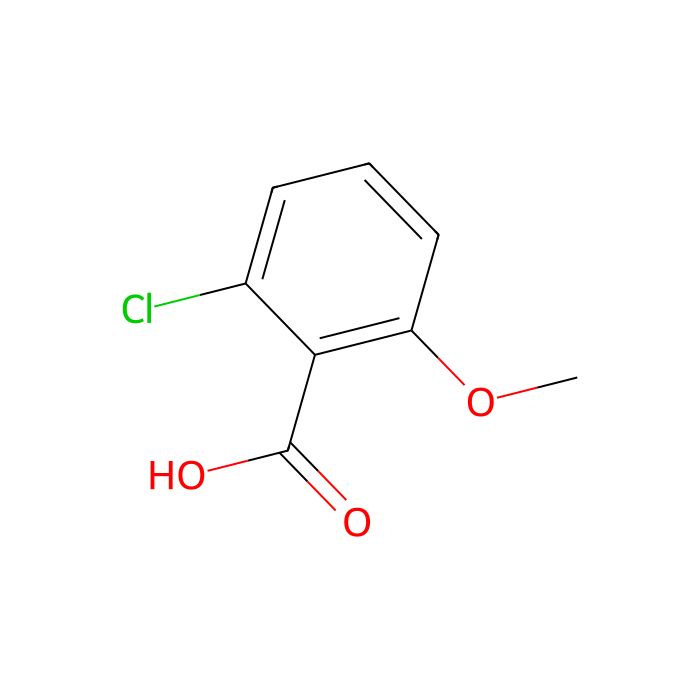
Determine the necessary mass, volume, or concentration for preparing a solution.
Taxonomy Tree
| Kingdom | Organic compounds |
|---|---|
| Superclass | Benzenoids |
| Classe | Benzene and substituted derivatives |
| Subclass | Benzoic acids and derivatives |
| Intermediate Tree Nodes | Methoxybenzoic acids and derivatives |
| Direct Parent | O-methoxybenzoic acids and derivatives |
| Alternative Parents | 2-halobenzoic acids Halobenzoic acids Benzoic acids 1-carboxy-2-haloaromatic compounds Phenoxy compounds Anisoles Methoxybenzenes Benzoyl derivatives Alkyl aryl ethers Chlorobenzenes Aryl chlorides Vinylogous halides Monocarboxylic acids and derivatives Organic oxides Organochlorides Hydrocarbon derivatives |
| Molecular Framework | Aromatic homomonocyclic compounds |
| Substituents | O-methoxybenzoic acid or derivatives - 2-halobenzoic acid or derivatives - Halobenzoic acid or derivatives - 2-halobenzoic acid - Halobenzoic acid - Benzoic acid - Methoxybenzene - Anisole - 1-carboxy-2-haloaromatic compound - Phenol ether - Benzoyl - Phenoxy compound - Alkyl aryl ether - Halobenzene - Chlorobenzene - Aryl chloride - Aryl halide - Vinylogous halide - Carboxylic acid derivative - Carboxylic acid - Monocarboxylic acid or derivatives - Ether - Organohalogen compound - Organochloride - Organooxygen compound - Organic oxygen compound - Organic oxide - Hydrocarbon derivative - Aromatic homomonocyclic compound |
| Descrizione | This compound belongs to the class of organic compounds known as o-methoxybenzoic acids and derivatives. These are benzoic acids in which the hydrogen atom at position 2 of the benzene ring is replaced by a methoxy group. |
| External Descriptors | Not available |
Find and download the COA for your product by matching the lot number on the packaging.
| Lot Number | Certificate Type | Data | Oggetto |
|---|---|---|---|
| Certificate of Analysis | Jul 17, 2024 | C192742 | |
| Certificate of Analysis | Jul 17, 2024 | C192742 | |
| Certificate of Analysis | Jul 17, 2024 | C192742 | |
| Certificate of Analysis | Jul 17, 2024 | C192742 | |
| Certificate of Analysis | Jul 17, 2024 | C192742 | |
| Certificate of Analysis | Jul 17, 2024 | C192742 |
| Peso molecolare | 186.59 |
|---|---|
| XLogP3 | 1.200 |
| Hydrogen Bond Donor Count | 1 |
| Hydrogen Bond Acceptor Count | 3 |
| Rotatable Bond Count | 2 |
| Exact Mass | 186.008 Da |
| Monoisotopic Mass | 186.008 Da |
| Topological Polar Surface Area | 46.500 Ų |
| Heavy Atom Count | 12 |
| Formal Charge | 0 |
| Complexity | 172.000 |
| Isotope Atom Count | 0 |
| Defined Atom Stereocenter Count | 0 |
| Undefined Atom Stereocenter Count | 0 |
| Defined Bond Stereocenter Count | 0 |
| Undefined Bond Stereocenter Count | 0 |
| The total count of all stereochemical bonds | 0 |
| Covalently-Bonded Unit Count | 1 |
H302:Harmful if swallowed
H315:Causes skin irritation
H319:Causes serious eye irritation
H335:May cause respiratory irritation
P261:Avoid breathing dust/fume/gas/mist/vapors/spray.
P264:Wash hands [and …] thoroughly after handling.
P270:Do not eat, drink or smoke when using this product.
P271:Use only outdoors or in a well-ventilated area.
P280:Wear protective gloves/protective clothing/eye protection/face protection.
P321:Specific treatment (see ... on this label).
P330:Rinse mouth.
P302+P352:IF ON SKIN: wash with plenty of water.
P304+P340:IF INHALED: Remove person to fresh air and keep comfortable for breathing.
P305+P351+P338:IF IN EYES: Rinse cautiously with water for several minutes. Remove contact lenses if present and easy to do - continue rinsing.
P362+P364:Take off contaminated clothing and wash it before reuse.
P405:Store locked up.
P403+P233:Store in a well-ventilated place. Keep container tightly closed.
P501:Dispose of contents/container to an approved waste disposal plant.
P264+P265:Wash hands [and …] thoroughly after handling. Do not touch eyes.
P301+P317:IF SWALLOWED: Get medical help.
P337+P317:If eye irritation persists: Get medical help.
P332+P317:If skin irritation occurs: Get medical help.
P319:Get medical help if you feel unwell.
No item-specific, validated protocols are provided for this product.
General laboratory workflows (literature/practice-based; adapt to your system):
Always perform appropriate controls and safety assessments. For detailed, step-by-step SOPs, consult primary literature or internal method repositories.
This product is a synthetic aromatic carboxylic acid and is not a native metabolite or cofactor. No item-specific biological data are provided.
General, literature-based context (not product-specific):
No claims are made regarding pharmacology, toxicity thresholds, or clinical relevance. For any biological testing, ensure appropriate controls, and consult institutional biosafety guidance.
Not typically used as a buffering agent.
For pH control, select established buffers (e.g., acetate, phosphate, Tris, HEPES) matched to your target pH range.
While the substance itself is a target/intermediate rather than a solvent, greener choices can be made around how it is synthesized, coupled, and processed (literature guidance):
Illustrative comparison (general):
Trade-offs must be balanced against solubility, reaction rates, and selectivity; verify with small-scale trials.
No item-specific pharmacopeial status or excipient role is provided for this product.
General formulation/manufacturing context (literature-based; not a therapeutic claim):
If a compendial grade (USP/EP) or GMP documentation is required, contact Aladdin Scientific for availability; otherwise, this catalog item is intended for research use only.
Item-specific specifications: Not specified for this item; refer to CoA/Spec Sheet.
Literature/general properties for 2-chloro-6-methoxybenzoic acid (for reference only; not product specifications):
Practical implications:
Always confirm exact values (mp, purity, residuals, water content, UV cutoff, etc.) from the item’s CoA/Spec Sheet before method development.
How to interpret common grades for this compound class (general guidance; not product-specific):
Recommendations:
As an ortho-disubstituted benzoic acid bearing an aryl chloride and a methoxy group, 2-chloro-6-methoxybenzoic acid is a versatile aromatic building block. Typical research uses (literature-based; expand as suitable):
Applications include preparation of substituted salicylic-acid analogs, herbicide/pigment intermediates, and SAR libraries where para Cl/OMe relationship modulates electronics and sterics.
General literature guidance for typical transformations with 2-chloro-6-methoxybenzoic acid (verify and optimize for your system):
Yields vary with substrates/conditions; run small-scale screens to optimize ligand/base/solvent combinations, especially for aryl-chloride activation.
General safety considerations for halogenated aromatic carboxylic acids (literature/experience-based guidance; not product-specific):
This product is a solid building block rather than a solvent. Solvent choice pertains to its dissolution and use in synthesis/processing.
Small comparison (literature guidance):
Always confirm solvent compatibility with chosen reagents/catalysts and consult CoA for any solvent-residual constraints.
Item-specific storage and shipping (from Product Data):
Additional handling guidance (general; not product-specific):
Reconstitution: As a small-molecule solid, no aqueous reconstitution is required by default. For stock solutions, typical research concentrations are 10–100 mM in DMSO or MeOH; filter through 0.2 µm PTFE/RC if particulate is present.
For definitive storage limits, solution stability, and retest dates, consult the product’s CoA/Spec Sheet and SDS.
A halogenated, ortho-disubstituted benzoic acid featuring an electron-donating methoxy group and an electron-withdrawing chloro substituent para to one another across the aromatic ring.
Notes: Where literature identifiers differ from catalog entries, defer to the product CoA/Spec Sheet for definitive item-specific identity data.
Key functional elements and how they can be exploited (literature/practice-based guidance):
Retrosynthetic value:
Purification tips:
Not applicable. This product is a small-molecule chemical and not an antibody, enzyme, or targeted biological reagent.