≥97% per flussi di lavoro cromatografici e analitici sensibili che richiedono un'interferenza minima della linea di base.
🌡
Stoccaggio e spedizione
Room temperature Spedizione Normal. Consultare il COA specifico del lotto per le specifiche esatte.
📋
Documenti di qualità
SDS, COA, scheda tecnica e scheda delle specifiche disponibili per il download. COA specifico del lotto accessibile tramite ricerca per numero di lotto.
📚
Prova documentale
Citato in 1 pubblicazioni peer-reviewed su cromatografia, sintesi organica e reazioni di accoppiamento incrociato.
Panoramica
2-Chlorobenzimidazole can be synthesized by reacting benzimidazole-2-one with phosphoryl chloride in the presence of phenol;
Application:
2-Chlorobenzimidazole can be used to synthesize the following:
1-methyl-2-chlorobenzimidazole via reaction with dimethyl sulfate;
1-ethyl-2-chlorobenzimidazole via reaction with diethyl sulfate;
1-benzyl-2-chlorobenzimidazole via reaction with benzyl chloride;
2-chloro-4,5,6,7-tetrabromobenzimidazole via bromination with bromine;
It may be used as a building block to synthesize 4-amino-6-benzimidazole-pyrimidines;
This compound belongs to the class of organic compounds known as benzimidazoles. These are organic compounds containing a benzene ring fused to an imidazole ring (five member ring containing a nitrogen atom, 4 carbon atoms, and two double bonds).
External Descriptors
Not available
1. Djoumbou Feunang Y, Eisner R, Knox C, Chepelev L, Hastings J, Owen G, Fahy E, Steinbeck C, Subramanian S, Bolton E, Greiner R, and Wishart DS. ClassyFire: Automated Chemical Classification With A Comprehensive, Computable Taxonomy. Journal of Cheminformatics, 2016, 8:61.
Determine the necessary mass, volume, or concentration for preparing a solution.
Dilution Calculator
Determine the dilution needed to prepare a stock solution.
Reconstitution Calculator
Recensioni
Recensioni dei clienti
Application Protocols
No vendor-validated biological assay protocols are provided for this item. As a synthetic intermediate, application conditions are reaction-specific. See the Reaction Conditions section for literature guidance on SNAr and cross-coupling. For analytical handling:
NMR sample prep (general): Dissolve 5–20 mg in 0.6 mL DMSO-d6 or CD3OD; gentle warming/sonication may assist dissolution.
LC/MS stock solutions: Prepare at 1–10 mM in DMSO; dilute into acetonitrile/water with 0.1% formic acid for injection as needed.
These are general, literature-based suggestions and not item-specific validations.
Biological Roles
No item-specific biological data are provided. The following are general insights on benzimidazole scaffolds (literature; not specific to this product lot):
Structural motif: Benzimidazole is a well-known bioisostere of purines and can engage in hydrogen bonding via its [nH] donor and ring N acceptor, enabling interactions with nucleic acids, enzymes, and receptors in biochemical studies.
Protonation/tautomerism: The ring can be protonated under acidic conditions, modulating solubility and binding characteristics—useful in assay optimization.
Research applications:
Used as a heteroaromatic core in probe and ligand design for enzymology and metalloprotein coordination (through N donors).
2-Substitution allows tuning of electronics and sterics to modulate binding affinity in screening libraries.
Metabolic/biotransformation considerations:
Benzimidazole derivatives can undergo oxidative metabolism (ring hydroxylation) and dehalogenation in biological systems (literature precedent). Such data are highly structure-dependent; do not extrapolate without experimental confirmation.
Important: This product is supplied strictly for research use only and is not intended for food, drug, or household use.
Buffer Applications
2-Chlorobenzimidazole is not a standard buffering reagent and is not typically used to prepare biochemical buffers or electrophoresis running solutions. Its limited aqueous solubility and lack of a well-defined, practical buffering range make it unsuitable as a primary buffer component.
For laboratory use involving this compound, select appropriate assay buffers independently (e.g., phosphate, HEPES, Tris) and dissolve 2-chlorobenzimidazole in a compatible cosolvent (DMSO, DMF) before spiking into the aqueous buffer if necessary.
Green Alternatives
Greener choices focus on solvent and energy reduction while maintaining reactivity at the C2–Cl site.
Replace DMF/NMP with propylene carbonate, Cyrene, or ethanol/water systems where compatible (reduced reproductive toxicity/biopersistence).
Use 2-MeTHF or CPME instead of dioxane or THF in Pd-catalyzed couplings; they offer improved safety and often easier separations.
Employ aqueous micellar media (e.g., TPGS-750-M) for SNAr or cross-coupling to cut organic solvent use; may require surfactant removal steps.
Energy and process intensification:
Microwave or flow chemistry can shorten reaction times and lower catalyst loadings, reducing energy per batch.
Reagent/catalyst considerations:
Favor Pd on recyclable supports or nickel catalysis under milder conditions when feasible.
Use inorganic carbonate bases (K2CO3, K3PO4) in greener solvents to avoid strong, hazardous bases.
Comparison snapshot (general):
Traditional: DMF (excellent solvation, regulatory concern) vs. Greener: EtOH/H2O or propylene carbonate (safer profile, may reduce rates).
Traditional: Dioxane (suspect carcinogen listing in some jurisdictions) vs. Greener: 2-MeTHF/CPME (better safety, sometimes lower dielectric).
Note: Reaction performance is substrate- and ligand-dependent; confirm with small-scale screens before adopting greener conditions.
Pharmaceutical Uses
No pharmacopeial status or excipient role is provided for this item. The information below reflects general practice for heteroaromatic building blocks (literature; not item-specific):
Role: Employed as a synthetic intermediate to access 2-substituted benzimidazoles during discovery and process development. It is not used as a formulated excipient.
Relevance in development chemistry:
Facilitates structure–activity relationship (SAR) exploration at the C2 position of the benzimidazole core.
Useful for rapidly assembling analog series via SNAr or cross-coupling reactions from a common intermediate.
Quality considerations for development use:
Confirm identity/purity by NMR, HRMS, and HPLC; evaluate residual chloride reactivity in downstream steps.
Track potential genotoxic impurities from halogenated intermediates per organizational risk assessments.
No therapeutic or clinical claims are made. For any GMP-related use, obtain appropriate quality documentation and perform risk-based qualification.
Physical Properties
Item-specific specifications (BP/MP, density, UV cutoff, impurities) are not provided in the Product Data.
Item-specific values:
Appearance: Not specified for this item; refer to CoA/Spec Sheet.
Molecular formula: Not specified for this item; refer to CoA/Spec Sheet.
Molecular weight: Not specified for this item; refer to CoA/Spec Sheet.
Literature/general properties (for reference; not item-specific):
Physical state: Typically a crystalline solid for benzimidazole derivatives with ring chloro substitution.
Solubility profile (qualitative):
Sparingly soluble in water; increased solubility in polar aprotic solvents (DMSO, DMF, NMP) and moderately in hot alcohols.
Often compatible with mixed solvent systems for recrystallization (e.g., EtOAc/hexanes or EtOH/water), selection guided by trial.
Acid–base behavior: Benzimidazole N–H is weakly acidic; ring nitrogens confer weak basicity (conjugate acid pKa of benzimidazoles commonly ~5–6, literature). Substitution at C2 can slightly decrease basicity.
Lipophilicity: Aromatic chloro substitution increases hydrophobic character vs benzimidazole; logP expected to be low-to-moderate for heteroaromatics (literature trend, no item-specific value).
Practical notes:
Dissolution for analytical or reaction use commonly achieved in dry DMSO or DMF; gentle warming and sonication can help.
Hygroscopicity is generally low for halo-benzimidazoles, but prolonged exposure to humid air may affect weighing precision.
Quality and Grades
Item-specific grade/purity: Not specified for this item; refer to CoA/Spec Sheet.
Stabilizers/inhibitors: Not specified for this item; refer to CoA/Spec Sheet.
Interpretation and expectations (general guidance):
Research-grade heteroaromatic building blocks are typically supplied at high purity suitable for synthesis and method development. Confirm exact assay, residual solvents, and impurity profiles on the CoA.
For chromatography-sensitive applications (e.g., trace catalysis or medicinal chemistry SAR), consider requesting additional data (water Karl Fischer, residual metals, and UV profile) if not listed.
If HPLC/GC area % is provided on the CoA, note whether it refers to normalized area or external standard methods. Trace isomeric/tautomeric impurities can occur in benzimidazoles; advanced purification (recrystallization or prep-HPLC) may be advisable for demanding applications.
Batch-to-batch reproducibility: Verify lot-specific melting behavior, NMR conformity (1H/13C), and mass spec. Chlorinated heteroaromatics sometimes exhibit minor hydro-dechlorination impurities; monitor by LC/MS.
Reaction and Applications
As an electrophilic C2–chloro benzimidazole, this compound is a versatile synthon for building 2-substituted benzimidazoles.
Nucleophilic substitutions (literature):
Amination: Direct displacement of C2–Cl by primary/secondary amines under basic or catalytic conditions to form 2-aminobenzimidazoles. Copper-catalyzed or Buchwald–Hartwig approaches can be employed.
Thiation/thiolation: Reaction with thiourea (followed by hydrolysis) affords 2-mercaptobenzimidazole; direct substitution with thiolates gives 2-thioethers.
Alkoxylation: RO− substitution to 2-alkoxy derivatives under strong basic conditions (less common but feasible with activating conditions).
Cross-coupling (literature):
Suzuki–Miyaura, Negishi, Stille, or Kumada couplings at C2 replacing Cl with C(sp2/sp3) fragments using Pd(0)/Ni catalysts and suitable ligands. C–Cl bonds typically require more active catalysts/ligands (e.g., bulky biaryl phosphines).
Heterocycle elaboration:
Enables rapid SAR exploration at C2, a position that profoundly affects benzimidazole electronics and H-bonding.
Useful in the synthesis of dyes, ligands, corrosion inhibitors, and heteroaryl frameworks for materials and medicinal chemistry research (no clinical claims).
Practical tips:
Ensure rigorous exclusion of water for strong nucleophiles; C2–Cl is relatively activated by adjacent nitrogens, aiding SNAr.
For metal catalysis, consider base/catalyst systems known to engage aryl chlorides (e.g., K3PO4 or Cs2CO3 with Pd/XPhos-type ligands).
Monitor for tautomerism and N–H participation; protection (e.g., N-alkylation) can sometimes improve selectivity or solubility.
Reaction Conditions
General, literature-based guidance for transforming 2-chlorobenzimidazole (verify on small scale):
SNAr amination (to 2-aminobenzimidazoles):
Solvent: DMF, DMSO, or ethanol.
Base: K2CO3, Cs2CO3, or DIPEA (1.5–3.0 equiv).
Conditions: 80–140 °C, 2–16 h; sealed tube or microwave can accelerate. Copper catalysis (CuI, 5–10 mol%) with diamine ligands may lower temperature.
Thiation/thiolation:
Thiourea route: EtOH or DMF, reflux 4–12 h, then alkaline hydrolysis to furnish 2-mercaptobenzimidazole.
Direct thiolate substitution: NaS-R in DMF, 60–120 °C, 2–10 h.
Base: NaOtBu or Cs2CO3; Solvent: toluene, dioxane, or CPME.
Temperature: 80–120 °C; Time: 4–16 h.
Suzuki–Miyaura C–C coupling:
Catalyst: Pd(PPh3)4 (3–5 mol%) or Pd-precatalyst + bulky biaryl phosphine.
Base: K3PO4 or Cs2CO3 (aqueous or anhydrous).
Solvent: dioxane/H2O, EtOH/H2O, or 2-MeTHF/H2O; 70–110 °C, 4–18 h.
Workup/purification tips:
Quench with water; extract with EtOAc. Charcoal treatment can remove Pd traces. Recrystallization from alcohols often effective for benzimidazole products.
Reported yields vary widely (40–90%) depending on nucleophile, catalyst, and substitution; optimization of ligand/base and solvent is typically required.
All conditions are literature guidance and should be validated experimentally.
Safety and Handling
GHS/CLP classification is not provided in the Product Data; always consult the SDS for authoritative hazard information.
Item-specific hazard data:
Signal word: Not specified for this item; refer to SDS.
H-statements: Not specified for this item; refer to SDS.
GHS classification/pictograms: Not specified for this item; refer to SDS.
General safety guidance for chlorinated heteroaromatics (literature/experience):
Potential hazards: May cause irritation to skin, eyes, or respiratory tract; dust can be a nuisance and should be minimized.
PPE: Use lab coat, safety glasses, and appropriate gloves (e.g., nitrile). Handle powders in a ventilated hood to avoid dust inhalation.
Incompatibilities: Avoid strong bases or nucleophiles at elevated temperature unless intended for reaction; avoid strong oxidizers. Chlorinated heteroaromatics are generally stable under ambient conditions.
Fire and reactivity: Organic solid; combustible. Use CO2, dry chemical, or foam for small fires. No unusual reactivity expected under normal storage.
First aid (overview; defer to SDS):
Inhalation: Move to fresh air; seek medical advice if symptoms persist.
Skin/eye contact: Rinse with water for several minutes; remove contaminated clothing.
Ingestion: Rinse mouth; seek medical attention.
Handling tips:
Weigh in a glove box or hood if static/dusting is observed.
For solution prep, add solvent slowly with gentle agitation to minimize clumping.
Dispose of waste as halogenated organic waste per institutional and regulatory guidance.
Solvent Selection
2-Chlorobenzimidazole is a moderately polar, aromatic heterocycle with limited aqueous solubility. Solvent choice depends on the task (dissolution vs. reaction vs. purification).
Polarity/miscibility (literature-based):
Water: Low solubility; solubility can increase in acidic media (protonation) or with cosolvents.
Polar aprotics (DMSO, DMF, NMP): Excellent solubility; preferred for stock solutions and SNAr/cross-coupling reactions.
Alcohols (MeOH, EtOH, i-PrOH): Moderate solubility, improved when hot; useful for recrystallization or greener SNAr variants.
Ethers/esters (THF, 2-MeTHF, EtOAc): Variable solubility; often useful in combinations for workups and crystallizations.
Hydrocarbons (toluene, heptane): Poor-to-moderate solubility; more suitable in mixed systems for crystallization.
Practical selection tips:
For nucleophilic substitutions at C2: Dry DMF/DMSO or NMP facilitate dissolution and reactivity; ensure low water to protect sensitive nucleophiles.
For Pd-catalyzed cross-coupling: Dioxane, toluene, CPME, or alcohols with aqueous base are commonly used; choose based on ligand/base system.
For analytics: DMSO-d6 or CD3OD often give sharp NMR signals; CDCl3 may be inadequate if insoluble.
Stability notes (general guidance for similar heteroaromatics; not item-specific guarantees):
Store tightly sealed, protected from excessive humidity and light. Avoid prolonged exposure to high heat.
Under normal lab conditions, chlorinated benzimidazoles are stable for extended periods. Check integrity by NMR/LC prior to critical experiments.
Reconstitution/preparation of solutions (general):
Solvents: DMSO or DMF for concentrated stocks; MeOH or EtOH for less concentrated solutions. Warm gently (≤50 °C) and sonicate if needed.
Working solutions: If dosing into aqueous media, prepare a DMSO stock (e.g., 10–100 mM) and dilute to the desired final concentration ensuring acceptable cosolvent percentage.
Filtration: 0.2 µm PTFE syringe filter recommended for particle removal prior to analytical use.
Freeze–thaw and aliquoting:
For DMSO stocks, aliquot and store at 2–8 °C or −20 °C to minimize freeze–thaw; allow to reach room temp before opening to reduce moisture ingress.
Spec sheet note: If lot-specific re-test dates or additional storage instructions are required, consult the CoA/Spec Sheet.
Research Use Note: For research use only.
Structure and Identity
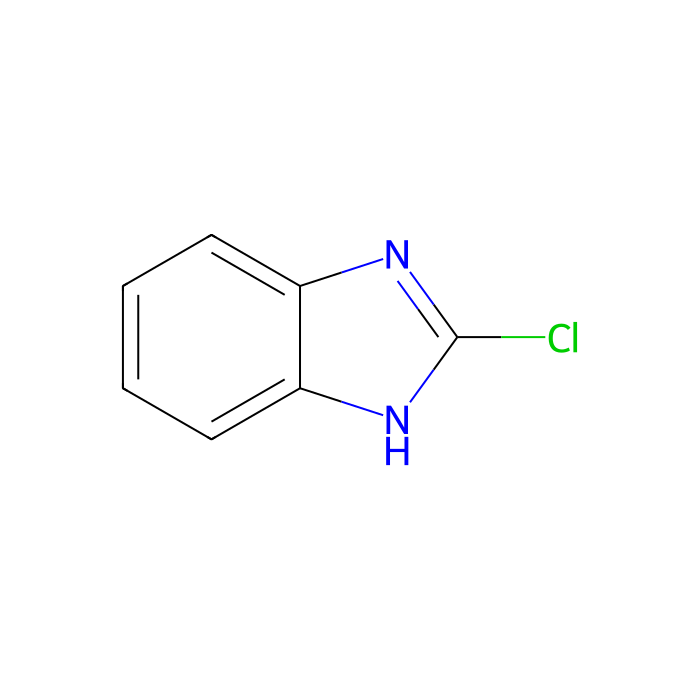
A fused imidazole–benzene heteroaromatic bearing a chlorine substituent at the C2 position of the benzimidazole core.
Item-specific identifiers (from Product Data):
SKU: C137611
CAS: 4857-06-1
InChIKey: Not specified for this item; refer to CoA/Spec Sheet.
SMILES: Not specified for this item; refer to CoA/Spec Sheet.
Literature identifiers (for reference; not item-specific specs):
Common name: 2-Chlorobenzimidazole
Molecular formula (literature): C7H5ClN2
Molecular weight (literature): ~152.58 g/mol
Example SMILES (literature): c1ccc2[nH]c(Cl)nc2c1 (tautomeric forms may exist)
Structural features:
Core: Benzimidazole (benzene fused to imidazole) with one endocyclic pyrrolic nitrogen ([nH]) and one imine-like pyridinic nitrogen.
Substitution: Chlorine at the C2 position (the electrophilic carbon between the two nitrogens of the imidazole ring).
Aromaticity: Fully conjugated bicyclic system with 10 π-electrons across the fused rings.
Functional groups: Aromatic C–Cl (activated by adjacent N atoms), N–H (weakly acidic), and an imine-type N.
2D structure in words:
A benzene ring fused to a five-membered imidazole ring. The imidazole contains an N–H at position 1 and a sp2 nitrogen at position 3. The carbon at position 2 (shared by both nitrogens) bears a chlorine substituent, rendering it an electrophilic center amenable to substitution.
Synthetic Utility
Key functional elements make 2-chlorobenzimidazole a high-value synthon:
Electrophilic C2–Cl: Activated toward substitution by the adjacent nitrogens. Supports:
SNAr with N-, S-, and O-nucleophiles to deliver 2-amino, 2-thio, or 2-alkoxy benzimidazoles.
Metal-catalyzed C–C and C–N couplings (Pd/Ni, Buchwald–Hartwig, Suzuki, Negishi).
N–H functionality: Provides a site for protection (e.g., N-alkylation) or metal coordination; can influence regioselectivity and catalyst binding.
Fused aromatic system: Enhances rigidity and planarity; useful in materials motifs and as a privileged medicinal chemistry scaffold (research context).
Retrosynthetic leverage:
Many 2-substituted analogs converge on this chloro intermediate, enabling late-stage diversification from a common stock material.
2-Mercaptobenzimidazole accessible via thiourea route offers a handle for further functionalizations (S-alkylation, coupling as a thioamide equivalent).
Practical considerations:
Aryl chloride reactivity: Often requires stronger catalysts/ligands than bromides/iodides; consider electron-rich bulky phosphines or NHCs.
Competing pathways: N-arylation of external amines vs. C2 substitution can be tuned via base, solvent, and ligand choices.
Purification: Products frequently crystallize; otherwise, normal-phase chromatography with EtOAc/hexanes or MeOH/DCM gradients is effective.
Target Specificity
Not applicable. This product is a small-molecule heteroaromatic building block, not a biological macromolecule or antibody. No antigen/epitope/clone/isotype information applies.
Domande frequenti
How should this product be stored?
Store at room temperature.
What is the purity of this product?
This product is supplied at ≥97% purity (chemical assay). Lot-specific values are stated on the Certificate of Analysis.
How is this product shipped?
This product ships under standard ambient conditions. No temperature-controlled packaging is required.
What are the CAS number, molecular formula and molecular weight?
The CAS Number is 4857-06-1, the molecular formula is C7H5ClN2, and the molecular weight is 152.58 g/mol. InChIKey AYPSHJCKSDNETA-UHFFFAOYSA-N.
What documentation is provided?
Available product documentation, including Certificates of Analysis (COA), Safety Data Sheets (SDS), and specification sheets, is shown in the product document area. Document availability and access follow the current site policy.
Utilizziamo i cookie per garantire il corretto funzionamento del sito web e, ove consentito, per migliorare la tua esperienza. Puoi gestire le tue preferenze in qualsiasi momento nelle Impostazioni. Per saperne di più, consulta la nostra Cookie Policy.
Desidera che le inviamo un messaggio quando avremo sconti disponibili?
Ricordamelo più tardi
Grazie! Controlli la sua casella di posta per confermare.
Products are supplied to verified businesses, institutions, and qualified professionals for research and development use only. Not for use in humans, animals, diagnosis, or therapy.

 C1911205