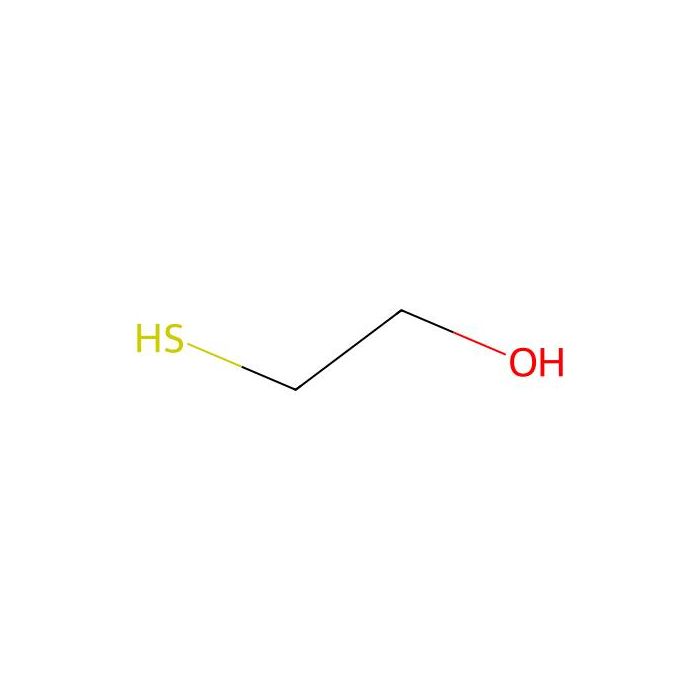
2-Mercaptoethanol - UltraBio™, Suitable for molecular biology, ≥99%(GC) , CAS No.60-24-2

CAS: 60-24-2 Cat. No.: M755744 Formula: C2H6OS Peso molecolare: 78.13 Beilstein Registry Number: 773648 Numero EC: 200-464-6
Disponibile su ordine
GRADE & PURITY UltraBio™ ? UltraBio™ — Aladdin's line for molecular-biology applications. Use for nuclease-free, high-consistency reagents across molecular workflows. Suitable for molecular biology ? Molecular-biology grade — free of nucleases and contaminants that degrade DNA/RNA. Use in cloning, PCR, and nucleic-acid work needing clean reagents. ≥99%(GC)
Storage
Store at 2-8°C
Shipped In
Wet ice,FedEx DG Service
★
Size
Germania (EU)
USA*
Price
Qty
25ml
M755744-25ml
—
5 Disponibile
84,08€
100ml
M755744-100ml
—
2 Disponibile
228,13€
Enter a quantity for the sizes you want to add.
🧪
Why this grade

UltraBio™, Suitable for molecular biology, ≥99%(GC) Suitable for molecular biology,UltraBio™ for sensitive chromatographic and analytical workflows requiring minimal baseline interference.

🌡

Storage & shipping

Store at 2-8°C Ships Wet ice,FedEx DG Service Check lot-specific COA for exact specifications.

📋

Quality documents

SDS, COA, datasheet, and spec sheet available for download. Lot-specific COA accessible via lot number lookup.

📚

Literature proof

Cited in 279 peer-reviewed publications across chromatography, organic synthesis, and cross-coupling reactions.

Panoramica

2-Mercaptoethanol has been used
  • in the protein extraction buffer prepared for leaf samples.
  • as a supplement in cell culture media.
  • in the procedure of RNA extraction.
BME is suitable for reducing protein disulfide bonds prior to polyacrylamide gel electrophoresis and is usually included in a sample buffer for SDS-PAGE at a concentration of 5%. Cleaving intermolecular (between subunits) disulfide bonds allows the subunits of a protein to separate independently on SDS-PAGE. Cleaving intramolecular (within subunit) disulfide bonds allows the subunits to become completely denatured so that each peptide migrates according to its chain length with no influence due to secondary structure.

Specifications

Specifiche e purezza
UltraBio™, Suitable for molecular biology, ≥99%(GC)
Condizioni di conservazione di stoccaggio
Store at 2-8°C
Spedito in
Wet ice,FedEx DG Service
Questo prodotto richiede spedizione a catena fredda. I servizi di terra e altri servizi economici non sono disponibili.
Grado
Suitable for molecular biology, UltraBio™
Purezza
≥99%(GC)
Nomi e identificatori
Pubchem Sid
PH
4.5-6 (20 °C, 500 g/L)
Sorrisi canonici
C(CS)O
IUPAC Name
2-sulfanylethanol
InChIKey
DGVVWUTYPXICAM-UHFFFAOYSA-N
INCHI
1S/C2H6OS/c3-1-2-4/h3-4H,1-2H2
Isomeri SMILES
C(CS)O
WGK Germania
3
RTECS
KL5600000
Numero UN
2966
Gruppo di imballaggio
II
Peso molecolare
78.13
Beilstein
773648
Reaxy-Rn
773648
Reaxys-RN_link_address
https://www.reaxys.com/reaxys/secured/hopinto.do?context=S&query=IDE.XRN=773648&ln=

Documentazione

📋 Safety Data Sheet (SDS)

Comprehensive hazard, handling, storage, and regulatory compliance document.

Download SDS →

✅ Certificate of Analysis (COA)

Lot-specific quality data. Enter your lot number to retrieve the exact COA.

Look up COA →

📊 Datasheet

Quick-reference summary of product specifications and applications.

View datasheet →

🔬 Specification Sheet

Full quality attributes and acceptance criteria for this grade.

View spec sheet →

Advanced Data

Taxonomic Classification

Taxonomy Tree

KingdomOrganic compounds
SuperclassOrganosulfur compounds
ClasseThiols
SubclassAlkylthiols
Intermediate Tree Nodes Not available
Direct ParentAlkylthiols
Alternative Parents Primary alcohols  Hydrocarbon derivatives  
Molecular FrameworkAliphatic acyclic compounds
Substituents Alkylthiol - Organic oxygen compound - Hydrocarbon derivative - Primary alcohol - Organooxygen compound - Alcohol - Aliphatic acyclic compound
DescrizioneThis compound belongs to the class of organic compounds known as alkylthiols. These are organic compounds containing the thiol functional group linked to an alkyl chain.
External Descriptors a small molecule
Struttura 3D
Modello di struttura chimica interattiva


Certificati (CoA, COO, BSE/TSE e tabella di analisi)
C of A & Other Certificates(BSE/TSE, COO):
Analytical Chart:

Find and download the COA for your product by matching the lot number on the packaging.

4 results found

Lot NumberCertificate TypeDataOggetto
B2525517Certificate of AnalysisFeb 27, 2025 M755744
C2617065Certificate of AnalysisFeb 27, 2025 M755744
G2603011Certificate of AnalysisFeb 27, 2025 M755744
B2518076Certificate of AnalysisFeb 24, 2025 M755744
Proprietà chimiche e fisiche
SolubilitàH 2 O: 0.5 M at 20 °C, clear, colorless
Indice di rifrazione1.499-1.502
Punto di infiammabilità (°F)167℉
Punto di infiammabilità (°C)75℃
Punto di ebollizione (°C)157-158°C
Punto di fusione (°C)-100°C
Peso molecolare78.140 g/mol
XLogP3-0.200
Hydrogen Bond Donor Count2
Hydrogen Bond Acceptor Count2
Rotatable Bond Count1
Exact Mass78.0139 Da
Monoisotopic Mass78.0139 Da
Topological Polar Surface Area21.200 Ų
Heavy Atom Count4
Formal Charge0
Complexity10.000
Isotope Atom Count0
Defined Atom Stereocenter Count0
Undefined Atom Stereocenter Count0
Defined Bond Stereocenter Count0
Undefined Bond Stereocenter Count0
The total count of all stereochemical bonds0
Covalently-Bonded Unit Count1
Domande frequenti e articoli
UltraBio™: Defining Excellence in Molecular Biology Applications
Molecular Biology Grade
ZYMOLYASE Experimental Protocol
Comparing Guanidine Hydrochloride and Urea for Inclusion-Body Solubilization
Enzyme Protectants and Common Methods to Prolong Enzymatic Activity
Difference Between Enzyme Activity and Specific Activity
Common Questions and Answers for SDS-PAGE Experiments
Common Issues for Western Blot (WB)
Common Reducing Agents Used in Protein Experiments
Standard Operating Procedure (SOP) for Bis-Tris Polyacrylamide Gel Electrophoresis (SDS-PAGE)
Common Reagents for Reducing Protein Disulfide Bonds
Buffer Additives to Prevent Protein Precipitation
Common Protectants and Formulations for Protein Storage
Why Did My Ni-Agarose Beads Turn Black or Brown?
Standard Operating Procedure (SOP) for the Protein Tris–Glycine Electrophoresis System
Why Are Nickel Agarose Beads Blue?
How to Optimize Buffer Components for Ni-Agarose Beads
His-Tagged Protein Purification
His-Tag Protein Purification: Common Troubleshooting Questions and Practical Solutions
A Practical Guide to Small-Molecule Chemical Probes: Concept Clarification, Causal Validation, and Experimental Selection (with Product Navigation and Tables A–D)
Endoproteinase Lys-C: Mechanism, Applications, and Method-Control Considerations for Lysine-Specific Digestion
A Review of Ten Commonly Used Techniques for Detection, Quantification, and Interaction Analysis in Nucleic Acid Research
Protein Tags Demystified: Classification, Properties, and Suitable Experimental Applications
Self-Assembled Monolayers (SAMs): Selection & Methodology Process Window and Verification/Troubleshooting Along the Alkanethiol/Au Route (with Selection Guide and Product Tables 1–3)
RNA Extraction Technologies: Method Systems, Operational Workflows, and Key Quality-Control Considerations
Glutathione Reductase: A Flavin-Dependent Reductive System Maintaining GSH/GSSG Homeostasis, with Assays and Applications
Chymosin: A Review of Molecular Features, Coagulation Kinetics, and Activity Evaluation
Bromelain: Enzymological Properties and Key Points for Food, Pharmaceutical, and Industrial Applications
Whey Protein: Composition Profile, Manufacturing Routes, and Key Product-Type Essentials
Research Applications of Pancreatin: An Overview
Review of Glucose-6-phosphate Dehydrogenase (G6PD): Structural Features, Metabolic Functions, and Research Applications
The Golden Pair for Nucleic Acid Extraction: RNase A and Proteinase K
Selective Deprotection and Sulfonyl Group Migration of N-Aryl Sulfonamides Mediated by TfOH (Trifluoromethanesulfonic Acid): Reaction Patterns and Synthetic Implications
Decision Logic for Peptide Synthesis Routes: Applicability and Criteria for Choosing among SPPS, LPPS, and Recombinant Expression
Comparative Principles and Selection of CTAB, SDS, TRIzol, and Column-Based Purification Systems in Nucleic Acid Extraction from Plant Samples
From Functional Groups to Experimental Decision-Making: Protein Crosslinker Selection and Experimental Essentials
GITC——Key Reagent for Nucleic Acid Extraction and Sample Protection
Common Reducing Agents in Antibody–Drug Conjugates (ADCs)
Route Selection for Thiol Synthesis: C–S Bond Construction, Sulfur Source Forms, and Thiol Release
Citations of This Product
Calcolatori di soluzioni
Recensioni

Recensioni dei clienti

Shall we send you a message when we have discounts available?

Remind me later

Thank you! Please check your email inbox to confirm.

Oops! Notifications are disabled.