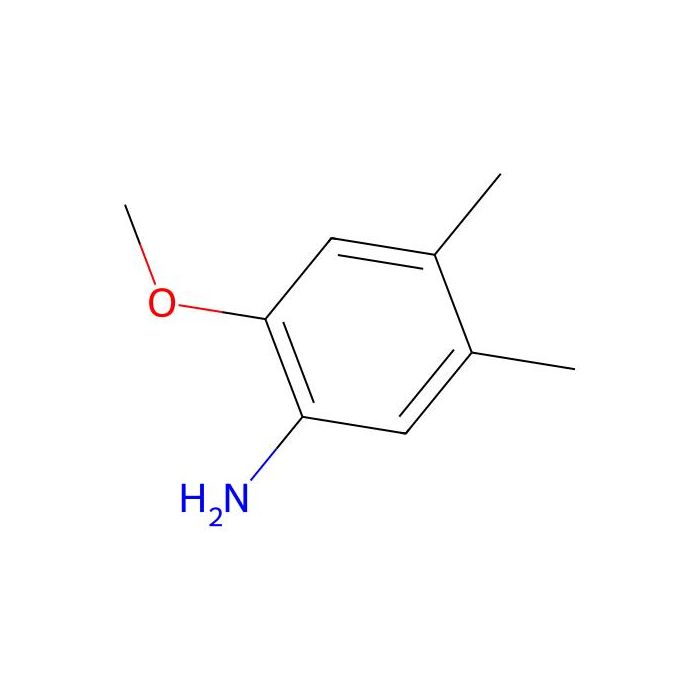
This compound belongs to the class of organic compounds known as aminophenyl ethers. These are aromatic compounds that contain a phenol ether, which carries an amine group on the benzene ring.
External Descriptors
Not available
1. Djoumbou Feunang Y, Eisner R, Knox C, Chepelev L, Hastings J, Owen G, Fahy E, Steinbeck C, Subramanian S, Bolton E, Greiner R, and Wishart DS. ClassyFire: Automated Chemical Classification With A Comprehensive, Computable Taxonomy. Journal of Cheminformatics, 2016, 8:61.
Certificati (CoA, COO, BSE/TSE e tabella di analisi)
C of A & Other Certificates(BSE/TSE, COO):
Analytical Chart:
Proprietà chimiche e fisiche
Peso molecolare
151.210 g/mol
XLogP3
1.900
Hydrogen Bond Donor Count
1
Hydrogen Bond Acceptor Count
2
Rotatable Bond Count
1
Exact Mass
151.1 Da
Monoisotopic Mass
151.1 Da
Topological Polar Surface Area
35.300 Ų
Heavy Atom Count
11
Formal Charge
0
Complexity
127.000
Isotope Atom Count
0
Defined Atom Stereocenter Count
0
Undefined Atom Stereocenter Count
0
Defined Bond Stereocenter Count
0
Undefined Bond Stereocenter Count
0
The total count of all stereochemical bonds
0
Covalently-Bonded Unit Count
1
Calcolatori di soluzioni
Molarity Calculator
Determine the necessary mass, volume, or concentration for preparing a solution.
Dilution Calculator
Determine the dilution needed to prepare a stock solution.
Reconstitution Calculator
Recensioni
Recensioni dei clienti
Application Protocols
Not applicable. No validated bioassay protocols (WB, IHC, IF, FC) or similar application guidance is associated with this small-molecule building block. For synthetic uses, see Reaction & Applications and Reaction Conditions for general laboratory guidance.
Biological Roles
This product is a synthetic aromatic amine building block; it is not a biomolecule and has no established physiological role.
General information on aniline derivatives (literature; not specific to this item):
Aromatic amines can interact with biological nucleophiles after metabolic activation (e.g., N-oxidation or N-acetylation in vivo), but such considerations are outside the scope of research-use reagents and must not be inferred as product-specific properties.
The electron-rich nature of methoxy/methyl-substituted anilines makes them useful as donor components in dye molecules and materials used in bioimaging research; in such contexts they are intermediates rather than active biological agents.
For research use only: Any biological testing or in vitro assay use should be conducted under appropriate safety approvals and SDS guidance.
Buffer Applications
Not typically applicable. 2-Methoxy-4,5-dimethylaniline is a hydrophobic aromatic amine used as a synthetic intermediate, not a buffering agent. If aqueous handling is required (e.g., diazotization), it is commonly converted to its anilinium salt in mineral acid rather than used as a buffer component. See Reaction & Applications and Reaction Conditions for practical aqueous-phase notes.
Green Alternatives
Although 2-methoxy-4,5-dimethylaniline itself is a substrate, the environmental footprint of operations involving it can be improved by solvent and reagent choices.
Greener solvent swaps (literature guidance):
Replace DCM/chloroform with EtOAc, MEK, or 2-MeTHF for acylations and extractions when feasible.
Use 2-MeTHF or CPME instead of THF for moisture-tolerant steps; both enable easier phase separations and can be sourced from bio-feedstocks (2-MeTHF).
For EAS at elevated temperature, consider anisole or toluene alternatives such as dimethyl carbonate (where compatible) or propylene carbonate for polar processes.
Workup/purification:
Employ heptane/EtOAc in place of hexane/EtOAc to reduce VOC toxicity profile.
Minimize silica waste by using crystallization or acid–base salt toggling (convert to anilinium hydrochloride for aqueous purification, then basify).
Reagent selection:
Oxidations: Prefer H2O2 or Oxone over chromates; use catalytic systems (TEMPO/bleach) when appropriate.
Halogenation: NBS/NCS in safer solvents vs elemental halogens; electrochemical halogenation where possible.
Formylations: Modern Vilsmeier surrogates or Rieche variants in greener media can reduce POCl3/DMF hazards.
Comparison snapshot (general):
DCM vs EtOAc: EtOAc is biodegradable, lower toxicity; DCM offers higher density/volatility aiding phase splits—trade off process ease vs EHS.
THF vs 2-MeTHF: 2-MeTHF is bio-based, less prone to peroxide formation, and easier separations; THF is more miscible with water and widely validated.
Note: Validate substitutions at small scale to ensure regioselectivity and yield are maintained.
Pharmaceutical Uses
No pharmacopeial excipient status or formulation role is specified for this item; refer to CoA/Spec Sheet.
General context (non-clinical; no therapeutic claims):
Aromatic anilines like 2-methoxy-4,5-dimethylaniline are used as intermediates in the synthesis of pharmaceutical candidates and fine chemicals, particularly where an electron-rich aniline is required for subsequent coupling, azo formation, or heterocycle assembly.
Process considerations: Salt formation (e.g., hydrochloride) can improve handling, crystallinity, and safety for scale-up. Protection of the amine (Boc, Cbz, Ac) is often leveraged to control regioselectivity and minimize side reactions during electrophilic steps.
Impurity control: Potential oxidative byproducts (quinone-imine-like species) and diarylamine dimers may form upon storage/processing; processes should include antioxidant strategies or inert conditions if purity is critical.
All uses are limited to laboratory research and chemical manufacturing R&D contexts.
Physical Properties
Item-specific specifications (BP, MP, density, refractive index, water/peroxide/metal limits, UV cutoff) are not specified for this item; refer to CoA/Spec Sheet.
General/literature-based properties for context (not item specifications):
Physical state/appearance: Highly substituted anilines of similar substitution are typically low-melting solids or high-boiling liquids with faintly colored appearance due to oxidative sensitivity; actual state for this lot not specified.
Polarity: Moderately polar aromatic amine; basic nitrogen can engage in hydrogen bonding and salt formation; methoxy increases polarity relative to xylene analogs.
Acid–base behavior: As a primary aniline, expected to be weakly basic in water (literature pKa of anilinium conjugate generally ~4.6–5.5; methoxy/methyl substitution can slightly increase basicity). Exact pKa for this compound not specified.
Solubility tendencies (qualitative):
Organic: Expected to be miscible or highly soluble in common organic solvents (EtOAc, DCM, THF, toluene, MeOH, acetonitrile).
Aqueous: Typically low solubility as the free base; forms water-soluble salts with mineral acids (e.g., HCl) if needed.
Volatility/boiling: Substituted anilines with multiple ring substituents generally have high boiling points and low vapor pressures; specific values not specified for this item.
Always verify actual numeric properties from the lot-specific CoA before using for process design, hazard assessment, or purification planning.
Quality and Grades
Item-specific grade/purity: Not specified for this item; refer to CoA/Spec Sheet.
Stabilizer/additives: Not specified for this item; refer to CoA/Spec Sheet.
Guidance on grades for aromatic amine building blocks (general information):
Research/technical grade: Suitable for most synthetic transformations and screening campaigns. Trace metal levels, residual solvents, and UV background are generally not controlled to chromatographic specifications.
Purified or >98% grade: Preferred for SAR studies and materials destined for scale-up to process development, where impurity profiles and spectral cleanliness matter.
HPLC grade (when applicable to solvents): Emphasizes UV transmittance and low non-volatile residue; for solids like this, an HPLC assay is used to quantify purity, but “HPLC grade” as a solvent descriptor does not apply.
What to review on the CoA for this item:
Identification: 1H/13C NMR match, MS, and IR signatures consistent with 2-methoxy-4,5-dimethylaniline.
Assay/purity and related substances: Look for specific thresholds for anisidine oxidation byproducts, diarylamine dimers, or O-/N-methylated impurities.
Residual solvents and water (Karl Fischer): Not specified for this item; refer to CoA/Spec Sheet.
Appearance and color: Documented lot color and physical state can indicate oxidative history; request fresh lot if stringent color limits are required.
Reaction and Applications
As an electron-rich, multiply activated aniline, 2-methoxy-4,5-dimethylaniline is a versatile intermediate in aromatic functionalization and heterocycle synthesis.
Electrophilic aromatic substitution (EAS):
Directors: –NH2 and –OMe both strongly activate and direct ortho/para; with 4,5-dimethyl substitution, the most accessible positions are C3 (between –OMe and 4-Me) and C6 (ortho to –NH2 and 5-Me). Regioselectivity can be high under controlled conditions.
Typical EAS: Halogenation (NBS/NCS with control), formylation (Vilsmeier–Haack), Friedel–Crafts sulfonylation, nitration under very mild conditions.
N-Functionalization chemistry:
Amide and carbamate formation with acylating/alkoxycarbonyl reagents; useful for protection (Boc, Cbz) to modulate directing effects during EAS.
Reductive amination on the aniline nitrogen generally requires prior activation or protection/deprotection sequences.
Diazonium chemistry:
Diazotization (NaNO2/HCl, 0–5 °C) provides access to azo dyes via coupling with activated aromatics or to aryl–X via Sandmeyer-type transformations (–Cl, –Br, –CN) at the amine-bearing carbon (replacement of –NH2).
Cross-coupling via anilinium pseudohalides (literature):
Conversion to diazonium or to aryl triflates (after phenolic derivatization) enables Suzuki, Heck, or Chan–Lam couplings for further elaboration.
Heterocycle construction:
Intramolecular or intermolecular cyclizations (e.g., to benzimidazoles via condensation with carboxylic acids/aldehydes under oxidative conditions) leveraging the primary amine.
Materials/optical uses (general):
Donor-rich anilines serve as precursors to push–pull dyes and hole-transporting motifs; methoxy and methyl donors enhance electron richness.
Practical tips: Protect –NH2 (e.g., Boc) to tune EAS regioselectivity; conduct air-minimized operations to limit oxidative darkening; add base modifiers during chromatography to reduce tailing.
Reaction Conditions
The following conditions are general literature guidance for electron-rich anilines and should be optimized for this substrate; they are not item-specific specifications.
N-Acylation (amide formation):
Typical: Acid chloride (1.05–1.2 eq), Et3N or pyridine (2–3 eq), DCM or THF, 0 °C to rt, 0.5–2 h. Workup with aqueous NH4Cl. Often quantitative to high yields.
Boc protection:
Boc2O (1.1–1.5 eq), DMAP cat., THF/MeCN, rt, 1–4 h; or NaHCO3-buffered dioxane/H2O. Deprotect with TFA/DCM at 0 °C to rt.
Electrophilic halogenation (ring):
NBS or NCS (1.05–1.2 eq), AcOH or MeCN, 0 °C to rt, 0.5–3 h. Expect substitution at the most activated free positions (often C3/C6) subject to sterics.
Vilsmeier–Haack formylation:
POCl3 (1.2–2 eq) in DMF (solvent/reagent), 0 °C to 80 °C, 2–8 h; quench onto ice/NaOAc. Strong activation may require temperature control to avoid polyformylation.
Diazotization and azo coupling:
Form anilinium hydrochloride (2–3 M HCl), cool to 0–5 °C; add NaNO2 (1.05 eq) maintaining <5 °C. For coupling, use phenols/anilines in EtOH/H2O with NaOAc or pyridine, 0–10 °C; coupling completes in 0.5–2 h.
Benzimidazole formation (condensation):
With 1,2-dicarbonyls or aldehyde/oxidant pairs; e.g., o-formylated intermediate + NH source under acid catalysis, 80–120 °C, 4–16 h.
Notes:
Strong activation increases rate but can reduce selectivity; consider amide protection to tune directing effects.
Use inert atmosphere and dry solvents where moisture-sensitive reagents are employed.
Monitor closely by TLC/UPLC; add 0.5–1% Et3N to mobile phase to reduce tailing.
Safety and Handling
Item-specific safety details
GHS classification: Not specified for this item; refer to SDS.
Pictograms: Not specified for this item; refer to SDS.
Signal word / H-statements: Not specified for this item; refer to SDS.
General safety considerations for substituted anilines (literature/good practice; not item-specific):
Hazards: Aromatic amines can cause skin/eye irritation and may be harmful if inhaled or absorbed through skin. Some are methemoglobin formers; avoid inhalation and prolonged skin contact. Oxidation can produce colored impurities; handle under air-minimized conditions if purity is critical.
PPE: Lab coat, nitrile gloves, splash goggles. Use in a fume hood to avoid vapor/aerosol exposure.
Incompatibilities: Strong oxidizers (risk of exothermic reaction/oxidation); acyl/alkylating agents (react readily with amines); nitrosating agents (risk of N-nitrosamine formation in acidic nitrite conditions—avoid such combinations).
First aid (overview):
Skin: Wash with soap and water; remove contaminated clothing.
Eyes: Rinse cautiously with water for several minutes; seek medical attention if irritation persists.
Inhalation: Move to fresh air; seek medical advice if symptoms occur.
Ingestion: Rinse mouth; do not induce vomiting; get medical attention.
Storage precautions: Keep container tightly closed at room temperature (per Product Data). Protect from light and air if long-term storage to minimize oxidation/discoloration. Segregate from oxidizers and acids.
Always consult the official SDS for authoritative hazard identification, exposure limits, and emergency measures.
Solvent Selection
This product is an aromatic amine building block rather than a solvent. However, solvent choice can strongly influence its handling, reactions, and purifications.
Polarity class and miscibility (general tendencies):
Expected to dissolve well in moderately polar organics (EtOAc, THF, MeOH, MeCN) and in aromatic hydrocarbons (toluene). Limited solubility in alkanes and in water as the free base; forms water-soluble salts with acids.
Solvent effects on reactivity:
Electrophilic aromatic substitution (EAS): Often run in glacial AcOH, DCM, or nitrobenzene/sulfuric media depending on transformation. For mild formylations/halogenations, DCM/MeCN can provide good control.
N-acylations/urethane formation: DCM, THF, or toluene with base (Et3N, pyridine) are common; polar aprotic solvents aid in fast acylation.
Diazotization/azo coupling: Aqueous mineral acid to form the anilinium salt, then cold NaNO2; coupling in ethanol, aqueous NaOAc, or pyridine depending on partner.
Small comparison (literature guidance):
DCM vs EtOAc: DCM improves phase separation and rate in acylations; EtOAc is greener and easier to remove but may require longer times.
Toluene vs THF: Toluene tolerates higher temperatures for EAS; THF enhances solubility for base-mediated steps (e.g., Boc protection) but may need drying.
For chromatographic purification, start with hexane/EtOAc or toluene/EtOAc gradients; add 0.5–1% Et3N to suppress tailing of the basic amine.
Storage and Reconstitution
Item-specific storage: Room temperature (per Product Data).
Shipped in: Not specified for this item; refer to CoA/Spec Sheet.
Appearance: Not specified for this item; refer to CoA/Spec Sheet.
General best practices (not item-specific):
Container: Store in a tightly sealed amber glass bottle to minimize light exposure and oxidative discoloration common to electron-rich anilines.
Atmosphere: If storing for extended periods, consider a dry inert headspace (N2/Ar) and include a desiccant to limit moisture uptake and acid-catalyzed degradation.
Stability: Avoid prolonged exposure to air, light, and elevated temperatures; oxidative darkening does not necessarily indicate loss of assay but may complicate purification.
Reconstitution: Not applicable; supplied neat. If preparing solutions, use dry, oxygen-limited solvents (e.g., degassed toluene, THF, EtOAc, MeCN). For aqueous operations (diazotization), convert to anilinium salt in mineral acid immediately before use.
Freeze–thaw: Not applicable to the neat solid/liquid. For stock solutions, aliquot under inert atmosphere and store at appropriate temperature for the solvent; minimize freeze–thaw cycling.
Always refer to the product’s CoA/SDS for lot-specific handling and stability information.
Structure and Identity
2-Methoxy-4,5-dimethylaniline is an electron-rich, highly substituted aniline useful as an aromatic building block.
Item-specific identifiers (from Product Data)
CAS: 18087-12-2
PubChem CID: 19357140
InChIKey: 18746 (as provided)
SKU: M1027955
Category Path: 全部 / 可售 / 生命科学
Literature/computed identity details (for reference; not item-specific specifications)
Electronic character: Strongly activated aromatic ring due to two powerful ortho/para directors (–NH2, –OMe) plus alkyl donors; expected high electron density at the remaining unsubstituted positions (notably C3 and C6).
2D description in words: A benzene ring with –NH2 at C1; –OCH3 at C2; –CH3 at C4 and C5; the only unsubstituted ring carbons are C3 and C6.
Note: Structural strings and formula are provided as general literature identifiers; consult the product CoA/SDS for definitive identity confirmation for this item.
Synthetic Utility
Key functional elements and their reactivity:
Nucleophilic nitrogen (primary aniline):
Rapid acylation/carbamoylation for amide/carbamate synthesis; temporary protection to modulate directing effects.
Electrophilic N-arylation/alkylation under suitable conditions (e.g., Buchwald–Hartwig as nucleophile to aryl halides; Mitsunobu-type N-alkylations of suitable alcohols).
Activated aromatic ring:
High reactivity toward EAS at C3 and C6 due to synergistic –NH2/–OMe activation and alkyl donation; enables regioselective halogenation, formylation, and sulfonylation.
Diazotization of the aniline followed by Sandmeyer-type substitutions to introduce halogens, CN, or to effect deamination, expanding substitution patterns inaccessible by direct EAS.
Downstream elaboration:
Construction of benzimidazoles and quinazolinones via condensation/cyclization with carboxylic acid derivatives or ortho-formylated intermediates.
Azo dye precursors: Coupling the diazonium with activated aromatics or enols yields intensely colored donor–acceptor systems.
Retrosynthetic value:
The dense donor substitution (–OMe, 4/5-Me) offers a pre-installed electron-donating motif for materials chemistry (e.g., hole-transport fragments) and provides a handle for selective late-stage diversification at C3/C6.
Practical guidance:
Consider temporary amide protection to reduce over-activation during EAS.
Use base-modified silica or basic alumina for chromatography to mitigate tailing/adsorption of the amine.
Limit exposure to air/heat to avoid oxidative darkening; include trace antioxidant if compatible.
Target Specificity
Not applicable. This product is a small-molecule aromatic amine, not a biological targeting reagent (e.g., antibody, ligand, or inhibitor) with defined target specificity. No antigen/epitope, clone, isotype, or species reactivity information applies.
We use cookies to ensure the website functions properly and, where permitted, to improve your experience. You can manage your preferences at any time in Settings. Learn more in our Cookie Policy.
Shall we send you a message when we have discounts available?
Remind me later
Thank you! Please check your email inbox to confirm.
Products are supplied to verified businesses, institutions, and qualified professionals for research and development use only. Not for use in humans, animals, diagnosis, or therapy.