This compound belongs to the class of organic compounds known as dialkyl ethers. These are organic compounds containing the dialkyl ether functional group, with the formula ROR', where R and R' are alkyl groups.
External Descriptors
polyether
1. Djoumbou Feunang Y, Eisner R, Knox C, Chepelev L, Hastings J, Owen G, Fahy E, Steinbeck C, Subramanian S, Bolton E, Greiner R, and Wishart DS. ClassyFire: Automated Chemical Classification With A Comprehensive, Computable Taxonomy. Journal of Cheminformatics, 2016, 8:61.
Determine the necessary mass, volume, or concentration for preparing a solution.
Dilution Calculator
Determine the dilution needed to prepare a stock solution.
Reconstitution Calculator
Recensioni
Recensioni dei clienti
Application Protocols
No assay or immunoapplication protocols are provided for this solvent. Usage is highly method-specific. For chemical synthesis or materials work:
General solvent use protocol (guidance)
Verify quality on receipt (KF water, GC purity, peroxide test as needed).
If required, dry over 3 Å sieves or distill under argon from CaH2.
Use an inert-gas manifold or Schlenk techniques for air-/moisture-sensitive chemistry.
For extractions, consider salting-out to improve phase separation due to water miscibility.
Prior to any distillation, test for peroxides and remove if present (e.g., pass through activated alumina).
Research Use Note (from Product Data)
For research use only.
Biological Roles
This product is an organic solvent (diglyme) intended for laboratory/research use; it is not a biochemical reagent with intrinsic biological function. No biological roles are claimed for this catalog item.
General context (literature/general knowledge)
Glymes are synthetic polyether solvents; they do not occur in normal metabolism and have no known physiological role.
In biochemical research, coordinating ethers like diglyme are occasionally used as co-solvents for non-aqueous or low-water systems to solubilize salts or polar small molecules; their strong cation solvation can perturb enzyme structure/function and are generally avoided in active biocatalysis.
In electrochemistry and materials biology interfaces (e.g., biosensors), glymes have been explored as components of electrolytes due to their dielectric properties, but such uses are materials-focused rather than biological.
Toxicology note (general)
Some members of the glyme family have regulatory classifications for reproductive toxicity. Handle with care, minimize exposure, and consult the SDS for this specific substance and local regulations.
Takeaway
Use primarily as a coordinating organic solvent in chemical/materials workflows; avoid assuming biocompatibility. For biological systems, choose buffers and biocompatible cosolvents (e.g., glycerol, PEGs) unless non-aqueous conditions are explicitly required.
Buffer Applications
Not typically applicable. Diglyme is an organic ether solvent and is not used to prepare aqueous biological buffers or pH-controlled systems.
Practical note
If trace amounts are present as a co-solvent in an aqueous system, verify compatibility with your biomolecules and instruments; expect changes in dielectric constant and potential denaturation of proteins.
For buffer preparation, use standard buffering agents (e.g., phosphate, Tris, HEPES) and refer to their dedicated buffer application guidance.
Green Alternatives
Evaluation of diglyme against greener solvent options must balance performance (coordination, high bp) with health, safety, and environmental considerations.
Considerations (general/literature)
Pros: High boiling point reduces VOC emissions vs very volatile ethers; excellent cation solvation can reduce catalyst/loadings in some reactions.
Cons: Ether peroxide risk; glymes have regulatory scrutiny for reproductive toxicity in some jurisdictions; not derived from bio-based feedstocks; complete miscibility with water can complicate wastewater treatment.
Alternative options (general)
2-Methyltetrahydrofuran (2-MeTHF): Bio-based, lower toxicity profile; bp ~80 °C; less coordinating—may not match reactivity for salt-rich systems.
Cyclopentyl methyl ether (CPME): Hydrophobic, relatively green profile; bp ~106 °C; forms fewer peroxides; less cation-solvating than diglyme.
Propylene carbonate (PC): Non-volatile, high dielectric; excellent for polar reactions and electrochemistry; very high bp/viscosity and poor compatibility with strong bases/nucleophiles in some cases.
Dimethyl carbonate (DMC): Readily biodegradable, low toxicity; limited coordination and basicity; bp ~90 °C.
At-a-glance comparison (literature values)
Diglyme: bp ~162 °C; strong coordination; miscible with water; peroxide-forming; high solvency for salts.
2-MeTHF: bp ~80 °C; moderate polarity; water-immiscible; better phase separations; less coordinating.
CPME: bp ~106 °C; water-immiscible; robust to acids/bases; reduced peroxide tendency.
PC: bp ~242 °C; very polar; limited compatibility with very strong nucleophiles.
Choose based on required temperature window, need for cation solvation, separations, and HSE constraints.
Pharmaceutical Uses
No therapeutic or clinical claims are made. The following describes potential roles as a processing solvent in pharmaceutical R&D/manufacturing (general knowledge):
Possible roles (general)
Reaction solvent for high-temperature nucleophilic substitutions, Williamson ether syntheses, and polymerizations where cation solvation is advantageous.
Crystallization or co-solvent in process development for polar APIs/intermediates; its water miscibility enables controlled anti-solvent strategies.
Electrolyte solvent component in battery-related devices for medical hardware R&D (materials focus, not for use in humans).
Considerations
Residual solvent status: Glymes are not common compendial Class 1–3 solvents; control and justify any residual levels per ICH Q3C and local regulations. Analytical methods (GC headspace) should be validated.
Toxicological profile: Review SDS and regulatory guidance—some glymes are under special restrictions in certain regions. Implement appropriate containment and exposure controls.
Extractables/leachables: As a coordinating ether, may solvate ionic species; assess compatibility with processing equipment and elastomers.
Documentation
For this catalog item, grade/purity and any stabilizers are not specified; consult the CoA/Spec Sheet to assess suitability for your intended pharmaceutical process step.
Physical Properties
Item-specific specs are not provided in the Product Data. The following are typical literature values for diglyme (bis(2-methoxyethyl) ether, CAS 111-96-6); use for guidance only and confirm on the CoA/SDS for this lot.
Molecular weight (literature): 134.17 g/mol (matches formula C6H14O3).
Boiling point (literature): ~162–164 °C at 1 atm.
Melting point (literature): ~−64 °C.
Density (literature): ~0.943 g/mL at 25 °C (approx. 0.95 g/mL at 20 °C).
Refractive index n20/D (literature): ~1.403–1.406.
Vapor pressure (literature): ~1–2 mmHg at 25 °C (low volatility compared to THF or DME).
Dielectric constant ε (literature): ~7–8 at 20–25 °C.
Viscosity (literature): ~1.3–1.6 mPa·s at 25 °C.
Water solubility/miscibility (literature): Miscible with water and many polar organic solvents (alcohols, ketones, acetonitrile); dissolves many salts and organometallic reagents due to cation solvation.
Partition coefficient (logP, literature): Low/negative (high polarity for an ether); reported values near 0 to −0.3.
UV cutoff (item-specific): Not specified for this item; refer to CoA/Spec Sheet.
Peroxide tendency (general): Like many ethers, can form peroxides on storage with air and light—monitor periodically.
Note: Values vary by source and measurement method; do not treat as product specifications.
Quality and Grades
Item-specific grade/purity
Grade/Purity: Not specified for this item; refer to CoA/Spec Sheet.
Appearance: Not specified for this item; refer to CoA/Spec Sheet.
What grade typically implies (general guidance for solvent buyers)
“ACS/AR” (if provided on CoA): Meets general analytical reagent criteria but may not meet low-UV or low-water requirements for trace analyses.
“HPLC/LC-MS grade” (if provided): Low non-volatile residue and low UV absorbance across 200–400 nm; filtered for particulates—preferred for chromatographic use.
“Anhydrous” (if provided): Supplied at a guaranteed low water level. Verify water content by Karl Fischer on receipt; maintain inert, desiccated storage.
Stabilizers: Glyme solvents are often shipped without stabilizers; if any inhibitor or metal deactivator is present, it will be declared on the CoA. Consider implications for highly sensitive catalysis.
Quality control considerations (general)
Key impurity risks: Water, alcohols/glycols (hydrolysis), higher glymes, and peroxides. For air- or water-sensitive reactions, verify: KF water, residual peroxides, and UV baseline (if spectroscopic work).
Recommended incoming tests (as applicable): KF titration, GC purity profile, peroxide test (e.g., iodometric), UV scan, and trace metals by ICP if using with homogeneous/heterogeneous catalysts.
Documentation
For this catalog item, rely on the batch CoA/Spec Sheet for definitive limits and any stabilizer disclosure.
Reaction and Applications
With three ether oxygens and a flexible backbone, diglyme is a powerful coordinating solvent/ligand that stabilizes metal cations and can dramatically enhance rates of nucleophilic processes.
Nucleophilic substitutions and base-promoted reactions (literature)
SN2 reactions and Williamson ether synthesis at elevated temperatures benefit from diglyme’s high bp and ability to solvate cations (e.g., Na+/K+ alkoxides, cyanides, thiolates), increasing “free” anion activity.
Phase-transfer-like effects can occur without added PTC due to intrinsic chelation.
Organometallic chemistry (literature)
Supports reactions of Grignard reagents, organolithiums, and alkali-metal mediated reductions; enhances solubility of salts (e.g., NaI in Finkelstein reactions, Wurtz-type couplings).
Forms labile solvates with Li+, Na+, K+, Mg2+ that modulate reactivity and selectivity. Common in Birch-type variants and dissolving-metal conditions where compatible.
Polymerizations and materials (literature)
Used as solvent for anionic/cationic polymerizations requiring strong cation solvation (e.g., ethylene oxide derivatives) and in electrolytes for electrochemistry/battery R&D.
Practical tips (general)
Drying: 3 Å molecular sieves overnight, or distill from CaH2 under inert gas. Test KF before air-/moisture-sensitive use.
Peroxide control: Test and remove peroxides prior to concentration/distillation (activated alumina columns can reduce hydroperoxides).
Metal compatibility: Avoid prolonged contact with reactive metals that catalyze peroxide formation; glass-lined or stainless systems preferred.
Workup: Diglyme’s water miscibility can simplify extractions but may complicate phase separations; salting-out (e.g., brine) can assist. Vacuum removal may require elevated bath temps due to low vapor pressure.
Reaction Conditions
General, literature-based guidance for using diglyme as a reaction solvent. Always optimize for your substrate and consult primary literature.
Drying and setup
Dry over 3 Å molecular sieves for ≥12 h or distill from CaH2 under argon. Verify KF (<0.02–0.05% w/w commonly targeted for air-/moisture-sensitive chemistry; target depends on system).
Use inert atmosphere (N2/Ar). Product Data indicates argon-charged supply.
Typical temperature ranges
Room temperature to 150 °C in closed systems; reflux at ~162–164 °C for higher-temperature operations. Use oil/sand baths or sealed tubes/pressure vessels as appropriate.
Concentrations
0.1–2 M common for substitution/coupling chemistry. Higher concentrations feasible due to good salt solvation; ensure mixing and heat removal.
Representative conditions (literature examples)
Williamson ether synthesis: Alkyl halide (1.0 eq), sodium alkoxide (1.2–2.0 eq), diglyme, 80–140 °C, 2–16 h; monitor by GC/LC. Salts often fully dissolve.
Finkelstein (R–Cl → R–I): NaI (2–3 eq) in diglyme, 80–120 °C; iodide’s high nucleophilicity and solubility in glymes accelerates exchange.
Metal-promoted couplings: Na/K dispersions in diglyme with haloarenes/haloalkanes at 60–110 °C; caution—exothermic and gas evolution possible.
Catalysis notes
Coordinating ethers may inhibit some transition-metal catalysts (e.g., Lewis-acidic systems). Screen non-coordinating solvents if activity is suppressed.
Workup/yields
Isolation often involves aqueous quench, salt removal, and solvent exchange. Reported yields vary widely by substrate but can improve vs less coordinating ethers due to rate enhancements.
Safety
Test for and remove peroxides before concentration/distillation. Employ blast shields for high-temperature/pressurized runs.
Safety and Handling
Always consult the SDS for definitive hazard, first-aid, and disposal guidance for this specific lot. The Product Data lists no GHS fields; the following are general precautions for glyme-type ethers (diglyme, CAS 111-96-6):
General hazards (general knowledge)
Ethers may form shock-sensitive peroxides upon prolonged exposure to air/oxygen and light. Periodically test for peroxides, especially before distillation; pass through activated alumina or reduce peroxides if detected.
Combustible liquid; vapors may form ignitable mixtures with air near the flash point. Use away from ignition sources and hot surfaces.
Can cause eye and skin irritation; inhalation of vapors or mists may cause respiratory irritation. Prolonged exposure to some glymes has been associated with reproductive toxicity in regulatory classifications (verify SDS for this substance).
Storage and incompatibilities
Product Data: Store under argon (argon charged). Keep container tightly closed, dry, and protected from light.
Keep away from strong oxidizers, strong acids, and strong bases that can promote degradation. Avoid copper/bronze catalysts that may accelerate peroxide formation.
Store in amber or opaque containers when possible; use inhibitors or peroxide scavengers only if compatible with your application.
PPE and engineering controls
Use in a fume hood; wear safety glasses or face shield, lab coat, and suitable chemical-resistant gloves (e.g., nitrile). Use splash protection when pouring larger volumes.
First aid (overview; defer to SDS)
Eye/Skin: Rinse with water for ≥15 minutes; remove contaminated clothing. Seek medical attention if irritation persists.
Inhalation: Move to fresh air; obtain medical attention if symptoms occur.
Ingestion: Rinse mouth; do not induce vomiting; seek medical advice.
Fire-fighting (general)
Use alcohol-resistant foam, dry chemical, or CO2. Cool containers with water spray.
Solvent Selection
Diglyme is a polar, coordinating, aprotic ether with relatively high boiling point. It often outperforms less coordinating ethers (e.g., MTBE, CPME) when strong cation solvation or elevated temperatures are required.
Polarity and coordination (literature/general)
Dielectric constant ~7–8; donor number in the 20s (good Lewis basicity for cation complexation).
Strong solvator of alkali/alkaline-earth cations; enhances nucleophilicity of associated anions (e.g., alkoxides, cyanides).
Miscibility profile (literature)
Miscible with water, alcohols, acetone, acetonitrile, ethers, aromatics, and many chlorinated solvents. Dissolves many salts better than less polar ethers.
When to choose diglyme
Need for high-temperature ether medium (bp ~162–164 °C) for SN2, Williamson ether synthesis, or polymerizations.
Organometallic chemistry where chelation assists reactivity (e.g., reactions of Na/K salts, organolithium/Grignard under controlled conditions).
Electrochemistry or battery R&D where glyme coordination is beneficial (screening studies; observe safety guidance).
When to consider alternatives
If low toxicity and greener profile are priorities: 2-MeTHF or CPME.
If extremely high boiling/thermal stability is required: triglyme/tetraglyme or sulfone solvents (DMSO, sulfolane) depending on system.
If non-coordinating conditions are essential (to avoid catalyst inhibition): use toluene, heptane, or dichloromethane as appropriate.
Quick comparison (general)
THF (bp 66 °C): more volatile, less thermally robust; excellent for low-temp work.
DME (bp 85 °C): lower bp; less viscous; similar coordination but lower thermal window.
Diglyme (bp ~162 °C): best for higher-temperature ether conditions and stronger cation solvation.
Storage and Reconstitution
Item-specific guidance (from Product Data)
Storage Conditions: Argon charged. Keep container tightly closed under inert gas to limit peroxide formation and moisture uptake.
Shipped In: Normal conditions.
Additional best practices (general)
Store in a cool, dry, well-ventilated area away from light and ignition sources. Use amber bottles or protect from light to minimize peroxide formation.
After opening, blanket headspace with argon or nitrogen. For frequent access, consider septum-capped bottles with inert overpressure.
Monitor periodically for peroxides, especially if stored for extended periods or before any heating/distillation.
For highest dryness, keep over activated 3 Å molecular sieves (pre-activated) and verify by Karl Fischer titration before sensitive use.
Avoid copper/bronze fittings; use glass or compatible stainless components.
Reconstitution
Not applicable—this product is supplied as a liquid solvent. No reconstitution is required. If solidification occurs at low temperature (unlikely given mp ~−64 °C), warm gently to ambient and mix thoroughly.
Shelf life
Not specified for this item; refer to CoA/Spec Sheet. Implement routine quality checks (KF, GC, peroxide test) to determine ongoing fitness for use.
Structure and Identity
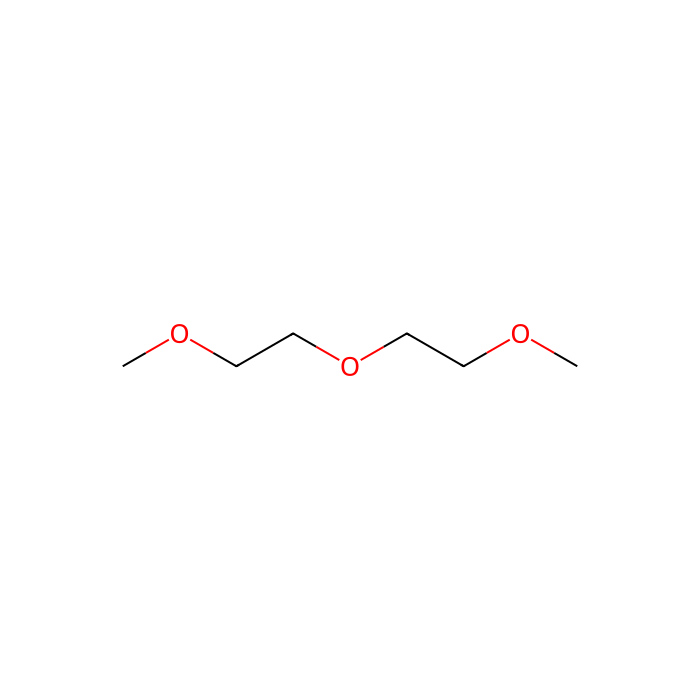
A polar, chelating ether solvent of the glyme family, commonly known as diglyme (bis(2-methoxyethyl) ether). Useful for coordinating metal cations and enabling highly nucleophilic conditions.
Item-specific (from Product Data)
SKU: M104417
Product Name: 2-Methoxyethyl ether (CAS 111-96-6) — commonly referred to as diglyme
CAS: 111-96-6
CID: 8150
Storage note: Argon charged; shipped normal
Grade/Purity: Not specified for this item; refer to CoA/Spec Sheet.
Functional groups: Three ether oxygens (two internal –O– linkages and two terminal methoxy groups considered as ends of a di-alkyl ether chain).
Motifs: Flexible diethylene glycol backbone with terminal methyl ethers; acts as a bidentate/chelating donor through two ether oxygens.
2D description in words: A linear chain CH3–O–CH2–CH2–O–CH2–CH2–O–CH3, with ether oxygens at positions 2, 5, and 8 relative to the leftmost methyl carbon; no rings, no stereocenters.
Donor properties: Strong Lewis base relative to common ethers; good solvator of hard cations (Li+, Na+, K+, Mg2+).
Synthetic Utility
Diglyme’s value in synthesis derives from its ability to strongly solvate metal cations while remaining aprotic, thereby boosting the nucleophilicity of counter-anions and enabling high-temperature operation.
Functional/coordination features (general)
Tridentate ether environment (three O donors along a flexible chain) chelates alkali and alkaline-earth metals; forms labile solvates that tune reactivity.
Representative transformations (literature)
Williamson ether synthesis and SN2 reactions with Na/K alkoxides, thiolates, and cyanides at 80–150 °C.
Halide exchange (Finkelstein, e.g., R–Cl to R–I with NaI) benefiting from enhanced NaI solubility.
Metal-mediated couplings/reductions (e.g., dissolving-metal or Na/K-promoted couplings) where coordination stabilizes reactive species.
Grignard and organolithium manipulations when higher bp than THF/DME is desired, subject to reagent compatibility.
Polymerizations where cation solvation governs kinetics (e.g., EO-derived monomers), and as a medium for inorganic salt dissolution.
Retrosynthetic value
Enables otherwise sluggish substitutions on hindered or deactivated substrates by increasing anion activity and allowing higher temperatures without switching to protic or strongly basic amide solvents.
Practical considerations
Drying/quality: Ensure low water and low peroxide content. KF and iodometric/UV peroxide tests are recommended before sensitive applications.
Workup and recovery: Water miscibility eases salt removal; vacuum distillation (monitor peroxides) enables recovery. Consider brine salting-out if phase separation is desired.
Target Specificity
Not applicable. This catalog item is a small-molecule solvent (diglyme), not a biological macromolecule or affinity reagent. No antigen/epitope, clone, isotype, or species reactivity is relevant.
We use cookies to ensure the website functions properly and, where permitted, to improve your experience. You can manage your preferences at any time in Settings. Learn more in our Cookie Policy.
Shall we send you a message when we have discounts available?
Remind me later
Thank you! Please check your email inbox to confirm.
Products are supplied to verified businesses, institutions, and qualified professionals for research and development use only. Not for use in humans, animals, diagnosis, or therapy.

 J2209510