≥95% per flussi di lavoro cromatografici e analitici sensibili che richiedono un'interferenza minima della linea di base.
🌡
Stoccaggio e spedizione
Room temperature Spedizione Normal. Consultare il COA specifico del lotto per le specifiche esatte.
📋
Documenti di qualità
SDS, COA, scheda tecnica e scheda delle specifiche disponibili per il download. COA specifico del lotto accessibile tramite ricerca per numero di lotto.
📚
Prova documentale
Citato in 0 pubblicazioni peer-reviewed su cromatografia, sintesi organica e reazioni di accoppiamento incrociato.
This compound belongs to the class of organic compounds known as medium-chain fatty acids. These are fatty acids with an aliphatic tail that contains between 4 and 12 carbon atoms.
External Descriptors
Unsaturated fatty acids
1. Djoumbou Feunang Y, Eisner R, Knox C, Chepelev L, Hastings J, Owen G, Fahy E, Steinbeck C, Subramanian S, Bolton E, Greiner R, and Wishart DS. ClassyFire: Automated Chemical Classification With A Comprehensive, Computable Taxonomy. Journal of Cheminformatics, 2016, 8:61.
Determine the necessary mass, volume, or concentration for preparing a solution.
Dilution Calculator
Determine the dilution needed to prepare a stock solution.
Reconstitution Calculator
Recensioni
Recensioni dei clienti
Application Protocols
No assay/application protocols (e.g., WB, IHC, IF, FC) are provided for this item. As a small-molecule reagent, usage depends on the chosen synthetic or analytical procedure.
Practical starting points (general)
Esterification: 2-octynoic acid (1.0 eq), alcohol (3–5 eq), catalytic p‑TsOH, Dean–Stark in toluene or use DCC/DMAP in DCM at 0–25 °C.
Amide formation: HATU (1.1 eq), DIPEA (3 eq), amine (1.1 eq) in DMF, 0–25 °C, monitor by LC–MS.
Hydrogenation: Lindlar catalyst, EtOAc, 1 atm H2, monitor IR/NMR for loss of alkyne signal.
Refer to primary literature or method-specific SOPs for detailed procedures and safety controls.
Biological Roles
This product is intended for research use only.
General/literature context (not product-specific, no clinical claims)
2-Octynoic acid is a medium-chain, unsaturated fatty-acid analog containing an internal alkyne. Such molecules can modulate membrane–lipid interactions differently than saturated analogs due to increased rigidity and linearity of the C≡C segment.
In biochemistry and chemical biology, aliphatic acids are commonly converted to amides/esters for probe development, lipidation studies, or surface immobilization; the internal alkyne offers a handle for further derivatization via electrophilic addition or metal-catalyzed transformations (though it is not the standard bioorthogonal terminal-alkyne tag).
Carboxylate salts of medium-chain acids increase aqueous compatibility for in vitro assays; protonated acids partition into membranes and hydrophobic phases.
Practical note
For any biological experiment, confirm purity, endotoxin background (if relevant), and solvent vehicle effects. Use appropriate controls to distinguish effects of the alkyne moiety from the acid function and hydrophobic chain.
Buffer Applications
Not typically used as a buffering agent. 2-Octynoic acid is a hydrophobic carboxylic acid with limited water solubility and lacks a suitable pKa/pH range and solubility profile for conventional lab buffers.
Practical guidance
If an aqueous environment is required, prepare soluble carboxylate salts (e.g., Na+, K+) or use co-solvents (DMSO, ethanol) at low percentages with proper controls.
For pH control, use standard buffers (phosphate, HEPES, Tris) and treat 2-octynoic acid as a solute or substrate, not as a buffer component.
Green Alternatives
Because 2-octynoic acid is a substrate/reagent, greener practice focuses on solvent and reagent choices for its transformations rather than replacing the molecule itself.
Greener solvent options (general)
Prefer ethyl acetate, methanol/ethanol, 2‑MeTHF, CPME, or propylene carbonate over chlorinated solvents where compatible with the reaction.
For extractions, use EtOAc/heptane systems instead of DCM where phase behavior permits.
Greener coupling strategies (general)
Use catalytic coupling methods (e.g., organocatalytic esterifications, enzyme-catalyzed acylations) where appropriate.
Minimize stoichiometric chlorinating agents (SOCl2, oxalyl chloride). Alternatives: CDI activation (CO2 by‑product) or mixed anhydrides that avoid halogenated waste.
Energy and safety considerations
Conduct hydrogenations at ambient temperature/pressure where possible; consider flow hydrogenation to enhance safety.
Avoid Hg2+ salts for alkyne hydration due to toxicity; gold- or Brønsted-acid catalysis in greener solvents can be preferable.
Example comparison (general, illustrative)
DCM-based EDC/DMAP coupling vs EtOAc or MeCN: EtOAc/MeCN reduce chlorinated waste; MeCN is polar aprotic but has better environmental profile than DCM. 2‑MeTHF can replace THF in many reductions and hydroborations, offering renewable sourcing and easier separations.
Pharmaceutical Uses
No pharmacopeial listing or excipient status is specified for this item; refer to CoA/Spec Sheet.
General formulation context (no therapeutic claims)
As a hydrophobic carboxylic acid, 2-octynoic acid could, in principle, be converted to esters/amides used as intermediates in API synthesis or as modifiers in lipid-based formulations for research. However, suitability depends on impurity profile, residual solvents, and toxicological assessment.
For any GMP-relevant use, dedicated qualification is required (identity/purity, residual solvents, elemental impurities, stability) and must not rely on research-grade material.
Physical Properties
Item-specific specifications
Appearance: Not specified for this item; refer to CoA/Spec Sheet.
Any numeric physicochemical specs (bp, mp, density, refractive index, water, metals, UV cutoff): Not specified for this item; refer to CoA/Spec Sheet.
Literature/general physicochemical data (for reference; not item specifications)
Phase at ambient conditions: typically a colorless to pale liquid or low-melting solid for C8 unsaturated fatty acids.
Acid dissociation: pKa (carboxylic acid) typically ~4.5–4.8 for medium-chain aliphatic acids (literature, general class behavior).
Solubility: sparingly soluble in water; miscible with common organic solvents (e.g., diethyl ether, dichloromethane, acetone, alcohols) (literature).
Partitioning: logP for C8 aliphatic acids typically in the 2.5–3.5 range (literature, estimated for chain length and unsaturation).
Volatility: lower volatility than corresponding ester; can exhibit noticeable odor typical of short/medium-chain fatty acids (literature).
Notes
Use the item’s CoA/Spec Sheet for exact numerical values required for regulated or method-critical work.
Reported literature values vary with measurement method, purity, and temperature; confirm experimentally for process design.
Quality and Grades
Item-specific quality information
Grade/Purity: Not specified for this item; refer to CoA/Spec Sheet.
Guidance on typical grades for this compound class (general)
Research grade: Suitable for most synthetic and analytical workflows. Verify inhibitor/stabilizer-free status if performing sensitive catalysis.
High-purity/GC grade (if offered): Tighter control of volatile/odorant impurities and lower aldehyde/ketone content—useful for kinetic studies and surface-sensitive analyses.
Considerations for 2-octynoic acid
Stabilizers: Not commonly stabilized; if stabilizers are present, they should be disclosed on the CoA. Absence/presence of stabilizers can influence polymerization/catalyst compatibility.
Impurities to watch (general): Saturated (octanoic acid) and mono-unsaturated (octenoic acid) homologs, residual solvents, water content. For spectroscopic work, confirm absence of peroxide or halogenated species if the material was processed under oxidizing/halogenating conditions.
Documentation: For method validation or regulated environments, use the lot-specific CoA/SDS for purity assay, residual solvents, and elemental analysis.
Reaction and Applications
General reactivity profile
Carboxylic acid handle: readily transformed into esters, amides, anhydrides, and acid chlorides (e.g., SOCl2, oxalyl chloride); enables peptide-like couplings (EDC, DIC, HATU) to furnish 2‑alkynyl amides/esters.
Internal alkyne: participates in hydrogenation (to alkene/alkane), halogenation (Br2/Cl2), hydrohalogenation (HX), hydroboration/oxidation (to enones/ketones), metal-catalyzed additions (e.g., Au- or Pt-catalyzed hydration to ketones), and cycloaddition chemistry under suitable activation (e.g., [2+2+2] cycloadditions with transition-metal catalysts).
Selective hydrogenation: Lindlar catalyst affords the corresponding oct-2-enoic acid; full hydrogenation yields octanoic acid.
Oxymercuration/acid-catalyzed hydration: gives a ketone adjacent to the carboxyl-bearing chain (tautomerization from enol); reaction conditions dictate regioselectivity for internal alkynes.
Amide/ester libraries: activation with HATU or EDCI/DMAP enables rapid preparation of 2‑alkynyl amides/esters for SAR or probe development.
Cross-coupling at the alkyne: formation of metal–acetylide is not typical for internal alkynes; however, electrophilic additions and vinyl-metal intermediates allow further elaboration.
Practical tips
Use anhydrous conditions for acid chloride or CDI activation; trace water reduces coupling efficiency.
Control hydrogenation carefully to avoid over-reduction; monitor by GC/IR (disappearance of ~2100–2250 cm−1 C≡C stretch).
For hydration/isomerization of internal alkynes, catalyst choice (Hg2+, Au, Pt) and solvent acidity strongly influence outcome and regioselectivity.
Use cases
Fatty-acid–like scaffold introducing a rigid linear segment; useful in materials, surface modification, and as a handle for further elaboration in synthetic sequences.
Reaction Conditions
General guidance from literature (not item specifications):
Amide/ester couplings
Reagents: EDC·HCl (1.1–1.5 eq) + HOBt/HOAt or HATU (1.0–1.2 eq); base DIPEA (2–3 eq).
Solvents: DMF, DCM, or MeCN (anhydrous).
Temperature/time: 0–25 °C, 1–16 h depending on nucleophile.
Notes: For hindered amines, use HATU/HOAt; monitor by TLC/LC–MS.
Acid chloride route
SOCl2 (1.5–3 eq), catalytic DMF, 0–reflux until gas evolution ceases; concentrate, then add to amine in DCM/Et3N at 0–25 °C.
Selective hydrogenation of C≡C
Lindlar (5–10 wt% of substrate) in EtOAc or iPrOH, 1 atm H2, 0–25 °C; monitor to E- or Z-alkenoic acid depending on conditions. For full saturation, Pd/C under 1–3 atm H2, ambient T.
Hydration to ketone
Au(I/III) catalysts (1–5 mol%) with protic acid cocatalyst in MeOH/MeCN/H2O mixtures, 25–60 °C. Avoid Hg2+ for greener practice.
Halogenation/hydrohalogenation
Br2 or HBr in DCM/AcOH at 0–25 °C; control equivalents to avoid over-addition. Regiochemistry on internal alkynes may be mixture—optimize conditions.
Workup considerations
Acidic quench preserves acid functionality for couplings; basic washes generate carboxylate—reacidify before isolation if free acid is desired.
All conditions should be optimized on small scale; yields and selectivities depend on catalyst, solvent, and substituent effects.
Safety and Handling
Item-specific hazard information
Signal Word: Not specified for this item; refer to SDS.
H-Statements: Not specified for this item; refer to SDS.
GHS Classification/Pictograms: Not specified for this item; refer to SDS.
General safety guidance for alkynoic acids (literature/general)
Hazards: Carboxylic acids are typically irritant/corrosive to eyes/skin at higher concentrations; unsaturated acids may cause respiratory/skin irritation upon prolonged exposure.
PPE: Use chemical-resistant gloves (e.g., nitrile), lab coat, and eye protection (safety glasses or face shield). Employ a fume hood to minimize inhalation exposure.
Incompatibilities: Avoid strong bases (uncontrolled neutralization/heat), strong oxidizers (possible exotherm), reactive metals (salt formation, hydrogen evolution in presence of moisture and metal hydrides), and acid-sensitive reagents. Internal alkynes are generally stable but avoid strong electrophilic halogenation conditions unless intended.
Handling tips: Minimize exposure to air for odor control; keep containers tightly closed. For accurate stoichiometry, standardize concentration if used as a solution.
First aid (overview; defer to SDS): Skin—wash with soap/water. Eyes—rinse cautiously with water for several minutes; remove contacts. Inhalation—move to fresh air. Ingestion—rinse mouth; seek medical attention as appropriate.
Waste: Collect organic acid waste in appropriate halogenated/non‑halogenated streams per local regulations.
Always consult the product SDS for authoritative, lot-specific hazard information and response measures.
Solvent Selection
Applicability: 2-Octynoic acid is a reagent/substrate rather than a bulk solvent. This section addresses solvents suitable for dissolving and reacting this compound.
Polarity and solvation (general)
Functional groups: one carboxylic acid (polar, protic) and a largely hydrophobic C8 chain with an internal alkyne.
Expected solubility: good solubility in moderately polar aprotic solvents (THF, acetone, acetonitrile, DMSO), chlorinated solvents (DCM, chloroform), and ethers (diethyl ether, MTBE). Limited water solubility; improved as salts in basic aqueous media.
Choosing by application
Coupling to amines/alcohols: DMF, DCM, THF, MeCN commonly used; choose dry solvents for carbodiimide or uronium couplings.
Hydrogenation/isomerization on Pd/C, PtO2: alcohols (EtOH, iPrOH) or ethyl acetate are convenient; avoid strong acids that can promote hydration/ketonization if undesired.
Hydroboration/oxidation or halogenation across C≡C: THF or DCM under inert atmosphere.
Salt formation/extraction: convert to carboxylate with NaHCO3/Na2CO3 for aqueous workup and partitioning.
Small comparison (general)
DCM vs EtOAc: DCM provides higher solubility and inertness toward bases; EtOAc is greener and suitable for extractions and some catalytic hydrogenations.
THF vs MeCN: THF better for organometallic additions (if applicable); MeCN preferred for polar coupling reagents and EDC/HOBt chemistry.
Dry your chosen solvent if water-sensitive activations are planned (e.g., acid chloride formation, CDI coupling).
Storage and Reconstitution
Item-specific storage/shipping
Storage Conditions: Room temperature (from Product Data).
Shipped In: Normal (from Product Data).
General guidance
Container: Store tightly closed in glass with PTFE-lined cap to limit permeation/odor; minimize headspace to reduce oxidative uptake.
Atmosphere: Ambient air is acceptable for most uses; for long-term purity, an inert atmosphere (N2/Ar) and desiccation are prudent.
Light/moisture: Protect from excessive light and moisture to maintain stability and prevent hydrolysis/contamination.
Stabilizers: Not specified for this item; refer to CoA/Spec Sheet.
Solution handling
Prepare stock solutions in dry, compatible solvents (e.g., DCM, THF, MeCN, EtOH, DMSO) immediately before use when possible.
If storing solutions, keep at 2–8 °C in sealed vials; allow to equilibrate to room temperature before opening to avoid moisture ingress. Validate stability empirically.
Research Use Note: For research use only (from Product Data).
Structure and Identity
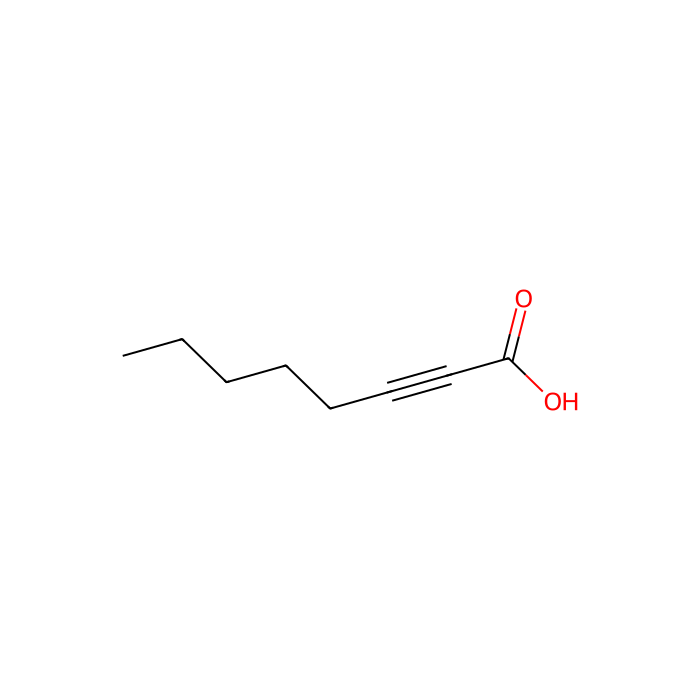
Brief overview: 2-Octynoic acid (oct-2-ynoic acid) is an eight‑carbon, unsaturated carboxylic acid bearing an internal alkyne at the 2‑position relative to the carboxyl.
Item-specific (from Product Data)
SKU: B301308
Product Name: 2-Octynoic acid
CAS: 5663-96-7
InChIKey: 31469
SMILES: Not specified for this item; refer to CoA/Spec Sheet.
Molecular Formula: Not specified for this item; refer to CoA/Spec Sheet.
Molecular Weight: Not specified for this item; refer to CoA/Spec Sheet.
Literature identity (for reference; not item specifications)
Structural features: one carboxylic acid (–CO2H); one internal C≡C triple bond between C2–C3; linear, aliphatic chain (C8 total including carboxyl carbon); achiral.
2D structural description (literature): A terminal carboxyl group is attached to an sp‑hybridized carbon that forms a C≡C bond with the adjacent carbon, followed by a saturated methylene chain terminating in a methyl group.
Synthetic Utility
Functional group leverage
Carboxylic acid: gateway to acyl derivatives (acid chloride, mixed anhydride, activated esters) enabling amide/ester formation with broad nucleophile scope.
Internal alkyne: platform for stereocontrolled reductions (to E/Z-alkenes via catalyst choice), ketone formation via hydration, and vicinal difunctionalizations (halogenation, hydrohalogenation, hydroboration/oxidation).
Retrosynthetic value
2-Octynoic acid enables introduction of a rigid linear segment into amide/ester backbones for conformational tuning in ligands and materials.
It serves as a convergent handle: one end (acid) couples under mild, chemoselective conditions, while the C≡C can be diversified post‑assembly, supporting late-stage modification.
Representative strategies (literature/general)
Convert to acid chloride (SOCl2, catalytic DMF) then couple with amines (Et3N, DCM) to access 2‑alkynyl amides; subsequent semihydrogenation affords geometrically defined enamides.
Gold-catalyzed hydration in alcoholic solvents yields ketones/acetals that can enter aldol or reductive amination sequences.
Radical additions (e.g., AIBN/thiol) across the internal alkyne furnish thioether-functionalized acids for materials and surface chemistry.
Analytical tracking
IR: strong C=O at ~1700–1725 cm−1; alkyne C≡C stretch typically 2100–2250 cm−1 (often weak for internal alkynes). 1H/13C NMR: downfield carboxyl carbon ~175–180 ppm; sp carbons ~70–90 ppm.
Target Specificity
Not applicable. This product is a small-molecule reagent, not a biological targeting agent (e.g., antibody, enzyme, or ligand with defined epitope/clone). No target specificity data are provided for this item.
Utilizziamo i cookie per garantire il corretto funzionamento del sito web e, ove consentito, per migliorare la tua esperienza. Puoi gestire le tue preferenze in qualsiasi momento nelle Impostazioni. Per saperne di più, consulta la nostra Cookie Policy.
Desidera che le inviamo un messaggio quando avremo sconti disponibili?
Ricordamelo più tardi
Grazie! Controlli la sua casella di posta per confermare.
Products are supplied to verified businesses, institutions, and qualified professionals for research and development use only. Not for use in humans, animals, diagnosis, or therapy.

 C2317706