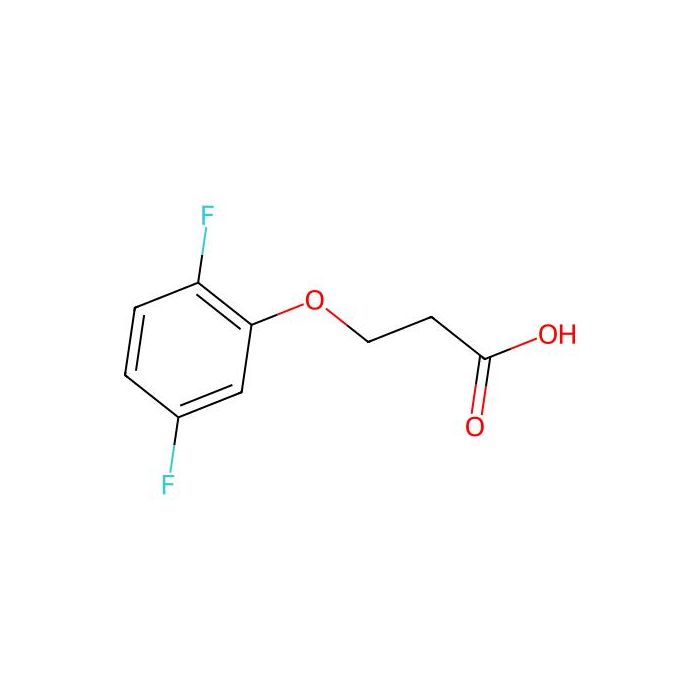
This compound belongs to the class of organic compounds known as 3-phenoxypropionic acids. These are aromatic compounds containing a 3-phenoxypropionic acid.
External Descriptors
Not available
1. Djoumbou Feunang Y, Eisner R, Knox C, Chepelev L, Hastings J, Owen G, Fahy E, Steinbeck C, Subramanian S, Bolton E, Greiner R, and Wishart DS. ClassyFire: Automated Chemical Classification With A Comprehensive, Computable Taxonomy. Journal of Cheminformatics, 2016, 8:61.
Certificati (CoA, COO, BSE/TSE e tabella di analisi)
C of A & Other Certificates(BSE/TSE, COO):
Analytical Chart:
Proprietà chimiche e fisiche
Peso molecolare
202.150 g/mol
XLogP3
1.600
Hydrogen Bond Donor Count
1
Hydrogen Bond Acceptor Count
5
Rotatable Bond Count
4
Exact Mass
202.044 Da
Monoisotopic Mass
202.044 Da
Topological Polar Surface Area
46.500 Ų
Heavy Atom Count
14
Formal Charge
0
Complexity
198.000
Isotope Atom Count
0
Defined Atom Stereocenter Count
0
Undefined Atom Stereocenter Count
0
Defined Bond Stereocenter Count
0
Undefined Bond Stereocenter Count
0
The total count of all stereochemical bonds
0
Covalently-Bonded Unit Count
1
Calcolatori di soluzioni
Molarity Calculator
Determine the necessary mass, volume, or concentration for preparing a solution.
Dilution Calculator
Determine the dilution needed to prepare a stock solution.
Reconstitution Calculator
Recensioni
Recensioni dei clienti
Application Protocols
No tested biological assay protocols are specified for this item. As a small-molecule reagent, its use protocols depend on the intended chemical transformation.
General guidance (chemistry workflows):
Preparing stock solutions: Dissolve the free acid in DMSO (e.g., 10–100 mM) for screening, or in dry DMF/DCM for coupling reactions; adjust with base (DIPEA) as needed.
Coupling setup: Charge dry solvent, base, coupling reagent, and substrate under inert atmosphere when moisture-sensitive. Monitor by TLC (acidic modifier in eluent) or LC–MS.
Workup tips: For reactions run in basic media, acidify aqueous phase to pH ~2–3 to recover the neutral acid into EtOAc. Wash organic layers with brine and dry thoroughly before concentration.
For any biological or analytical application, design fit-for-purpose protocols and validate experimentally. Consult the SDS and CoA for handling and quality details.
Biological Roles
Item-specific biological/biochemical roles: Not specified for this item; the product is for research use only.
General context (literature-based, not product-specific):
Aryloxypropionic acids are common motifs in small-molecule libraries. Their ionizable carboxylic acid and lipophilic aryl ether often confer tunable permeability and binding characteristics for biochemical screening.
The presence of two fluorine atoms can modulate electronic properties and metabolic stability of the aryl ring, influencing interactions with proteins or membranes in discovery research. Fluorine typically reduces oxidative metabolism at substituted positions and can shift pKa of nearby functional groups via inductive effects.
As simple carboxylic acids, such compounds frequently act as ligands for proteins with cationic residues (e.g., Lys/Arg) through salt bridges in biophysical assays, or serve as precursors to amide-linked probes, esters, or photoaffinity labels.
No claims are made regarding any biological activity, safety, or efficacy. Any use in biological systems should be preceded by appropriate toxicity and off-target profiling. For definitive biological roles or activities, consult primary literature relevant to your intended application.
Buffer Applications
This compound is a monocarboxylic acid and is not typically used as a primary buffering agent.
Practical notes:
The free acid can form salts (e.g., sodium or triethylammonium) and may provide limited buffering capacity around its pKa (literature: ~3.5–4.5 for related acids). However, dedicated buffers (acetate, citrate, MES, etc.) are strongly preferred for controlled pH systems.
In workflows requiring dissolution in aqueous media, transient pH adjustment with dilute base (NaHCO3, NaOH) to form the carboxylate is a common practice, followed by re-acidification after extractions if the neutral acid is needed.
Recommendation: Use established buffer systems for biochemical or analytical applications and reserve this compound’s acid–base chemistry for solubility manipulation or derivatization steps.
Green Alternatives
Although the compound itself is a substrate, greener choices can be made for solvents and reagents used with it.
Replace DCM/chloroform with EtOAc or 2-MeTHF for extractions and chromatography when feasible.
Use MeCN or 2-MeTHF instead of THF in moisture-sensitive couplings to reduce peroxide risk and improve safety.
Prefer ethanol or isopropanol as reaction media for esterifications or salt formations when solubility permits.
Reagent considerations:
Swap DCC (urea waste, sensitizer) with EDC·HCl in aqueous-organic systems; combine with OxymaPure instead of HOBt to reduce explosive risk.
Favor catalytic approaches:
Steglich-like esterifications can sometimes be run with catalytic DMAP and green solvents.
Enzymatic esterifications in solvent-free or green media for selective transformations (where applicable in research).
Mini comparison (typical trade-offs):
DCM vs EtOAc: EtOAc is biodegradable and less toxic; DCM often gives faster separations but with higher environmental burden.
DMF/DMSO vs MeCN/2-MeTHF: DMF/DMSO provide excellent solubility but are problematic in waste streams; MeCN is more volatile/easier to remove; 2-MeTHF is bio-derived with favorable EHS profile.
Waste minimization:
Use in situ acid activation (EDC + NHS/Oxyma) to avoid isolating acid chlorides.
Implement aqueous workups that crystallize the neutral acid from its salt by controlled acidification, reducing solvent volumes.
Document any solvent/reagent substitutions in your lab’s green chemistry metrics (E-factor, PMI) to quantify benefits.
Pharmaceutical Uses
No pharmacopeial status, excipient role, or formulated uses are specified for this item; refer to the CoA/Spec Sheet.
General considerations for medicinal chemistry workflows (not clinical claims):
Role as an intermediate: The carboxylic acid can be converted to amides, esters, or bioisosteres (e.g., tetrazoles) to explore structure–activity relationships (SAR). The 2,5-difluorophenyl ether motif is a common design element to adjust lipophilicity and electronics.
Prodrug strategies: Masking of the acid as esters (e.g., isopropyl, pivaloyloxymethyl) is often explored in research to modulate permeability; deprotection conditions should be orthogonal to sensitive motifs.
Developability: Free acids may present solubility and permeability challenges; salt screening (amine salts) and co-crystallization are standard tactics in early formulation studies.
All uses are for research and laboratory development only. No therapeutic or clinical applications are claimed or implied.
Physical Properties
Item-specific specifications: Not specified for this item; refer to CoA/Spec Sheet.
General/literature-based expectations for this structural class (aryloxypropionic acids; provided for context, not as specifications):
Phase/appearance: Many phenoxypropionic acids are low-melting solids or viscous oils depending on substitution; the 2,5-difluoro pattern favors crystalline solids, but this is compound-dependent.
Acid strength: Carboxylic acid pKa typically ~3.5–4.5 (literature) for aryl–O–(CH2)2–CO2H systems; deprotonation markedly increases aqueous solubility.
Lipophilicity: Introduction of two fluorines on the aryl ring generally increases hydrophobicity; analogous compounds exhibit logP in the ~2–3 range (literature, estimated).
Solubility profile (qualitative, literature):
Acid form: Limited solubility in water; soluble in polar organic solvents (MeOH, EtOH, acetone, acetonitrile), and moderately to well soluble in EtOAc, DMSO, DMF, DCM.
As salts (Na+, K+, amine): Readily water-soluble.
Thermal behavior: Carboxylic acids can show broadened melting transitions due to hydrogen-bonded aggregates; neat boiling points are often not reported as they may decompose before boiling at 1 atm.
Spectroscopic notes (literature): Strong IR band for C=O near 1700–1725 cm−1 (acid dimer), broad O–H 2500–3300 cm−1; 19F NMR with two distinct aromatic F resonances; 1H NMR with benzylic O–CH2 (~4.0–4.3 ppm) and methylene adjacent to CO2H (~2.6–2.9 ppm).
For exact numerical values (mp, purity, density, UV cutoff, residuals), consult the CoA/Spec Sheet.
Quality and Grades
Item-specific grade/purity: Not specified for this item; refer to CoA/Spec Sheet.
Guidance for interpreting grades (general):
Research-grade/AR: Suitable for most synthetic and analytical workflows. Typical controls include identity (NMR/IR/HRMS), assay by HPLC/GC, and limits on common residual solvents or water. If HPLC or LC–MS work is intended, consider grades flagged for low non-volatile residue and low UV background.
Low-UV/HPLC grade (if applicable): Emphasis on minimal UV-absorbing impurities, which is useful when the compound itself contains an aromatic chromophore. For gradient LC, low baseline drift and tight control of stabilizers are advantageous.
Stabilizers: Not expected for this class unless provided explicitly. If any stabilizer is present (e.g., trace antioxidant), it will be disclosed on the CoA.
What to look for on the CoA/Spec Sheet for this item:
Assay/percent purity basis (anhydrous vs. as is)
Identity confirmation (1H/13C/19F NMR, IR, HRMS)
Water content (Karl Fischer), residual solvents, and inorganic impurities
Appearance consistency (solid/oil) and color
Any salt content or neutralization state, if relevant
If your application is particularly sensitive (e.g., medicinal chemistry SAR or catalyst screening), request the latest CoA lot data and consider additional in-house QC (water content by KF, residual metals by ICP-MS) as needed.
Reaction and Applications
This difluorinated aryloxypropionic acid serves as a versatile building block in synthetic chemistry. Key application families (literature-based):
Amide couplings: Conversion to amides using carbodiimides (DCC/EDC) or uronium/phosphonium reagents (HATU, HBTU, PyBOP) with bases (DIPEA, NMM). The –(CH2)2–CO2H chain provides flexibility and separates the amide from the aromatic core, often improving solubility of products.
Steglich esterification (DCC/DMAP) under mild conditions,
Acid chloride route (SOCl2 or oxalyl chloride; then alcohol/amine), taking care with the aryl fluoride integrity.
Salt formation: Readily forms sodium/potassium/amine salts for solubility modulation, crystallization, or phase-transfer processes.
Decarboxylative pathways: Carboxylates can undergo decarboxylative coupling/functionalization under photoredox or silver-mediated conditions (literature), enabling access to alkyl radicals anchored to the aryloxy moiety.
Aryl fluoride reactivity: The 2,5-difluoro pattern can participate in SNAr with hard nucleophiles (e.g., alkoxides, amines, thiolates) at positions bearing F as leaving groups, especially in polar aprotics at elevated temperature; chemoselectivity may be tunable by temperature and base.
Protecting-group strategies: The free acid can be masked as tert-butyl or benzyl esters for orthogonal deprotection (TFA or hydrogenolysis, respectively).
Practical tips:
Drying: For moisture-sensitive couplings, azeotrope with toluene or co-evaporate with anhydrous solvents; verify water content by KF when critical.
Acid tailing on silica: Add 0.1–1% acetic or formic acid to mobile phases to improve chromatographic behavior.
Monitor aryl–F integrity under strong nucleophilic/basic conditions to avoid unintended SNAr.
Reaction Conditions
General literature conditions for common transformations (guidance only; optimize per substrate):
Workup: Filter dicyclohexylurea; wash with dilute acid/base to remove DMAP.
Acid chloride formation and derivatization:
Reagents: SOCl2 (3–5 eq) with catalytic DMF; reflux 1–3 h
Follow-up: Add alcohol or amine with base (pyridine/triethylamine) at 0–25 °C
Caution: Maintain anhydrous conditions; avoid prolonged heating that could promote SNAr on the ring.
Reduction to alcohol (BH3·THF):
Solvent: THF (anhydrous)
Reagents: BH3·THF (1.2–1.5 eq)
Temp/Time: 0 °C to rt, 1–4 h; quench carefully with MeOH/H2O
SNAr on difluoroarene (amine/thiolate):
Solvent: DMSO or DMF
Base/Nucleophile: NaOtBu, K2CO3, or the neat amine; 2–5 eq
Temp/Time: 80–140 °C, 4–24 h (sealed tube often beneficial)
Notes: Regioselectivity may favor positions bearing F; verify by 19F/1H NMR.
Decarboxylative coupling (via NHPI ester):
Reagents: DIC or EDC to form NHPI ester; photoredox (Ir(ppy)3), Ni catalyst for C–C formation
Solvent: MeCN/DMF; Blue LEDs, rt to 40 °C
These are starting points; scale, substrate electronics, and nucleophile/basicity will dictate optimization.
Safety and Handling
Authoritative safety information must be taken from the product SDS.
Item-specific hazard data: Not specified for this item; refer to SDS for signal word, hazard statements, GHS classification, and pictograms.
General guidance for aryloxy carboxylic acids (literature-based, not product-specific):
Likely hazards: May cause skin and eye irritation; ingestion or inhalation of dusts/mists can be harmful. Low volatility, but dust formation should be minimized.
PPE: Use lab coat, safety glasses or face shield, and appropriate chemical-resistant gloves (e.g., nitrile). Employ local exhaust ventilation when weighing or transferring powders.
Handling: Avoid breathing dust; prevent contact with skin and eyes. Do not mix with strong oxidizers. Contact with strong bases will form carboxylate salts; strong acids and dehydrating agents can promote acylation/dehydration.
Incompatibilities: Strong oxidizing agents; strong bases (for storage, may lead to salt formation and hygroscopicity); reactive acid chlorides/anhydrides (if used in situ, control conditions carefully). Avoid prolonged contact with reactive metals if converting to acid chloride.
First aid (overview):
Inhalation: Move to fresh air; seek medical attention if symptoms persist.
Skin/eye contact: Rinse with plenty of water for at least 15 minutes; remove contaminated clothing; seek medical advice if irritation persists.
Ingestion: Rinse mouth; do not induce vomiting unless directed by medical personnel; seek medical attention.
Fire safety: Organic acids are combustible; use CO2, dry chemical, or foam. Thermal decomposition may release COx and HF-containing species due to fluorinated aromatic ring—wear SCBA in a fire scenario.
Always consult the SDS before use.
Solvent Selection
Relevance: This compound is a small organic acid building block, not used as a bulk solvent. Solvent selection here refers to choosing media for dissolution, reactions, and purification.
General solubility/miscibility guidance (literature/experience-based):
Polar protic solvents: Methanol, ethanol, isopropanol typically dissolve the acid; solubility improves upon forming salts (e.g., with triethylamine).
Polar aprotic: DMSO and DMF provide excellent solubility for stock solutions and coupling reactions; acetonitrile often acceptable but lower capacity.
Moderately polar: Ethyl acetate and acetone dissolve the neutral acid; EtOAc useful for extraction from aqueous base after re-acidification.
Nonpolar: Limited solubility in hexanes/heptane; mixtures with EtOAc or MTBE facilitate crystallizations.
When to choose what:
Stock solutions for screening: DMSO (high solubility), or MeOH/EtOH if avoiding DMSO reactivity.
Coupling chemistry (amide/ester formation): DMF, DCM, or MeCN with carbodiimide or uronium reagents; add base (DIPEA) as needed.
SNAr or nucleophilic aromatic substitution on the difluorophenyl ring: Polar aprotic (DMSO/DMF) at elevated temperatures with strong nucleophiles.
Purification: Normal-phase silica with gradients of hexanes/EtOAc or DCM/MeOH containing 0.1–1% acetic acid to reduce tailing of acidic compounds; reverse-phase C18 with aqueous buffer (acidified) for LC-based purifications.
Small comparison (typical choices):
DCM vs. EtOAc: DCM gives faster silica movement but is less green; EtOAc is safer/greener with adequate elution strength for many aryloxy acids.
DMF/DMSO vs. MeCN: DMF/DMSO offer superior solubility; MeCN is easier to remove and more LC-friendly.
Storage and Reconstitution
Item-specific storage: Room temperature (per Product Data). Avoid excessive heat and direct sunlight. Keep container tightly closed.
Additional best practices (general):
Atmosphere: Store in a dry place; protect from moisture to avoid clumping or unintended salt formation. Use desiccant if ambient humidity is high.
Container: Use amber glass or opaque containers to minimize photochemical degradation of the aromatic system; keep cap tightly sealed to prevent solvent uptake.
Stability: Aryloxy carboxylic acids are typically stable under ambient lab conditions. Avoid strong bases/acids during storage.
Reconstitution/dissolution (guidance):
Organic stocks: Dissolve in DMSO, DMF, MeOH, EtOH, or EtOAc. If aqueous use is required, form a soluble salt by adding a stoichiometric base (e.g., NaHCO3, NaOH, or an amine), then adjust pH as needed after use.
Filtration: For analytical work, pass solutions through 0.2 µm PTFE or PVDF filters to remove particulates.
Freeze–thaw: If preparing DMSO stocks for screening, aliquot to avoid repeated freeze–thaw cycles.
Disposal: Collect waste solutions as halogenated or non-halogenated organic waste depending on solvent; follow institutional and regulatory guidelines.
For definitive stability, shelf life, and reconstitution conditions specific to the supplied lot, refer to the CoA/Spec Sheet.
Structure and Identity
Brief description: 3-(2,5-Difluorophenoxy)propanoic acid is an aryloxypropionic acid bearing two fluorine substituents on the phenyl ring at the 2- and 5-positions, connected through an ether linkage to a 3-carbon carboxylic acid side chain.
Aromatic ring (phenyl) substituted with F at 2- and 5-positions
Ether linkage (aryl–O–alkyl) connecting ring to a propionic acid chain
Terminal carboxylic acid (–CO2H), no stereogenic centers
2D structure in words: A difluorophenyl ring bonded to an oxygen atom (phenoxy), which is connected to a –CH2–CH2–CO2H propionic acid chain; fluorines at ortho (2-) and meta (5-) relative to the ether oxygen.
Synthetic Utility
Functional group portfolio and reactivity (literature-based):
Carboxylic acid:
Activation to acyl derivatives (acid chloride, anhydride) for amide/ester formation.
Coupling via EDC/HOBt (or Oxyma)/DIPEA; HATU/HBTU for challenging amines.
Curtius/Schmidt-type rearrangements (via acyl azide) to access amines/urethanes (advanced use with caution).
Benzylic ether linkage (Ar–O–CH2–): Typically robust; under strongly acidic Lewis conditions, ether cleavage is possible—use protective strategies where needed.
Difluoroarene:
Potential for SNAr displacement of F by nucleophiles (amines, thiolates) under forcing, polar aprotic conditions.
Site-selective functionalization may be tuned by temperature, base strength, and nucleophile hardness.
Side-chain elaboration:
Homologation (Arndt–Eistert) from acid chloride to extend the chain length.
Reduction (e.g., BH3·THF) to primary alcohol, then onward to halides, azides, or amines.
Decarboxylative cross-couplings (photoredox/Ni) from the carboxylate or redox-active esters (NHPI), enabling C–C bond formations.
Retrosynthetic value:
Serves as a convergent handle connecting a functionalized difluorophenyl core with diverse amide/ester partners, enabling rapid library synthesis.
Practical considerations:
Keep basic impurities low during acid chloride formation to avoid aryl fluoride substitution.
For chromatography, acidify eluents to minimize tailing; convert to a tert-butyl ester to improve volatility for GC if needed.
Target Specificity
Not applicable. This product is a small-molecule building block and is not an antibody, enzyme, or targeted biological reagent. No antigen/epitope, clone, isotype, or species reactivity information applies.
We use cookies to ensure the website functions properly and, where permitted, to improve your experience. You can manage your preferences at any time in Settings. Learn more in our Cookie Policy.
Shall we send you a message when we have discounts available?
Remind me later
Thank you! Please check your email inbox to confirm.
Products are supplied to verified businesses, institutions, and qualified professionals for research and development use only. Not for use in humans, animals, diagnosis, or therapy.