Determine the necessary mass, volume, or concentration for preparing a solution.
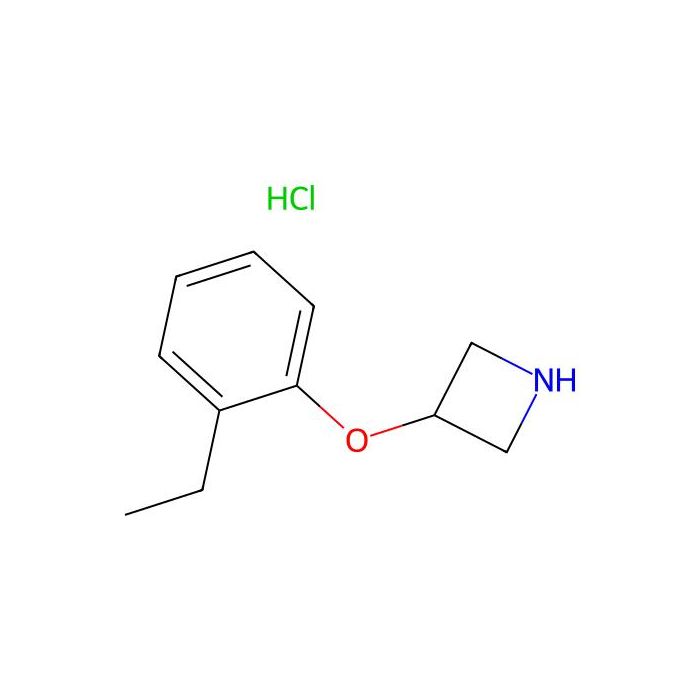
3-(2-Ethylphenoxy)azetidine hydrochloride - ≥97% , CAS No.1269052-48-3
Disponibile su ordine
GRADE & PURITY ≥97%
Storage
Room temperature

≥97% for sensitive chromatographic and analytical workflows requiring minimal baseline interference.
Room temperature Ships Check lot-specific COA for exact specifications.
SDS, COA, datasheet, and spec sheet available for download. Lot-specific COA accessible via lot number lookup.
Cited in 0 peer-reviewed publications across chromatography, organic synthesis, and cross-coupling reactions.
Comprehensive hazard, handling, storage, and regulatory compliance document.
Download SDS →Lot-specific quality data. Enter your lot number to retrieve the exact COA.
Look up COA →Full quality attributes and acceptance criteria for this grade.
View spec sheet →Taxonomy Tree
| Kingdom | Organic compounds |
|---|---|
| Superclass | Benzenoids |
| Classe | Phenol ethers |
| Subclass | Not available |
| Intermediate Tree Nodes | Not available |
| Direct Parent | Phenol ethers |
| Alternative Parents | Phenoxy compounds Alkyl aryl ethers Azetidines Dialkylamines Azacyclic compounds Hydrochlorides Hydrocarbon derivatives |
| Molecular Framework | Aromatic heteromonocyclic compounds |
| Substituents | Phenoxy compound - Phenol ether - Alkyl aryl ether - Monocyclic benzene moiety - Azetidine - Azacycle - Organoheterocyclic compound - Secondary amine - Ether - Secondary aliphatic amine - Hydrochloride - Organic oxygen compound - Organooxygen compound - Organonitrogen compound - Organic nitrogen compound - Amine - Hydrocarbon derivative - Aromatic heteromonocyclic compound |
| Descrizione | This compound belongs to the class of organic compounds known as phenol ethers. These are aromatic compounds containing an ether group substituted with a benzene ring. |
| External Descriptors | Not available |
| Peso molecolare | 213.700 g/mol |
|---|---|
| XLogP3 | |
| Hydrogen Bond Donor Count | 2 |
| Hydrogen Bond Acceptor Count | 2 |
| Rotatable Bond Count | 3 |
| Exact Mass | 213.092 Da |
| Monoisotopic Mass | 213.092 Da |
| Topological Polar Surface Area | 21.300 Ų |
| Heavy Atom Count | 14 |
| Formal Charge | 0 |
| Complexity | 156.000 |
| Isotope Atom Count | 0 |
| Defined Atom Stereocenter Count | 0 |
| Undefined Atom Stereocenter Count | 0 |
| Defined Bond Stereocenter Count | 0 |
| Undefined Bond Stereocenter Count | 0 |
| The total count of all stereochemical bonds | 0 |
| Covalently-Bonded Unit Count | 2 |
No tested biological assay protocols are provided for this item. As a small-molecule reagent, usage protocols depend on the intended synthetic or screening application. General guidance:
Refer to your lab’s SOPs and method-specific literature for detailed protocols. This product is for research use only.
No biological roles are specified for this catalog item. The following provides general context (literature/general) relevant to azetidine-containing small molecules:
Important: This product is supplied strictly for research use only. No claims are made regarding physiological function, therapeutic activity, or diagnostic utility. Any biological testing should be designed and interpreted by qualified professionals, and appropriate approvals and safety protocols must be followed.
This compound is not a standard buffering agent and no buffer-system applications are specified for this item. As an amine hydrochloride salt, it will contribute to solution acidity/basicity, but it is not used to maintain a defined pH range like dedicated buffers (e.g., phosphate, HEPES, Tris).
Practical note (general):
For buffer preparation guidance, refer instead to established buffering systems; this product is best viewed as a small-molecule building block or probe, not a buffer component.
While specific process conditions are not defined for this item, the following greener strategies (literature/general) can reduce solvent and hazard footprints when working with azetidine salts and related building blocks:
Comparison of common solvent choices (general):
Operational choices:
Tradeoffs:
Always confirm performance and impurity profiles when swapping solvents; item-specific solvent compatibility is not provided.
No pharmacopeial status, excipient role, or formulation use is specified for this item. The following general considerations apply to amine HCl salts in development chemistry (literature/general), without implying clinical or therapeutic use:
Important: Aladdin supplies this product for research use only. No claims are made regarding therapeutic applications, dosing, safety in humans/animals, or compliance with pharmacopoeial monographs.
Item-specific numeric specifications are not provided in the Product Data. Consult the CoA/Spec Sheet for authoritative values.
Practical notes (general): the HCl salt form often presents as a crystalline solid with higher melting/decomposition temperatures relative to the corresponding free base. Always verify lot-specific properties on the CoA before process design.
Interpretation and guidance (general):
Research Use Note: For research use only. Not for human or veterinary use, diagnostic procedures, or food applications.
This molecule is a versatile heterocyclic building block combining an azetidine ring (strain-enhanced reactivity at nitrogen/carbon under certain conditions) with a 2‑ethylphenoxy aryl ether. While item-specific performance data are not provided, typical applications for azetidine-containing aryl ethers (literature/general) include:
Practical tips:
Note: Manufacturer application notes were not provided; the above reflects general synthetic utility of azetidine HCl salts.
Item-specific conditions are not provided. The following general conditions are commonly effective with azetidine free bases and their salts (literature/general):
Notes and cautions:
Yields will vary with substrate and conditions; consult primary literature for closely related azetidine derivatives.
Hazard classification for this specific item is not provided in the Product Data. Always consult the product SDS for authoritative safety information.
General safety considerations for amine hydrochloride salts (literature/general):
First aid (general guidance; not a substitute for SDS):
Spill/leak response (general): Avoid dust generation; collect with inert absorbent, transfer to a suitable container for disposal according to local regulations.
Fire: Use CO2, dry chemical, or foam. Combustion may produce COx, NOx, and HCl. Use SCBA in confined fires.
This product is supplied as a hydrochloride salt of a basic azetidine. Item-specific solubility is not provided; use the following general guidance for amine hydrochloride salts (literature/general):
Practical approaches:
Selection hints:
Note: Confirm actual solubility and stability in your chosen solvent experimentally, as they are not specified for this item.
Reconstitution and solution handling (general guidance):
Always refer to the SDS and CoA/Spec Sheet for lot-specific storage and handling recommendations.
Product: 3-(2-Ethylphenoxy)azetidine hydrochloride (SKU: E995552)
Structural description (based on name; general chemistry interpretation):
Note: Identity parameters specific to this lot (exact formula, exact MW, and structural strings) are not specified in the provided Product Data and should be confirmed against the CoA/Spec Sheet.
This molecule merges an azetidine ring with a 2‑ethylphenoxy substituent, offering several orthogonal handles (literature/general guidance):
Use cases:
Not applicable. This product is a small-molecule building block, not a biological macromolecule or affinity reagent. No antigen/epitope or species reactivity information applies.