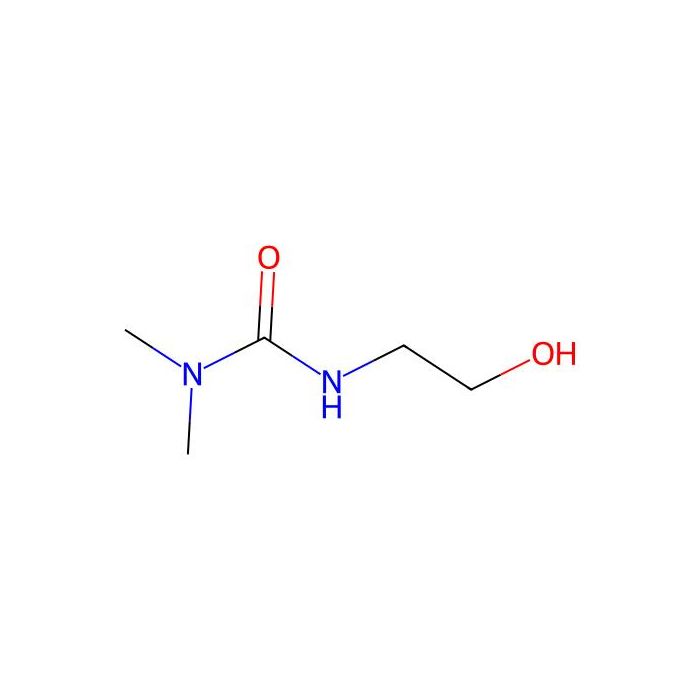
This compound belongs to the class of organic compounds known as ureas. These are compounds containing two amine groups joined by a carbonyl (C=O) functional group.
External Descriptors
Not available
1. Djoumbou Feunang Y, Eisner R, Knox C, Chepelev L, Hastings J, Owen G, Fahy E, Steinbeck C, Subramanian S, Bolton E, Greiner R, and Wishart DS. ClassyFire: Automated Chemical Classification With A Comprehensive, Computable Taxonomy. Journal of Cheminformatics, 2016, 8:61.
Certificati (CoA, COO, BSE/TSE e tabella di analisi)
C of A & Other Certificates(BSE/TSE, COO):
Analytical Chart:
Proprietà chimiche e fisiche
Peso molecolare
132.160 g/mol
XLogP3
-1.100
Hydrogen Bond Donor Count
2
Hydrogen Bond Acceptor Count
2
Rotatable Bond Count
2
Exact Mass
132.09 Da
Monoisotopic Mass
132.09 Da
Topological Polar Surface Area
52.600 Ų
Heavy Atom Count
9
Formal Charge
0
Complexity
93.000
Isotope Atom Count
0
Defined Atom Stereocenter Count
0
Undefined Atom Stereocenter Count
0
Defined Bond Stereocenter Count
0
Undefined Bond Stereocenter Count
0
The total count of all stereochemical bonds
0
Covalently-Bonded Unit Count
1
Calcolatori di soluzioni
Molarity Calculator
Determine the necessary mass, volume, or concentration for preparing a solution.
Dilution Calculator
Determine the dilution needed to prepare a stock solution.
Reconstitution Calculator
Recensioni
Recensioni dei clienti
Application Protocols
No tested bioassay protocols are specified for this item. As a small-molecule building block/additive, typical procedures relate to synthetic transformations and analytical preparation:
Stock solution preparation (general): dissolve to 10–100 mg/mL in water, methanol, ethanol, or DMSO; filter through 0.2 µm PTFE/NYLON; store aliquots at room temperature or 2–8 °C as appropriate.
Reaction setup: for alcohol derivatization (e.g., tosylation), dry glassware and solvents; inert atmosphere recommended; maintain 0–5 °C during reagent addition.
Analytical methods: HPLC with water/acetonitrile + 0.1% formic acid or ammonium formate; detection at 200–220 nm typically captures urea chromophore weakly—use ELSD/LC–MS if UV sensitivity is insufficient.
Refer to your internal SOPs and literature precedents for detailed step-by-step protocols tailored to your application.
Biological Roles
Item-specific biological data: Not specified for this item; refer to primary literature if needed.
General notes (biochemistry/chemistry interface; not clinical)
Urea motif: the urea functionality is a prevalent H-bonding element in medicinal chemistry for engaging protein backbones or acidic side chains. Dimethyl substitution reduces basicity and often modulates permeability.
Hydroxyethyl handle: confers hydrophilicity and can engage in additional H-bonding with biomolecules or water, impacting solubility and aggregation.
Metabolic expectations: small aliphatic ureas and primary alcohols may undergo oxidative metabolism (alcohol to aldehyde/acid) and hydrolytic pathways; however, dimethylureas are generally hydrolytically robust under physiological pH.
No specific endogenous role is known for 3-(2-hydroxyethyl)-1,1-dimethylurea. Any biological interactions would be context- and target-dependent in research assays. This product is supplied strictly for research use only.
Buffer Applications
This compound is not a buffering reagent and does not constitute a standard biological buffer system. It lacks a conjugate acid/base pair in the physiological pKa range suitable for buffering.
Practical guidance
If used in aqueous assays, it can be dissolved into an existing buffer (e.g., phosphate, HEPES, Tris) selected for your target pH range.
Verify that hydrogen-bonding interactions of the urea do not perturb your assay (e.g., protein stability screens). Conduct compatibility tests as needed.
Green Alternatives
Scope note: This product is a functional building block, not a volatile solvent. “Greener alternatives” considerations therefore relate to processing choices and reagent selection around its use.
Greener processing choices (literature/general)
Solvents: prioritize water, ethanol, isopropanol, or 2-MeTHF over chlorinated or high-toxicity dipolar aprotics when feasible. DMC (dimethyl carbonate) can replace phosgene-derived reagents for carbonate formation.
Activating groups: prefer sulfonylation with safer reagents (e.g., MsCl under buffered conditions) or green leaving groups (e.g., organic carbonates) over hazardous halogenating conditions.
Coupling/carbonylation: use CDI or DSC as phosgene-free carbonylating agents; apply catalytic organic carbonates with transcarbonation where appropriate.
Workup/waste: exploit the compound’s water solubility to minimize halogenated solvent use; crystallization from benign solvents can reduce energy-intensive distillation.
Illustrative comparison (general)
Traditional: CH2Cl2, DMF, MsCl + Et3N; phosgene equivalents for carbonates.
Greener tilt: EtOAc or 2-MeTHF, ethanol/water mixtures; DMC or CDI; organic bases like DBU in catalytic amounts.
Trade-offs
Water or bio-derived solvents may change selectivity/kinetics; validate reaction performance.
DMC/CDI routes can require higher temperatures or longer times compared to more hazardous reagents.
Note: Selection should be guided by your process safety, regulatory targets, and solvent/reagent guides (e.g., CHEM21, Pfizer/Sanofi solvent selection guides).
Pharmaceutical Uses
No pharmacopeial status or excipient role is specified for this item; refer to CoA/Spec Sheet if regulatory designations are needed.
General formulation context (non-clinical, research-only)
As a hydrophilic small molecule, it may serve as a model compound for studying urea-based H-bonding in formulation research or as a polarity modulator in screening studies.
In pre-formulation, the hydroxyethyl substituent can influence hygroscopicity and solid-state behavior (polymorphism/solvate formation). Characterization via DSC/TGA and PXRD is advised if solid dosage form research is pursued.
Important: No medical or therapeutic claims are made. This product is provided strictly for research use only and is not intended for human or animal administration.
Physical Properties
Item-specific specifications
Appearance: Not specified for this item; refer to CoA/Spec Sheet.
Purity/Grade: Not specified for this item; refer to CoA/Spec Sheet.
Water/peroxide/metal limits, UV cutoff: Not specified for this item; refer to CoA/Spec Sheet.
General/literature expectations for this structure (for planning only; not product specs)
Physical state: typically a low-melting solid or viscous liquid for small hydroxyalkyl ureas due to strong H-bonding and polarity.
Solubility: expected to be high in water and polar organic solvents (MeOH, EtOH, DMSO, DMF); limited solubility in nonpolar hydrocarbons (literature trend for hydroxyalkyl ureas).
Acid/base: neutral compound; urea NH is weakly acidic (pKa of conjugate acid typically ~0–1; overall molecule does not form stable salts without strong acids). Alcohol pKa ~15–16 (literature, typical for primary alcohols).
Partitioning: logP anticipated to be low (hydrophilic character) based on two heteroatom-rich functionalities (literature trend).
Volatility: very low; negligible vapor pressure relative to common solvents.
Note: Definitive numeric values (mp, bp, density, refractive index, solubility in g/L) are not established here. For method validation or regulatory work, obtain item-specific values from the CoA/SDS or measure under your laboratory conditions.
Quality and Grades
Item-specific information
Grade/Purity: Not specified for this item; refer to CoA/Spec Sheet.
Stabilizers/inhibitors: None indicated; Not specified for this item; refer to CoA/Spec Sheet.
Guidance on grades (general; for selection and method suitability)
Research grade: appropriate for synthesis, screening, and non-regulated analytical work. Verify impurity profile if used as a reference standard or in quantitative assays.
HPLC/LC–MS suitability: when used as analyte or additive, low non-volatile residue and low UV background are beneficial. If such grading is required (e.g., HPLC grade, LC–MS grade), confirm via CoA as it is not stated here.
Water content and residual solvents: hydroxyalkyl ureas are hygroscopic to varying degrees due to strong H-bonding. If anhydrous conditions are critical, determine Karl Fischer water content on receipt. Item-specific specification is not provided here.
Practical notes
If your application is moisture sensitive (e.g., precise stoichiometry in coupling), consider gentle drying under high vacuum at ambient or mildly elevated temperature, provided this aligns with the SDS thermal stability guidance.
Batch-to-batch consistency: consult CoA for assay, residual solvents, and chromatographic purity to meet internal quality requirements.
Reaction and Applications
Context: 3-(2-Hydroxyethyl)-1,1-dimethylurea combines a secondary urea and a primary alcohol, enabling diverse transformations and utility as a polar handle or H-bonding additive.
Representative applications (literature/general; not specific to supplied item)
Building block for linkers: the terminal alcohol can be functionalized (e.g., tosylation/mesylation) to generate leaving groups for nucleophilic substitution, installing the dimethylurea motif into more complex scaffolds.
Carbamate/carbonate synthesis: alcohol coupling with carbonylating agents (e.g., CDI + ROH, phosgene equivalents, organic carbonates) to furnish carbonates or enable further orthogonal protection strategies alongside the urea.
Urea N–H derivatization: the remaining urea NH can be acylated, sulfonylated, or alkylated under controlled conditions to tune H-bonding and basicity.
Polymer and materials chemistry: hydroxyalkyl ureas appear as chain extenders or crosslinkable units in isocyanate/urethane networks; the urea may enhance mechanical strength via H-bonding (literature precedent).
Organocatalysis/additives: urea motifs (including dimethylureas) can act as H-bond donors to activate electrophiles (e.g., thiourea/urea catalysis paradigms). The pendant alcohol improves solubility in polar media.
Practical tips
Protecting group interplays: the urea NH is less nucleophilic; if selective modification of the alcohol is desired, ensure conditions that do not over-activate the urea carbonyl.
For nucleophilic substitutions after sulfonylation, consider neighboring-group participation is minimal; control elimination by mild bases and low temperatures.
Analytical: strong H-bonding can broaden NMR signals; recording in DMSO-d6 or adding a drop of D2O may simplify spectra by exchanging the NH/OH.
Reaction Conditions
General literature-guidance for common transformations on 3-(2-hydroxyethyl)-1,1-dimethylurea (not product specs; verify experimentally)
Alcohol activation (tosylation/mesylation)
Typical: MsCl (1.2–1.5 equiv) or TsCl (1.2–1.5 equiv), base (Et3N, pyridine, or DIPEA, 2–3 equiv), 0–25 °C, 1–3 h (Ms) or 4–16 h (Ts), solvents: DCM, MeCN, or EtOAc. Work under dry conditions to avoid hydrolysis.
Nucleophilic substitution of sulfonates
Azidation: NaN3 (2–3 equiv) in DMF/DMSO, 50–80 °C, 2–8 h; subsequent reduction affords the amine.
Halide exchange: LiBr or NaI (Finkelstein-like) in acetone or MeCN, reflux, 2–6 h.
Oxidation of primary alcohol
TEMPO/NaOCl/KBr (pH ~9–10, biphasic H2O/EtOAc), 0–25 °C, 0.5–2 h to aldehyde/acid depending on conditions.
Swern: DMSO/oxalyl chloride, −78 to 0 °C, 1–2 h gives aldehyde.
Carbonate formation
With dimethyl carbonate (DMC): catalytic base (e.g., DBU), 80–120 °C (sealed or reflux in DMC), 4–16 h.
With CDI: CDI (1.2–1.5 equiv) in THF/MeCN, 0–25 °C, 1–3 h to O-acylimidazole, then alcohol/amine trapping.
Urea N-functionalization
Acylation/sulfonylation: acyl/sulfonyl chloride (1.1–1.5 equiv), base (Et3N), DCM/MeCN, 0–25 °C, 1–4 h.
Alkylation: alkyl halide (1.5–2.0 equiv), base (K2CO3, Cs2CO3) in MeCN/DMF, 25–60 °C, 4–16 h. Protect OH if O-alkylation competes.
Notes
Control moisture and temperature to prevent undesired transcarbamoylation or decomposition.
Monitor by LC–MS or TLC with polar eluents; visualize with ninhydrin (for NH) or KMnO4.
Expected yields are substrate-dependent; typical ranges 60–90% for well-optimized steps (literature generality).
Safety and Handling
Item-specific hazard statements
GHS classification, signal word, pictograms, H-statements: Not specified for this item; refer to the SDS for authoritative information.
General safety considerations for hydroxyalkyl ureas (literature/analog-based; not product-specific)
Expected hazards: low acute toxicity profile is common for simple ureas and aliphatic alcohols, but skin/eye irritation is possible. Avoid inhalation of dust/aerosol and prolonged skin contact.
PPE: wear safety glasses, lab coat, and appropriate chemical-resistant gloves (e.g., nitrile). Use in a fume hood to minimize exposure to aerosols or mists.
First aid (general):
Skin/eye contact: rinse with water for several minutes; remove contaminated clothing; seek medical attention if irritation persists.
Ingestion/inhalation: move to fresh air; rinse mouth; seek medical attention if unwell. Follow SDS guidance.
Incompatibilities: strong oxidizers (may oxidize the alcohol); strong acids/chlorinating agents (risk of carbamoyl chloride formation under forcing conditions); strong bases (can promote transcarbamoylation or alcohol deprotonation).
Thermal stability: ureas can decompose on strong heating to release isocyanates/amine fragments; avoid excessive temperatures and hotplates above necessary process limits.
Environmental: prevent release to waterways; compound is water soluble—collect aqueous waste for appropriate disposal.
Always defer to the product SDS for definitive hazard classification, exposure limits, and spill/firefighting measures.
Solvent Selection
Applicability: This product is a small polar organic molecule (not a solvent). Selection here refers to solvents to dissolve or process it.
General solubility/miscibility guidance (literature trends for hydroxyalkyl ureas)
Moderately soluble: acetonitrile, acetone, ethyl acetate (variable with water content).
Poorly soluble: nonpolar hydrocarbons (hexanes, heptane), chlorinated solvents may show limited solubility without polar cosolvents.
Polarity and interactions
Strong hydrogen-bonding capacity (one HBD and multiple HBAs) favors polar protic or dipolar aprotic solvents.
For crystallization, mixed solvent systems (e.g., EtOH/EtOAc, MeOH/MTBE, water/EtOH) can be tuned to manage solubility and crystallization kinetics.
Processing tips
For analytical stock solutions, DMSO or water are practical first choices; filter through 0.2 µm if particulate is present.
For moisture-sensitive downstream chemistry on the alcohol (e.g., sulfonylation), dry solvent and inert atmosphere help maintain reproducibility.
If phase-transfer or biphasic setups are required, add a miscible cosolvent (e.g., MeCN or EtOH) to bring the compound into the desired phase.
Storage and Reconstitution
Item-specific storage
Recommended storage: Room temperature (per Product Data).
Shipped in: Not specified for this item; refer to CoA/Spec Sheet.
General handling and solution stability (literature-based guidance)
Solid/liquid handling: keep container tightly closed to minimize moisture uptake. If material becomes syrupy due to hygroscopicity, gentle vacuum desiccation can restore handling properties.
Solution stability: aqueous or alcoholic solutions are generally stable for days to weeks at ambient temperatures; for long-term storage, prepare fresh as needed or store at 2–8 °C. Avoid prolonged exposure to strong acids/bases in solution.
Reconstitution: to prepare concentrated stocks, dissolve in water, methanol, ethanol, or DMSO with mild warming if necessary. Record exact solvent, concentration, and preparation date on the label.
Freeze–thaw: not typically required; if freezing solutions, use sealed, headspace-minimized vials to limit carbonation/evaporation. Avoid repeated freeze–thaw by aliquoting.
Always consult the product’s CoA and SDS for definitive storage constraints and incompatibilities. Research use only.
Structure and Identity
Brief overview: 3-(2-Hydroxyethyl)-1,1-dimethylurea is a bifunctional small molecule bearing a secondary urea (one NH) and a terminal primary alcohol, useful as a polar building block and hydrogen-bonding additive.
Item-specific (from Product Data)
CAS: 65869-66-1
SKU: H986485
Storage conditions: Room temperature
Category path: 全部 / 可售 / 生命科学
InChIKey: 57615 (as provided)
Computed/literature identity (structure, not item-specific specs)
Synonym (systematic description): N-(2-hydroxyethyl)-N′,N′-dimethylurea (nomenclature equivalent to the given name)
Molecular formula (computed from structure): C5H12N2O2
Molecular weight (computed): ~132.16 g/mol
Structural features (descriptive)
Functional groups: secondary urea (–NH–CO–NMe2) and primary alcohol (–CH2CH2–OH)
Hydrogen bonding: strong dual H-bonding capacity (one donor NH and two carbonyl/alcohol acceptors; alcohol is both donor/acceptor)
No rings; acyclic, no stereogenic centers
2D description: a dimethylated urea carbonyl linked to an NH that is substituted by a 2-carbon chain terminating in a hydroxyl group.
Synthetic Utility
Functional group leverage
Primary alcohol (–CH2CH2OH):
Convert to sulfonates (Ms/Ts) for SN2 coupling with nucleophiles (halides, azide, thiols, amines).
Oxidize to aldehyde/acid (e.g., TEMPO/bleach, Swern, PDC) to access acylated derivatives bearing the dimethylurea unit.
Form carbonates/carbamates with DMC, CDI, or chloroformates for protecting or linking strategies.
Secondary urea (–NH–CO–NMe2):
N-acylation/sulfonylation to modulate H-bond donor strength.
N-alkylation under mild conditions (e.g., alkyl halides with base) to access tertiary ureas; chemoselectivity control is required to avoid O-alkylation of the alcohol unless protected.
Retrosynthetic value
The molecule can serve as a masked dimethylcarbamoyl donor tethered to a two-carbon spacer. Disconnection through the C–O bond (leaving-group formation) or through the urea N–C bond (via isocyanate or CDI coupling) provides routes to append the dimethylurea motif onto complex substrates.
Analytical and purification
High polarity often necessitates reverse-phase chromatography or normal-phase with polar modifiers (MeOH/EtOAc with 0.1–1% NH3). Crystallization can be induced from alcohol/ether or alcohol/ester mixtures.
Protecting group logic
Protect the alcohol (e.g., TBDMS, MOM) when performing selective N-functionalization. Alternatively, transient carbonate formation can mask the OH during urea derivatization.
Target Specificity
Not applicable. This product is a small organic molecule (not an antibody, enzyme, or affinity reagent). No antigen/epitope or species reactivity applies.
We use cookies to ensure the website functions properly and, where permitted, to improve your experience. You can manage your preferences at any time in Settings. Learn more in our Cookie Policy.
Shall we send you a message when we have discounts available?
Remind me later
Thank you! Please check your email inbox to confirm.
Products are supplied to verified businesses, institutions, and qualified professionals for research and development use only. Not for use in humans, animals, diagnosis, or therapy.