Determine the necessary mass, volume, or concentration for preparing a solution.
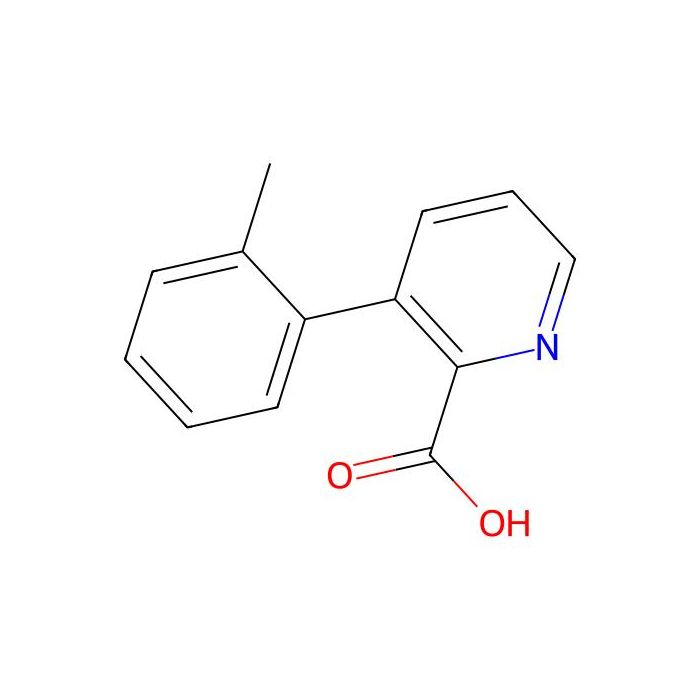
3-(2-Methylphenyl)picolinic acid - ≥96% , CAS No.1226205-60-2
Disponibile su ordine
GRADE & PURITY ≥96%
Storage
Room temperature

≥96% for sensitive chromatographic and analytical workflows requiring minimal baseline interference.
Room temperature Ships Check lot-specific COA for exact specifications.
SDS, COA, datasheet, and spec sheet available for download. Lot-specific COA accessible via lot number lookup.
Cited in 0 peer-reviewed publications across chromatography, organic synthesis, and cross-coupling reactions.
Comprehensive hazard, handling, storage, and regulatory compliance document.
Download SDS →Lot-specific quality data. Enter your lot number to retrieve the exact COA.
Look up COA →Full quality attributes and acceptance criteria for this grade.
View spec sheet →Taxonomy Tree
| Kingdom | Organic compounds |
|---|---|
| Superclass | Organoheterocyclic compounds |
| Classe | Pyridines and derivatives |
| Subclass | Phenylpyridines |
| Intermediate Tree Nodes | Not available |
| Direct Parent | Phenylpyridines |
| Alternative Parents | Pyridinecarboxylic acids Toluenes Heteroaromatic compounds Carboxylic acids Azacyclic compounds Organopnictogen compounds Organooxygen compounds Organonitrogen compounds Organic oxides Hydrocarbon derivatives |
| Molecular Framework | Aromatic heteromonocyclic compounds |
| Substituents | 3-phenylpyridine - Pyridine carboxylic acid - Pyridine carboxylic acid or derivatives - Toluene - Monocyclic benzene moiety - Benzenoid - Heteroaromatic compound - Carboxylic acid derivative - Carboxylic acid - Azacycle - Organic nitrogen compound - Hydrocarbon derivative - Organic oxide - Organooxygen compound - Organonitrogen compound - Organopnictogen compound - Organic oxygen compound - Aromatic heteromonocyclic compound |
| Descrizione | This compound belongs to the class of organic compounds known as phenylpyridines. These are polycyclic aromatic compounds containing a benzene ring linked to a pyridine ring through a CC or CN bond. |
| External Descriptors | Not available |
| Peso molecolare | 213.230 g/mol |
|---|---|
| XLogP3 | 2.700 |
| Hydrogen Bond Donor Count | 1 |
| Hydrogen Bond Acceptor Count | 3 |
| Rotatable Bond Count | 2 |
| Exact Mass | 213.079 Da |
| Monoisotopic Mass | 213.079 Da |
| Topological Polar Surface Area | 50.200 Ų |
| Heavy Atom Count | 16 |
| Formal Charge | 0 |
| Complexity | 254.000 |
| Isotope Atom Count | 0 |
| Defined Atom Stereocenter Count | 0 |
| Undefined Atom Stereocenter Count | 0 |
| Defined Bond Stereocenter Count | 0 |
| Undefined Bond Stereocenter Count | 0 |
| The total count of all stereochemical bonds | 0 |
| Covalently-Bonded Unit Count | 1 |
No assay-specific protocols are provided for this small-molecule reagent.
For validated, application-specific protocols, consult primary literature relevant to picolinic acid derivatives.
Product Data: Research Use Only.
Literature/general context (no clinical claims)
No specific biochemical pathway participation or receptor/target interactions are established for this exact compound in the literature provided here.
This compound is not a conventional buffering agent. While it contains an acidic (carboxyl) and a basic (pyridyl) site, it is not typically used to prepare laboratory buffers.
Greener choices relate primarily to solvent and coupling reagent selection rather than the substrate.
Preferred solvents (relative greenness vs common choices)
Coupling chemistry
Small comparison (general)
| Task | Conventional | Greener alternative | Trade-offs | | --- | --- | --- | --- | | Amide coupling | DCM/DMF + HATU | 2-MeTHF/EtOAc + CDI/COMU | Solubility may limit loading | | Workup | DCM extraction | EtOAc/MTBE | Slightly higher solvent volume | | Drying | Molecular sieves | Vacuum + azeotrope | Time vs convenience |
Note: Selection must balance EHS metrics with reaction performance; verify with small-scale trials.
No pharmacopeial excipient status or formulation role is specified for this item.
General discovery context (non-clinical)
Compliance note
Product Data (item-specific)
Literature/Computed values (reference only; not item specifications)
Practical notes (general)
Product Data (item-specific)
Interpreting common grades (general guidance)
98% or >99% purity (if specified): supports structure–activity studies and metal complexation; check residual solvent and water content if critical.
Stabilizers/additives
Recommendations
As a picolinic-acid–derived biaryl, this compound functions both as a building block and as a ligand precursor.
Building block transformations (literature/general)
Coordination chemistry
Practical tips
Illustrative conditions (literature-style guidance; adapt to your substrate and scale):
Amide coupling (carboxylic acid → amide)
Esterification (Fischer)
Acid chloride formation
Decarboxylative cross-coupling (carboxylate as coupling handle)
Metal complexation (picolinate formation)
These ranges are general references from heteroaromatic carboxylic acid chemistry; optimize stoichiometry, temperature, and time for your specific substrate and scale.
Product Data (item-specific)
General laboratory safety guidance for aromatic carboxylic acids and pyridines (not a substitute for SDS)
Always consult the product’s SDS for authoritative hazard, toxicological, and handling information.
This compound is a biaryl heteroaromatic carboxylic acid. Solvent choice is driven by ionization state and target operation (reaction vs. analysis).
Polarity/miscibility profile (literature-based expectations)
Typical selections by task
Comparative notes
Item-specific solvent limits and UV cutoffs: Not specified for this item; refer to CoA/Spec Sheet.
Product Data (item-specific)
General storage guidance
Reconstitution and solutions
Stability notes
Refer to the product CoA and SDS for any item-specific stability data and handling instructions.
Brief overview: 3-(2-Methylphenyl)picolinic acid is a heteroaromatic carboxylic acid featuring a pyridine-2-carboxylic acid (picolinic acid) core bearing an o-tolyl (2-methylphenyl) substituent at the 3-position. The scaffold offers a bidentate N,O donor set (pyridyl N and carboxylate O), useful in coordination chemistry and as a directing group in synthesis.
Key functional motifs and reactivity (general literature guidance):
Carboxylic acid handle
Pyridyl nitrogen
Biaryl core with ortho-methyl
Retrosynthetic value
Purification and analytics
Not applicable. This product is a small-molecule heteroaromatic acid, not an antibody, enzyme, or biologic. No target/epitope/isotype information applies. For molecular recognition or binding studies, refer instead to the Synthetic Utility and Reaction & Applications sections.