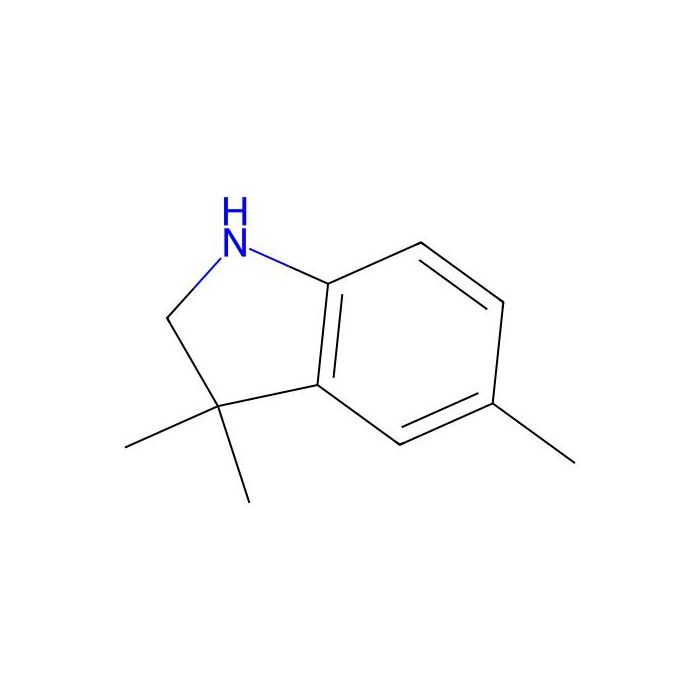
This compound belongs to the class of organic compounds known as indolines. These are compounds containing an indole moiety, which consists of pyrrolidine ring fused to benzene to form 2,3-dihydroindole.
External Descriptors
Not available
1. Djoumbou Feunang Y, Eisner R, Knox C, Chepelev L, Hastings J, Owen G, Fahy E, Steinbeck C, Subramanian S, Bolton E, Greiner R, and Wishart DS. ClassyFire: Automated Chemical Classification With A Comprehensive, Computable Taxonomy. Journal of Cheminformatics, 2016, 8:61.
Certificati (CoA, COO, BSE/TSE e tabella di analisi)
C of A & Other Certificates(BSE/TSE, COO):
Analytical Chart:
Proprietà chimiche e fisiche
Peso molecolare
161.240 g/mol
XLogP3
3.200
Hydrogen Bond Donor Count
1
Hydrogen Bond Acceptor Count
1
Rotatable Bond Count
0
Exact Mass
161.12 Da
Monoisotopic Mass
161.12 Da
Topological Polar Surface Area
12.000 Ų
Heavy Atom Count
12
Formal Charge
0
Complexity
174.000
Isotope Atom Count
0
Defined Atom Stereocenter Count
0
Undefined Atom Stereocenter Count
0
Defined Bond Stereocenter Count
0
Undefined Bond Stereocenter Count
0
The total count of all stereochemical bonds
0
Covalently-Bonded Unit Count
1
Calcolatori di soluzioni
Molarity Calculator
Determine the necessary mass, volume, or concentration for preparing a solution.
Dilution Calculator
Determine the dilution needed to prepare a stock solution.
Reconstitution Calculator
Recensioni
Recensioni dei clienti
Application Protocols
Not applicable. No bioassay or immunoassay protocols (e.g., WB, IHC, IF, FC) are associated with this small-molecule reagent. For synthetic applications, see the Reaction Conditions and Synthetic Utility sections for general guidance.
Biological Roles
This product is intended as a synthetic organic intermediate for research and materials chemistry. It is not typically used to probe endogenous biological pathways directly.
General notes (context only, not product-specific claims):
Indoline and indole frameworks are common in natural products and bioactive molecules, but 3,3,5-trimethyl substitution is a synthetic motif primarily leveraged for tuning photophysical properties in dye chemistry (e.g., cyanines, spiropyrans), rather than for mimicking biological ligands.
The secondary amine can be protonated to form salts; however, no specific biochemical role or metabolic pathway is attributable to this particular substituted indoline.
For any biological experiments, ensure appropriate controls and consult institutional safety approvals. No medical or clinical uses are claimed or supported.
Buffer Applications
Not typically applicable. 3,3,5-Trimethylindoline is a neutral organic building block, not a buffering reagent. If handling in aqueous systems is required (e.g., extractions or salt formation), acidify to form a water-soluble ammonium salt and adjust pH with a conventional buffer (e.g., phosphate, acetate) as appropriate for your application.
Green Alternatives
Greener process considerations center on solvent and reagent choices for reactions of 3,3,5-trimethylindoline (the substrate itself is a specialty building block and not readily "replaced").
Solvent substitution (general guidance):
Replace chlorinated solvents (DCM, chloroform) with ethyl acetate, 2-MeTHF, cyclopentyl methyl ether (CPME), or propylene carbonate when compatible with the reaction.
For polar aprotic media, consider dimethyl carbonate (DMC), sulfolane, or green(er) amide alternatives (e.g., NEP) in place of DMF/NMP, balancing performance and safety.
Bases and alkylations: Use carbonate bases (K2CO3, Cs2CO3) in MeCN/2-MeTHF rather than strong alkoxides in polar aprotics when feasible. Explore phase-transfer catalysis (PTC) to reduce solvent and energy intensity.
Oxidations: Prefer catalytic aerobic oxidations (Pd/C under O2, TEMPO/bleach variants) or benign oxidants (Oxone) instead of stoichiometric chromium(VI) or DDQ, provided selectivity is acceptable.
Workup/waste minimization: Employ acid–base extraction to switch solubility and reduce silica usage; crystallize isolable salts (e.g., HCl salt) rather than chromatograph when possible.
Comparison snapshot (general):
DCM → EtOAc/2-MeTHF: similar solubility for indoline derivatives; lower toxicity and environmental impact; note higher boiling points affecting removal.
DMF → MeCN/2-MeTHF: improved regulatory profile; may require higher temperature or longer time.
DDQ → catalytic aerobic dehydrogenation: reduced hazardous waste; may need pressure control and catalyst handling.
Pharmaceutical Uses
No pharmacopeial/compendial status is provided for this item. It is supplied strictly for research use as a synthetic intermediate.
Context (non-clinical):
Indoline derivatives can serve as intermediates in the preparation of specialty colorants, imaging agents, and analytical probes. 3,3,5-Trimethylindoline is commonly leveraged in the synthesis of photochromic/spiro compounds and cyanine-type dye scaffolds, which may find use in research imaging and materials, not as drug substances or excipients.
Do not use in humans or for clinical applications.
Appearance: Not specified for this item; refer to CoA/Spec Sheet.
Molecular weight: Not specified for this item; refer to CoA/Spec Sheet.
Density, melting/boiling point, refractive index, UV cut-off, water/peroxide/metal content: Not specified for this item; refer to CoA/Spec Sheet.
Literature/general expectations for indoline derivatives (for context only):
Many indolines are low-melting solids or high-boiling liquids with moderate hydrophobicity and good solubility in common organic solvents (e.g., dichloromethane, THF, ethyl acetate, toluene) and limited solubility in water.
The secondary amine typically exhibits weak basicity (pKb comparable to anilines), enabling salt formation with strong acids and reversible protonation under mildly acidic conditions.
Substitution with gem-dimethyl at C-3 generally increases steric bulk, can elevate boiling point relative to unsubstituted indoline, and reduces propensity for oxidation relative to indoline but does not eliminate it (air/oxidant sensitivity varies with conditions).
Notes:
Use the product’s CoA for exact assay, residual solvent, and trace impurity data applicable to this SKU.
When property values are critical to your process (e.g., for distillation cut, DSC/TGA, or chromatography method set-up), verify with lot-specific CoA or perform in-house characterization (NMR, GC/MS, Karl Fischer, DSC) as needed.
Quality and Grades
Item-specific grade/purity:
Grade/Purity: Not specified for this item; refer to CoA/Spec Sheet.
Interpretation and guidance:
When "Research Grade" materials are supplied without a defined assay, the actual purity and impurity profile should be confirmed by the lot-specific Certificate of Analysis (e.g., NMR purity, GC/HPLC area %, residual solvents, and water by KF).
For chromatography-sensitive applications (e.g., dye/intermediate synthesis or catalytic steps), consider evaluating UV background, amine titer, and trace metals if these are critical to yield/color.
Stabilizers: Not specified for this item; refer to CoA/Spec Sheet. If no stabilizer is declared, assume neat material. If your use is air-sensitive, consider handling under nitrogen and store in amber glass to minimize oxidation.
If ultra-high purity is required (e.g., for photonic materials or analytical reference work), contact Technical Support for availability of higher grades, or request additional CoA attributes (e.g., LCMS purity, total amines, specific base number).
Reaction and Applications
Use profile (synthetic intermediate):
3,3,5-Trimethylindoline is a sterically encumbered indoline that serves as a key precursor to functional dyes and photochromic materials. The gem-dimethyl at C-3 increases steric bulk and can influence reactivity and conformational preference of the indoline ring.
Quaternization to indolinium salts: Alkylation at nitrogen with alkyl halides or dialkyl sulfates affords indolinium salts, which are core building blocks for cyanine/merocyanine and spiropyran photochromic dyes.
Condensation/formylation at C-2: Electrophilic reactions (e.g., Vilsmeier–Haack) can introduce a formyl at C-2 after N-protection or under controlled conditions, enabling downstream coupling.
Oxidation to indole derivatives: Dehydrogenation (DDQ, Pd/C, or IBX under aerobic conditions) converts indolines to indoles, broadening heteroaromatic scaffolding options.
Electrophilic aromatic substitution on the benzene ring: The 5-methyl group is ortho/para-directing and slightly activates the ring, supporting halogenation, nitration (mild), sulfonylation, and Friedel–Crafts acylation under controlled conditions.
N-Functionalization: Carbamate/amide formation (phosgene equivalents, CDI) or sulfonamides (TsCl, MsCl) provide protective handles that modulate basicity and directivity.
Practical tips:
Drying: Basic nitrogen can retain moisture and CO2; dry over K2CO3 or molecular sieves before moisture-sensitive steps.
Atmosphere: While not pyrophoric, minimizing air/oxidant exposure helps limit background coloration from slow oxidation.
Analysis: Track reactions by TLC with basic modifiers (e.g., 0.1% Et3N) to avoid tailing of amine-containing compounds.
Reaction Conditions
The following conditions are general literature guidance for indoline derivatives and should be optimized for your substrate and scale.
N-Alkylation (to indolinium salts):
Solvent: MeCN, acetone, or 2-MeTHF.
Base: K2CO3/Cs2CO3 (for neutral alkylation); for quaternization, base is not required—use excess alkyl halide.
Temperature: 20–60 °C; quaternization often proceeds at ambient to gentle reflux.
Time/Yield: 1–24 h; often high conversions; isolate as crystalline salts by anti-solvent addition (Et2O/MTBE).
Vilsmeier–Haack formylation (C-2):
Reagents: POCl3/DMF, or oxalyl chloride/DMF surrogate.
Solvent: DMF or MeCN; 0–80 °C.
Notes: N-protection may improve selectivity; quench cautiously to hydrolyze iminium intermediates.
Oxidation to indole:
Reagents: DDQ (CH2Cl2, 0–25 °C), or Pd/C under O2 (toluene/MeCN, 60–100 °C).
Notes: Control conditions to avoid overoxidation; monitor by TLC/NMR (aromatic NH in indole typically further downfield).
Electrophilic aromatic substitution (EAS):
Halogenation: NBS/NCS (AcOH or MeCN), 0–25 °C; regioselectivity guided by 5-Me and amine activation.
Friedel–Crafts acylation: Acyl chloride/AlCl3 in DCM or toluene at 0–25 °C; protect N if needed to avoid N-acylation.
Workup/purification:
Acid–base toggling facilitates phase separation. Convert to salts for crystallization; otherwise, use basic-modified silica or reverse-phase chromatography.
Always conduct small-scale trials to tune equivalents, temperature, and time.
Safety and Handling
Authoritative safety data must be taken from the product SDS.
GHS information (item-specific):
Signal word / H-statements / Pictograms / Classification: Not specified for this item; refer to SDS.
General handling guidance for indoline derivatives (literature-based, not item-specific):
Hazards: Aromatic amines/indoline derivatives may cause skin/eye irritation and may be harmful if inhaled or ingested. Some can undergo air oxidation to colored species; avoid prolonged exposure to air/strong oxidants.
PPE: Laboratory coat, nitrile gloves, splash goggles. Use in a fume hood to minimize inhalation exposure.
Incompatibilities: Strong oxidizing agents (risk of exothermic reaction/oxidation), strong acids or acylation agents (reactive at the amine), and strong bases in the presence of halogenated solvents (avoid potential side reactions).
First aid overview: If inhaled, move to fresh air; if on skin, wash with soap and water; if in eyes, rinse cautiously for several minutes; if swallowed, rinse mouth—seek medical attention in all cases per SDS guidance.
Spill/leak response: Absorb with inert material, collect in chemical waste. Ventilate area and avoid skin contact.
Fire safety: Use CO2, dry chemical, or foam. Combustion may produce COx, NOx. Keep containers tightly closed and away from ignition sources.
Peroxide formation: Not generally a concern for this class (non-ether), but monitor for oxidation/discoloration over time; store under recommended conditions.
Solvent Selection
This product is a nitrogen heteroaromatic building block rather than a solvent. Selection of process solvent pertains to its use in reactions, workups, and crystallizations.
General solvent behavior (literature-based):
Polarity/solubility: Indoline derivatives are typically soluble in moderately polar organic solvents (e.g., dichloromethane, chloroform, THF, ethyl acetate, acetonitrile) and in nonpolar aromatics (toluene). Aqueous solubility is generally low at neutral pH but increases under acidic conditions via amine protonation (salt formation).
Acid–base handling: For extractions, protonate the amine with dilute HCl to partition into water, then basify and back-extract into organic solvent.
Choosing solvents by task:
N-alkylation/acylation: Polar aprotic (DMF, DMSO, MeCN) or acetone/MeCN with base; avoid protic solvents that quench base.
Electrophilic aromatic substitution on the benzene ring: Nonpolar aromatics (toluene, chlorobenzene) with Lewis/Brønsted acids.
Oxidations to indoles or N-oxides: Use chlorinated solvents or MeCN with controlled oxidant addition.
Workup/crystallization: Free base often oils; convert to an acid salt (e.g., HCl) for crystallization from alcohol/ether mixtures if needed.
Note: Verify actual solubility and stability of your lot in the chosen solvent; where critical, run micro-scale tests and consult the CoA.
Storage and Reconstitution
Storage conditions (item-specific): Room temperature (as provided). Store tightly closed in a dry, well-ventilated place away from strong oxidizers and acids. For long-term preservation of color and purity, consider storing under inert gas and in amber glass.
Shipped in: Not specified for this item; refer to CoA/Spec Sheet.
Appearance: Not specified for this item; refer to CoA/Spec Sheet.
Reconstitution: Supplied neat (no reconstitution required). If preparing stock solutions, use dry, oxygen-poor solvents (e.g., anhydrous MeCN, THF, or DCM) and store aliquots in sealed vials at ambient or 2–8 °C depending on solvent stability.
Freeze–thaw: Not applicable to neat solid/liquid. If solutions are prepared, avoid repeated freeze–thaw; aliquot as needed.
Shelf-life: Refer to CoA/SDS for recommended retest date. Inspect periodically for discoloration, which can indicate slow oxidation; if observed, repurify as appropriate (e.g., short path, recrystallization, or preparative chromatography).
SMILES: Not specified for this item; refer to CoA/Spec Sheet.
Molecular formula: Not specified for this item; refer to CoA/Spec Sheet.
Molecular weight: Not specified for this item; refer to CoA/Spec Sheet.
Structural features (general chemistry description):
Indoline core: a bicyclic system consisting of a benzene ring fused to a partially saturated five-membered ring containing one nitrogen (a 2,3-dihydroindole framework).
Substitution pattern: geminal dimethyl substitution at C-3 (3,3-dimethyl) on the saturated ring carbon adjacent to nitrogen, and one methyl at C-5 on the benzene ring. This creates a sterically encumbered benzylic (C-3) center and a weakly electron-donating para/ortho-directing methyl on the aryl ring.
Functional groups: secondary amine (indoline N–H) embedded in a bicyclic scaffold; benzenoid aromatic ring; benzylic positions at C-2/C-3.
Stereochemistry: none expected at C-3 due to gem-dimethyl substitution (quaternary carbon); overall molecule is achiral in the absence of additional substitution.
2D structure in words:
A benzene ring fused at positions 1–2 to a five-membered, partially saturated ring bearing an NH at position 1. The saturated ring carbon at position 3 carries two methyl groups (gem-dimethyl), and the benzene ring position 5 bears a methyl substituent.
Synthetic Utility
Functional group and site reactivity (general for indoline scaffolds):
N–H (secondary amine): amenable to alkylation, acylation, sulfonylation; can be quaternized to give indolinium salts that are pivotal for dye assembly (e.g., cyanine linkages through methine bridges).
C-2 (alpha to nitrogen): relatively activated toward electrophiles (Vilsmeier formylation, Mannich-type additions) after appropriate conditioning/protection; useful entry to aldehydes/ketones for further elaboration.
Aromatic ring (bearing 5-methyl): slightly activated and directed by methyl; allows selective halogenation, nitration (mild), and Friedel–Crafts acylation with control over regioselectivity.
Benzylic positions: oxidation or substitution strategies can introduce handles, though the gem-dimethyl at C-3 limits reactivity there and enhances thermal stability.
Retrosynthetic value:
The scaffold can be disconnected to an aniline and a C2–C3 fragment in conceptual planning, but practically it is more often a starting synthon for assembling merocyanine/spiropyran cores via N-alkylation and subsequent condensations.
Protection strategies:
Carbamates (Boc, Cbz) attenuate basicity and can improve regioselectivity in electrophilic substitutions; removal under standard conditions (acidolysis/hydrogenolysis) typically tolerated by the aromatic core.
Analytical control:
Monitor N-alkylation by 1H NMR (downfield shift/disappearance of NH) and HRMS (Δ+14 for Me). Use basic-modified silica or reverse-phase methods to mitigate amine tailing.
Target Specificity
Not applicable. This product is a small-molecule building block and does not have a biological target, antigen, clone, or isotype. No target specificity data are provided for this item.
We use cookies to ensure the website functions properly and, where permitted, to improve your experience. You can manage your preferences at any time in Settings. Learn more in our Cookie Policy.
Shall we send you a message when we have discounts available?
Remind me later
Thank you! Please check your email inbox to confirm.
Products are supplied to verified businesses, institutions, and qualified professionals for research and development use only. Not for use in humans, animals, diagnosis, or therapy.