Determine the necessary mass, volume, or concentration for preparing a solution.
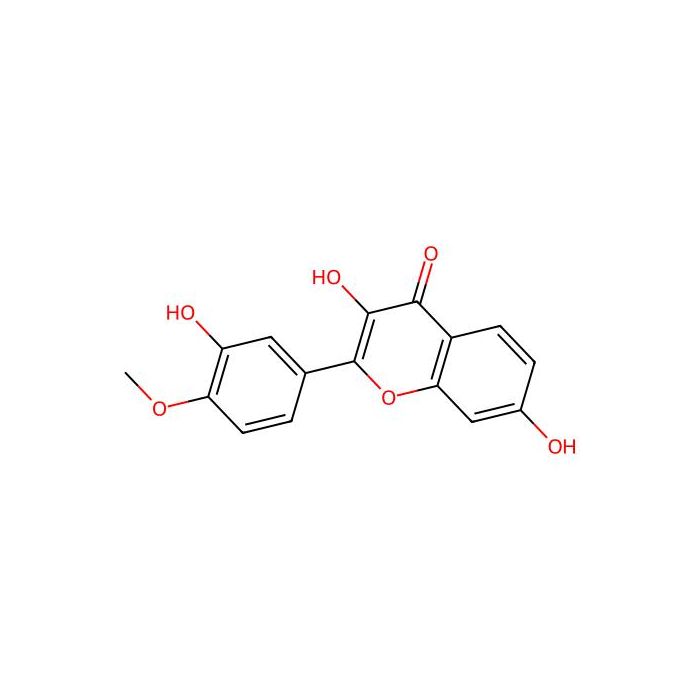
3,3',7-Trihydroxy-4'-methoxyflavone , CAS No.57396-72-2
Disponibile su ordine
Storage
Room temperature

for sensitive chromatographic and analytical workflows requiring minimal baseline interference.
Room temperature Ships Check lot-specific COA for exact specifications.
SDS, COA, datasheet, and spec sheet available for download. Lot-specific COA accessible via lot number lookup.
Cited in 0 peer-reviewed publications across chromatography, organic synthesis, and cross-coupling reactions.
| Sorrisi canonici | COC1=C(C=C(C=C1)C2=C(C(=O)C3=C(O2)C=C(C=C3)O)O)O |
|---|---|
| IUPAC Name | 3,7-dihydroxy-2-(3-hydroxy-4-methoxyphenyl)chromen-4-one |
| InChIKey | QVYSSMFEUBQBEU-UHFFFAOYSA-N |
| INCHI | 1S/C16H12O6/c1-21-12-5-2-8(6-11(12)18)16-15(20)14(19)10-4-3-9(17)7-13(10)22-16/h2-7,17-18,20H,1H3 |
| Isomeri SMILES | COC1=C(C=C(C=C1)C2=C(C(=O)C3=C(O2)C=C(C=C3)O)O)O |
| PubChem CID | 5378244 |
| Peso molecolare | 300.26 |
Comprehensive hazard, handling, storage, and regulatory compliance document.
Download SDS →Lot-specific quality data. Enter your lot number to retrieve the exact COA.
Look up COA →Full quality attributes and acceptance criteria for this grade.
View spec sheet →Taxonomy Tree
| Kingdom | Organic compounds |
|---|---|
| Superclass | Phenylpropanoids and polyketides |
| Classe | Flavonoids |
| Subclass | Flavones |
| Intermediate Tree Nodes | Not available |
| Direct Parent | Flavonols |
| Alternative Parents | 4'-O-methylated flavonoids 3'-hydroxyflavonoids 3-hydroxyflavonoids 7-hydroxyflavonoids Chromones Methoxyphenols Methoxybenzenes Anisoles Phenoxy compounds 1-hydroxy-2-unsubstituted benzenoids Alkyl aryl ethers Pyranones and derivatives 1-hydroxy-4-unsubstituted benzenoids Heteroaromatic compounds Oxacyclic compounds Hydrocarbon derivatives Organic oxides |
| Molecular Framework | Aromatic heteropolycyclic compounds |
| Substituents | 4p-methoxyflavonoid-skeleton - 3-hydroxyflavone - 3'-hydroxyflavonoid - 3-hydroxyflavonoid - 7-hydroxyflavonoid - Hydroxyflavonoid - Chromone - Benzopyran - Methoxyphenol - 1-benzopyran - Phenoxy compound - Anisole - Methoxybenzene - Phenol ether - Phenol - 1-hydroxy-2-unsubstituted benzenoid - Pyranone - Alkyl aryl ether - 1-hydroxy-4-unsubstituted benzenoid - Benzenoid - Pyran - Monocyclic benzene moiety - Heteroaromatic compound - Organoheterocyclic compound - Oxacycle - Ether - Organooxygen compound - Organic oxygen compound - Hydrocarbon derivative - Organic oxide - Aromatic heteropolycyclic compound |
| Descrizione | This compound belongs to the class of organic compounds known as flavonols. These are compounds that contain a flavone (2-phenyl-1-benzopyran-4-one) backbone carrying a hydroxyl group at the 3-position. |
| External Descriptors | Flavones and Flavonols |
| Peso molecolare | 300.260 g/mol |
|---|---|
| XLogP3 | 2.300 |
| Hydrogen Bond Donor Count | 3 |
| Hydrogen Bond Acceptor Count | 6 |
| Rotatable Bond Count | 2 |
| Exact Mass | 300.063 Da |
| Monoisotopic Mass | 300.063 Da |
| Topological Polar Surface Area | 96.200 Ų |
| Heavy Atom Count | 22 |
| Formal Charge | 0 |
| Complexity | 473.000 |
| Isotope Atom Count | 0 |
| Defined Atom Stereocenter Count | 0 |
| Undefined Atom Stereocenter Count | 0 |
| Defined Bond Stereocenter Count | 0 |
| Undefined Bond Stereocenter Count | 0 |
| The total count of all stereochemical bonds | 0 |
| Covalently-Bonded Unit Count | 1 |
No item-specific validated protocols are provided for this product. Refer to the primary literature and method notes below as general guidance; adjust to your system.
General stock solution preparation (research use)
Example analytical workflow (LC–MS, general)
Antioxidant assay setup (DPPH, general)
These are literature-style examples only. Not specified for this item; refer to CoA/Spec Sheet and SDS, and validate in your laboratory.
Note: For research use only. The following summarizes general biochemical roles of flavones; it does not imply medical or clinical use.
General context (literature)
In vitro biochemical behavior
Analytical utility
Caution
This compound is not a buffering reagent. It is typically dissolved in an organic solvent and then diluted into aqueous buffers for biochemical assays.
This product is a solid research chemical rather than a solvent; “green alternatives” mainly concern solvent selection and processing routes rather than substitution of the compound itself.
Greener solvent choices for handling/analysis (general guidance)
Example comparison (qualitative)
Process considerations
No therapeutic or clinical claims. The compound may be employed in pharmaceutical research workflows as follows (general information; not item-specific specifications):
Analytical and reference uses
Preformulation and excipient interaction studies
Metabolism and stability (in vitro research)
Regulatory status
Item-specific specifications
Literature/general values and expectations (for planning; not item specifications)
Practical notes
Item-specific quality information
Guidance on interpreting grades (general)
Practical QC considerations
Typical research applications (general for this flavone)
Chemical reactivity and derivatization
Practical tips
General conditions for common transformations on polyphenolic flavones (guidance from literature; not item-specific specs):
O-alkylation (ether formation)
O-acylation
Demethylation of 4'-OMe
Metal complexation studies
Analytical detection
Item-specific hazard details
General laboratory safety guidance (for similar polyphenolic flavones; defer to SDS for authoritative data)
Polarity and miscibility (general guidance)
Choosing a solvent by application
Comparison (general)
Drying notes
Item-specific storage
General handling guidance
Reconstitution (general recommendations for research use)
Stability notes
Brief description: 3,3',7-Trihydroxy-4'-methoxyflavone is a polyphenolic flavone bearing three phenolic hydroxyls (C3 of the heterocycle, C7 on the A-ring, and C3' on the B-ring) and a methoxy substituent at C4' on the B-ring. The core is the flavone scaffold (2-phenyl-4H-1-benzopyran-4-one).
Item-specific identifiers (Product Data)
Literature/Computed identifiers (clearly labeled)
Structural features (general chemistry description)
Although primarily a research standard, 3,3',7-trihydroxy-4'-methoxyflavone can serve as a versatile building block for derivatization and SAR libraries.
Functional group transformations
Cross-coupling and late-stage modification
Retrosynthetic perspective
Practical notes
Not applicable. This product is a small-molecule flavone, not an antibody or affinity reagent. No antigen/epitope/isotype data are relevant. If your work involves binding studies (e.g., enzyme inhibition or metal chelation), refer to the Reaction & Applications and Biological Roles sections for mechanistic context.