
Determine the necessary mass, volume, or concentration for preparing a solution.
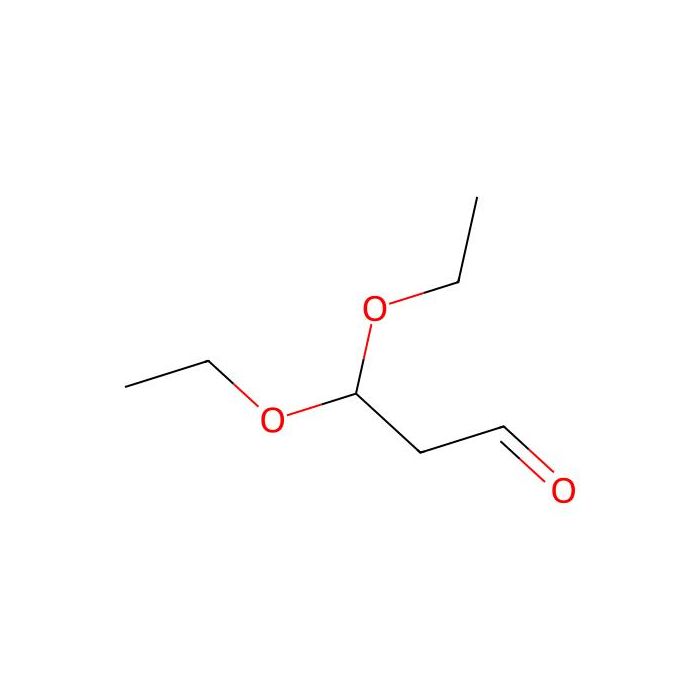
3,3-Diethoxypropanal - ≥97% , CAS No.6367-37-9
Disponibile su ordine
GRADE & PURITY ≥97%
Storage
Room temperature
≥97% for sensitive chromatographic and analytical workflows requiring minimal baseline interference.
Room temperature Ships Check lot-specific COA for exact specifications.
SDS, COA, datasheet, and spec sheet available for download. Lot-specific COA accessible via lot number lookup.
Cited in 0 peer-reviewed publications across chromatography, organic synthesis, and cross-coupling reactions.
| Sorrisi canonici | CCOC(CC=O)OCC |
|---|---|
| IUPAC Name | 3,3-diethoxypropanal |
| InChIKey | WTRPATCGXBMKKJ-UHFFFAOYSA-N |
| INCHI | 1S/C7H14O3/c1-3-9-7(5-6-8)10-4-2/h6-7H,3-5H2,1-2H3 |
| Peso molecolare | 146.180 |
Comprehensive hazard, handling, storage, and regulatory compliance document.
Download SDS →Lot-specific quality data. Enter your lot number to retrieve the exact COA.
Look up COA →Full quality attributes and acceptance criteria for this grade.
View spec sheet →Taxonomy Tree
| Kingdom | Organic compounds |
|---|---|
| Superclass | Organic oxygen compounds |
| Classe | Organooxygen compounds |
| Subclass | Carbonyl compounds |
| Intermediate Tree Nodes | Aldehydes |
| Direct Parent | Alpha-hydrogen aldehydes |
| Alternative Parents | Acetals Organic oxides Hydrocarbon derivatives |
| Molecular Framework | Aliphatic acyclic compounds |
| Substituents | Alpha-hydrogen aldehyde - Acetal - Organic oxide - Hydrocarbon derivative - Aliphatic acyclic compound |
| Descrizione | This compound belongs to the class of organic compounds known as alpha-hydrogen aldehydes. These are aldehydes with the general formula HC(H)(R)C(=O)H, where R is an organyl group. |
| External Descriptors | Not available |
| Peso molecolare | 146.180 g/mol |
|---|---|
| XLogP3 | 0.300 |
| Hydrogen Bond Donor Count | 0 |
| Hydrogen Bond Acceptor Count | 3 |
| Rotatable Bond Count | 6 |
| Exact Mass | 146.094 Da |
| Monoisotopic Mass | 146.094 Da |
| Topological Polar Surface Area | 35.500 Ų |
| Heavy Atom Count | 10 |
| Formal Charge | 0 |
| Complexity | 76.900 |
| Isotope Atom Count | 0 |
| Defined Atom Stereocenter Count | 0 |
| Undefined Atom Stereocenter Count | 0 |
| Defined Bond Stereocenter Count | 0 |
| Undefined Bond Stereocenter Count | 0 |
| The total count of all stereochemical bonds | 0 |
| Covalently-Bonded Unit Count | 1 |
No assay/biological application protocols are provided for this item. It is supplied as a chemical building block for synthesis. For synthetic operations, see Reaction Conditions and Synthetic Utility sections for general, literature-based procedural guidance.
This product is intended for research and laboratory use only. No biological or clinical roles are claimed for this item.
General context (literature/general):
Please avoid inferring biological activity or suitability for in vivo use from its chemical structure. Consult your institutional biosafety office before any non-chemical use.
Not typically applicable. 3,3-Diethoxypropanal is an organic building block, not a buffering agent. It does not form defined acid/base pairs suitable for maintaining pH in aqueous systems. For laboratory use, focus on the synthetic and reaction guidance sections.
Greenness considerations relate to solvent choice and protecting-group strategy rather than replacing the reagent outright.
Strategy alternatives (literature/general):
Solvent greening (literature/general):
Compact comparison (general):
Note: The unique chemoselectivity of 3,3-diethoxypropanal as a monoacetal of malondialdehyde is not always replicated by “greener” substitutes; greening efforts should focus on solvent selection, telescoped processes, and minimization of acid usage and waste.
No pharmacopeial or excipient status is provided for this item. It is offered for research use only and is not formulated for therapeutic, diagnostic, or clinical applications.
General formulation context (literature/general):
Item-specific numerical specifications (BP, MP, density, refractive index, purity, etc.): Not specified for this item; refer to CoA/Spec Sheet.
General/literature expectations for compounds of this class (acetalized aldehydes of low molecular mass):
Note: For quantitative values (boiling point, density, refractive index, water/peroxide/UV specs), consult the lot-specific CoA or specification sheet. Avoid relying on generic literature values for method validation or regulatory work.
Guidance on grades for this reagent class (literature/general):
Batch-to-batch quality control suggestions (general):
3,3-Diethoxypropanal is a versatile masked-dialdehyde synthon. The free aldehyde reacts while the diethoxy acetal protects the second carbonyl, enabling sequential or chemoselective transformations (literature/general).
Representative applications (literature/general):
Practical tips:
General literature guidance for this reagent class (verify and optimize for your system):
Acid-catalyzed acetal hydrolysis (to unmask malondialdehyde):
Aldol/Knoevenagel at the free aldehyde:
Wittig/HWE olefination:
Reductive amination:
Note: Expected yields and exact conditions are substrate-dependent; run small-scale screens. Avoid strong mineral acid in workup unless deprotection is intended.
Authoritative safety information is in the Safety Data Sheet (SDS). The following are general considerations for aldehyde–acetal reagents.
This product is an organic building block rather than a solvent. Selection below refers to solvents suitable for handling and reactions involving 3,3-diethoxypropanal (general guidance).
Quick comparison (literature/general):
Good handling practices (literature/general):
Short description: 3,3-Diethoxypropanal is an aldehyde bearing a geminal diethoxy (acetal) substituent at the terminal C-3 carbon, functioning as a masked dialdehyde/malonaldehyde equivalent in synthesis.
Structural features (general description from name):
Functional group profile (literature/general):
Retrosynthetic value:
Named/typical transformations (literature/general):
Selectivity notes:
Not applicable. This product is a small-molecule chemical reagent, not a biologic or affinity reagent. No antigen/epitope or species reactivity applies.