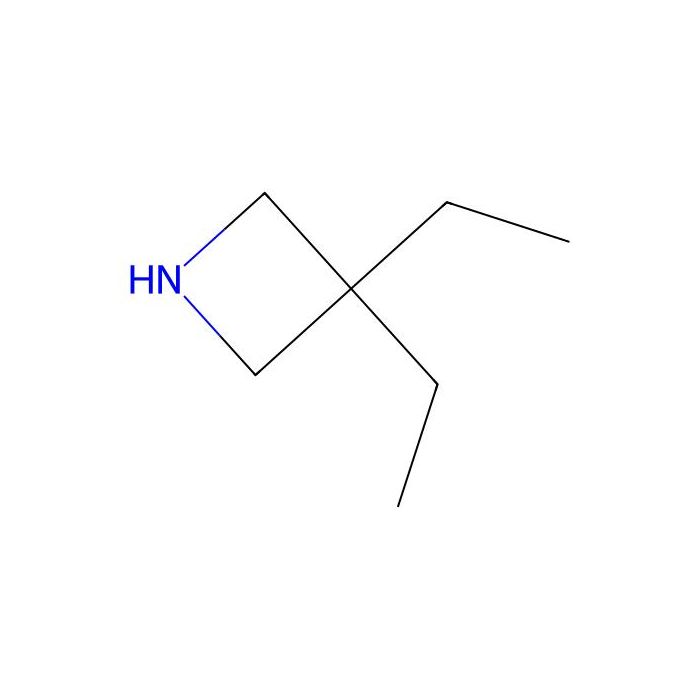
This compound belongs to the class of organic compounds known as azetidines. These are organic compounds containing a saturated four-member heterocycle where one nitrogen atom replaces a carbon atom.
External Descriptors
Not available
1. Djoumbou Feunang Y, Eisner R, Knox C, Chepelev L, Hastings J, Owen G, Fahy E, Steinbeck C, Subramanian S, Bolton E, Greiner R, and Wishart DS. ClassyFire: Automated Chemical Classification With A Comprehensive, Computable Taxonomy. Journal of Cheminformatics, 2016, 8:61.
Certificati (CoA, COO, BSE/TSE e tabella di analisi)
C of A & Other Certificates(BSE/TSE, COO):
Analytical Chart:
Proprietà chimiche e fisiche
Peso molecolare
113.200 g/mol
XLogP3
1.500
Hydrogen Bond Donor Count
1
Hydrogen Bond Acceptor Count
1
Rotatable Bond Count
2
Exact Mass
113.12 Da
Monoisotopic Mass
113.12 Da
Topological Polar Surface Area
12.000 Ų
Heavy Atom Count
8
Formal Charge
0
Complexity
68.500
Isotope Atom Count
0
Defined Atom Stereocenter Count
0
Undefined Atom Stereocenter Count
0
Defined Bond Stereocenter Count
0
Undefined Bond Stereocenter Count
0
The total count of all stereochemical bonds
0
Covalently-Bonded Unit Count
1
Calcolatori di soluzioni
Molarity Calculator
Determine the necessary mass, volume, or concentration for preparing a solution.
Dilution Calculator
Determine the dilution needed to prepare a stock solution.
Reconstitution Calculator
Recensioni
Recensioni dei clienti
Application Protocols
Not applicable. No immunoassay or bioassay protocols (WB, IHC, IF, FC) are associated with this small‑molecule reagent. For synthetic uses, see the Reaction Conditions and Synthetic Utility sections for general guidance.
Biological Roles
Item-specific biological data: Not specified for this item; no biological testing is provided. For research use only.
General considerations (literature; not product claims)
3,3‑Diethylazetidine is a small, cationic organic amine under physiological pH when protonated. It has no known endogenous biological role.
Azetidine motifs are used as fragments/scaffolds in medicinal chemistry due to their basicity, conformational restriction, and ability to modulate physicochemical properties (pKa, lipophilicity, solubility) of candidate molecules.
Protonated secondary amines can engage in ionic interactions with acidic residues (e.g., Asp/Glu) and form H‑bonding networks; dialkyl substitution at the 3‑position will increase lipophilicity versus unsubstituted azetidine.
Metabolic considerations for dialkylazetidines (general): likely pathways include N‑dealkylation (if tertiary), N‑oxidation to amine oxides, and ring hydroxylation followed by ring opening under oxidative conditions; exact ADME depends on substitution pattern.
No conclusions regarding efficacy, toxicity, or clinical utility should be drawn from the above; those depend on specific derivatives and are outside the scope of this catalog listing.
Buffer Applications
This compound is a hydrophobic secondary amine building block and is not typically employed as a defined buffering agent.
Not typically applicable: It lacks a conjugate acid/base pair with a convenient pKa and formulation profile for common biological buffer ranges (pH 6–8). If pH control is required in reactions using this amine, select standard buffers (e.g., phosphate, HEPES) or use acid/base equivalents during workup.
Practical tip: For aqueous manipulations, handle as its water‑soluble salt (e.g., hydrochloride), but use established biological buffers for pH maintenance rather than relying on the amine itself.
Green Alternatives
Because 3,3‑diethylazetidine is a basic building block rather than a process solvent, “green alternatives” focuses on greener handling/form and substitution choices in synthesis.
Greener handling/form
Use as a crystalline salt (e.g., HCl, p‑toluenesulfonate) to reduce volatility, odor, and flammability during storage and weighing; convert in situ to the free base. This can reduce fugitive emissions and operator exposure.
Employ solvent‑minimized or solventless acylations where feasible, or run in greener solvents such as 2‑MeTHF, CPME, EtOAc, or propylene carbonate instead of chlorinated solvents (where reaction compatibility allows).
Potential substitutes (when an azacycle is needed but hazard/odor must be minimized)
Morpholine (contains an ether oxygen) or piperazine derivatives can offer reduced odor and, in some cases, improved aqueous handling, though they change electronic properties.
Piperidine or 3‑substituted piperidines can substitute for basicity while lowering ring strain; trade‑off is increased size and different sterics.
Comparison snapshot (literature, qualitative)
3,3‑Diethylazetidine: high basicity, compact, volatile/odorous; excellent nucleophile; small‑ring strain.
Morpholine: lower basicity, higher polarity, better aqueous handling; often preferred in greener solvent systems.
2‑MeTHF vs DCM for acylations with this amine: 2‑MeTHF is bio‑based and lower toxicity; may require longer reaction time or different base but often suitable.
Choose alternatives based on EHS profile, solvent recyclability, and performance in the specific transformation.
Pharmaceutical Uses
Item-specific pharmacopeial status: Not specified for this item; refer to CoA/Spec Sheet. No USP/EP monograph is indicated.
General formulation/manufacturing context (no therapeutic claims)
Role as intermediate: 3,3‑Diethylazetidine can serve as a building block for synthesis of API candidates, where the azetidine ring provides a compact, basic motif affecting permeability and potency in SAR programs.
Salt handling: The hydrochloride or other pharmaceutically acceptable salts can improve crystallinity and handling during process development; salt switching is a common strategy for purification and stability.
Process reagent: As a secondary amine, it may be used as a nucleophile for amide formation or as a base in certain non‑critical steps; however, dedicated process bases (e.g., DIPEA, DBU) are more typical.
Analytical controls (general)
Establish residual solvent and amine impurity limits per ICH Q3C/Q3A if used in GMP settings.
Characterize polymorph/solid form for salts if isolated; confirm by XRPD/DSC.
This product is supplied for research use only and is not intended for human or veterinary use.
Physical Properties
Item-specific data
Appearance: Not specified for this item; refer to CoA/Spec Sheet.
Grade/Purity: Not specified for this item; refer to CoA/Spec Sheet.
Literature/general properties for the neat free base (reference values; not specifications)
Molecular formula: C7H15N
Molecular weight: ~113.20 g/mol (calculated from atomic weights)
Physical state: typically a low‑viscosity liquid for small secondary amines of this size; may be colorless to pale yellow (literature expectation)
LogP and refractive index: not widely reported for this specific derivative; expect moderate hydrophobicity from two ethyl groups (literature expectation)
Solubility: secondary amines of this size are generally miscible with many organic solvents (ethers, alcohols, chlorinated solvents, hydrocarbons) and show limited to moderate water miscibility; actual solubility depends on temperature and presence of salts (literature expectation)
Volatility/odor: small aliphatic amines are often volatile with strong amine odor (literature observation)
If precise BP/MP/density/RI are required: Not specified for this item; refer to CoA/Spec Sheet and SDS. Avoid relying on surrogate values from related azetidines for specification‑critical work.
Quality and Grades
Item-specific status
Grade/Purity: Not specified for this item; refer to CoA/Spec Sheet.
Stabilizers/Inhibitors: Not specified for this item; refer to CoA/Spec Sheet.
Interpreting common grades (general guidance)
Research grade: suitable for most synthesis and discovery work; impurity profile may not be defined for trace-level applications.
Purified or ≥98% grade: typically supports medicinal chemistry and catalog synthesis with minimized aliphatic/amine impurities; verify actual assay on CoA.
Water/metal/peroxide/UV specifications: Not specified for this item; refer to CoA/Spec Sheet.
Implications for this structure
Secondary amines can contain residual moisture and dissolved CO2; assay by quantitative NMR or GC often more reliable than titration due to basicity and volatility.
Trace primary amine or aldehyde contaminants can strongly affect downstream reactions (e.g., acylations, reductive aminations); consider pre‑treatment (e.g., distillation over base) if your application is impurity‑sensitive.
Recommended quality checks (general)
Verify identity by 1H/13C NMR (diagnostic ring methylene signals, absence of N–H exchange broadened signal upon D2O addition will convert NH to ND), GC–MS or LC–MS.
Determine water content by Karl Fischer if moisture‑sensitive chemistry is planned (value not specified for this item).
Reaction and Applications
As a nucleophilic secondary amine
N‑Acylation to amides and carbamates (e.g., with acid chlorides, anhydrides, CDI, or Boc2O). The compact, strained ring can influence sterics and basicity, giving distinct SAR in medicinal chemistry analogs.
Reductive amination with aldehydes/ketones to form tertiary amines; stereochemical issues are minimal since the substrate is achiral.
Alkylation to tertiary amines or quaternary ammonium salts using alkyl halides or dialkyl sulfates.
As a strained small‑ring scaffold
Ring‑opening reactions under strongly acidic or oxidative conditions can yield β‑ or γ‑amino derivatives (strain‑release pathways reported for azetidines in literature).
N‑Oxidation (amine oxide formation) followed by Cope‑type eliminations or rearrangements can be leveraged for skeletal diversification (literature concept).
Building‑block use in discovery chemistry
Azetidine motifs are valued in medicinal chemistry as saturated, conformationally restricted, and basic fragments; 3,3‑dialkyl substitution alters lipophilicity and metabolic stability relative to unsubstituted azetidine.
Useful for surveying vector space where a compact, cationic center is desired without introducing chirality (two identical ethyls at C‑3 give an achiral quaternary carbon).
Practical tips
Dry the amine (e.g., over KOH pellets then distill, literature practice) before moisture‑sensitive couplings.
For exothermic acylations/alkylations, control addition and temperature (0–5 °C to start) due to increased nucleophilicity of strained amines.
For workup, convert to an HCl salt to facilitate crystallization or extraction into aqueous phase; then basify to regenerate the free base.
Reaction Conditions
The following are general, literature‑style conditions for common manipulations of secondary aliphatic amines and azetidines; they are guidance, not product specifications.
N‑Acylation (to amides/carbamates)
Reagents: acid chloride or anhydride (1.05–1.2 eq), or Boc2O (1.1–1.5 eq)
Base: Et3N (2–3 eq) or Na2CO3 (aqueous biphasic)
Solvent: DCM, THF, MeCN, or toluene
Temperature/time: 0 °C to rt, 0.5–4 h; monitor by TLC/LC–MS
Reductive amination (to tertiary amines)
Carbonyl partner (1.0 eq), amine (1.2–2.0 eq), NaBH3CN (1.2–1.5 eq) in MeOH/MeCN; catalytic AcOH to form iminium
Temperature/time: rt to 40 °C, 2–16 h; alternative NaBH(OAc)3 in DCE/MeOH with AcOH
Alkylation (SN2)
Alkyl halide (1.1–1.5 eq), base (K2CO3/NaHCO3) in MeCN/acetone; or neat with phase‑transfer catalysts
Temperature/time: rt to reflux, 2–24 h; quaternization favored with excess electrophile
Salt formation/crystallization
Dissolve amine in Et2O/THF and treat with anhydrous HCl in ether (1.0–1.1 eq) at 0 °C; isolate the amine hydrochloride by filtration; dry under vacuum
Oxidation to amine oxide
Reagent: mCPBA (1.1 eq) in DCM at 0 °C to rt; 1–3 h; caution for exotherm
Yields and exact conditions vary with substrates; optimization is recommended for your specific transformation.
Safety and Handling
Item-specific hazard data: Not specified for this item; refer to SDS for authoritative GHS classification, signal word, pictograms, and H‑statements.
General hazards for aliphatic secondary amines and small azetidines (literature/good practice; not item-specific GHS)
Irritation/corrosivity: can cause irritation to skin, eyes, and respiratory tract; liquid contact may cause burns depending on basicity and concentration.
Flammability: many low‑molecular‑weight amines are flammable liquids/vapors; keep away from ignition sources and hot surfaces.
Volatility/odor: strong amine odor; use in a fume hood to prevent inhalation exposure and odor contamination.
Reactivity/incompatibilities: avoid contact with strong oxidizers, acylating agents, acid chlorides/anhydrides, nitrosating agents (risk of N‑nitrosamine formation), and strong acids (exothermic neutralization; salt formation). Absorbs CO2 from air forming ammonium carbamates; keep tightly closed.
PPE and engineering controls (general guidance)
Handle in a certified chemical fume hood.
Wear nitrile gloves (change regularly), lab coat, and splash‑rated safety goggles or face shield.
For large‑scale transfers, use grounding/bonding to mitigate static ignition if flammable.
First-aid overview (general)
Eye/skin: Immediately flush with water for ≥15 min; remove contaminated clothing.
Inhalation: Move to fresh air; seek medical attention if symptoms persist.
Ingestion: Rinse mouth; do not induce vomiting; seek medical attention.
Always consult the product‑specific SDS before use.
Solvent Selection
This product is a reagent/building block rather than a dedicated solvent. Selection of a medium for reactions using 3,3‑diethylazetidine should consider basicity, nucleophilicity, and volatility.
Polarity and miscibility (literature expectations)
The free base is a moderately hydrophobic, basic amine likely miscible with many organic solvents (ethers, alcohols, chlorinated solvents, aromatics) and partially miscible with water.
Forms crystalline or oily salts (e.g., HCl, TsOH) that are typically highly water‑soluble—useful for extractions/purifications.
Solvent choices by transformation
N‑Acylation/Carbamylation: dichloromethane, THF, MeCN, or toluene; include a base scavenger if acylation is slow.
Reductive amination (when used as amine partner): MeOH, EtOH, iPrOH, or MeCN with compatible reducing agents (NaBH3CN, NaBH(OAc)3).
Quaternization (alkyl halides): polar aprotics (MeCN, acetone) to dissolve salts and accelerate SN2.
Protection (Boc, Cbz): DCM, THF, or dioxane with base.
Comparison (general)
Versus more hydrophilic amines (e.g., ethanolamine), 3,3‑diethylazetidine is less water‑soluble, aiding aqueous workups.
Versus larger cyclic amines (piperidine, morpholine), the strained azetidine may display higher nucleophilicity toward some electrophiles; choose solvent to manage exotherm and rate.
Note: For chromatography, pre‑add a small % of base (e.g., 1–2% Et3N in mobile phase) to suppress tailing of basic amines.
Storage and Reconstitution
Item-specific storage/shipping
Storage conditions: Room temperature (as provided in Product Data). Store tightly closed in a dry, well‑ventilated place.
Shipped in: Not specified for this item; refer to CoA/Spec Sheet.
General handling guidance for secondary amines
Protect from air and moisture when possible; amines can absorb CO2 and H2O, forming salts/carbamates and altering assay.
For long‑term storage, consider aliquoting under inert gas (N2/Ar) in amber glass to minimize oxidation and adsorption.
If odor control is critical, convert to a stable salt (e.g., HCl) for storage and weigh‑outs, then regenerate the free base before use.
Reconstitution/pretreatment (if received as a solid salt)
Dissolve the salt in water or alcohol, basify with NaHCO3/Na2CO3, and extract with an organic solvent (e.g., EtOAc, MTBE). Dry over MgSO4/Na2SO4 and remove solvent under reduced pressure to obtain the free base.
Drying: If needed for moisture‑sensitive reactions, dry the free base over KOH pellets or molecular sieves, then distill under reduced pressure (literature practice).
Always verify stability and handling requirements on the lot‑specific CoA and SDS. Product is for research use only.
Structure and Identity
Brief overview: 3,3-Diethylazetidine is a saturated four‑membered azaheterocycle (azetidine) bearing two ethyl substituents at the C-3 ring carbon; it is a secondary amine and a strained small ring useful as a building block.
Item-specific (from Product Data)
SKU: D971483
Product name: 3,3-Diethylazetidine
CAS: 89854-61-5
PubChem CID: 21914518
InChIKey: 375575 (as provided)
SMILES: Not specified for this item; refer to CoA/Spec Sheet.
Literature/computed identity (for reference; not item-specific specifications)
Molecular formula (literature): C7H15N
Molecular weight (literature): ~113.20 g/mol
Core functional groups: secondary amine (–NH–), saturated azetidine ring (four‑membered N-heterocycle), two ethyl substituents on C-3 generating a quaternary carbon center (no stereocenter since substituents are identical)
2D structural description (words): A four‑membered ring consisting of three methylene carbons and one NH nitrogen. The carbon opposite the nitrogen (C-3) is quaternary and bears two pendant ethyl chains (–CH2CH3, –CH2CH3); the other two ring carbons are CH2 units adjacent to the ring nitrogen.
Stereochemistry: None expected (achiral at C-3 due to two identical ethyl groups).
Synthetic Utility
Functional group reactivity
N‑center: readily acylated, sulfonylated, carbamylated; undergoes alkylation to tertiary amines or quaternary ammonium salts. Oxidizable to amine oxides.
Ring carbons: the C‑3 is a quaternary center (two ethyls) and not prone to deprotonation; C‑2 and C‑4 are benzylic‑like only in the sense of being α to nitrogen, enabling directed functionalization after appropriate N‑protection (literature precedent for azetidine α‑lithiation varies with protecting group and substitution).
Reductive amination: combine with carbonyl partners under NaBH3CN/NaBH(OAc)3 to rapidly access tertiary amines.
Amide synthesis: HATU/EDC/CDI couplings to introduce amide linkages with carboxylic acids; Boc protection followed by coupling can improve selectivity.
Quaternization/Hofmann–type pathways: formation of quaternary ammonium salts may enable subsequent eliminations or ring‑opening sequences (substrate dependent).
Strain‑release modifications: azetidines can undergo acid‑promoted or oxidative ring opening to furnish linear amino derivatives useful in scaffold hopping.
Retrosynthetic value
Serves as an “aza‑isostere” of tert‑butyl‑like steric bulk at C‑3 while retaining a cationic center; useful for probing steric/electronic effects without introducing chirality.
The dialkyl substitution at C‑3 increases lipophilicity compared with unsubstituted azetidine, aiding in balancing solubility/permeability in analog design.
Target Specificity
Not applicable. This is a small‑molecule building block, not a biological macromolecule or targeting reagent. No antigen/epitope/clone/isotype information applies to this product.
We use cookies to ensure the website functions properly and, where permitted, to improve your experience. You can manage your preferences at any time in Settings. Learn more in our Cookie Policy.
Shall we send you a message when we have discounts available?
Remind me later
Thank you! Please check your email inbox to confirm.
Products are supplied to verified businesses, institutions, and qualified professionals for research and development use only. Not for use in humans, animals, diagnosis, or therapy.