Determine the necessary mass, volume, or concentration for preparing a solution.
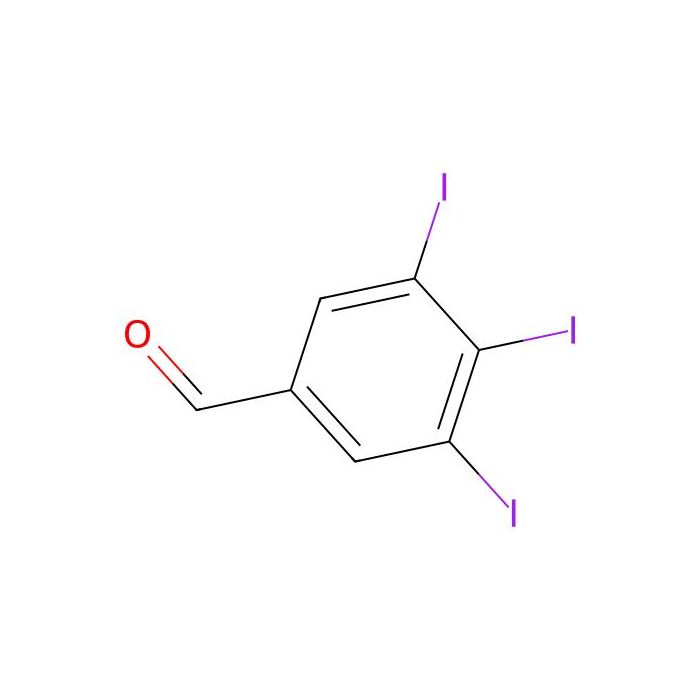
3,4,5-Triiodobenzaldehyde - ≥95% , CAS No.1083181-39-8
Disponibile su ordine
QUALITÀ & PUREZZA ≥95%
Storage
Room temperature

≥95% per flussi di lavoro cromatografici e analitici sensibili che richiedono un'interferenza minima della linea di base.
Room temperature Spedizione . Consultare il COA specifico del lotto per le specifiche esatte.
SDS, COA, scheda tecnica e scheda delle specifiche disponibili per il download. COA specifico del lotto accessibile tramite ricerca per numero di lotto.
Citato in 0 pubblicazioni peer-reviewed su cromatografia, sintesi organica e reazioni di accoppiamento incrociato.
Documento completo su pericoli, manipolazione, stoccaggio e conformità normativa.
<<<<<<< HEAD Scarica SDS → ======= Scarica SDS → >>>>>>> release248-p3Dati di qualità specifici del lotto. Inserisci il numero di lotto per recuperare il COA esatto.
Cerca COA →Riepilogo di riferimento rapido delle specifiche e applicazioni del prodotto.
Visualizza scheda tecnica →Attributi di qualità completi e criteri di accettazione per questa qualità.
Visualizza scheda delle specifiche →Taxonomy Tree
| Kingdom | Organic compounds |
|---|---|
| Superclass | Benzenoids |
| Classe | Benzene and substituted derivatives |
| Subclass | Benzoyl derivatives |
| Intermediate Tree Nodes | Not available |
| Direct Parent | Benzoyl derivatives |
| Alternative Parents | Benzaldehydes Iodobenzenes Aryl iodides Organoiodides Organic oxides Hydrocarbon derivatives |
| Molecular Framework | Aromatic homomonocyclic compounds |
| Substituents | Benzoyl - Benzaldehyde - Aryl-aldehyde - Iodobenzene - Halobenzene - Aryl iodide - Aryl halide - Organic oxygen compound - Organic oxide - Hydrocarbon derivative - Organooxygen compound - Organoiodide - Organohalogen compound - Aldehyde - Aromatic homomonocyclic compound |
| Descrizione | This compound belongs to the class of organic compounds known as benzoyl derivatives. These are organic compounds containing an acyl moiety of benzoic acid with the formula (C6H5CO-). |
| External Descriptors | Not available |
| Peso molecolare | 483.810 g/mol |
|---|---|
| XLogP3 | 3.300 |
| Hydrogen Bond Donor Count | 0 |
| Hydrogen Bond Acceptor Count | 1 |
| Rotatable Bond Count | 1 |
| Exact Mass | 483.732 Da |
| Monoisotopic Mass | 483.732 Da |
| Topological Polar Surface Area | 17.100 Ų |
| Heavy Atom Count | 11 |
| Formal Charge | 0 |
| Complexity | 139.000 |
| Isotope Atom Count | 0 |
| Defined Atom Stereocenter Count | 0 |
| Undefined Atom Stereocenter Count | 0 |
| Defined Bond Stereocenter Count | 0 |
| Undefined Bond Stereocenter Count | 0 |
| The total count of all stereochemical bonds | 0 |
| Covalently-Bonded Unit Count | 1 |
No application protocols (e.g., WB, IHC, IF, FC) are applicable to this small-molecule reagent. For synthetic applications, refer to the Reaction Conditions tab for representative procedures and to current literature for scale-up and optimization.
Manufacturer applications: Not specified for this item; refer to the catalog page and CoA/Spec Sheet. Research Use Only.
Item-specific biological roles: Not applicable; this is a synthetic building block for research use only.
General context (literature):
Compliance note: No medical, diagnostic, or therapeutic uses are claimed or supported for this product. For research use only.
This compound is a hydrophobic aromatic aldehyde and is not used as a buffering agent. It lacks acid/base pairs in the physiological pH range suitable for buffering.
Practical note: If used in biomolecule conjugation method development, reactions are typically run in acetate, phosphate, or anilinium-catalyzed buffers with organic co-solvent (e.g., 10–30% DMF/DMSO) to solubilize the aldehyde. Select the buffer based on the nucleophile (aminooxy/hydrazide) and desired pH (commonly pH 4–6 for oxime/hydrazone formation).
Greener strategy revolves around solvent and catalyst choices; the substrate itself is a heavily halogenated aromatic and not inherently “green.” The aim is to reduce process mass intensity and hazardous solvent use in its transformations.
Greener options (literature/general):
Concise comparison (general, not item-specific):
Trade-offs: Greener media can slow reactions or require re-optimization of ligand/base; ensure adequate mixing and oxygen control for O2/TEMPO oxidations.
Item-specific pharmacopeial/excipient status: Not specified for this item; refer to CoA/Spec Sheet.
General, non-clinical context:
Item-specific specifications: Not specified for this item; refer to CoA/Spec Sheet.
General/literature expectations (for professional planning only; not item specifications):
Handling-relevant traits (general):
If exact BP/MP, density, refractive index, UV cutoff, water/peroxide/metal limits are needed: Not specified for this item; refer to CoA/Spec Sheet.
Item-specific grade/purity information: Not specified for this item; refer to CoA/Spec Sheet.
Interpretation and implications (general guidance):
What to check on receipt (practical QA):
Functional handles:
Representative reaction families and use-cases (literature/general):
Practical tips:
General literature conditions (guidance only; optimize per substrate and scale):
Notes: In sequential couplings, adjust ligand/electronic bias to control order. Protect –CHO if strong base/heat is required to prevent aldol-type side reactions.
Authoritative classification for this specific item: Not specified for this item; refer to SDS for complete and current GHS details (signal word, hazard statements, pictograms, and precautionary statements).
General hazards (aromatic aldehydes and aryl iodides; literature/experience):
PPE and engineering controls (good laboratory practice):
Incompatibilities and reactivity (general):
First-aid overview (non-authoritative; consult SDS):
Waste: Collect halogenated organic waste in designated containers; follow institutional and local regulations.
Context: This product is a solid aromatic aldehyde/aryl iodide used as a substrate or building block. Solvent choice affects solubility, coupling efficiency, and carbonyl reactivity.
General solubility/miscibility guidance (literature/experience):
Choosing a solvent by application:
Comparison notes (general):
Item-specific storage/shipping:
General handling guidance (literature/experience):
Reconstitution/stock solutions (general):
Freeze–thaw: Not typically required for solids. If storing solutions, aliquot and store under inert gas at low temperature (e.g., 2–8 C for DMSO/DMF stocks) and minimize freeze–thaw cycles.
Research Use Only: For laboratory research use; not for human or veterinary use.
Brief overview: 3,4,5-Triiodobenzaldehyde is a heavily iodinated aromatic aldehyde bearing three aryl iodides (at the 3-, 4-, and 5-positions) ortho/meta to the formyl group, providing a dual-function handle: a reactive aldehyde and highly activatable C–I bonds for cross-coupling.
Item-specific identifiers (Product Data):
Structure description (general/literature):
Computed/literature identifiers (not item-specific):
2D structure in words: A benzene ring with –CHO at the top (C-1). Moving clockwise, positions 2 (H), 3 (I), 4 (I), 5 (I), 6 (H); thus three adjacent iodines occupy the 3–5 arc opposite the aldehyde.
Key reactivity elements:
Strategic value in synthesis (literature/general):
Common manipulations:
Notes: Monitor for partial deiodination and over-reaction of –CHO in strongly nucleophilic/basic media; protect if necessary.
Not applicable. This product is a small-molecule building block and does not have biological target specificity, antigen/epitope reactivity, clone, or isotype. No item-specific target data are provided.