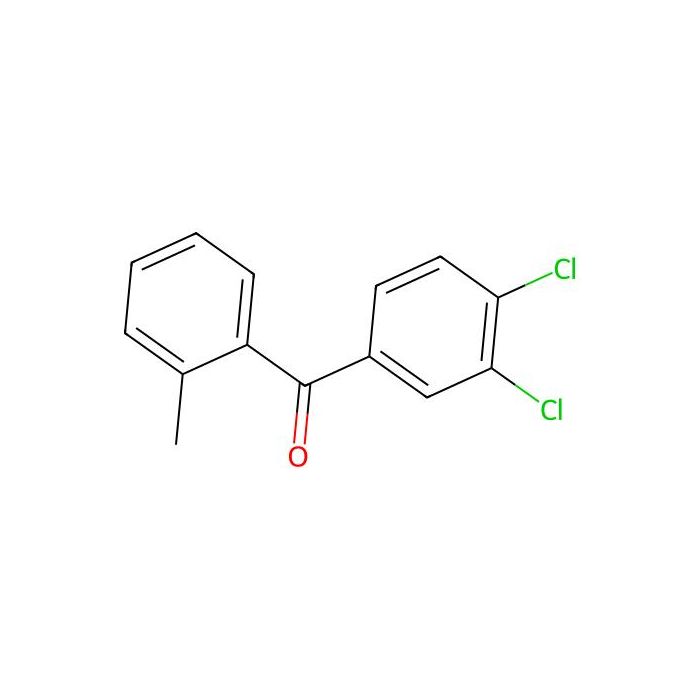
This compound belongs to the class of organic compounds known as benzophenones. These are organic compounds containing a ketone attached to two phenyl groups.
External Descriptors
Not available
1. Djoumbou Feunang Y, Eisner R, Knox C, Chepelev L, Hastings J, Owen G, Fahy E, Steinbeck C, Subramanian S, Bolton E, Greiner R, and Wishart DS. ClassyFire: Automated Chemical Classification With A Comprehensive, Computable Taxonomy. Journal of Cheminformatics, 2016, 8:61.
Certificati (CoA, COO, BSE/TSE e tabella di analisi)
C of A & Other Certificates(BSE/TSE, COO):
Analytical Chart:
Proprietà chimiche e fisiche
Peso molecolare
265.100 g/mol
XLogP3
4.900
Hydrogen Bond Donor Count
0
Hydrogen Bond Acceptor Count
1
Rotatable Bond Count
2
Exact Mass
264.011 Da
Monoisotopic Mass
264.011 Da
Topological Polar Surface Area
17.100 Ų
Heavy Atom Count
17
Formal Charge
0
Complexity
279.000
Isotope Atom Count
0
Defined Atom Stereocenter Count
0
Undefined Atom Stereocenter Count
0
Defined Bond Stereocenter Count
0
Undefined Bond Stereocenter Count
0
The total count of all stereochemical bonds
0
Covalently-Bonded Unit Count
1
Calcolatori di soluzioni
Molarity Calculator
Determine the necessary mass, volume, or concentration for preparing a solution.
Dilution Calculator
Determine the dilution needed to prepare a stock solution.
Reconstitution Calculator
Recensioni
Recensioni dei clienti
Application Protocols
No vendor-validated biological application protocols (e.g., WB, IHC, IF, FC) are provided for this small-molecule reagent. Usage will depend on the synthetic or photochemical context.
General laboratory protocol examples (non-validated, literature-style):
Preparation of a Grignard adduct: Dissolve the ketone (0.5–1.0 mmol) in anhydrous THF (5–10 mL/mmol) under N2. Cool to 0 °C and add a solution of RMgX (1.2–1.5 equiv) dropwise. Stir 1–2 h warming to rt. Quench with sat. NH4Cl, extract with EtOAc, dry, and purify by column or recrystallization.
Suzuki coupling at 4-Cl site: Charge a sealed tube with the ketone (1.0 equiv), aryl boronic acid (1.2–1.5 equiv), Pd2(dba)3 (1–2 mol% Pd), XPhos (2–4 mol%), K3PO4 (3.0 equiv), and 1,4-dioxane/H2O (4:1). Heat at 100 °C for 12–18 h. Cool, filter through celite, extract, and purify.
These are illustrative only. Optimize to your substrate and catalyst system. For any biological testing, develop bespoke protocols and risk assessments.
Biological Roles
This product is a synthetic halogenated diaryl ketone with no known endogenous biological role.
Endogenous function: none; not a metabolite or biomolecule.
Interactions (general, literature): benzophenone motifs can intercalate with lipid environments due to high lipophilicity and absorb UV light; such properties are exploited in material science, not biological systems.
Biotransformation potential: aryl ketones may undergo phase I reduction to alcohols or oxidation at benzylic positions in biological systems; chlorinated aromatics may exhibit persistence. These are general considerations for environmental fate studies, not specific to therapeutic use.
Research context: used as a chromophoric probe or a hydrophobic scaffold in materials and surface chemistry. Any biological testing should be performed under appropriate lab safety approvals.
Note: No medical or clinical claims are made for this product. It is supplied strictly for research use only (per Product Data).
Buffer Applications
Not typically applicable. 3,4-Dichloro-2'-methylbenzophenone is a hydrophobic organic solid with negligible water solubility and no buffering functionality. It is not used to prepare aqueous buffers.
For practical handling in aqueous workflows, dissolve first in a miscible organic co-solvent (e.g., DMSO or acetonitrile) before dilution, if required for analytical purposes. Otherwise, refer to sections on Solvent Selection and Reaction & Applications for relevant usage.
Green Alternatives
While the substrate itself is a halogenated aromatic ketone (not inherently “green”), greener choices can be made in processing and solvent selection.
Greener solvent options (literature guidance):
Replace chlorinated process solvents with ethers or esters where feasible:
DCM/chloroform → ethyl acetate, 2-MeTHF, CPME, or toluene for dissolution/extraction.
DMF/DMAc/NMP (for couplings) → propylene carbonate, 2-MeTHF, or Cyrene where compatible with the catalyst system.
For Suzuki couplings, aqueous ethanol or 2-MeTHF/water biphasic systems can reduce solvent hazards while maintaining activity with suitable ligands/bases.
Energy and waste minimization:
Employ photoredox catalysis under LED irradiation (near-UV) to harness the benzophenone chromophore, potentially reducing thermal input versus high-temperature couplings.
Favor catalytic hydrogenation or transfer hydrogenation for carbonyl reduction over stoichiometric hydride reagents when possible.
Comparison snapshot (process-focused):
2-MeTHF vs THF: similar solvating power; 2-MeTHF is bio-based, higher bp, and less peroxide-prone; THF is more miscible with water and widely validated for organometallics.
EtOAc vs DCM: EtOAc is biodegradable and less toxic; DCM offers higher solubility and rapid evaporation but is a suspected carcinogen with higher VOC impact.
Trade-offs: Some greener solvents may alter catalyst performance (especially for aryl chloride activation). Conduct small-scale screenings and consult solvent selection guides (e.g., GSK/ACS) to balance EHS with reactivity and yield.
Pharmaceutical Uses
No pharmacopeial status or excipient role is provided in the Product Data. This compound is offered for research use only and is not intended for human or veterinary use.
Potential roles (general, non-clinical): a synthetic intermediate in discovery chemistry for hydrophobic scaffolds; UV-absorbing benzophenone units can be leveraged in photoligation or photoaffinity labeling strategies in vitro. Such uses require thorough purification and analytical validation; they do not imply any therapeutic application.
Regulatory: absent specific grade declarations (USP/EP/JPE), material is not suitable for GMP manufacture. For any preclinical manufacturing uses, confirm impurity limits, residual solvents, and trace metals via CoA and appropriate qualification.
Formulation note: due to low aqueous solubility and strong aromaticity, formulation as an excipient is atypical; it is more commonly a synthetic intermediate or photochemical reagent in materials science.
Reminder: Research use only, per Product Data.
Physical Properties
Item-specific specifications are not provided in the Product Data. Do not treat the following as specifications; they are literature/computed expectations for this structural class and should be verified experimentally or via CoA/SDS.
Appearance: Not specified for this item; refer to CoA/Spec Sheet. (Typically a pale solid for related benzophenones.)
Molecular formula (literature for the named structure): C14H10Cl2O
Melting point: Not specified for this item; refer to CoA/Spec Sheet. (Benzophenone derivatives with dihalogenation commonly melt in the 60–120 °C range; substituent pattern will shift this.)
Boiling point: Not specified for this item; refer to CoA/Spec Sheet. (Diaryl ketones often decompose before boiling at 1 atm; sub-atmospheric distillation is uncommon.)
Density: Not specified for this item; refer to CoA/Spec Sheet.
Refractive index: Not applicable to solids; Not specified for this item; refer to CoA/Spec Sheet.
LogP: Not specified for this item; refer to CoA/Spec Sheet. (Aryl ketones with two Cl typically show high lipophilicity; literature estimates logP > 3.)
Solubility (qualitative, literature): sparingly soluble in water; soluble in common organic solvents (e.g., DCM, chloroform, THF, toluene, hot ethanol/IPA, acetone, acetonitrile). Solubility improves with gentle heating and in chlorinated/aromatic solvents.
UV–Vis (literature): benzophenone chromophore shows π→π* absorption ~240–260 nm and n→π* ~325–360 nm; substituents (Cl, Me) can red-shift modestly. Use this only as qualitative guidance.
Vapor pressure: expected very low at ambient due to high MW and aromaticity (no item-specific data).
Quality and Grades
Grade/Purity: Not specified for this item; refer to CoA/Spec Sheet.
Appearance: Not specified for this item; refer to CoA/Spec Sheet.
Interpretation and guidance:
Without an explicit grade (e.g., “98%”, “HPLC grade”, “AR”), purity, residual solvents, and trace metals are defined by the item’s internal specification/CoA. Request the current CoA for lot-specific assays and impurity profiles.
For structure-driven applications (e.g., cross-coupling on aryl chlorides, photochemistry), trace halide salts, peroxides, and moisture are typically less critical than in air/moisture-sensitive reagents, but residual acidic impurities can affect base-sensitive transformations. If needed, recrystallization or short plug chromatography can polish the material for demanding synthetic steps.
UV cut-off and low-fluorescence grades are sometimes sought for photophysical studies of benzophenones; if relevant, verify absorbance background via CoA or measure in-house.
Stabilizers: None are indicated in the Product Data. If stabilizers or inhibitors are required for your workflow, confirm absence/presence via CoA.
Metals/specifications: Not specified for this item; refer to CoA/Spec Sheet.
Recommendation: For catalytic reactions, consider pre-washing or recrystallization to remove potential chloride-containing inorganic residues, and verify melting point/HRMS/1H NMR of your lot to confirm identity and purity before scale-up.
Reaction and Applications
As a substituted benzophenone, 3,4-dichloro-2'-methylbenzophenone is both a versatile synthetic intermediate and a useful chromophore in photochemistry.
Photochemistry (literature): benzophenone moieties undergo efficient n→π* excitation and can abstract hydrogen from donors, generating ketyl radicals. Substitution (Cl, Me) modulates triplet energies and ISC efficiencies, enabling use as a photosensitizer in polymerization or as a handle for photoredox transformations.
Carbonyl transformations: classical reductions (NaBH4 for diarylmethanol; Wolff–Kishner or Clemmensen for deoxygenation), nucleophilic additions (Grignard/organolithium) to afford tertiary alcohols, and oxime/hydrazone formation for further modifications.
Cross-coupling leverage: the 3,4-dichloro substitution enables site-selective Pd-catalyzed couplings (Suzuki–Miyaura, Buchwald–Hartwig amination, or Kumada/Negishi with activated systems). Modern ligands (e.g., BrettPhos, XPhos) can activate aryl chlorides at moderate temperatures, allowing diversification of the chloro-bearing ring while retaining the ketone.
Electrophilic aromatic substitution: the carbonyl deactivates the ring toward EAS; however, the methyl-bearing ring may participate in directed metalation (ortho effects) or benzylic functionalizations.
Building block role: serves as a precursor to UV-absorbing materials, ligands, and advanced intermediates for agro/functional materials. The ortho-methyl can impart atropisomerism or conformational bias in downstream scaffolds.
Practical notes:
Dry, oxygen-free conditions are recommended for organometallic additions and some couplings; the ketone is moisture-stable but air exclusion protects sensitive catalysts.
Protect from strong light during storage and manipulations when photochemical outcomes are not desired.
Reaction Conditions
General literature guidance for typical transformations of halogenated benzophenones. Verify and optimize for your system.
Suzuki–Miyaura coupling (aryl chloride):
Catalyst/ligand: Pd2(dba)3 (1–2 mol% Pd) with XPhos or BrettPhos (2–4 mol% ligand).
Base: K3PO4 or Cs2CO3 (2–3 equiv).
Solvent: toluene/H2O, 1,4-dioxane, or 2-MeTHF/H2O.
Temperature: 90–110 °C; 6–20 h.
Notes: 4-Cl often couples faster than 3-Cl; sequential or selective coupling possible by tuning conditions.
Buchwald–Hartwig amination (aryl chloride):
Catalyst: Pd(OAc)2 or Pd2(dba)3 with RuPhos/BrettPhos; NaOtBu or Cs2CO3 as base.
Solvent: toluene, dioxane, or DMAc.
Temperature: 80–110 °C; 8–24 h.
Nucleophilic addition to carbonyl:
Grignard: RMgX (1.1–1.5 equiv) in anhydrous THF or ether, 0 °C to rt, 1–3 h; quench into NH4Cl. Yields for tertiary alcohols commonly >70% with appropriate R groups.
Organolithium: RLi at −78 to 0 °C in THF/Et2O for sensitive substrates; rapid reactions with careful control to avoid overreaction.
Reductions:
NaBH4/MeOH or EtOH at 0–25 °C, 1–4 h → diarylmethanol.
Irradiation: 350–365 nm LEDs in acetonitrile or isopropanol (as H-donor), rt; 1–6 h.
Notes: Shield from oxygen for radical reactions; consider triplet quenchers/additives for selectivity.
All temperatures/times are literature-type ranges and not item-specific specifications.
Safety and Handling
Always consult the product SDS for authoritative guidance. The Product Data do not include GHS details for this item, so the following are general best practices for halogenated aromatic ketones.
GHS classification, signal word, pictograms, H-statements: Not specified for this item; refer to SDS.
Likely hazards (general): May cause skin/eye irritation; dust may be harmful if inhaled; harmful to aquatic life is common for halogenated aromatics. Avoid generation of dust and environmental release.
PPE: lab coat, safety glasses or goggles, and appropriate chemical-resistant gloves (e.g., nitrile). Use in a fume hood to avoid inhalation of dust or vapors.
Handling: Avoid prolonged light exposure; benzophenones can act as photosensitizers. Prevent contact with strong oxidizers and strong reducing agents. Avoid strong bases/acids if performing reactions; the solid is generally stable at ambient conditions.
Incompatibilities (general): strong oxidizers, strong bases under heating (possible hydrodehalogenation in reactive media), alkali metals. Avoid sodium/alkali dispersion.
First aid (overview):
Inhalation: move to fresh air; seek medical attention if symptoms persist.
Skin contact: wash with soap and water; remove contaminated clothing.
Eye contact: rinse cautiously with water for several minutes; remove contact lenses if present and easy.
Ingestion: rinse mouth; seek medical advice. Do not induce vomiting unless directed.
Fire safety: Combustible organic solid. Use dry chemical, CO2, or foam. Combustion may produce HCl and phosgene traces; firefighters should wear SCBA.
Spill response: Avoid dust; collect mechanically and place in suitable container for disposal. Prevent discharge to drains.
Solvent Selection
This compound is a hydrophobic, halogenated diaryl ketone. It exhibits poor water solubility and good solubility in moderately polar to nonpolar organic solvents.
Limited: lower alcohols at RT (improves when warm), hexanes (may require large volumes).
Poor: water and aqueous buffers.
Selection tips:
For photochemistry and UV–Vis: choose spectroscopic-grade acetonitrile or ethanol; to minimize background at ~330–360 nm, verify solvent UV cut-off.
For crystallization: hot ethanol/IPA, acetone/hexanes, or EtOAc/hexanes systems are commonly effective; adjust by monitoring solubility curves.
For cross-coupling on the aryl chlorides: high-boiling polar aprotics (dioxane, toluene with t-BuOH or DMAc) facilitate Pd-catalyzed C–C coupling at 90–120 °C.
For nucleophilic additions/reductions at the carbonyl: THF, toluene, or ether solvents under anhydrous conditions are typical.
Comparison (general):
DCM vs toluene: DCM offers faster dissolution and easy removal; toluene is higher-boiling and better for elevated-temperature coupling chemistry.
THF vs EtOAc: THF provides better solvation for organometallic additions; EtOAc is greener and useful for workups and crystallizations.
Shipped In: Not specified for this item; refer to CoA/Spec Sheet.
Practical guidance:
Container: Store tightly closed in a dry, well-ventilated place. Use amber glass to minimize light exposure; benzophenone chromophores can photosensitize under UV/strong light.
Atmosphere: Not air- or moisture-sensitive under normal conditions. For long-term storage, keep desiccated to prevent caking and to preserve handling quality.
Stability: Aromatic ketones are generally stable at ambient temperatures. Avoid prolonged exposure to direct sunlight and strong oxidizers.
Reconstitution: Not applicable—shipments are typically provided as neat solid. For solution preparation, dissolve in an appropriate organic solvent (e.g., DCM, THF, toluene, acetone, acetonitrile, or DMSO) with mild warming if needed.
Freeze–thaw: Not relevant unless stored as a solution. For stock solutions, aliquot and store according to solvent stability (e.g., DMSO or acetonitrile at 2–8 °C, protected from light). Allow to equilibrate to room temperature before opening to prevent condensation.
Always refer to the current CoA/SDS for lot-specific details and follow institutional chemical hygiene plans.
Structure and Identity
A substituted benzophenone featuring two chloro substituents on one ring (3,4-) and a methyl group ortho to the carbonyl on the other ring (2'). The molecule comprises two phenyl rings linked by a carbonyl (diaryl ketone) with deactivating halogens and an ortho-methyl that can impart steric bias.
SKU: D953175
Product Name: 3,4-Dichloro-2'-methylbenzophenone
CAS: 951887-30-2
PubChem CID: 21571934
InChIKey (Product Data): 221011
SMILES: Not specified for this item; refer to CoA/Spec Sheet.
Molecular Formula: Not specified for this item; refer to CoA/Spec Sheet. (Computed/literature estimate for the named structure: C14H10Cl2O)
Molecular Weight: Not specified for this item; refer to CoA/Spec Sheet. (Computed/literature estimate for C14H10Cl2O: ~264.99 g/mol)
Structural features (general description):
Core: benzophenone (diaryl ketone, Ar–CO–Ar').
Substituents: 3,4-dichloro on one ring (electron-withdrawing, ortho/para deactivating); 2'-methyl on the opposite ring (weakly electron-donating, ortho-steric bulk).
2D description: two phenyl rings flanking a carbonyl carbon; one ring bears adjacent chloro groups at the meta and para positions; the other bears an ortho methyl. Planarity about the carbonyl with restricted rotation; ortho-Me can twist the aryl plane, affecting photophysics and reactivity.
Stereochemistry: none (achiral as drawn).
Synthetic Utility
Key functional features that enable broad synthetic value:
Carbonyl reactivity: As a benzophenone, the carbonyl accepts nucleophiles (RMgX, RLi) to give tertiary alcohols; selective reductions (NaBH4, catalytic hydrogenation) furnish diarylmethanols. Further transformations include tosylation/halogenation of the alcohol, or dehydration to alkenes.
Deoxygenation: Wolff–Kishner or Clemmensen protocols convert the ketone to the corresponding diarylmethane, useful for constructing more reduced frameworks.
Alpha/benzylic functionalization: though lacking α-hydrogens at carbonyl carbon (diaryl), benzylic positions on the 2'-methyl ring permit oxidation (to benzyl alcohol/acid), bromination, or cross-coupling after conversion to benzyl halides.
Aryl chloride handles (3,4-positions): enable diversification via Pd-catalyzed Suzuki–Miyaura (to install aryl/heteroaryl), Buchwald–Hartwig amination (to install amines), or Miyaura borylation (to form pinacol boronates). Directed selectivity between 3- and 4-chloro sites can be tuned with ligand choice and temperature.
Lithiation/metal–halogen exchange: at low temperature, aryl chloride activation (e.g., Li-halogen exchange on the more activated ring) permits subsequent electrophile trapping, although Pd-catalysis is generally preferred for functional group tolerance.
Photochemical utility: benzophenone triplet sensitization can promote intramolecular cyclizations or hydrogen abstraction, creating radicals for C–C bond formation.
These properties position the compound as a robust branching node for late-stage diversification in SAR campaigns and materials synthesis.
Target Specificity
Not applicable. This product is a small-molecule organic reagent, not a biological targeting reagent or antibody. No antigen/epitope/isotype information exists for this item in the Product Data.
We use cookies to ensure the website functions properly and, where permitted, to improve your experience. You can manage your preferences at any time in Settings. Learn more in our Cookie Policy.
Shall we send you a message when we have discounts available?
Remind me later
Thank you! Please check your email inbox to confirm.
Products are supplied to verified businesses, institutions, and qualified professionals for research and development use only. Not for use in humans, animals, diagnosis, or therapy.