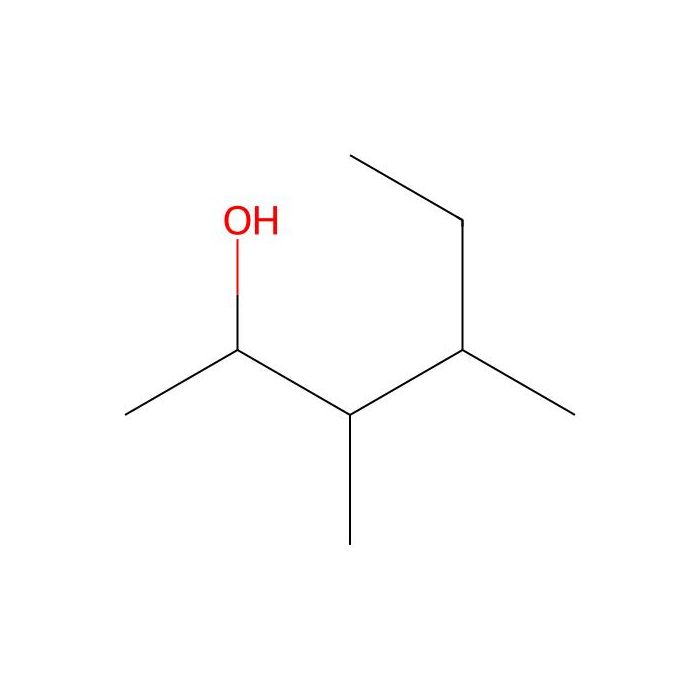
This compound belongs to the class of organic compounds known as secondary alcohols. These are compounds containing a secondary alcohol functional group, with the general structure HOC(R)(R') (R,R'=alkyl, aryl).
External Descriptors
Not available
1. Djoumbou Feunang Y, Eisner R, Knox C, Chepelev L, Hastings J, Owen G, Fahy E, Steinbeck C, Subramanian S, Bolton E, Greiner R, and Wishart DS. ClassyFire: Automated Chemical Classification With A Comprehensive, Computable Taxonomy. Journal of Cheminformatics, 2016, 8:61.
Certificati (CoA, COO, BSE/TSE e tabella di analisi)
C of A & Other Certificates(BSE/TSE, COO):
Analytical Chart:
Proprietà chimiche e fisiche
Peso molecolare
130.229 g/mol
XLogP3
2.600
Hydrogen Bond Donor Count
1
Hydrogen Bond Acceptor Count
1
Rotatable Bond Count
3
Exact Mass
130.136 Da
Monoisotopic Mass
130.136 Da
Topological Polar Surface Area
20.200 Ų
Heavy Atom Count
9
Formal Charge
0
Complexity
71.000
Isotope Atom Count
0
Defined Atom Stereocenter Count
0
Undefined Atom Stereocenter Count
3
Defined Bond Stereocenter Count
0
Undefined Bond Stereocenter Count
0
The total count of all stereochemical bonds
0
Covalently-Bonded Unit Count
1
Calcolatori di soluzioni
Molarity Calculator
Determine the necessary mass, volume, or concentration for preparing a solution.
Dilution Calculator
Determine the dilution needed to prepare a stock solution.
Reconstitution Calculator
Recensioni
Recensioni dei clienti
Application Protocols
No standardized biological assay protocols (e.g., WB, IHC, IF, FC) are applicable to this small-molecule reagent. Usage is procedure-specific to the intended synthetic or analytical transformation.
General laboratory handling (literature):
For synthetic use, follow the Reaction Conditions section as a starting point and adjust stoichiometry, solvent, and temperature based on substrate compatibility.
For analytical reference or calibration, prepare gravimetric stock solutions in an appropriate solvent (e.g., isooctane, toluene, or acetonitrile) and store in sealed, inert vials.
Item-specific protocol details: Not specified for this item; refer to CoA/Spec Sheet.
Biological Roles
No specific biological function is assigned to 3,4-dimethyl-2-hexanol. It is a synthetic, branched aliphatic secondary alcohol used for research and chemical manufacturing.
General biochemistry of aliphatic secondary alcohols (literature):
Metabolic fate: In biological systems, aliphatic alcohols are commonly oxidized by alcohol dehydrogenases to the corresponding ketones, then further processed via phase I/II metabolism (e.g., reduction/oxidation, conjugation with glucuronic acid or sulfate) to increase polarity for excretion.
Membrane interactions: Medium-chain alcohols can partition into lipid bilayers due to hydrophobicity (logP ~2–3), potentially altering membrane fluidity at sufficient concentrations in model systems.
Biodegradation: Branched alcohols are generally biodegradable in aerobic environments, though branching can slow microbial degradation relative to linear isomers (literature trend).
Research context
The compound may be used as a hydrophobic probe, substrate analog in enzymology (e.g., alcohol dehydrogenase studies), or as a model for studying structure–property relationships of branched amphiphiles.
Note: All uses are for research and laboratory purposes only; no clinical or diagnostic use is implied.
Buffer Applications
This product is not a buffering agent and is not typically used to prepare aqueous buffer systems. Due to its low water solubility and hydrophobic character, it has limited applicability in standard biochemical buffer formulations.
For experimental systems requiring this alcohol in aqueous media, consider:
Preparing concentrated stocks in miscible organic cosolvents (e.g., DMSO, ethanol) and diluting into buffer below solubility limits.
Monitoring final organic content to maintain biological assay compatibility.
Refer instead to the Reaction & Applications and Synthetic Utility sections for more relevant usage guidance.
Green Alternatives
As a substrate reagent rather than a process solvent, “green alternatives” focus on choosing cleaner methods that transform 3,4-dimethyl-2-hexanol with reduced hazard and waste.
Greener method choices (literature):
Oxidation: Prefer catalytic systems (e.g., TEMPO/NaOCl in biphasic water/EtOAc, or Cu/nitroxyl with air) over stoichiometric chromium(VI) reagents. Electrochemical oxidations are also emerging, minimizing heavy metal waste.
Esterification: Use enzymatic acylations (lipases in green solvents like 2-MeTHF or CPME) or carbodiimide-free couplings (acid anhydrides, catalytic DMAP) to reduce urea byproducts.
Dehydration: Solid acid catalysts (Amberlyst, zeolites) under solvent-minimized conditions can replace strong mineral acids.
Solvent selection: Favor bio-based ethers (2-MeTHF), CPME, ethyl acetate, or supercritical CO2 where feasible instead of chlorinated solvents.
Illustrative comparison (literature):
Swern or DMP oxidation vs. TEMPO/bleach
Hazard/waste: DMSO activators or hypervalent iodine byproducts vs. benign salt water; advantage TEMPO/bleach.
Selectivity: Both provide secondary ketone in high yield; TEMPO systems require careful pH control.
Chlorinated media (DCM) vs. 2-MeTHF/EtOAc for acylations
EHS profile: lower toxicity and better lifecycle metrics with 2-MeTHF/EtOAc.
Note: These are general green chemistry considerations. They are not specifications of this item.
Pharmaceutical Uses
No pharmacopeial status or excipient role is specified for this item. It is supplied for research use only.
General formulation context (literature):
Medium-chain aliphatic alcohols can function as hydrophobic carriers, penetration enhancers, or intermediates in the synthesis of APIs and excipients. However, secondary branched C8 alcohols are more commonly used as synthetic intermediates than as direct formulation components.
If considered as a process intermediate, control of residual levels in final drug substance/product should follow ICH Q3 guidelines for impurities and residual solvents (if used as cosolvent).
Note: No therapeutic or clinical claims are made for this product. Consult internal quality systems if evaluating for GMP-manufacturing relevance.
Physical Properties
Item-specific numerical specifications are not provided in the Product Data for this SKU; consult the CoA/Spec Sheet for authoritative values.
Literature/computed reference values for the compound class (branched C8 secondary alcohol):
Phase/appearance (literature): typically a colorless liquid with mild alcohol odor.
Boiling point: commonly in the 170–185 °C range for branched C8 secondary alcohols (literature, analogous to 2-octanol ~179 °C).
Melting point: expected well below 0 °C (literature, secondary octanols are usually low-melting liquids).
Density (20–25 °C): approximately 0.82–0.84 g/mL (literature range for branched C8 alcohols).
Refractive index n20 D: typically ~1.430–1.440 (literature).
LogP (octanol/water): estimated 2.2–2.8 (literature/QSPR for C8 secondary alcohols).
Water solubility: low to moderate, on the order of grams per liter at ambient temperature (literature; 2‑octanol ~2–3 g/L).
pKa (of conjugate acid): ROH is very weakly acidic; typical pKa ~16–18 in water (literature).
Viscosity: low; similar to other medium-chain alcohols (literature qualitative).
Notes
Values above are provided as general guidance for method development. They are not specifications for this item.
Exact properties depend on isomer ratio and stereochemistry; verify with your batch documentation.
Quality and Grades
Grade/Purity: Not specified for this item; refer to CoA/Spec Sheet.
Stabilizers/Inhibitors: Not specified for this item; refer to CoA/Spec Sheet.
Appearance: Not specified for this item; refer to CoA/Spec Sheet.
Guidance on grades (general, literature):
Neat reagent grade alcohols are typically suitable for synthesis and process development. If using in analytical contexts (e.g., reference standard, qNMR), verify assay method (GC, HPLC), residual solvents, and water content on the CoA.
Low-UV or LC/MS grades (when offered) control background absorbance/ions for trace analysis; not usually necessary for use as a synthetic substrate.
Stabilizers (if present) can influence downstream reactions (e.g., acid-catalyzed dehydration or oxidation). If your transformation is sensitive, confirm absence/presence and remove by distillation or washing as needed.
Recommendations
For stereosensitive chemistry, request information on optical purity and isomer composition. Secondary alcohol stereochemistry affects reaction outcomes (e.g., Mitsunobu inversion, asymmetric oxidation).
Reaction and Applications
As a secondary alkanol, 3,4-dimethyl-2-hexanol serves as a versatile substrate and building block in organic synthesis.
Representative transformations (literature):
Oxidation to ketone: Converts to 3,4-dimethyl-2-hexanone using chromic reagents, PCC, Dess–Martin periodinane, Swern, or catalytic TEMPO/bleach under appropriate conditions. Branched frameworks often oxidize cleanly with minimal over-oxidation.
Dehydration/olefination: Acid-catalyzed dehydration (H2SO4, POCl3/pyridine, or catalytic p-TsOH) affords internal alkenes (mixtures of regio-/stereoisomers possible). Alternatively, convert to a sulfonate (Ts/ Ms) then eliminate with base for better control.
Nucleophilic substitution via activation: Formation of tosylate/mesylate or halide (e.g., SOCl2, PBr3) allows SN1/SN2 substitution to access diverse C–X or C–N derivatives; Mitsunobu reaction enables inversion at C2 with oxygen and nitrogen nucleophiles.
Protection: Secondary alcohol protection as silyl ethers (TBS, TIPS) or carbonates (Boc2O) for multi-step sequences on the branched C8 scaffold.
Ester synthesis: Steglich esterification (DCC/DMAP) or acyl chloride coupling gives sterically encumbered esters useful as chiral auxiliaries or lipophilic probes.
Metalation/derivatization: Oxidation to ketone followed by stereoselective reduction (CBS, Meerwein–Ponndorf–Verley) provides access to defined stereochemistry at C2; ketone also undergoes aldol and imine chemistry.
Practical tips (literature):
Drying: Secondary alcohols can be dried by azeotropic distillation (e.g., with toluene) or storing over activated 3 Å molecular sieves.
Workup: Oxidations with DMP/Swern favor neutral or mildly basic aqueous workups to avoid acid-catalyzed dehydration.
Reaction Conditions
Typical literature conditions for secondary alcohol manipulations (general guidance; optimize for your system):
Oxidation to ketone
Dess–Martin periodinane (1.3–1.5 equiv), CH2Cl2 or EtOAc, 0 °C to rt, 1–3 h; typical isolated yields 80–95%.
TEMPO/NaOCl (0.05 equiv TEMPO, KBr, pH 8.6 buffer, biphasic H2O/EtOAc), 0–5 °C to rt; 75–90%.
Dehydration to alkenes
POCl3 (1.2–1.5 equiv) in pyridine, 0 °C to rt, 2–4 h; E/Z internal alkene mixture, 60–85%.
p-TsOH (5–10 mol%) in toluene, reflux with azeotropic water removal; 50–80%.
Activation and substitution
TsCl (1.1–1.5 equiv), pyridine or Et3N, 0 °C to rt, 2–6 h; then SN2 with Nu− in polar aprotic solvent (DMF/DMSO/MeCN), rt to 80 °C as needed.
PBr3 (0.35–0.5 equiv), Et2O or toluene, 0 °C to rt, 1–2 h → secondary bromide; follow with displacement.
Protection (silylation)
TBSCl (1.2–1.5 equiv), imidazole in DMF or DCM, rt, 2–4 h; typical yields 85–95%.
Solvents and atmosphere
Use dry, oxygen-free solvents (DCM, toluene, 2-MeTHF, EtOAc) for moisture-sensitive steps; inert atmosphere (N2/Ar) for air-sensitive reagents.
Notes
Branched substrates may exhibit slower SN2 displacement; increase nucleophile strength or temperature, or employ Mitsunobu for inversion with O/N nucleophiles.
Safety and Handling
Product-specific GHS classification and hazard statements are not provided in the Product Data. Always consult the product SDS for definitive safety information.
General safety considerations for aliphatic secondary alcohols (literature guidance):
Flammability: Combustible liquid; vapors may form flammable mixtures with air at elevated temperatures. Keep away from ignition sources and hot surfaces. Ground/bond containers when dispensing.
Irritation: May cause eye and skin irritation; inhalation of vapors/mist may cause respiratory irritation and CNS depression at high concentrations.
Incompatibilities: Strong oxidizers (risk of exotherm), strong acids (can catalyze dehydration), acid chlorides/anhydrides (acylation), alkali metals and strong bases (may react vigorously), and reactive reducing agents.
Recommended PPE: Safety glasses or chemical splash goggles, lab coat, and appropriate chemical-resistant gloves (e.g., nitrile). Use in a fume hood to minimize inhalation exposure.
First aid (overview; defer to SDS):
Inhalation: Move to fresh air; monitor breathing; seek medical attention if symptoms persist.
Skin contact: Wash with soap and water; remove contaminated clothing.
Eye contact: Rinse cautiously with water for several minutes; remove contact lenses if present and easy; seek medical attention for persistent irritation.
Ingestion: Rinse mouth; do not induce vomiting unless directed by medical personnel.
Spill & fire response: Use inert absorbent for small spills; ventilate area. For fire, use alcohol-resistant foam, dry chemical, or CO2. Water spray can cool containers but may spread liquid.
Research Use Note: For research use only.
Solvent Selection
This product is a branched secondary alcohol reagent rather than a general-purpose solvent. Selection of a reaction or workup solvent should consider its modest polarity and limited water miscibility.
General solubility/miscibility trends (literature):
Miscible with: many nonpolar/aprotic organic solvents (hexanes, toluene, diethyl ether, MTBE, CPME), and partially with polar aprotics (DCM, THF). Limited miscibility with acetonitrile and alcohol–water mixtures depending on ratio.
Water: low solubility (grams per liter scale); phase separation is typical in aqueous systems.
When to use/avoid as solvent or cosolvent (literature):
Use sparingly as a protic cosolvent to modulate acidity/nucleophilicity or to quench reactive intermediates. Its secondary OH may hydrogen-bond and influence selectivity.
Avoid using as bulk solvent in base- or acid-catalyzed transformations where competing reactions (esterification, dehydration, etherification) could occur.
Comparative notes (literature):
Versus primary C8 alcohols (e.g., 1-octanol): lower boiling range and slightly higher polarity; secondary center is more prone to oxidation and dehydration.
Versus short-chain alcohols (MeOH, EtOH): much less polar and poorly water-miscible; better for dissolving hydrophobic substrates without strong protic effects.
Shipped In: Not specified for this item; refer to CoA/Spec Sheet.
Reconstitution: Not applicable; supplied neat. If dilution is required, prepare solutions in dry, compatible solvents (e.g., hexanes, toluene, EtOAc, 2-MeTHF) under clean, airtight conditions to minimize moisture pickup and volatilization.
Good practice (literature):
Keep container tightly closed in a cool, well-ventilated place away from oxidizers and ignition sources.
If long-term storage of solutions is needed, use amber glass with PTFE-lined caps; blanket with inert gas to limit oxidation. Store at 2–8 °C to reduce volatility, unless the solution would precipitate.
Avoid prolonged exposure to strong acids/bases to prevent side reactions (dehydration, transesterification).
Secondary alcohols may slowly oxidize; periodic GC/HPLC assay is recommended for critical applications.
Research Use Note: For research use only.
Structure and Identity
A branched secondary alkanol with eight carbons, 3,4-dimethyl-2-hexanol contains an OH at C2 on a hexyl backbone bearing methyl substituents at C3 and C4. This creates three potential stereogenic centers (C2, C3, C4), giving up to eight stereoisomers in principle.
Product Data identifiers (as provided)
CAS: 19550-05-1
PubChem CID: 140547
InChIKey: 195137 (note: format appears non-standard; verify against SDS/CoA)
SMILES: Not specified for this item; refer to CoA/Spec Sheet.
Computed/literature identity (for reference; not item-specific)
Molecular formula: C8H18O (computed from name)
Molecular weight: ~130.23 g/mol (computed)
One possible non-stereochemical SMILES (literature): CC(O)C(C)C(C)CC
A six-carbon linear chain numbered from the OH-bearing C2; C3 and C4 each carry a pendant methyl group. The OH at C2 is secondary, flanked by C1 (methyl terminus) and C3 (methyl-substituted methine). The substituent pattern renders C2, C3, and C4 stereogenic in substituted isomers.
Synthetic Utility
Key functional element is a secondary alcohol embedded in a sterically encumbered C8 framework, enabling diverse downstream elaborations.
Strategic features (literature):
C2 stereocenter: Enables access to enantio- and diastereodefined scaffolds through kinetic resolution, asymmetric oxidation (e.g., AZADO/TEMPO variants), or stereospecific substitutions (Mitsunobu inversion, neighboring group participation).
Branch points (C3, C4): Provide handles for constructing quaternary/tertiary centers after activation (e.g., via radical hydrogen abstraction and subsequent functionalization or through directed C–H activation on oxidized derivatives).
Useful transformations (literature):
Oxidation to ketone followed by:
Reductive amination → branched secondary amines.
Wittig/Julia–Kocienski → defined alkenes.
Enolate chemistry → α-functionalized derivatives.
Conversion to sulfonate (Ts/Ms) → SN2 substitution to install halides, azides, thiols, or oxygen nucleophiles; subsequent reduction or cyclization builds heterocycles.
Carbonate/carbamate formation to tune lipophilicity and stability for probe development.
Etherification: Williamson-type after activation, or direct acid-catalyzed ether formation with primary alcohols.
Protecting group logic (literature):
Silyl ethers (TBS, TBDPS) generally robust to bases and mild acids; selective deprotection strategies allow orthogonality in multistep syntheses.
The branched nature provides a lipophilic backbone useful for tuning physicochemical properties in small-molecule libraries.
Target Specificity
Not applicable. This product is a small-molecule chemical reagent and is not an antibody, probe, or biological ligand with defined target specificity.
Item-specific targeting data: Not specified for this item; refer to CoA/Spec Sheet.
We use cookies to ensure the website functions properly and, where permitted, to improve your experience. You can manage your preferences at any time in Settings. Learn more in our Cookie Policy.
Shall we send you a message when we have discounts available?
Remind me later
Thank you! Please check your email inbox to confirm.
Products are supplied to verified businesses, institutions, and qualified professionals for research and development use only. Not for use in humans, animals, diagnosis, or therapy.