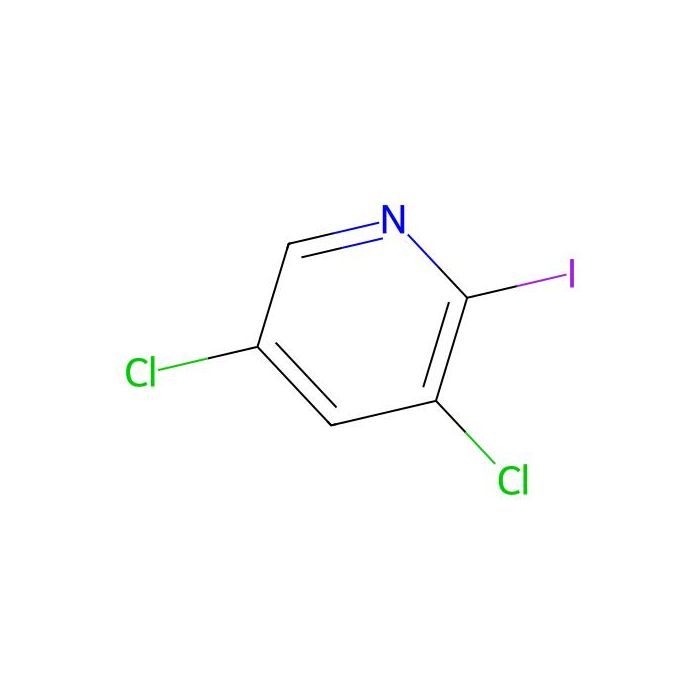
This compound belongs to the class of organic compounds known as polyhalopyridines. These are organic compounds containing a pyridine ring substituted at two or more positions by a halogen atom.
External Descriptors
Not available
1. Djoumbou Feunang Y, Eisner R, Knox C, Chepelev L, Hastings J, Owen G, Fahy E, Steinbeck C, Subramanian S, Bolton E, Greiner R, and Wishart DS. ClassyFire: Automated Chemical Classification With A Comprehensive, Computable Taxonomy. Journal of Cheminformatics, 2016, 8:61.
Certificati (CoA, COO, BSE/TSE e tabella di analisi)
C of A & Other Certificates(BSE/TSE, COO):
Analytical Chart:
Proprietà chimiche e fisiche
Peso molecolare
273.880 g/mol
XLogP3
2.800
Hydrogen Bond Donor Count
0
Hydrogen Bond Acceptor Count
1
Rotatable Bond Count
0
Exact Mass
272.861 Da
Monoisotopic Mass
272.861 Da
Topological Polar Surface Area
12.900 Ų
Heavy Atom Count
9
Formal Charge
0
Complexity
101.000
Isotope Atom Count
0
Defined Atom Stereocenter Count
0
Undefined Atom Stereocenter Count
0
Defined Bond Stereocenter Count
0
Undefined Bond Stereocenter Count
0
The total count of all stereochemical bonds
0
Covalently-Bonded Unit Count
1
Calcolatori di soluzioni
Molarity Calculator
Determine the necessary mass, volume, or concentration for preparing a solution.
Dilution Calculator
Determine the dilution needed to prepare a stock solution.
Reconstitution Calculator
Recensioni
Recensioni dei clienti
Application Protocols
Not applicable. No immunoassay or bioassay protocols (WB, IHC, IF, FC) are associated with this small-molecule building block. For synthetic use, refer to the Reaction Conditions and Synthetic Utility sections for literature-style setup guidance.
Biological Roles
Item-specific biological roles: Not specified for this item; refer to primary literature if required for a specific study.
General context (non-clinical, research only)
3,5-Dichloro-2-iodopyridine is a synthetic halogenated heteroaromatic and is not known as a natural metabolite or cofactor. It serves primarily as a chemical building block rather than a bioactive ligand per se.
Pyridine cores are common in bioactive molecules due to tunable basicity and hydrogen-bond acceptor capability. The presence of multiple halogens modulates lipophilicity, metabolic stability, and binding vectors when this scaffold is elaborated into target compounds.
In biochemical assay development, halopyridine intermediates may be used to assemble focused libraries for SAR exploration around kinase inhibitors, GPCR ligands, or enzyme modulators; however, intrinsic biological activity of the intermediate itself is not implied and should not be assumed without data.
Any handling for biological testing should conform to research-only use, with rigorous purification and characterization of final compounds before biological evaluation.
Buffer Applications
This compound is a neutral/weakly basic heteroaromatic building block, not a buffering agent. It is not typically used to prepare laboratory buffers or to control pH. For experimental work involving this material, choose a buffer appropriate to your assay or reaction system (e.g., phosphate, HEPES) independently of this reagent.
Green Alternatives
Greener solvent and catalyst choices (general, literature-informed)
Solvent substitution
Replace DCM/chloroform with 2-MeTHF, CPME, or toluene where possible; these offer lower toxicity and better environmental profiles while maintaining solubility for halopyridines.
For Suzuki couplings, use aqueous ethanol, water/dioxane, or water/2-MeTHF systems to reduce reliance on amide solvents. Consider micellar catalysis (TPGS-750-M) to conduct couplings in water.
Base and additive considerations
Carbonates (K2CO3) and phosphates (K3PO4) in water-rich media reduce waste salt hazards compared to cesium salts, with minor trade-offs in rate.
Catalyst optimization
Employ ligand-efficient Pd systems or Ni catalysis for C–Cl activation to lower precious metal loading. Heterogeneous Pd/C for Heck/Suzuki may simplify recovery but can reduce selectivity for N-heteroaryl substrates.
Energy usage
Use higher-boiling green ethers (2-MeTHF) to operate at slightly elevated temperatures, shortening reaction times. Consider flow chemistry to enhance heat/mass transfer and reduce solvent volumes.
Greener: 2-MeTHF/H2O or ethanol/H2O; Pd(PPh3)4 or modern XPhos-type Pd precatalysts at ≤0.5 mol%; room temp to 70 C; or micellar water with ppm Pd.
Trade-offs
Amide-free systems may require more active ligands; water-rich media can increase base hydrolysis of sensitive partners. Validate on small scale.
Pharmaceutical Uses
Item-specific pharmacopeial status and excipient role: Not specified for this item; refer to CoA/Spec Sheet.
General context (non-clinical)
3,5-Dichloro-2-iodopyridine is used in pharmaceutical research as a versatile synthetic intermediate for constructing 2,3,5-trisubstituted pyridines. These motifs frequently appear in discovery programs where halogen handles are leveraged for modular assembly and late-stage diversification.
Typical roles are confined to route development and medicinal chemistry synthesis. It is not employed as an excipient and has no compendial monograph to our knowledge (literature). No therapeutic or clinical claims are made or implied.
Manufacturing considerations: When incorporated into upstream steps, attention to residual halides and palladium content in downstream APIs is required; appropriate purging studies and metal scavenging protocols should be implemented per ICH Q3D and internal quality policies.
Physical Properties
Item-specific specifications
Appearance: Not specified for this item; refer to CoA/Spec Sheet.
Molecular formula: Not specified for this item; refer to CoA/Spec Sheet. (Calculated/literature formula is C5H2Cl2IN; see Structure & Identity.)
Molecular weight: Not specified for this item; refer to CoA/Spec Sheet. (Calculated/literature value ~273.88 g/mol.)
Boiling point, melting point, density, refractive index, water/peroxide/metal limits, and UV cutoff: Not specified for this item; refer to CoA/Spec Sheet.
General/literature expectations for this class (non-specification)
Physical state: Halogenated pyridines of this substitution pattern are typically low-melting solids or high-boiling oils; the heavy iodine often increases crystallinity and density relative to lighter analogs.
Solubility profile: Poorly soluble in water; readily soluble in polar aprotic organic solvents (e.g., DMSO, DMF, acetonitrile) and moderately to well soluble in halogenated (DCM, chloroform) and aromatic solvents (toluene). Solubility in alcohols varies with temperature.
Volatility: Significantly lower than non-halogenated pyridines due to the iodine substituent; suitable for standard fume hood handling without notable evaporation.
Notes for use
Prior to critical applications (e.g., stoichiometric cross-couplings), verify water content and assay on the accompanying CoA. If necessary, dry under high vacuum over P2O5 or molecular sieves compatible with halopyridines (literature practice).
Quality and Grades
Item-specific quality information
Grade/Purity: Not specified for this item; refer to CoA/Spec Sheet.
Stabilizers/Inhibitors: Not specified for this item; refer to CoA/Spec Sheet.
Guidance for interpreting grades (general)
Research grade halopyridines are commonly supplied at ≥95–98% GC/HPLC purity for cross-coupling reliability. For air-/moisture-stable solids, no stabilizer is typically required. If a stabilizer is indicated on the CoA (rare for this class), assess potential interference with metal-catalyzed couplings and remove via pre-treatment (e.g., silica plug) if needed.
Chromatographic purity vs. assay: For coupling chemistry, both chromatographic purity and residual halide content (especially iodide vs. chloride ratios if mixtures) matter. Confirm identity by 1H/13C NMR and optionally 127I patterns in HRMS for robust traceability.
Trace metals/halides: If your downstream catalysis is Pd-sensitive, you may require specifications for residual metals/halides. These are Not specified for this item; refer to CoA/Spec Sheet.
Practical QA tips
Record lot-specific data (mp, NMR, LC) upon receipt to build an internal quality baseline.
If reproducibility issues arise in cross-couplings, evaluate water content (Karl Fischer) and halide purity; re-dry under vacuum if necessary.
Orthogonal halides: The aryl iodide at C-2 couples readily under mild Pd catalysis (Suzuki, Sonogashira, Heck), while the C–Cl bonds at C-3 and C-5 remain intact, enabling sequential elaboration. This facilitates rapid generation of 2-substituted-3,5-dichloropyridine libraries.
Suzuki–Miyaura: Aryl/alkenyl/heteroaryl boron partners; bases such as K2CO3, K3PO4, Cs2CO3 in aqueous dioxane/THF. N-heteroaryl iodides generally show high reactivity and tolerance of functional groups.
Sonogashira: Terminal alkynes under Pd/Cu catalysis to afford 2-alkynyl derivatives; subsequent hydrofunctionalizations (hydrogenation, cyclizations) diversify scaffolds.
Heck: Installation of alkenes at C-2; useful for further transformations (e.g., oxidative cyclizations, conjugate additions).
Leveraging the C–Cl positions
Buchwald–Hartwig amination or C–O coupling: With tailored ligands (e.g., BrettPhos/XPhos systems) the C–Cl at 3/5 can be activated later under more forcing conditions, enabling stepwise diversification.
SNAr considerations: The 3- and 5-positions (meta to N) are less activated than 2- or 4- in pyridines; strong nucleophiles, high temperatures, or activating substituents may be required if SNAr is pursued.
Metalation strategies
Halogen–metal exchange at C-2 (I→Mg or I→Li) at low temperature (e.g., iPrMgCl·LiCl or n-BuLi) provides access to 2-metallated pyridines for electrophile quench (formylation, carboxylation, acylation), while retaining C–Cl handles.
Applications in discovery chemistry
The 2,3,5-trisubstituted pyridine motif is prevalent in medicinal chemistry campaigns; this building block streamlines structure–activity explorations via modular, sequential couplings.
Reaction Conditions
General literature guidance (non-specification; optimize per system)
Suzuki–Miyaura at C–I (preferred first step)
Catalyst: Pd(dppf)Cl2·DCM (1–2 mol%) or Pd(PPh3)4 (1–3 mol%).
Base: K2CO3 or K3PO4 (2–3 equiv); aqueous component beneficial.
Solvent: 1,4-dioxane/H2O (3:1), THF/H2O, or 2-MeTHF/H2O.
Temperature/time: 50–80 C, 1–8 h for many aryl/heteroaryl boronates.
Notes: Add water last to maintain homogeneity; aryl boronic acids/esters both suitable.
Sonogashira at C–I
Catalyst system: Pd(PPh3)2Cl2 (1–2 mol%) + CuI (5–10 mol%).
Base/solvent: Et3N or iPr2NH in THF or MeCN.
Temperature: RT to 60 C; monitor to minimize Glaser homocoupling.
Buchwald–Hartwig amination at C–Cl (second-stage activation)
Catalyst/ligand: Pd2(dba)3 (1 mol% Pd) with BrettPhos or t-BuBrettPhos (2–4 mol% ligand) and NaOtBu or Cs2CO3.
Solvent: Toluene, dioxane, or DMAc.
Temperature: 90–120 C (C–Cl typically requires elevated temperatures).
Halogen–metal exchange (I→Mg or I→Li) at C–2
Reagent: iPrMgCl·LiCl (Turbo Grignard, 1.1–1.5 equiv) or n-BuLi (1.1 equiv).
Solvent/temperature: Dry THF, −78 to −20 C.
Quench: Electrophiles such as DMF (formylation), CO2 (carboxylation), acyl chlorides, or aldehydes.
Heck coupling at C–I
Catalyst: Pd(OAc)2 (1–2 mol%) with P(o-tol)3 or PPh3.
Base/solvent: Et3N or DIPEA; DMF or toluene.
Temperature: 80–120 C.
Notes
Pyridine nitrogen can inhibit catalysts; increase ligand loading, employ proton sponge bases, or protect/coordinate nitrogen transiently if needed.
All conditions are literature-style guidance; verify on small scale.
Safety and Handling
Item-specific hazard information
GHS classification, pictograms, signal word, and H-statements: Not specified for this item; refer to the SDS for authoritative safety details.
General safety guidance for halogenated heteroaromatics (literature/industry practice)
Likely hazards: May cause skin/eye irritation and respiratory tract irritation; harmful if swallowed. Avoid inhalation of dust/particles. Handle under a fume hood.
Personal protective equipment (PPE): Chemical-resistant gloves (e.g., nitrile), lab coat, safety glasses or splash goggles. For scale-up or dust-prone handling, consider a particulate respirator per institutional policy.
Storage incompatibilities: Keep away from strong bases and strong nucleophiles if undesired substitution at C–Cl is a concern at elevated temperature. Avoid strong oxidizers and reducing agents. Halopyridines do not typically form peroxides.
Handling practices: Minimize dust formation. Use clean, dry tools to prevent introduction of moisture that can affect coupling reactions. Grounding/bonding typically not critical for solids but follow standard antistatic precautions when weighing finely divided powders.
First-aid overview: In case of skin contact, wash with soap and water. For eye exposure, rinse cautiously with water for several minutes; remove contact lenses if present and easy to do. If inhaled, move to fresh air. If ingested, rinse mouth—do not induce vomiting. Seek medical attention for any persistent symptoms. Always defer to the SDS.
Spill/cleanup: Collect solids by gentle sweeping or HEPA vacuum; avoid generating dust. Dispose of waste per local regulations.
Solvent Selection
Solubility and polarity considerations (general for 3,5-dichloro-2-iodopyridine)
Polarity class: Moderately polar heteroaromatic; capable of hydrogen-bond acceptance via ring nitrogen, but no donors.
Expected miscibility: Insoluble in water; soluble in polar aprotic solvents (DMSO, DMF, DMAc, NMP, MeCN), and typically soluble in chlorinated solvents (DCM, chloroform) and aromatics (toluene, chlorobenzene). Solubility in ethers (THF, 2-MeTHF, CPME) is generally good.
Selection by application
Cross-coupling (Suzuki/Sonogashira/Negishi): Dioxane/H2O, THF/H2O, toluene, or DMAc/NMP are commonly used; choose based on base solubility and catalyst system.
Halogen–metal exchange or Mg insertion: Dry ethereal solvents (THF, 2-MeTHF) favored at low temperature.
SNAr (if attempted at C–Cl): High-boiling polar aprotics (DMSO, DMF) support nucleophile solvation and elevated temperatures.
Small comparison (general)
THF vs 2-MeTHF: 2-MeTHF provides greener profile and higher boiling point, aiding higher-temperature couplings with similar solubility.
Dioxane vs toluene: Dioxane/H2O enhances base solubility for Suzuki; toluene better for air-sensitive catalysts and higher temperature stability.
DMAc/NMP: Excellent for challenging aryl chloride activations with Buchwald ligands; consider worker exposure controls.
Practical tips
Drying: For moisture-sensitive steps, pre-dry solvents and reagent; use molecular sieves for MeCN/THF or freshly distilled dioxane as needed.
Additives: Aqueous co-solvent can accelerate Suzuki transmetalation; buffer pH to maintain base effectiveness while minimizing pyridine N-coordination issues.
Storage and Reconstitution
Item-specific storage
Storage Conditions: Room temperature (per Product Data).
Shipped In: Not specified for this item; refer to CoA/Spec Sheet.
General handling guidance
Container: Store in a tightly closed container under dry conditions. For long-term storage, keeping under inert gas (N2/Ar) is a prudent practice for sensitive cross-coupling workups, though halopyridines are generally air-stable.
Light/moisture: Protect from prolonged exposure to light and moisture to maintain assay and minimize hydrolytic impurities.
Reconstitution/solution prep: Prepare stock solutions in dry organic solvents (e.g., DMSO, THF, MeCN). For weighed solids, briefly purge vial headspace with nitrogen after use. Filter solutions if particulates are observed.
Stability after opening: Literature experience indicates solid halopyridines are stable for months at ambient conditions when kept dry. For critical applications, record LC/NMR at first use and re-check if stored solutions are older than a week.
Research Use Note
For research use only. Not for human or animal therapeutic or diagnostic applications.
Structure and Identity
Brief overview: 3,5-Dichloro-2-iodopyridine is a halogenated pyridine bearing an iodine at C-2 and chlorines at C-3 and C-5, providing a highly chemoselective coupling handle (C–I) orthogonal to two more robust C–Cl bonds.
Item-specific identifiers (from Product Data)
SKU: D972995
CAS: 1214350-54-5
InChIKey (as provided): 79774 (note: this is not in standard InChIKey format; consult CoA/SDS for canonical identifier)
SMILES: Not specified for this item; refer to CoA/Spec Sheet.
Ring system: 6-membered aromatic pyridine (one ring nitrogen).
Substitution pattern: 2-iodo (alpha to N), 3,5-dichloro (meta to N). The iodine is ortho to the ring nitrogen; chlorines occupy positions symmetrically related across the ring (3 and 5).
Functional groups: aromatic C–I and two aromatic C–Cl bonds; heteroaromatic ring nitrogen capable of coordination to metals and acting as a weak base.
2D description: A planar pyridine ring with N at position 1; immediately adjacent carbon (C-2) carries iodine; the next and the position para to it (C-3 and C-5 relative to N) each bear chlorine; remaining ring carbon (C-4) is unsubstituted.
Stereochemistry: None (achiral, planar aromatic).
Synthetic Utility
Key reactive elements
C–I bond at C-2: Highly reactive in oxidative addition; ideal for mild, chemoselective Pd-catalyzed cross-couplings (Suzuki, Sonogashira, Heck). Also amenable to halogen–metal exchange at low temperature (I→Li/Mg) to form 2-metallated pyridines.
C–Cl bonds at C-3 and C-5: More inert, enabling stepwise functionalization. Activatable under tailored conditions (Buchwald–Hartwig amination, C–O coupling, or Ni-catalyzed cross-couplings).
Ring nitrogen: Coordinates to metals (Pd, Ni, Cu, Mg), sometimes inhibiting catalysis; ligand and base choices can mitigate catalyst coordination.
Retrosynthetic value
Serves as a convergent node: Install diverse substituents at C-2 first (via C–I) and later elaborate C-3/C-5. Alternatively, perform directed metalation after I→Mg/Li exchange to introduce electrophiles with high regiocontrol.
Transformations (literature examples)
Suzuki–Miyaura to 2-aryl/heteroaryl products; subsequent Buchwald–Hartwig amination at C-3.
Sonogashira to 2-alkynyl products; hydrogenation → 2-alkyl or cyclization to fused scaffolds.
Carbonylation at C-2 (Pd-catalyzed, CO) to give 2-carboxamide/ester derivatives.
Direct Ni-catalyzed coupling at C–Cl with specialized ligands, enabling two-stage orthogonal couplings (I-first, Cl-second or vice versa under Ni-selective conditions).
Practical notes
For selective C–I activation, use milder conditions and ligands less prone to pyridine binding (e.g., dppf, SPhos). For C–Cl activation, stronger electron-rich bulky ligands (BrettPhos, t-BuBrettPhos) or Ni catalysts are advantageous.
Target Specificity
Not applicable. This product is a small-molecule chemical building block and does not possess biological target specificity parameters (e.g., antigen, epitope, clone, isotype). No item-specific data are provided for such attributes.
We use cookies to ensure the website functions properly and, where permitted, to improve your experience. You can manage your preferences at any time in Settings. Learn more in our Cookie Policy.
Shall we send you a message when we have discounts available?
Remind me later
Thank you! Please check your email inbox to confirm.
Products are supplied to verified businesses, institutions, and qualified professionals for research and development use only. Not for use in humans, animals, diagnosis, or therapy.