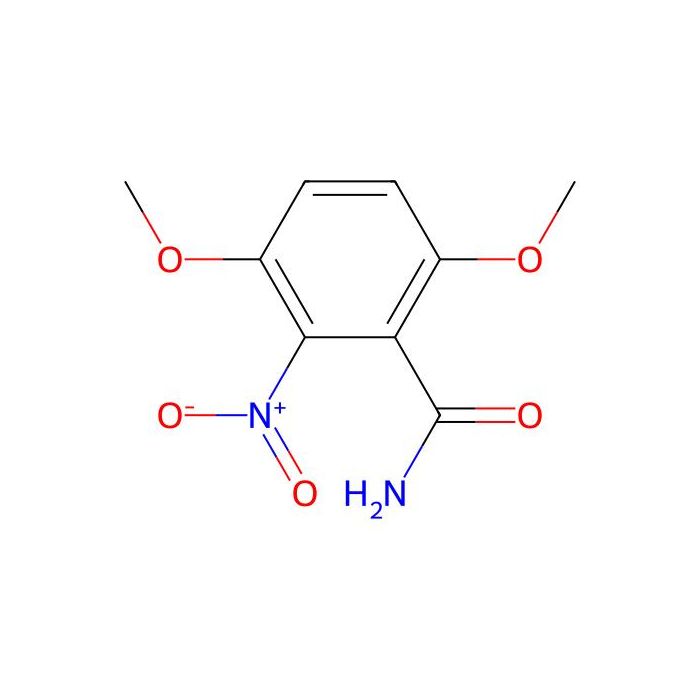
This compound belongs to the class of organic compounds known as nitrophenyl ethers. These are aromatic compounds containing a nitrobenzene moiety that carries an ether group on the benzene ring.
External Descriptors
Not available
1. Djoumbou Feunang Y, Eisner R, Knox C, Chepelev L, Hastings J, Owen G, Fahy E, Steinbeck C, Subramanian S, Bolton E, Greiner R, and Wishart DS. ClassyFire: Automated Chemical Classification With A Comprehensive, Computable Taxonomy. Journal of Cheminformatics, 2016, 8:61.
Certificati (CoA, COO, BSE/TSE e tabella di analisi)
C of A & Other Certificates(BSE/TSE, COO):
Analytical Chart:
Proprietà chimiche e fisiche
Peso molecolare
226.190 g/mol
XLogP3
-0.300
Hydrogen Bond Donor Count
1
Hydrogen Bond Acceptor Count
5
Rotatable Bond Count
3
Exact Mass
226.059 Da
Monoisotopic Mass
226.059 Da
Topological Polar Surface Area
107.000 Ų
Heavy Atom Count
16
Formal Charge
0
Complexity
278.000
Isotope Atom Count
0
Defined Atom Stereocenter Count
0
Undefined Atom Stereocenter Count
0
Defined Bond Stereocenter Count
0
Undefined Bond Stereocenter Count
0
The total count of all stereochemical bonds
0
Covalently-Bonded Unit Count
1
Calcolatori di soluzioni
Molarity Calculator
Determine the necessary mass, volume, or concentration for preparing a solution.
Dilution Calculator
Determine the dilution needed to prepare a stock solution.
Reconstitution Calculator
Recensioni
Recensioni dei clienti
Application Protocols
Not applicable. No biologic assay protocols (e.g., WB, IHC, IF, FC) are associated with this small-molecule reagent. For chemical use, refer to the Reaction Conditions, Synthetic Utility, and Solvent Selection sections for practical guidance.
Biological Roles
No item-specific biological data are provided. As a small aromatic amide with a nitro substituent, 3,6-dimethoxy-2-nitrobenzamide is primarily used as a chemical intermediate in research settings.
General biochemical considerations (literature/class-based):
Amide motif: prevalent in bioactive molecules due to hydrogen-bonding and conformational preferences; however, unsubstituted benzamides often display limited aqueous solubility.
Nitro group: typically used as a synthetic handle or protecting/activating group. Nitroaromatics can undergo bioreduction in vivo to anilines; in research, chemical reduction is preferred for controlled transformations.
Methoxy substituents: modulate lipophilicity and electronic properties; can be converted to phenols to alter H-bonding and metal-chelation profiles in ligand design (e.g., catecholates).
Use in biology: Any utilization is for in vitro/in vivo research chemistry as an intermediate or probe precursor. No claims are made regarding biological activity or clinical relevance for this specific compound.
Buffer Applications
This product is not a buffering agent and is not typically used to prepare biological buffers. If dissolved for biochemical assays, prepare concentrated stocks in DMSO or DMF and dilute into the desired buffer with vigorous mixing to avoid precipitation. For pH control, use established buffer systems (e.g., phosphate, HEPES, MOPS) appropriate to your application.
Green Alternatives
Although the compound itself is a solid intermediate (not a solvent), greener choices can be made in reactions and workups involving this substrate.
Greener choices (literature/guidance):
Solvents:
Prefer EtOAc or 2-MeTHF over CH2Cl2 for extractions and some reactions.
Use ethanol or isopropanol as hydrogenation media instead of MeOH/EtOAc when compatible.
Consider CPME or 2-MeTHF for BBr3-free demethylations (e.g., oxidative protocols) when chemoselectivity allows.
Reductions of nitro group:
Catalytic hydrogenation with H2 (Pd/C, Raney Ni) is generally cleaner than stoichiometric tin/iron salts, reducing metal waste.
Transfer hydrogenation (ammonium formate, formic acid) can reduce waste and avoid pressurized hydrogen.
Workup and purification:
Replace silica gel-heavy purifications with crystallization whenever possible (optimize solvent pairs such as EtOAc/hexanes or EtOAc/EtOH).
Comparison snapshot (general):
CH2Cl2 vs EtOAc: EtOAc offers lower toxicity and better environmental profile; may require temperature control to match solubility.
SnCl2/HCl vs H2/Pd-C: Hydrogenation minimizes inorganic sludge; requires appropriate pressure equipment and catalyst recovery.
Tradeoffs:
2-MeTHF/CPME can retain peroxides; manage by regular testing and stabilization.
Aqueous ethanol systems may lower substrate solubility; adjust temperature or cosolvent fraction to maintain reaction rates.
Pharmaceutical Uses
No pharmacopeial grade or excipient designation is provided for this item. It is intended for research use only.
Context in pharmaceutical R&D (general):
Functions as a synthetic intermediate or scaffold in medicinal chemistry programs. The nitro group serves as a convertible handle to the aniline, enabling rapid SAR exploration (acylation, sulfonylation, urea/amide formation).
The dimethoxy substitution pattern modulates electronics and lipophilicity and can be transformed (O-demethylation) to phenolic derivatives for analog generation.
Formulation notes (if used as a research tool compound):
Prepare stocks in DMSO (e.g., 10–50 mg/mL) and dilute into aqueous media to ≤1–2% DMSO final to maintain solubility. Filter sterilize if required for cell-based assays.
No claims are made regarding therapeutic use, safety, or efficacy.
Physical Properties
Item-specific physico-chemical specifications are not provided in the product data.
Appearance: Not specified for this item; refer to CoA/Spec Sheet.
Melting point: Not specified for this item; refer to CoA/Spec Sheet.
Boiling point: Not applicable (decomposes before boiling under ambient pressure for most benzamide solids; literature, general behavior).
Density: Not specified for this item; refer to CoA/Spec Sheet.
Refractive index: Not applicable to solids; not specified for this item.
UV-Vis characteristics: Aromatic amide/nitroaromatic typically shows strong absorption in the near-UV (250–350 nm) due to π–π* and n–π* transitions (literature, general behavior); item-specific cutoff/ε not specified.
pKa: The amide N–H is very weakly acidic (pKa > 15 in DMSO; literature, general). Phenolic pKa values do not apply (methoxy-protected).
LogP/solubility (qualitative, literature expectations):
Likely sparingly soluble in water due to aryl amide plus nitro and methoxy substitution.
Readily soluble in polar aprotic organic solvents (DMSO, DMF, NMP).
Moderately soluble in MeOH/EtOH and chlorinated solvents (CH2Cl2, CHCl3) depending on crystallinity (literature, class behavior).
Note: For authoritative, lot-specific physical constants (mp, assay, residual solvents, water content), consult the CoA/Specification Sheet for SKU D988155.
Quality and Grades
Grade/Purity: Not specified for this item; refer to CoA/Spec Sheet.
Research use: For research use only (as stated). Not for human or veterinary diagnostic or therapeutic use.
What grade implies (general guidance):
If provided as “research grade,” materials are suitable for synthetic chemistry, method development, and discovery workflows. They are not certified to pharmacopeial monographs unless explicitly stated.
If an HPLC/LC-MS grade solvent or reagent designation were given, that would indicate stringent control of UV absorbance and low non-volatile residue. No such designation is specified here.
Stabilizers/Additives:
None specified for this item. If present in a given lot, stabilizers will be declared on the CoA/Spec Sheet.
Quality controls typically associated with this class (general):
Identity confirmation by NMR and/or MS; purity by HPLC/GC; residual solvent and water by GC/KSF/Coulometric KF as applicable.
For nitroaromatics, monitoring for reduction byproducts (aniline derivatives) and for O-demethylated impurities is common.
Please refer to the lot-specific CoA for assay, impurity profile, and analytical methods for SKU D988155.
Reaction and Applications
As a multifunctional aryl amide, 3,6-dimethoxy-2-nitrobenzamide is a versatile intermediate for divergent synthesis.
Key transformations (literature/general):
Nitro reduction to an aniline: affords 2-amino-3,6-dimethoxybenzamide, unlocking diazotization, Sandmeyer-type substitutions, or direct coupling into heterocycles. Methods:
Catalytic hydrogenation (H2/Pd-C, H2/Raney Ni) in EtOH/EtOAc/MeOH.
Chemoselective transfer hydrogenation (e.g., ammonium formate/Pd-C) preserving the amide.
Iron/ammonium chloride or SnCl2/HCl for scalable reductions.
O-Demethylation: BBr3 or AlCl3/thiols to convert anisoles to catechols/phenols, enabling further derivatization (sulfation, etherification).
Amide N-functionalization: mild N-alkylation (e.g., Mitsunobu-type or via deprotonation with NaH/K2CO3 followed by alkyl halides) to access N-alkyl benzamides.
Dehydration of amide to nitrile: POCl3, SOCl2, or T3P-mediated conditions to obtain 3,6-dimethoxy-2-nitrobenzonitrile (literature, general), a useful handle for further nucleophilic additions.
Directed metalation/cross-coupling (indirect): While no halogen is present, post-reduction/diarylation routes or regioselective C–H activation adjacent to amide directing groups may be employed with suitable catalysts (Rh/Ir Pd C–H amidation/arylation; literature precedent for benzamides).
Use cases:
Building block for substituted anthranilamides after reduction.
Precursor to catechol-type benzamides via dual demethylation (ligand frameworks, polymer additives).
Intermediate for dye/ligand synthesis where nitro-to-amino conversion followed by acylation/urea formation is required.
Practical tips:
Keep moisture low for halophilic demethylations (BBr3) and for dehydration steps.
Protect the amide if harsh conditions might induce hydrolysis; monitor by HPLC-UV at ~254–280 nm.
Reaction Conditions
Typical conditions reported for closely related substrates (literature/general guidance; optimize per substrate):
Nitro reduction to aniline:
H2/Pd-C (5–10 wt% Pd on C, 5–10 mol% Pd relative): EtOH or EtOAc, RT to 50 °C, 1–6 h under 1–3 bar H2. Work up by filtration through celite; yields commonly 70–95% for clean substrates.
Fe/NH4Cl (or Fe/AcOH/H2O): 3–6 equiv Fe powder, EtOH/H2O (3:1), 50–80 °C, 2–8 h; filter off iron salts; yields 60–90%.
SnCl2·2H2O/HCl: 3–5 equiv, EtOH/conc. HCl, reflux; efficient but generates tin waste.
O-Demethylation (anisole to phenol):
BBr3 (1.0–2.0 equiv per –OMe): dry CH2Cl2, −78 °C to RT, 1–16 h; quench with MeOH/H2O. Double demethylation may require excess reagent or stepwise treatment. Protect amide if needed for harsh conditions.
Alternative: AlCl3/thiol systems or oxidative demethylation (CAN under specific contexts) with selectivity caveats.
Amide dehydration to nitrile:
SOCl2 (3–6 equiv) with catalytic DMF, reflux 1–4 h; or POCl3 (3–5 equiv), 80–110 °C. Quench cautiously; neutralize and extract. Monitor to avoid over-chlorination.
N-Alkylation:
NaH (60% dispersion, 1.2–1.5 equiv) in DMF or THF, 0 °C to RT, then alkyl halide (1.2–2.0 equiv); 1–6 h. Avoid β-hydride elimination-prone reagents.
Notes:
Competing reduction of the amide is rare under mild catalytic hydrogenation but can occur under forcing conditions.
Nitro presence can slow metal-catalyzed C–H activation; consider sequence planning (reduce first, then functionalize).
Safety and Handling
GHS classification and pictograms are not specified for this item; consult the product SDS for definitive safety information.
General guidance for nitro-substituted benzamides (literature/class-based):
Hazards: May cause eye/skin/respiratory irritation. Nitroaromatics can present methemoglobinemia risk upon significant exposure; avoid inhalation and ingestion. Dust may be combustible.
PPE: Use laboratory coat, safety glasses/goggles, and appropriate chemically resistant gloves (e.g., nitrile). Handle powders in a fume hood to minimize dust inhalation.
Handling: Avoid dust formation. Prevent contact with strong oxidizers or strong reducing agents unless part of a controlled reaction. When performing reductions (e.g., converting –NO2 to –NH2), provide adequate ventilation and gas management (H2/Ni, Fe/NH4Cl, or catalytic hydrogenation) and control exotherms.
Incompatibilities (general): Strong bases and Lewis acids can demethylate anisoles at elevated temperatures; strong dehydrating agents can dehydrate amides (decomposition risk).
First aid (overview; defer to SDS):
Inhalation: Move to fresh air; seek medical attention if symptoms persist.
Skin/eye: Rinse with water for at least 15 minutes; remove contaminated clothing; obtain medical advice for persistent irritation.
Ingestion: Rinse mouth; do not induce vomiting; seek medical attention.
Fire: Use CO2, dry chemical, or foam. Combustion may release NOx and CO. Thermal decomposition can produce irritating/toxic fumes.
Always consult and follow the SDS for SKU D988155 before use.
Solvent Selection
This compound is an aromatic amide with two methoxy groups and a nitro substituent. It behaves as a moderately polar, hydrogen-bond donor/acceptor solid with limited aqueous solubility.
Limited: Acetonitrile (depends on crystal packing); toluene (often low at RT, better hot).
Poor: Water (typically sparingly soluble).
Selection tips:
For analytical stocks: 10–50 mg/mL in DMSO is typically attainable (literature experience with similar aryl amides). Dilute into assay buffers with vigorous mixing; consider cosolvent <1–2% v/v to avoid precipitation.
For reductions (–NO2 to –NH2): ethanol, MeOH, or EtOAc with catalytic hydrogenation; or EtOH/water with Fe/NH4Cl. Polar aprotic solvents for metal-mediated reductions.
For demethylation (BBr3): use dry CH2Cl2 or toluene at 0 °C to room temperature (literature practice), strictly anhydrous.
Small comparison (general):
DMSO vs DMF: DMSO maximizes solubility and thermal stability; DMF offers easier removal but can form dimethylamine under strong base/heat.
EtOAc vs CH2Cl2: EtOAc is greener and suitable for workups; CH2Cl2 offers better solvation for nitroanisoles but is less eco-friendly.
Storage and Reconstitution
Storage conditions (item-specific): Room temperature (per product data). Store in a tightly closed container, desiccated, and protected from light to preserve integrity. Avoid prolonged exposure to heat and moisture.
Shipping: Not specified for this item; refer to CoA/Spec Sheet.
Reconstitution/dissolution (general):
Prepare concentrated stocks in dry DMSO, DMF, or NMP for laboratory use. Typical working stocks: 10–50 mg/mL in DMSO (filter if needed, 0.2 μm PTFE).
For reaction set-up, dissolve in anhydrous organic solvent (e.g., CH2Cl2, THF, EtOAc, toluene, or alcohols) as dictated by the transformation.
Stability: Nitrobenzamides are generally stable solids under ambient conditions. Avoid strong light and reducing atmospheres unless intentional; minimize repeated heating/cooling cycles.
Freeze–thaw guidance: Not required for solids. If storing DMSO solutions, aliquot and keep at −20 °C to limit freeze–thaw; allow to equilibrate to room temperature before opening to prevent moisture ingress.
Always verify lot-specific recommendations and shelf-life on the CoA for SKU D988155.
Structure and Identity
A substituted benzamide bearing an ortho-nitro group and two methoxy substituents on the aromatic ring (positions 3 and 6). Useful as an electrophile-modulated, electron-rich aryl amide building block.
Product name: 3,6-Dimethoxy-2-nitrobenzamide
CAS: 26002-58-4
PubChem CID (literature): 899770
InChIKey: Not specified for this item; refer to CoA/Spec Sheet.
SMILES: Not specified for this item; refer to CoA/Spec Sheet.
Molecular formula: Not specified for this item; refer to CoA/Spec Sheet.
Molecular weight: Not specified for this item; refer to CoA/Spec Sheet.
Structural features (general description):
Core: benzamide (aryl–CONH2) scaffold.
Substitution pattern: amide at C1; nitro (–NO2) at C2 (ortho to amide); methoxy groups (–OCH3) at C3 and C6 (meta to amide; ortho/para to nitro depending on position).
Functional groups: one primary amide, one nitro group, two anisole-type methoxy ethers.
Electronic profile: mixed donors (two methoxy) and a strong deactivating nitro; the amide is moderately deactivating and meta-directing in electrophilic substitution. The ring exhibits reduced electrophilic substitution reactivity but is activated for certain nucleophilic aromatic substitutions adjacent to –NO2 (literature, general behavior).
2D description: a benzene ring with –CONH2 at top (C1), –NO2 at ortho (C2), –OMe at C3 (adjacent to nitro) and a second –OMe at C6 (ortho to amide on the opposite side). No stereocenters; planar conjugated system across the aryl–amide axis.
Synthetic Utility
Functional group ensemble makes this substrate strategically valuable in multi-step synthesis.
Nitro-to-aniline switch: A classic “late-stage” unmasking to introduce nucleophilicity and enable diazotization, Buchwald–Hartwig amination (after halogenation), or coupling to carbonyls (Schiff base/urea formation). Reduction typically leaves the amide intact under catalytic conditions.
Dual anisole handles: Orthogonal transformations via selective O-demethylation (BBr3, AlCl3/thiols) to phenols permit:
Ether diversification (Williamson, Mitsunobu with suitable phenol protection).
Chelating ligand/catechol construction for metal-binding applications.
Amide as a directing group: Facilitates C–H functionalization on suitably positioned ring carbons with modern catalysts (Pd, Rh, Ru), albeit regioselectivity is influenced by the strong –NO2 and –OMe pattern (literature precedence for benzamides in directed C–H activation).
Dehydration to nitrile: Provides a handle for nucleophilic additions and for further substitution strategies (e.g., amidine formation, Ritter-type chemistry after activation).
N-Functionalization: Deprotonation of the amide N–H (NaH, KHMDS) followed by alkylation or acylation to access N-substituted analogs and imide-like derivatives.
Retrosynthetic perspective:
Accessible from 3,6-dimethoxy-2-nitrobenzoic acid or the corresponding acid chloride by ammonolysis or aminolysis.
Alternative approach via nitration of a dimethoxybenzamide under controlled conditions (directing/nitration regiocontrol required, literature-dependent).
Analytical control: Monitor transformations by HPLC-UV (254–280 nm) and LC–MS; nitro-to-amino conversions show characteristic UV shifts and MS −16 Da to −30 Da changes depending on pathway.
Target Specificity
Not applicable. This product is a small-molecule chemical intermediate, not a biological targeting reagent (e.g., antibody, ligand with defined biomolecular target). No antigen/epitope or species reactivity data are associated with SKU D988155.
We use cookies to ensure the website functions properly and, where permitted, to improve your experience. You can manage your preferences at any time in Settings. Learn more in our Cookie Policy.
Shall we send you a message when we have discounts available?
Remind me later
Thank you! Please check your email inbox to confirm.
Products are supplied to verified businesses, institutions, and qualified professionals for research and development use only. Not for use in humans, animals, diagnosis, or therapy.