This compound belongs to the class of organic compounds known as haloquinolines. These are compounds containing a quinoline moiety, which is substituted at one or more ring positions by n halogen atom.
External Descriptors
Not available
1. Djoumbou Feunang Y, Eisner R, Knox C, Chepelev L, Hastings J, Owen G, Fahy E, Steinbeck C, Subramanian S, Bolton E, Greiner R, and Wishart DS. ClassyFire: Automated Chemical Classification With A Comprehensive, Computable Taxonomy. Journal of Cheminformatics, 2016, 8:61.
Determine the necessary mass, volume, or concentration for preparing a solution.
Dilution Calculator
Determine the dilution needed to prepare a stock solution.
Reconstitution Calculator
Recensioni
Recensioni dei clienti
Application Protocols
No assay/diagnostic application protocols are specified for this small-molecule building block.
General lab use examples (non-validated, for guidance only):
Preparing a 10 mM DMSO stock: weigh the appropriate amount under a hood, dissolve in dry DMSO with gentle warming/sonication, aliquot, and store desiccated. Dilute into assay media to ≤0.5% DMSO v/v to minimize solvent effects.
Cross-coupling setup: dry glassware; charge aryl bromide, catalyst/ligand, base, and solvent; degas (sparge or freeze–pump–thaw), add coupling partner, heat with stirring; monitor by LC/MS or TLC; work up and purify by silica gel or reverse-phase as suitable.
For any validated application conditions, refer to your internal method development or contact technical support.
Biological Roles
No intrinsic biological role is assigned to 3-bromoquinolin-5-ol in living systems. The notes below provide general, non-clinical context relevant to heteroaromatic quinoline scaffolds.
Quinoline motif: prevalent in many bioactive small molecules and probes due to its planarity, aromaticity, and capacity for π–π stacking and hydrogen bonding via ring nitrogen. These features influence binding in protein/nucleic acid pockets (general literature context).
Phenolic functionality: can modulate redox and chelation behavior; many phenols form metal complexes or act as H-bond donors/acceptors in biochemical assays (general observation; not specific activity implied).
Fluorescence: quinoline derivatives often exhibit UV-excitable fluorescence; substitution patterns tune emission/quantum yields. Such properties are leveraged in assay development and materials research.
Physicochemical balance: presence of one basic site (quinoline N) and one acidic site (phenol) allows tuning of ionization state across pH, impacting permeability and solubility—useful in designing tool compounds for chemical biology studies.
Research-use caveat: This product is for research use only. No claims are made regarding therapeutic use, diagnosis, or biological efficacy. Users should perform their own target- and assay-specific validation if employing this scaffold in biochemical experiments.
Buffer Applications
This compound is a heteroaromatic small-molecule building block and is not a buffering agent. It is not typically used to make defined pH buffers.
Practical note:
For assay work, prepare DMSO stock solutions and dilute into the chosen buffer (e.g., phosphate, HEPES) with attention to final DMSO percentage to avoid precipitation. The phenolic OH and quinoline N may alter apparent solubility across pH; modest solubility increases may be seen in basic media via phenolate formation (general observation).
Green Alternatives
While 3-bromoquinolin-5-ol itself is a substrate, greener choices can be made for the solvents and reagents used with it.
Greener solvent swaps (literature guidance):
Replace DMF/NMP with Cyrene, propylene carbonate, or dimethyl carbonate when compatible with the reaction (check catalyst/base solubility).
Use 2-MeTHF or CPME in place of THF/1,4-dioxane for cross-couplings and metal–halogen exchange, noting improved safety and lower peroxide risk vs THF (still monitor peroxides for ethers).
Favor EtOAc, MeOH, or IPA over CH2Cl2/CHCl3 for workups and extractions where feasible.
Comparison snapshot (general):
THF vs 2-MeTHF: similar polarity; 2-MeTHF from biorenewable sources, higher boiling point (easier phase separations), reduced miscibility with water—can aid isolations.
DMF vs Cyrene: Cyrene is bio-based with lower toxicity profile; viscosity and base compatibility differ—optimize mixing and temperature.
Catalysis choices:
Employ ligand-optimized palladium precatalysts that operate at lower loadings/temperatures, reducing precious metal waste.
Consider nickel catalysis for certain couplings (Suzuki, amination) to lower Pd usage; validate for heteroaryl bromides.
Use aqueous micellar catalysis (e.g., surfactant-enabled couplings) where substrate solubility allows, to cut organic solvent volumes.
Pharmaceutical Uses
There are no pharmacopeial listings or excipient roles specified for this item. It is supplied for research use only.
Context (non-clinical):
3-Bromoquinolin-5-ol serves as a synthetic intermediate for the preparation of quinoline-based libraries and tool compounds in discovery chemistry. The aryl bromide and phenolic OH provide orthogonal handles for rapid SAR exploration, linker installation, and pro-motif elaboration.
Process-development note: If scaling couplings or protections, attention to residual palladium/nickel and halides is recommended; adopt metal scavengers and rigorous purifications to meet internal specifications should the intermediates advance in preclinical research (no clinical claims).
Solid form: No specific polymorph/solvate information is provided for this item; verify solid-state characteristics by DSC/XRPD if critical to downstream formulation research.
Physical Properties
Item-specific specifications are not provided in the Product Data. For authoritative values, consult the CoA/Spec Sheet for your lot.
Appearance: Not specified for this item; refer to CoA/Spec Sheet. (Heteroaryl phenols of this type are typically yellow to tan solids; literature-only comment.)
Melting point: Not specified for this item; refer to CoA/Spec Sheet. (Literature for related bromo-quinolinols suggests solid-state MPs often >150 °C; literature context only.)
Boiling point: Not applicable/rarely measured for solids with potential decomposition; specific value not specified for this item; refer to CoA/Spec Sheet.
Density: Not specified for this item; refer to CoA/Spec Sheet.
Solubility: Not specified for this item; refer to CoA/Spec Sheet. (General tendencies, literature: sparingly soluble in water; soluble in polar aprotic organics such as DMSO, DMF, NMP; moderately soluble in MeOH/EtOH; variable in EtOAc/CH2Cl2.)
LogP/logD: Not specified for this item; refer to CoA/Spec Sheet. (Quinoline phenols commonly show moderate lipophilicity; literature context only.)
pKa values (literature context, family-level): phenolic OH pKa typically ~8.5–10; quinoline N conjugate acid pKaH ~4–5, modulated by ring substituents. Not item-specific.
UV–Vis: Not specified for this item; refer to CoA/Spec Sheet. (Quinolines generally exhibit π–π* absorptions in the near-UV; literature context only.)
Important: Do not treat literature context as specifications for this catalog item.
Quality and Grades
Grade/Purity: Not specified for this item; refer to CoA/Spec Sheet.
UV cutoff, residual solvent limits, metal content, water content: Not specified for this item; refer to CoA/Spec Sheet.
Interpretation and guidance:
In absence of an explicit grade (e.g., “98%,” “HPLC grade,” “Anhydrous”), assume standard research-grade material suitable for synthetic and screening applications, and verify purity on the supplied CoA/Spec Sheet.
For transition-metal-catalyzed cross-couplings, trace metal contaminants and residual halides/acids can impact reactivity. If your application is catalyst-sensitive, consider in-house pretesting (e.g., GC/LC purity check; ICP-MS for metals) or contact us for higher-purity/low-metal options when available.
Stabilizers/inhibitors: None indicated in the Product Data. Phenolic compounds are generally stable without added stabilizers; nonetheless, verify on CoA if any antioxidants or residual protecting groups are present.
Lot-to-lot documentation: request CoA to confirm identity (NMR, LC/MS, HRMS), purity assay, and key residuals aligned to your use-case.
Fit-for-purpose:
Medicinal chemistry/building-block use typically tolerates >95% purity; for SAR/biology interfaces, higher purity and solid-state form (polymorph/solvate) control may be desirable—specify needs at order.
Reaction and Applications
Functional handles enable diverse transformations:
Aryl bromide at C3 (electrophile):
Cross-coupling: performs in Suzuki–Miyaura (to install aryl/heteroaryl/alkenyl groups), Buchwald–Hartwig amination (C–N), Sonogashira (C(sp2)–C(sp)), Negishi/Kumada (C–C). Quinoline’s innate electron deficiency can facilitate oxidative addition.
Halogen–metal exchange: i-PrMgCl·LiCl (Turbo Grignard) or n-BuLi at low temperature to form C3 organometal for subsequent electrophile trapping (formylation, acylation, borylation).
Direct borylation: Miyaura borylation with B2pin2 to access 3-boronate esters for modular diversification.
Phenolic OH at C5:
Protection: silyl (TBS/TIPS), benzyl, or carbonate to enable base-sensitive couplings at C3.
O-alkylation/arylation: Williamson ether synthesis, Chan–Lam coupling for aryl ethers; carbonate/ester formation for pro-moieties in materials/medchem contexts.
Triflation: convert to aryl triflate to create a second cross-coupling handle (dual-site diversification).
Ring nitrogen (N1):
N-oxidation (quinoline N-oxide) for directed C–H functionalization; subsequent deoxygenation if required.
Salt formation (e.g., HCl salt) to enhance aqueous handling/solubility during purification.
Use cases (manufacturer text expanded):
As a versatile quinoline building block for library synthesis, structure–property exploration, and ligand/scaffold elaboration in materials and chemical biology research (non-clinical).
Tips:
Dry, degas solvents for Pd-catalyzed couplings; monitor for proto-debromination.
Control base strength to avoid undesired O-arylation vs C-coupling when the phenol is unprotected.
Reaction Conditions
General literature guidance for quinoline aryl bromides; optimize per substrate and scale. Values below are not item-specific specifications.
Suzuki–Miyaura coupling (C3):
Catalyst: Pd(dppf)Cl2·DCM (1–3 mol%) or Pd-PEPPSI-type; ligand as needed.
Base: K2CO3, Cs2CO3, or K3PO4 (2–3 equiv).
Solvent: 1,4-dioxane/H2O, toluene/H2O, or CPME/H2O; 0.1–0.5 M.
Temp/time: 70–110 °C, 2–16 h.
Notes: Protect phenol to avoid homo/hetero-coupling at oxygen; aryl boronic acids/esters both suitable.
Tip: Pre-protect O5 as TBS or benzyl to suppress O-arylation.
Sonogashira (terminal alkynes):
Catalyst: Pd(PPh3)2Cl2 (1–3 mol%), CuI (2–5 mol%).
Base: Et3N or i-Pr2NH.
Solvent: THF, DMF, or 2-MeTHF.
Temp: rt–70 °C; inert atmosphere.
Halogen–metal exchange at C3:
Reagent: i-PrMgCl·LiCl (1.2–1.5 equiv) or n-BuLi (1.1–1.3 equiv).
Solvent: THF or 2-MeTHF.
Temp: −78 to 0 °C; then quench with electrophiles (DMF for CHO, B(OMe)3 for boronate, CO2 for CO2H).
Caution: Protect phenol or manage as its Mg/Li phenoxide to control chemoselectivity.
O-alkylation (Williamson): alkyl halide (1.2–2.0 equiv), K2CO3/NaH, DMF/acetone, rt–60 °C.
Yields: Many literature examples report 60–90% for optimized couplings on heteroaryl bromides; expect to screen ligands/bases.
Safety and Handling
Hazard classification details are not provided in the Product Data for this item. Always consult the SDS for definitive, lot-specific safety information.
GHS classification, pictograms, signal word, H/P statements: Not specified for this item; refer to SDS.
Likely hazards (general guidance for halogenated heteroaromatic phenols; not a classification): may cause skin/eye irritation; harmful if swallowed or inhaled; dust may irritate respiratory tract.
Recommended PPE: lab coat, safety glasses or goggles, appropriate chemical-resistant gloves (e.g., nitrile), and use in a fume hood to avoid inhalation of dust/vapors.
Handling notes:
Avoid dust generation; use weigh boats and antistatic measures.
Phenolic compounds can cause skin defatting; wash thoroughly after handling.
Aryl bromides are generally stable, but avoid strong bases/acids and strong oxidizers unless used under controlled conditions.
Incompatibilities (general): strong oxidizing agents; strong bases may induce undesired O- or N-alkylation/condensation; reactive metals may engage in halogen–metal exchange.
First aid (summary; defer to SDS):
Inhalation: move to fresh air; seek medical advice if symptoms persist.
Skin: wash with soap and water; remove contaminated clothing.
Eyes: rinse cautiously with water for several minutes; remove contact lenses if present and easy; continue rinsing.
Ingestion: rinse mouth; do not induce vomiting; seek medical attention.
Waste: dispose according to institutional and local regulations for halogenated organic solids.
Solvent Selection
This product is a heteroaromatic solid, not used as a solvent. Solvent considerations below focus on dissolving it for reactions or stock solutions.
General solubility/miscibility guidance (literature-based for quinolinols; verify experimentally):
Highly suitable: DMSO, DMF, NMP — strong polar aprotic solvents that solubilize both the quinoline core and phenol via H-bonding interactions.
Often suitable: methanol, ethanol, acetonitrile, acetone, ethyl acetate, chlorinated solvents (CH2Cl2, CHCl3). Solubility may be moderate; gentle heating/sonication can assist.
Poor: water and very nonpolar hydrocarbons (hexanes) due to limited ionization and aromaticity-driven hydrophobicity.
Selection by application:
Cross-coupling (Suzuki/Buchwald–Hartwig): 1,4-dioxane, toluene, or CPME with polar co-solvent (DMF, water) often balance catalyst stability and base solubility.
Nucleophilic substitution on aryl bromide/metal–halogen exchange: THF, 2-MeTHF, or MTBE at low temperature.
O-alkylation/esterification of the phenol: acetone, acetonitrile, DMF; biphasic systems (toluene/aqueous base) for phase-transfer conditions.
Practical tips:
Prepare concentrated DMSO or DMF stocks (e.g., 10–50 mM) for HTS/assays; dilute into assay buffers with surfactant if needed to avoid precipitation.
Filter warm solutions through PTFE to remove particulates before coupling chemistry.
Avoid prolonged exposure to strong bases in protic solvents to limit side reactions at the phenolic oxygen.
Container: Keep tightly closed in original packaging; minimize headspace to reduce moisture uptake.
Protection: Store dry and protect from prolonged light exposure. Use a desiccant in a secondary container if ambient humidity is high.
Stability: No specific shelf-life data provided; inspect periodically by NMR/LC for long-term projects. Phenolic heteroaromatics are generally stable at ambient conditions when kept dry and sealed.
Reconstitution/stock solutions:
Solvents: DMSO or DMF recommended for concentrated stock solutions; MeOH/EtOH or EtOAc for less polar applications. Water solubility is expected to be low; consider co-solvent strategies.
Procedure: Warm gently (≤40 °C) and sonicate if needed; filter through 0.2 µm PTFE to clarify.
Storage of solutions: Aliquot to avoid freeze–thaw; store DMSO stocks at −20 to 4 °C, protected from light. Validate solution stability for your use-case.
Research Use Note: For research use only. Not for human or veterinary use.
Structure and Identity
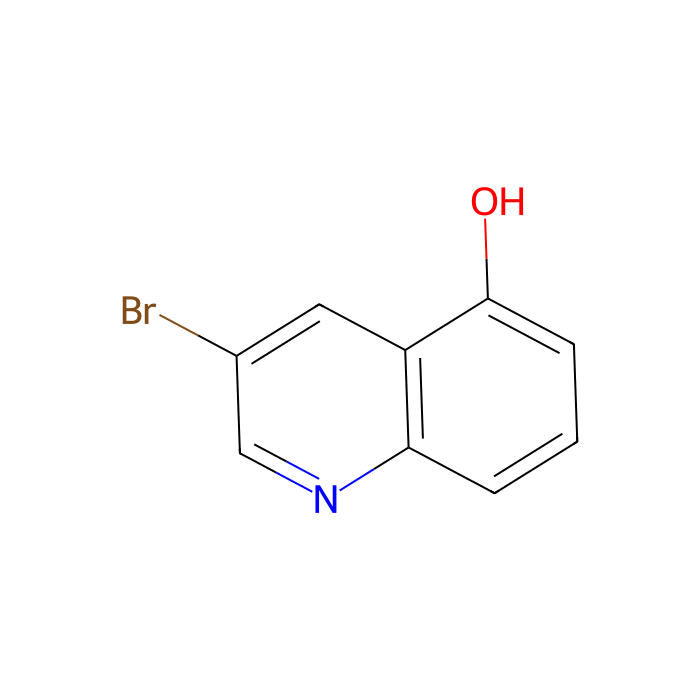
3-Bromoquinolin-5-ol is a heteroaromatic building block based on the quinoline scaffold with a bromine substituent and a phenolic hydroxyl.
CAS: 1123738-15-7 (product-specific)
PubChem CID: 135743708 (product-specific)
InChIKey: 239848 (as provided; unusual format—verify on CoA/SDS if needed)
SMILES: Not specified for this item; refer to CoA/Spec Sheet.
Molecular formula: Not specified for this item; refer to CoA/Spec Sheet.
Molecular weight: Not specified for this item; refer to CoA/Spec Sheet.
Structural features (general description from name):
Core: quinoline (benzannulated pyridine) ring system.
Substitution pattern: bromine at the 3-position of the quinoline and a phenolic –OH at the 5-position.
Functional groups: aryl bromide (useful for cross-coupling/metal–halogen exchange), phenol (acidic OH; can be protected/etherified/esterified), ring nitrogen (basic site capable of coordination and protonation).
2D description: a fused bicyclic aromatic system (benzene fused to pyridine). Counting from the ring nitrogen as position 1 (quinoline nomenclature), the bromine resides at C3 (on the pyridine ring), while the hydroxyl group is on C5 (on the benzene portion). No stereocenters are present.
Notes:
The presence of both an aryl bromide and a phenol on a quinoline offers orthogonal handles for derivatization in multistep synthesis.
Synthetic Utility
Reactivity map:
C3–Br (aryl bromide): primary site for Pd/Ni-catalyzed cross-couplings; suitable for formation of C–C (Suzuki, Negishi, Kumada, Stille), C–N (Buchwald–Hartwig, Ullmann-type), C–O (etherification), and C–S (thioether formation) bonds.
O5–H (phenol): tunable acidity allows formation of phenoxide for O-alkylation/arylation and acylation; can be transformed into a better leaving group (triflate/mesylate) for further cross-coupling. Protection strategies (TBS, benzyl, MOM) aid selectivity during metalation/coupling at C3.
N1 (quinoline): protonation/coordination chemistry can be exploited for directed C–H activation (via N-oxide intermediates) and salt formation for handling.
Retrosynthetic value:
Serves as a convergent node: C3 diversification via coupling plus independent O5 modification enables 2D SAR matrices from a single core.
Access to 3,5-disubstituted quinolines: O-triflation then sequential couplings (C3 then C5), or vice versa, facilitate orthogonal install of substituents with minimized protecting-group manipulations.
Practical considerations:
Catalyst deactivation by heterocycles: select ligands tolerant of N-containing substrates (e.g., BrettPhos, XPhos, SPhos for aminations/arylations; RuPhos or dppf-based systems for Suzuki). Additives (pyridine scavengers, base choice) can mitigate binding to Pd.
Competing O-arylation: when the phenol is unprotected, bases and ligand choice influence C–N/C–C vs O-arylation selectivity. Protect or pre-form phenoxide intentionally depending on the desired outcome.
Target Specificity
Not applicable to this product type. 3-Bromoquinolin-5-ol is a small-molecule building block and is not an antibody, enzyme, or affinity reagent. No antigen/epitope specificity, clone, or isotype information applies.
We use cookies to ensure the website functions properly and, where permitted, to improve your experience. You can manage your preferences at any time in Settings. Learn more in our Cookie Policy.
Shall we send you a message when we have discounts available?
Remind me later
Thank you! Please check your email inbox to confirm.
Products are supplied to verified businesses, institutions, and qualified professionals for research and development use only. Not for use in humans, animals, diagnosis, or therapy.

 J2218554